

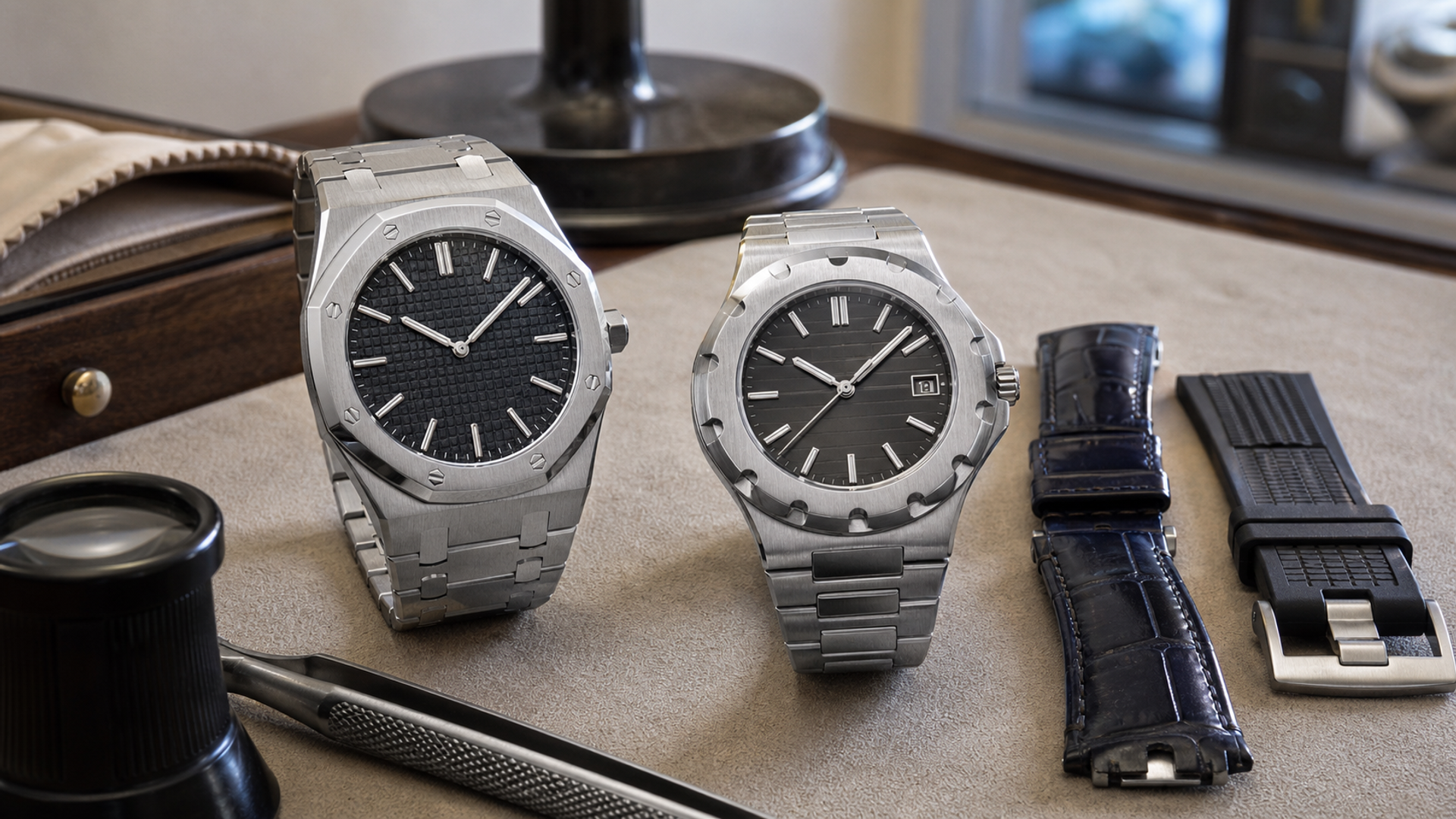
The Audemars Piguet Royal Oak and Vacheron Constantin Overseas are both high-watchmaking sports watches built around metal bracelets, strong case architecture and meticulous finishing. That shared description can hide their most important difference. The Royal Oak makes the bracelet and octagonal bezel the permanent centre of its identity. The Overseas places greater emphasis on versatility, with current references known for bracelet and strap systems that can change the watch's character.
This is not a brand-ranking exercise. It is a comparison of how two design philosophies behave on the wrist, in a wardrobe and over years of ownership. Both collections contain numerous sizes, materials and complications. Every technical figure must therefore be checked against the exact current reference.
The short answer
Choose the Royal Oak if its sharply faceted form, historically influential integrated-bracelet design and finishing are the reason you want the watch. Choose the Overseas if you value a more rounded case, travel-oriented versatility and the ability on supported references to move among bracelet, leather and rubber straps without turning the watch into a different purchase.
The Royal Oak often rewards a collector who wants one definitive visual object. The Overseas often rewards an owner who wants one haute-horlogerie watch to cover multiple environments. Neither generalisation replaces trying the exact reference.
Decision matrix
| Decision factor | Royal Oak | Overseas | Buyer question |
|---|---|---|---|
| Core architecture | Octagonal bezel, exposed screws, strong faceting | Notched bezel and softer transitions | Do you prefer graphic tension or rounded versatility? |
| Bracelet | Fundamental to the design and finishing experience | Integrated bracelet plus interchangeable options on relevant models | Is the bracelet the destination or one mode among several? |
| Strap use | Reference-specific and less central to the classic identity | Rubber and leather can be part of the intended system | Will climate and dress code change frequently? |
| Wrist presence | Broad, angular and light-reactive | Substantial but visually calmer in many versions | Which case shape sits better on your wrist bone? |
| Formality | Bracelet can read as refined jewellery | Leather can move the watch closer to formal dress | Do you want one fixed expression or deliberate transformations? |
| Travel function | Depends on reference | Collection includes travel-oriented complications and versatile straps | Which functions will you actually set and use? |
| Water use | Rating and controls vary by reference | Rating and controls vary by reference | Has the exact used watch been pressure tested? |
| Ownership | Finishing condition is critical | Finishing plus completeness of strap set matter | Can you document all links, straps, clasps and service history? |
Finishing is visible architecture, not decoration
The Royal Oak's case and bracelet use changes in plane, brushing direction and polished bevels to create movement under light. The effect depends on crisp transitions. On a worn or aggressively refinished example, those edges can soften, reducing the character even if the watch remains mechanically sound. Condition assessment must therefore include geometry, not simply scratches.
The Overseas also uses sophisticated finishing, but its case and bezel create a different rhythm. The bracelet's link design and the way it meets the case can feel more fluid, while a strap changes the proportion of metal visible on the wrist. The craft is no less important; it is presented through a more adaptable system.
Under boutique spotlights, both can look spectacular. Ask to view them in neutral daylight. Check the bezel, case flanks, first bracelet links and clasp. A phone's computational sharpening can disguise rounded edges or exaggerate scratches, so direct inspection or high-resolution neutral images are preferable.
Bracelet ergonomics and wrist shape
Integrated-bracelet watches cannot be judged by diameter alone. The first links may extend the visual span, and the case may sit differently on flat and rounded wrists. A bracelet that articulates quickly can make a nominally large watch comfortable; a broad rigid section can make a smaller number feel intrusive.
For the Royal Oak, make sure enough links are available to centre the clasp and allow the case to sit level. Check how individual links articulate and whether the bracelet pinches when the wrist bends. For the Overseas, test both the bracelet and the supplied strap options. A watch that is perfect on rubber may sit differently on metal, and a leather strap may alter the height and balance.
Temperature changes matter. If the bracelet has limited micro-adjustment, a fit achieved in an air-conditioned boutique may become tight in summer. Wear the watch for at least ten minutes and move rather than holding the wrist flat.
The Overseas strap system as an ownership proposition
On current compatible references, the ability to change from bracelet to rubber or leather is not merely a novelty. It can divide the watch into three practical modes: bracelet for daily luxury, rubber for warm-weather casual wear and leather for a more formal appearance. Confirm the exact contents of the package and practise the change before purchase.
This versatility adds its own due-diligence list. Check that straps are the correct type and size, that clasps or buckles are included, and that the change mechanism operates cleanly. On a pre-owned example, missing proprietary parts may be inconvenient or costly to replace. Inspect rubber for age and leather for moisture damage.
The Royal Oak's relative fixity can be an advantage. It discourages endless reconfiguration and preserves the clarity of the original design. If the bracelet is what moved you, a strap option may be irrelevant. The decision is philosophical as much as practical.
Dial and legibility
Both collections use textured or highly worked dials in many references. Texture produces depth, but polished hands and markers can disappear at certain angles. Check the exact dial in direct and indirect light. Complicated displays can also change the visual balance substantially.
The Royal Oak's dial and bezel create a dense geometric frame. On simple time-and-date references, that frame can make the watch feel concise. On chronographs or calendars, it becomes more technical. The Overseas often feels more open in simple configurations, but this depends on colour, size and complication.
Do not treat lume as a collection-wide constant. Confirm the reference and consider whether low-light readability matters for travel or evening use. A high-watchmaking sports watch can still be selected primarily for finishing, but the owner should understand the trade-off.
Complications and the real cost of complexity
The official Audemars Piguet watch collection and its sports models show the breadth of Royal Oak-family offerings. Vacheron Constantin's Overseas collection similarly spans time-and-date, chronograph, dual-time and more complicated watches. The Overseas 4520V is one current reference point, not a specification for the entire family.
A complication should solve a real desire. Dual time can be useful for frequent travellers. A chronograph offers interaction but increases dial density. A perpetual calendar or other high complication may be intellectually rewarding while requiring careful setting and more involved service.
Ask for a demonstration. Set the display yourself. Learn what corrections are prohibited at certain times and how the watch behaves after its power reserve is depleted. Ownership friction matters more than a brochure count.
Water, travel and daily resilience
Water resistance varies by model and is dependent on condition. Never assume that “sports watch” means every Royal Oak or Overseas should be used the same way. Confirm the rating, crown and pusher instructions, and obtain a current pressure test for a pre-owned watch before planned water exposure.
For travel, the Overseas' rubber strap can reduce visual formality and handle warm weather, but the watch remains valuable and recognisable. The Royal Oak's bracelet creates strong presence, which may be welcome at a private event and unwise in another context. Security, insurance and destination should shape the decision.
Carry valuable watches rather than checking them. Store photographs, reference and serial details securely and separately. Avoid publishing live location data. A service network is useful, but prevention is more valuable than emergency access.
Wardrobe and collection role
The Royal Oak works especially well when the wearer wants the watch to provide structure: simple tailoring, a knit polo, an unpatterned shirt or technical outerwear. Its facets and bracelet remain visible even when the dial is quiet. It can dress up, but it never becomes anonymous.
The Overseas can cover more visual territory. On bracelet it is a polished daily sports watch; on rubber it becomes more relaxed; on leather it can sit more naturally with tailoring. That range makes it a strong one-watch proposition for an owner willing to use the system.
In a larger collection, avoid redundant roles. If you already own another sharply integrated bracelet watch, the Overseas may add more range. If your collection is dominated by straps and round cases, the Royal Oak can introduce a decisive architectural counterpoint. The guide to how to build a three-watch collection offers a useful role-based method. For another perspective on integrated sports watches, compare the Patek Nautilus vs Aquanaut.
Buying checklist
Identify the complete reference, production era, material, dial and movement.
Compare case and bracelet geometry with trusted examples; look for over-polishing.
Confirm all bracelet links, strap components, clasps, tools and documentation.
Review service history and current timekeeping evidence.
Obtain water-resistance test information if relevant.
Verify seller identity, title to the watch, return terms and payment protections.
Budget for service without assuming a standard cost across complications.
Ignore claims of guaranteed appreciation or effortless resale.
Authorised purchase may simplify provenance and warranty, but availability is not assured. Independent-market access increases the need for authentication and condition evidence. Online asking prices are not confirmed transaction values.
A practical fitting test
Try the simplest comparable references first. Size both bracelets correctly. View the watches from conversational distance, then under a shirt cuff. On the Overseas, change to rubber and leather if those options are included. Operate the crown, clasp and relevant pushers. Check whether the watch stays centred while typing and walking.
Finally, imagine a month of use. If you would leave the Overseas on one strap forever, its flexibility may not deserve extra weight in the decision. If you admire the Royal Oak but worry about its constant visual intensity, that concern is unlikely to disappear.
Final verdict
Choose the Royal Oak when its faceted bracelet architecture is the non-negotiable attraction and you want a watch with a fixed, historically influential identity. Choose the Overseas when you want high-watchmaking finishing combined with deliberate changes of strap, mood and use. The first is often the stronger singular design statement; the second is often the stronger adaptable ownership system.
The correct result comes from reference-level comparison, wrist fit and a realistic view of service, security and wardrobe—not a hierarchy of names. The better sports watch is the one whose design compromises align with the life you already lead.
![How to Scan Receipts and Documents with Your Phone [Full Guide]](https://cdn.sanity.io/images/e0gp1l2g/production/0db13feec1d5e72b8a8a5f976d1f3e86619c9228-3840x1860.webp?w=180&h=180&q=78&auto=format&fit=crop)
![How to Scan Receipts and Documents with Your Phone [Full Guide]](https://cdn.sanity.io/images/e0gp1l2g/production/0db13feec1d5e72b8a8a5f976d1f3e86619c9228-3840x1860.webp?w=800&h=450&q=82&auto=format&fit=crop)
![Top 10 Two-Tone Carbon-Fibre Watches for Men [2026 List]](https://cdn.sanity.io/images/e0gp1l2g/production/18870799ba33fab0e038968359cd5772d7d7db30-1024x576.webp?w=800&h=450&q=82&auto=format&fit=crop)
![Top 10 Luxury Watches with Digital Complication Displays for Men [Latest]](https://cdn.sanity.io/images/e0gp1l2g/production/c4f6bf8c080f291c39f7cc85c7344ecff2fd3799-1024x553.webp?w=800&h=450&q=82&auto=format&fit=crop)