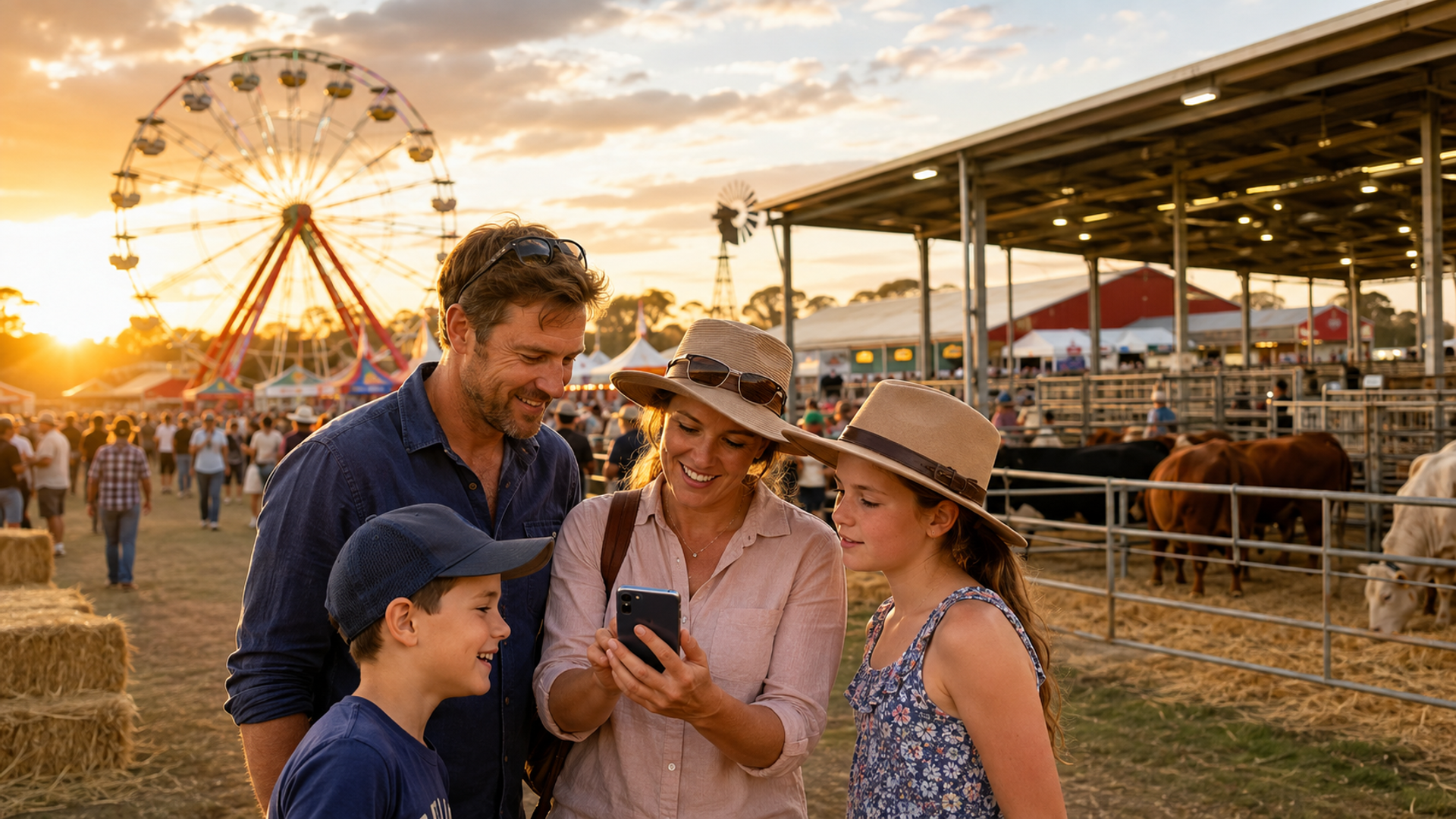
The Royal Adelaide Show runs from 5 to 13 September 2026 and is expected to draw hundreds of thousands of visitors. Its scale is the attraction and the planning problem. Livestock, food, rides, competitions and evening entertainment compete for the same hours, while families can lose time in queues and decision loops. A useful one-day plan cannot promise to see everything. It protects the experiences that matter most and creates a safe way to change course when crowds, weather or children’s energy do not match the schedule.
Direct answer
Arrive near opening, choose two fixed-time events and one flexible pavilion, establish a family meeting point immediately, and leave the most popular rides or showbags for a defined window rather than chasing them all day. Use public transport guidance, carry water and schedule an exit before the final crowd surge.
The status of royal adelaide show can change after publication. Use the update dates and source links below before making a time-sensitive, financial, safety or travel decision.
What is confirmed now
Evidence 1. The official Royal Adelaide Show programme lists activities across 5–13 September 2026. Read the source.
Evidence 2. South Australia Police expects about 400,000 attendees and publishes current safety and travel advice. Read the source.
Evidence 3. The Show's official visitor information covers tickets, access and planning details. Read the source.
Evidence 4. Adelaide Metro provides official public-transport planning and service information. Read the source.
These sources support only the claims attached to them. They do not prove that every social post, reseller listing, weather headline, schedule or interpretation about royal adelaide show is current.
The decision matrix
| Decision factor | Evidence to collect | Why it changes the answer | Control |
|---|---|---|---|
| Arrival window | gate opening, transport time and security entry | the first hour can carry more value than a late rush | target a specific gate and time |
| Anchor events | two fixed programme times | anchors prevent aimless backtracking | choose from different zones |
| Meeting protocol | a visible fixed point and contact card | mobile batteries and networks can fail | brief every family member |
| Queue budget | maximum wait for rides, food and showbags | waiting displaces unique exhibits | set walk-away times |
| Energy cycle | food, water, shade and quiet breaks | fatigue changes safety and spending decisions | schedule recovery before distress |
| Exit route | last event, station and backup pickup point | the final crowd is predictable | leave on a chosen trigger |
The matrix is the article-specific value object for royal adelaide show. It forces the reader to compare evidence, consequence and control instead of relying on one emotional cue. A useful result can be cautious: unknown is more accurate than a confident answer built from a missing field.
How each factor changes the result
Arrival window
For royal adelaide show, verify gate opening, transport time and security entry. This matters because the first hour can carry more value than a late rush. The practical control is to target a specific gate and time. The avoidable failure is that parking and ticket decisions happen in the queue. Write the observation beside its date, market and source; if the evidence is missing, mark the arrival window field unknown. Do not award a favourable conclusion merely because another factor looks strong. A reader can then see whether arrival window changed the answer or only changed the confidence around it.
Anchor events
For royal adelaide show, verify two fixed programme times. This matters because anchors prevent aimless backtracking. The practical control is to choose from different zones. The avoidable failure is that one delay collapses the whole day. Write the observation beside its date, market and source; if the evidence is missing, mark the anchor events field unknown. Do not award a favourable conclusion merely because another factor looks strong. A reader can then see whether anchor events changed the answer or only changed the confidence around it.
Meeting protocol
For royal adelaide show, verify a visible fixed point and contact card. This matters because mobile batteries and networks can fail. The practical control is to brief every family member. The avoidable failure is that the plan depends on one phone. Write the observation beside its date, market and source; if the evidence is missing, mark the meeting protocol field unknown. Do not award a favourable conclusion merely because another factor looks strong. A reader can then see whether meeting protocol changed the answer or only changed the confidence around it.
Queue budget
For royal adelaide show, verify maximum wait for rides, food and showbags. This matters because waiting displaces unique exhibits. The practical control is to set walk-away times. The avoidable failure is that sunk time creates more sunk time. Write the observation beside its date, market and source; if the evidence is missing, mark the queue budget field unknown. Do not award a favourable conclusion merely because another factor looks strong. A reader can then see whether queue budget changed the answer or only changed the confidence around it.
Energy cycle
For royal adelaide show, verify food, water, shade and quiet breaks. This matters because fatigue changes safety and spending decisions. The practical control is to schedule recovery before distress. The avoidable failure is that the break starts only after a meltdown. Write the observation beside its date, market and source; if the evidence is missing, mark the energy cycle field unknown. Do not award a favourable conclusion merely because another factor looks strong. A reader can then see whether energy cycle changed the answer or only changed the confidence around it.
Exit route
For royal adelaide show, verify last event, station and backup pickup point. This matters because the final crowd is predictable. The practical control is to leave on a chosen trigger. The avoidable failure is that everyone improvises when tired. Write the observation beside its date, market and source; if the evidence is missing, mark the exit route field unknown. Do not award a favourable conclusion merely because another factor looks strong. A reader can then see whether exit route changed the answer or only changed the confidence around it.
Worked scenario
Two adults and two children arrive by train at opening. Their anchors are a livestock judging session at 11:00 and an evening arena event. Between them, the family chooses one food hall and one ride zone, with a forty-minute maximum queue. Lunch and a quiet break are scheduled before the afternoon peak. At 18:30 they decide whether energy and weather justify the arena; otherwise the pre-agreed exit is used without debate.
Now stress-test the royal adelaide show result. Remove the most optimistic assumption, add the largest plausible friction and ask whether the action still makes sense. If the recommendation changes, name the decisive assumption. That is more useful than hiding uncertainty behind a single score.
Design the day around three wins
Ask each visitor for one priority, then combine them into two timed anchors and one flexible block. A livestock competition, food pavilion and evening spectacle create variety without crossing the grounds repeatedly. Screenshot the map and mark toilets, first aid and the meeting point before entering.
In this royal adelaide show decision, apply that principle to the exact date, location, product, account or route described above. Keep the source and the decision trigger together. If conditions change, update the conclusion rather than quietly preserving an attractive headline.
Make child safety concrete
Photograph children at the entrance so clothing is current, place a contact card in a pocket and point out staff uniforms. Agree that a separated child stays at the chosen meeting point or approaches identifiable staff. Do not rely on a young child remembering a phone number under stress.
In this royal adelaide show decision, apply that principle to the exact date, location, product, account or route described above. Keep the source and the decision trigger together. If conditions change, update the conclusion rather than quietly preserving an attractive headline.
Treat showbags and rides as decisions, not background
Set a showbag budget and inspect contents before buying. For rides, check height, health and loose-item rules before joining. A queue cap makes the family leave when the experience no longer justifies the wait. The goal is not maximum attractions per dollar; it is a day that remains enjoyable.
In this royal adelaide show decision, apply that principle to the exact date, location, product, account or route described above. Keep the source and the decision trigger together. If conditions change, update the conclusion rather than quietly preserving an attractive headline.
Use transport to reduce the hardest friction
Official public transport can avoid parking search and simplify the exit, but confirm the return service and walking distance. If driving, photograph the parking location and keep the pickup route independent of one person’s phone. Leave margin for road closures and pedestrian controls.
In this royal adelaide show decision, apply that principle to the exact date, location, product, account or route described above. Keep the source and the decision trigger together. If conditions change, update the conclusion rather than quietly preserving an attractive headline.
Know what to cut when the day changes
Cut the flexible pavilion first, not food, water or the agreed meeting protocol. If weather deteriorates, move indoors before the crowd does. If children are exhausted, leave before the evening headline. A successful Show day ends with one missed attraction and enough energy to get home safely.
In this royal adelaide show decision, apply that principle to the exact date, location, product, account or route described above. Keep the source and the decision trigger together. If conditions change, update the conclusion rather than quietly preserving an attractive headline.
Reader checklist
[ ] Buy tickets through the official channel
[ ] Save the programme and map
[ ] Choose two anchor events
[ ] Set a physical meeting point
[ ] Carry contact details for children
[ ] Set queue and showbag budgets
[ ] Schedule water and rest
[ ] Confirm the return service
Unchecked fields for royal adelaide show remain unresolved. They should trigger a recheck, a smaller commitment or a decision to wait; they should not be silently converted into approval.
Sources and method
theshow.com.au — The official Royal Adelaide Show programme lists activities across 5–13 September 2026.
police.sa.gov.au — South Australia Police expects about 400,000 attendees and publishes current safety and travel advice.
theshow.com.au — The Show's official visitor information covers tickets, access and planning details.
adelaidemetro.com.au — Adelaide Metro provides official public-transport planning and service information.
The external sources above were checked for this royal adelaide show treatment. Ranking pages were used only to identify repeated coverage and missing reader value. Their wording, paragraph order and distinctive structure were not copied. This article contributes its own matrix, scenario, failure modes and action checklist.
Continue with adjacent research
These contextual links provide adjacent planning or ownership information for royal adelaide show. They do not replace the official sources, professional help or current local conditions required for the decision in this article.
Final judgement
Arrive near opening, choose two fixed-time events and one flexible pavilion, establish a family meeting point immediately, and leave the most popular rides or showbags for a defined window rather than chasing them all day. Use public transport guidance, carry water and schedule an exit before the final crowd surge.
The Discover opportunity for royal adelaide show comes from timely usefulness and a concrete visual subject, not from a guarantee of distribution. The durable standard is a decision readers can verify, act on and revise when new evidence arrives.