

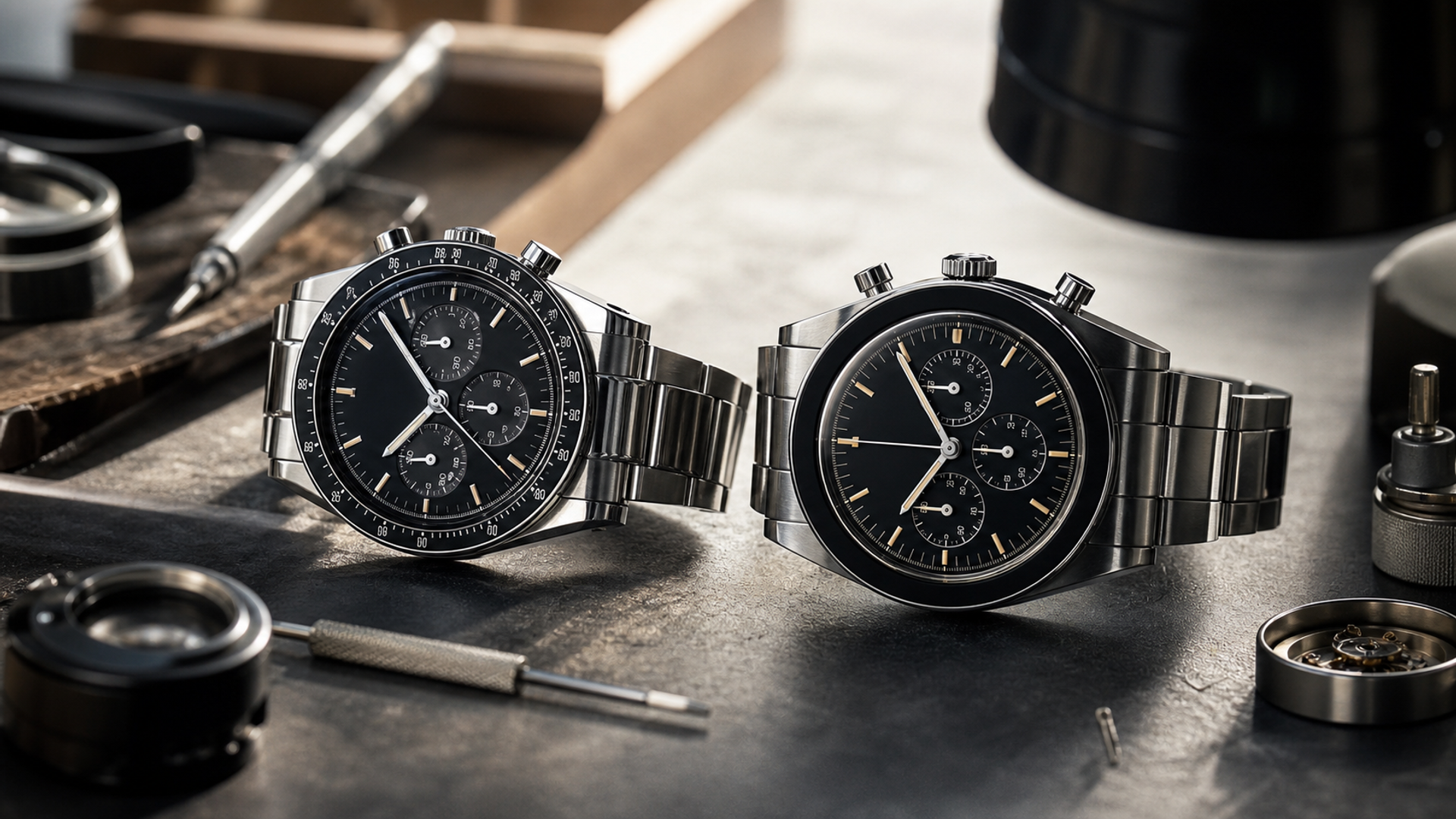
The Rolex Cosmograph Daytona and Omega Speedmaster Moonwatch Professional are both famous chronographs, but they solve different ownership problems. The Daytona is the better choice if you want a compact automatic sports chronograph with strong water resistance, a polished bracelet-led presence and an identity rooted in motor racing. The Speedmaster is the more compelling choice if you value manual winding, highly legible instrument design, space-flight history and the ability to buy into the core model family without building the entire decision around availability.
That is the short answer. The useful answer requires choosing a reference before comparing. “Daytona” covers steel, two-tone, gold and platinum versions; “Speedmaster” includes several movements, case materials and display arrangements. This guide uses the contemporary Oystersteel Daytona and the current Moonwatch Professional as the centre of gravity, while treating price and stock as volatile. Verify the exact reference, market and authorised seller before acting.
Quick decision matrix
| Decision factor | Daytona | Speedmaster Moonwatch Professional | Better fit |
|---|---|---|---|
| Winding | Automatic | Manual | Daytona for convenience; Speedmaster for ritual |
| Timing scale | Tachymeter on ceramic bezel | Tachymeter on anodised aluminium bezel | Daytona for durability; Speedmaster for historic character |
| Water resistance | 100 metres on the current steel reference | Lower, reference-dependent rating | Daytona for routine water exposure |
| Case presence | Compact, dense and polished | Broader dial, instrument-led visual footprint | Depends on wrist and style |
| Crystal choice | Sapphire on current Daytona | Hesalite or sapphire Moonwatch variants | Speedmaster offers the meaningful choice |
| Bracelet feel | Oyster bracelet with Easylink | Modern five-link-style steel bracelet or strap options | Try both; geometry matters more than reputation |
| Buying experience | Availability can dominate the decision | Core models are generally easier to identify and compare | Speedmaster for a cleaner purchase process |
| Emotional centre | Motorsport, finishing and scarcity | Space history, function and owner interaction | Choose the story you will still enjoy in ten years |
Start with the movement experience
The current Daytona uses Rolex calibre 4131, an automatic chronograph movement. Rolex describes it as entirely developed and produced in-house, and its current specifications list an approximately 72-hour power reserve. The practical advantage is simple: regular wear keeps the watch running, while the chronograph is integrated into a daily sports-watch package. The current official Daytona technical page is the right place to verify the exact reference rather than borrowing specifications from an older or precious-metal model.
The Moonwatch Professional makes manual winding part of the ownership experience. That is not automatically a disadvantage. A daily wind creates a relationship with the watch, keeps the case thinner than some automatic chronographs and suits collectors who enjoy visible mechanical routine. It is, however, less forgiving if you rotate many watches and expect to pick one up without setting it.
Choose the Daytona if “put it on and go” matters. Choose the Speedmaster if the winding ritual feels like a benefit rather than a chore. Do not choose either because one movement sounds more prestigious in isolation. Service access, the exact reference, usage and your tolerance for mechanical interaction matter more than a specification-table victory.
Timing function: racing tool versus space instrument
Both watches use a tachymeter scale, allowing average speed to be read over a known distance when the chronograph is operated correctly. Rolex places the scale on a monobloc Cerachrom ceramic bezel. Its current Daytona features page emphasises resistance to corrosion and scratches and explains the model’s connection to motor sport.
The Moonwatch’s black bezel and high-contrast dial are visually closer to a traditional instrument. The Speedmaster’s identity comes from spaceflight, but the everyday function is still a chronograph: timing a presentation, parking meter, cooking interval or journey segment. Most owners will not use either watch to calculate speed. What matters is whether the counters and scale remain legible to you in ordinary light.
Try the pushers. Observe how quickly you can distinguish elapsed minutes from running seconds. If the watch is beautiful but the chronograph is difficult for you to read, the complication has become decoration. That is acceptable—but it should be a conscious choice.
Hesalite or sapphire changes the Speedmaster decision
The Moonwatch Professional is unusual because the crystal decision meaningfully changes the character. Hesalite produces a warm, historically resonant distortion at the edge and is associated with the traditional Moonwatch expression. It can pick up marks, although light scratches can often be managed. Sapphire offers greater scratch resistance and, on relevant references, a display-back experience that many buyers value.
This is not a universal “authentic versus practical” contest. A collector who wants the closest emotional link to the historic tool may prefer Hesalite. A frequent traveller who dislikes crystal marks may prefer sapphire. Omega’s official 2026 Moonwatch announcement and Moonwatch press collection provide current first-party context, but bracelet, crystal, case-back and price still move with the exact reference and market.
The Daytona does not ask the same question in its current mainstream configuration. Its sapphire crystal and ceramic bezel make the ownership proposition more conventionally durable. That gives Rolex an advantage for a watch expected to move between office, airport, restaurant and weekend use with minimal negotiation.
Water resistance is a use-case question
The current steel Daytona is officially rated to 100 metres. That makes it the easier choice for an owner who wants one chronograph to tolerate swimming-adjacent life, changing weather and ordinary travel without constant anxiety. Water resistance still depends on seals, crown position, service condition and correct use; it is never a permanent property that survives neglect.
The Moonwatch is not a dive watch. Its lower water-resistance rating should be respected, and the chronograph pushers should not be operated underwater. If regular swimming is part of the brief, a dive watch or a Daytona may be the more rational one-watch solution. If the watch will remain on dry land, the numerical difference should not outweigh dial, movement and emotional fit.
Wearability is not captured by diameter
Both are often discussed around familiar nominal diameters, yet they wear differently. The Daytona’s case, bezel, polished centre links and compact dial architecture create a dense, jewellery-like sports-watch presence. The Speedmaster’s broad dial, twisted lugs and black bezel create a wider visual footprint. Wrist shape, not circumference alone, determines comfort.
Use this fitting sequence:
Centre the watch without tightening the bracelet excessively.
Check whether the lugs remain within the flat upper surface of the wrist.
Rotate the wrist as if typing, driving and lifting a cabin bag.
Confirm that the crown and pushers do not press into the hand.
Test the clasp against a laptop edge and jacket cuff.
Photograph the watch from one metre away; close-up phone images distort proportion.
The Daytona tends to suit buyers wanting a refined sports chronograph that can pass under smarter clothing. The Speedmaster tends to suit buyers who prefer visible instrument character. Neither is objectively more versatile; wardrobe, wrist and tolerance for polished surfaces decide.
The ownership-cost matrix
Purchase price is only one layer. Build a five-year ownership estimate around the real reference.
| Cost or friction | What to verify | Why it matters |
|---|---|---|
| Acquisition | Official retail price, seller status, availability and total tax | A headline price is irrelevant if the reference cannot be obtained on acceptable terms |
| Insurance | Declared value, geographic coverage and unattended-vehicle exclusions | Market attention can raise replacement complexity |
| Service | Recommended inspection, chronograph service scope and local service route | A chronograph is more complex than a time-only watch |
| Bracelet/strap | Sizing, spare links, strap compatibility and clasp comfort | Small fit problems can make an expensive watch remain unworn |
| Travel | Security routine, hotel-safe policy and border documentation | Ownership should not make every journey more stressful |
| Exit | Documentation, condition and selling costs | Resale is uncertain and should not be treated as guaranteed return |
Do not buy the Daytona because a secondary-market chart appears to promise profit. Do not buy the Speedmaster merely because it looks easier to replace. Watches are illiquid personal goods; condition, reference, completeness, timing and transaction costs can overturn a simple price narrative.
Which chronograph belongs in a collection?
If this is your only mechanical watch, the Daytona is the stronger all-weather, automatic proposition. It can cover more daily situations with less ritual, assuming the buying path is acceptable. The Speedmaster is the more expressive tool-watch proposition: it brings a manual-wind interaction, a clearer historical narrative and more meaningful configuration choices.
If you already own a diver and a formal watch, the Speedmaster may add the most distinct character. If you already own several manual-wind or vintage-inspired pieces, the Daytona may add a more polished automatic sports chronograph. Our guide to building a three-watch collection explains why role separation matters more than accumulating famous references. The broader men’s luxury watch brands guide helps place both makers within a wider shortlist.
Final verdict
Choose the Rolex Daytona for automatic convenience, stronger routine water resistance, ceramic-bezel durability and a compact polished sports-watch character. Choose the Omega Speedmaster Moonwatch Professional for manual-wind engagement, instrument clarity, space-history identity and a more direct reference-selection process.
Then buy the exact watch—not the internet’s idea of the watch. Confirm reference, crystal, bracelet, water resistance, warranty and authorised seller on the current official pages. Try it on. Operate the chronograph. Imagine servicing and travelling with it. The better chronograph is the one whose compromises you understand and whose interaction you still want after the status comparison has faded.
Sources and verification
Official product pages were checked for this 4 August 2026 publication package. References, availability, prices and specifications can change by market; verify the exact model before purchase.
![How to Scan Receipts and Documents with Your Phone [Full Guide]](https://cdn.sanity.io/images/e0gp1l2g/production/0db13feec1d5e72b8a8a5f976d1f3e86619c9228-3840x1860.webp?w=180&h=180&q=78&auto=format&fit=crop)
![How to Scan Receipts and Documents with Your Phone [Full Guide]](https://cdn.sanity.io/images/e0gp1l2g/production/0db13feec1d5e72b8a8a5f976d1f3e86619c9228-3840x1860.webp?w=800&h=450&q=82&auto=format&fit=crop)
![Top 10 Two-Tone Carbon-Fibre Watches for Men [2026 List]](https://cdn.sanity.io/images/e0gp1l2g/production/18870799ba33fab0e038968359cd5772d7d7db30-1024x576.webp?w=800&h=450&q=82&auto=format&fit=crop)
![Top 10 Luxury Watches with Digital Complication Displays for Men [Latest]](https://cdn.sanity.io/images/e0gp1l2g/production/c4f6bf8c080f291c39f7cc85c7344ecff2fd3799-1024x553.webp?w=800&h=450&q=82&auto=format&fit=crop)