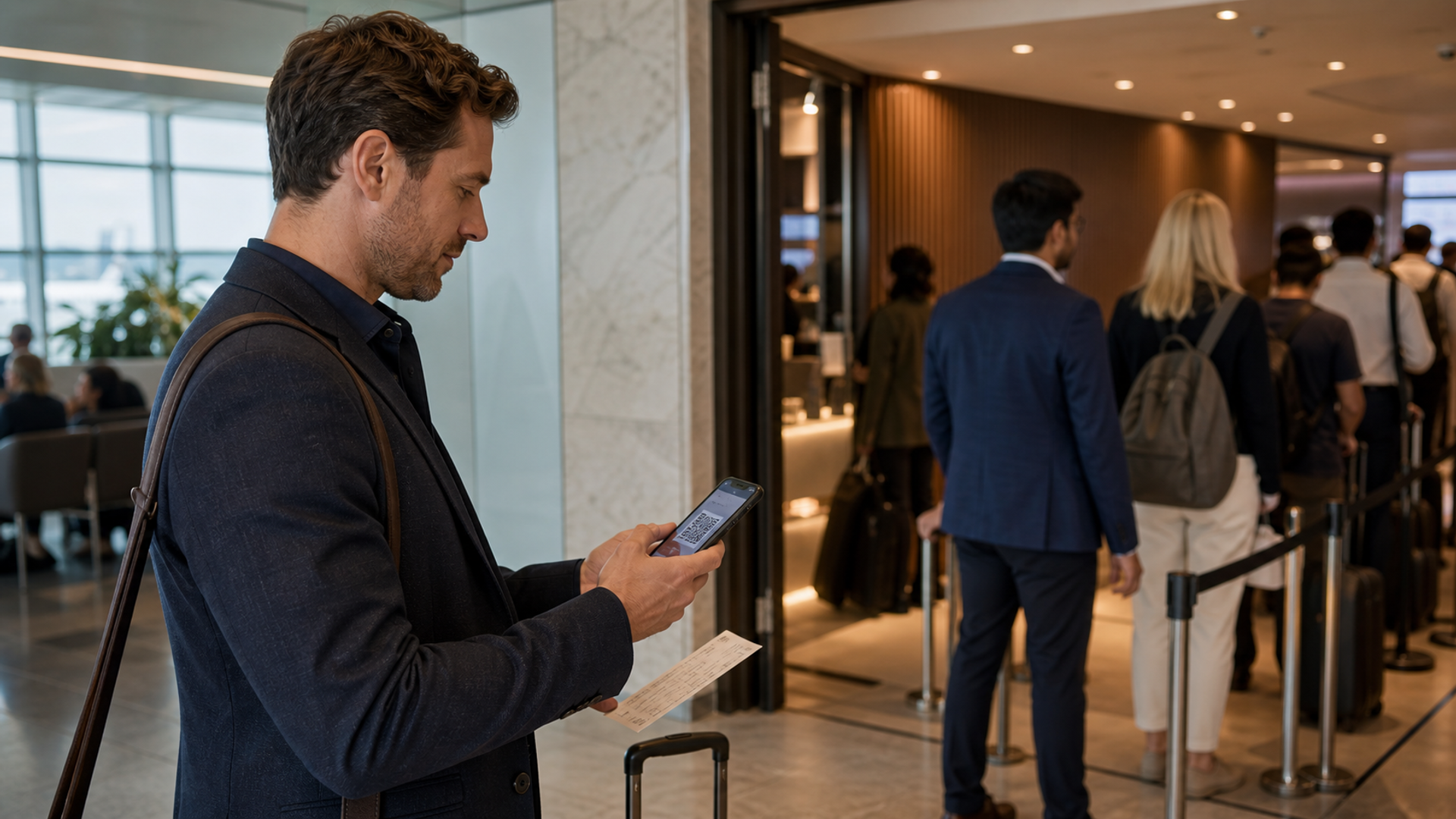
Priority Pass lounge access is useful, but it is not a universal reservation, a promise of admission or a single identical benefit. The outcome depends on four separate layers: the lounge is in your programme, it is accessible from your terminal and itinerary, it has capacity when you arrive, and your particular membership covers the visit on the terms you expect. Miss one layer and a card that looked “unlimited” at home may still leave you paying, waiting or walking away.
The most important preparation is therefore not downloading the app. It is identifying who issued your membership, checking the live entry for the exact lounge and reading the guest and visit terms attached to your account. Priority Pass’s conditions, effective 26 March 2026, state that individual lounges and merchants can have their own terms, access is subject to the correct means of access and boarding documentation, and programme details can change. Direct retail plans also differ from benefits supplied through banks and premium payment cards.
Quick answer:** Treat Priority Pass as a conditional access network, not a guaranteed booking. Confirm the lounge, terminal, operating hours, guest rules, visit entitlement and pre-book status on the day of travel, then keep an airport fallback that does not depend on lounge admission.
The five-layer lounge access test
Use this matrix before deciding whether a membership, credit-card benefit or paid visit is genuinely useful for a trip.
| Layer | Question to verify | Evidence to check | If it fails |
|---|---|---|---|
| Network | Is the exact lounge or experience available to your membership? | Logged-in Priority Pass app or website entry | Choose another terminal facility |
| Itinerary | Can your boarding pass reach it airside or landside? | Terminal, Schengen/non-Schengen and departure/arrival notes | Do not plan a terminal transfer solely for the lounge |
| Capacity | Is walk-in access being accepted at your arrival time? | Live lounge note, pre-book option and desk confirmation | Use a paid reservation or non-lounge fallback |
| Entitlement | Is your visit included, paid or capped? | Issuer benefit guide and membership visit history | Calculate the real per-person cost |
| Guests | How many guests are allowed and what will each cost? | Lounge rule plus card issuer’s terms | Split access or pay only with explicit consent |
This distinction matters because people often collapse five decisions into one sentence: “I have Priority Pass.” The membership establishes eligibility to use the network; it does not erase the operating rules of the airport, lounge, issuer or membership plan.
Start with the issuer, not the card colour
There are two broad ways to obtain access. You can buy a membership directly from Priority Pass, or receive access through another organisation—commonly a bank, card issuer or employer benefit. Those arrangements can look similar in the app while carrying different visit allowances, guest charges, merchant benefits and renewal rules.
Priority Pass’s current direct US offer illustrates the structure. Its Standard plan lists a US$99 annual fee plus US$35 for each member visit and US$35 per guest visit. Standard Plus lists US$329 with ten included member visits, then US$35 per member visit; guest visits remain US$35. Prestige lists US$469 with member visits included and US$35 per guest visit. These are a current US retail example, not a global price promise. Residence, currency, promotion and provider benefits can change the numbers.
A bank-issued membership may include a different number of visits, exclude restaurant credits, charge a different guest rate or require the linked payment card to remain open and in good standing. That is why the benefit guide from the issuing organisation controls the economics. The Priority Pass app controls the current network listing. You need both documents.
Before departure, write down:
membership source and expiry date;
included visits already used in the benefit year;
member charge after the allowance is exhausted;
guest charge, guest limit and children’s rule;
whether lounge alternatives such as restaurants or spas count;
whether pre-booking is included or separately charged.
Do not rely on a screenshot from the day the card was approved. A travel benefit can change before the annual-fee cycle ends, and a lounge can leave the network or change hours.
Why an eligible member can still be refused
Capacity is the most visible reason. A lounge may prioritise airline-contracted premium passengers, paid reservations or its own members during peaks. Priority Pass explicitly says access is subject to space availability on its membership page. Its pre-book terms go further: even a pre-book does not guarantee access, and admission remains at the lounge’s discretion, although the booking should improve planning at participating locations.
Location is the quieter failure. A lounge may be in another terminal, beyond a security checkpoint that your boarding pass cannot enter, or on the wrong side of passport control. In Europe, the programme’s conditions note that some lounges are within designated Schengen areas and are available only to travellers whose itinerary can access that zone. A 90-minute connection is not the moment to discover that the lounge requires a train, a second security screening or formal entry into the country.
Documentation is another hard gate. The current conditions require a valid means of access, a valid boarding pass and any additional identification the lounge requests. A photograph of a digital membership card or merely reciting the card number may not be accepted. If access is stored on a phone, preserve enough battery to display it and carry the physical card when your specific membership still supplies one.
Finally, operating hours may not match the airport’s. A lounge listed at a 24-hour airport can close overnight, limit stays, suspend arrivals access or stop accepting members before its official closing time. Check the live listing on the travel date.
Guest fees: the charge that surprises groups
Priority Pass defines a guest as an additional person entering with the primary member who is not using their own membership. The device at reception records how many people are admitted. Its member help warns that once access is confirmed, charges can apply and may not be reversible. Read the guest count before signing or tapping acceptance.
Three details require separate answers:
Does the lounge permit guests? The lounge may impose a lower guest limit than the membership generally allows.
Does the membership include guests? Some premium-card benefits include a set number; direct retail plans commonly charge per guest.
How are children counted? The age threshold and fee are location-specific. “Family access” is not a standard network-wide entitlement.
For a couple travelling six times a year, the value can change dramatically depending on whether the second traveller has their own membership. Suppose a benefit includes the primary member but charges US$35 for each guest visit. Six joint visits create US$210 in guest charges. If both travellers already hold eligible memberships, presenting them separately may be cheaper—but only if each entitlement is valid and the lounge accepts both. Never split or combine memberships in a way that conflicts with the issuer’s rules.
For business groups, agree the payment before reception records the visit. The membership holder’s linked card may be charged later, making an informal “bring everyone in” decision surprisingly difficult to reconcile on an expense report.
Is Priority Pass worth paying for?
The useful comparison is not annual fee versus the retail price printed at a lounge door. Compare the full cost with the airport behaviour you would otherwise choose.
Build a simple trip-year calculation:
Annual value = meals and quiet space you would actually buy + time saved by a usable location − annual fee − member visit fees − guest fees − pre-book fees − failed-access risk.
Then run three scenarios.
Occasional solo traveller
A traveller making three lounge visits may find a pay-per-visit plan, a single-use booking or an airline lounge pass more economical than a high annual fee. The membership is still valuable if it expands access at airports where paid entry is difficult, but only those real routes should count.
Frequent traveller with changing airports
Network breadth matters more here. Ten or more credible visits can justify an included-visit or unlimited-member tier, especially when the traveller regularly faces long connections. Map the actual airports first; do not price ten theoretical visits at airports you rarely use.
Couple or family
Guest economics dominate. Calculate each traveller separately. Two independent benefits can outperform one premium membership with repeated guest fees. Conversely, one card that explicitly includes two guests can be stronger than two low-tier memberships. Children’s access must be checked lounge by lounge.
The 24-hour pre-flight lounge checklist
Use this checklist the day before departure, not at the lounge desk.
Open the lounge listing while signed into the correct membership.
Match airport, terminal, concourse and security zone to the boarding pass.
Check opening hours against the planned arrival—not only flight departure.
Read maximum-stay, dress, children, guest and food-service notes.
Confirm the remaining member visit allowance with the issuer.
Confirm each guest’s charge and obtain agreement from the payer.
Decide whether pre-booking is available and whether its fee is justified.
Save the live entry for reference, but recheck it when you reach the airport.
Carry valid identification, boarding pass and accepted membership credential.
Name a fallback: airline lounge, paid workspace, quiet restaurant or gate plan.
A fallback protects the journey from becoming organised around a perk. For a 45-minute wait, walking across a large terminal for a lounge may produce less rest than staying near the gate. For a three-hour disruption, a confirmed paid space may be worth more than uncertain complimentary access.
Pre-booking, fast track and “experiences” are separate products
The app can show more than traditional lounges: airport restaurants, spas, sleep facilities, discount offers or fast-track services. Their rules can differ from lounge entry. The March 2026 conditions contain distinct terms for pre-book, airport fast track, discount offers and third-party platforms. A membership logo beside an experience does not mean it is complimentary.
Open the individual listing and look for the word that controls the transaction: included, discounted, pay on use, reservation fee or unavailable. Confirm whether using an experience consumes a visit entitlement. For fast track, remember that access does not replace airline check-in, immigration rules or security requirements.
A better way to use lounge access during disruption
During a delay or cancellation, first protect the itinerary: confirm the flight status, rebooking queue, baggage position and boarding time. Then evaluate the lounge. Some lounges do not make flight announcements, and Priority Pass’s conditions place responsibility for monitoring the flight on the traveller.
If you have access to an eligible VERTU Concierge service, a human concierge may help with premium travel, dining, rides or other high-touch arrangements, subject to service availability and the user’s authorisation. That can complement lounge research, but it does not override an airport operator’s capacity decision. The same principle applies to any agent or concierge: ask it to find alternatives and verify terms, not to promise admission it does not control. See VERTU’s guide to AI-to-human concierge handoff during travel disruption.
For connectivity and document resilience while travelling, the executive hotel Wi-Fi, hotspot and travel-router plan provides an adjacent checklist.
Sources and verification
Sources and programme pages were checked on 22 July 2026. Prices, lounge participation, issuer benefits, visit allowances and airport operating conditions can change. Recheck the live listing and the terms supplied by your membership issuer before every journey.
Final decision
Priority Pass works best as a broad option set backed by precise trip-level checks. It is poor as a promise that every airport wait will become a lounge visit. The disciplined user knows which layer has been verified, what each guest will cost and what to do if the lounge says no. That turns a vague premium benefit into a useful travel tool—and prevents the benefit from dictating the journey.