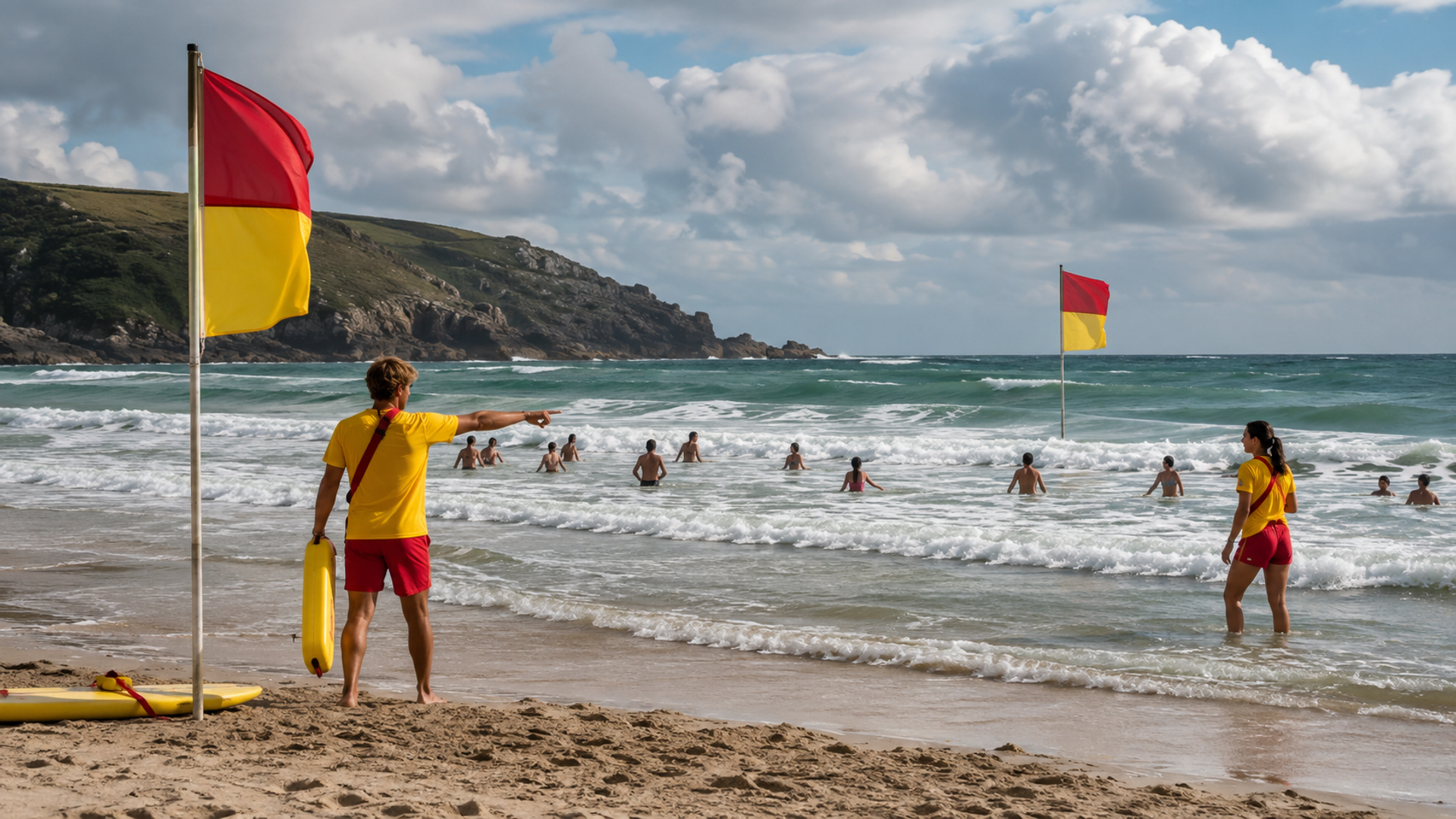
RNLI lifeguards rescued approximately 11 people at Porth Beach after swimmers moved beyond the flagged zone and encountered strong currents near the river mouth. One casualty became unconscious. The incident is useful because it shows how several ordinary choices combine: location, tide, recent rain, swell, group behaviour and the decision to leave the supervised area. Beach safety is not a rule memorised once. It is a short assessment made every time the water is entered.
Direct answer
Swim at a lifeguarded beach, stay between the red-and-yellow flags and ask the lifeguard about local currents before entering. At Porth, the rescued group had moved outside the flagged area into stronger currents, deeper water, large swell and spring-tide conditions. If caught in a rip, do not fight it directly; signal for help and follow RNLI guidance.
The status of rnli lifeguards porth beach rescue can change after publication. Use the update dates and source links below before making a time-sensitive, financial, safety or travel decision.
What is confirmed now
Evidence 1. RNLI's incident report says 11 swimmers encountered strong currents, large swell, spring tides and increased river flow outside the flagged area. Read the source.
Evidence 2. The official Porth Beach page lists 2026 lifeguard patrol dates and local beach information. Read the source.
Evidence 3. RNLI explains the meaning of red-and-yellow, black-and-white and red beach flags. Read the source.
Evidence 4. RNLI rip-current guidance advises not swimming directly against a rip and recommends signalling for help. Read the source.
These sources support only the claims attached to them. They do not prove that every social post, reseller listing, weather headline, schedule or interpretation about rnli lifeguards porth beach rescue is current.
The decision matrix
| Decision factor | Evidence to collect | Why it changes the answer | Control |
|---|---|---|---|
| Flag zone | where the red-and-yellow flags stand now | lifeguards place them for current conditions | enter only inside the zone |
| Tide and river | spring tide, river flow and water depth | river mouths can concentrate moving water | ask the lifeguard locally |
| Swell | wave size, period and breaking pattern | energy can exhaust swimmers before distance looks serious | stay shallower when uncertain |
| Group behaviour | who leads, watches and can call for help | groups often follow one confident person outside the safe area | appoint a shore observer |
| Exit trigger | fatigue, drift, cold and flag movement | early exit preserves the ability to return | leave at the first abnormal sign |
| Emergency action | lifeguard location and 999/112 Coastguard route | a rescuer without equipment can become another casualty | call and throw aid rather than enter |
The matrix is the article-specific value object for rnli lifeguards porth beach rescue. It forces the reader to compare evidence, consequence and control instead of relying on one emotional cue. A useful result can be cautious: unknown is more accurate than a confident answer built from a missing field.
How each factor changes the result
Flag zone
For rnli lifeguards porth beach rescue, verify where the red-and-yellow flags stand now. This matters because lifeguards place them for current conditions. The practical control is to enter only inside the zone. The avoidable failure is that yesterday's safe spot is reused. Write the observation beside its date, market and source; if the evidence is missing, mark the flag zone field unknown. Do not award a favourable conclusion merely because another factor looks strong. A reader can then see whether flag zone changed the answer or only changed the confidence around it.
Tide and river
For rnli lifeguards porth beach rescue, verify spring tide, river flow and water depth. This matters because river mouths can concentrate moving water. The practical control is to ask the lifeguard locally. The avoidable failure is that a calm surface is read as weak current. Write the observation beside its date, market and source; if the evidence is missing, mark the tide and river field unknown. Do not award a favourable conclusion merely because another factor looks strong. A reader can then see whether tide and river changed the answer or only changed the confidence around it.
Swell
For rnli lifeguards porth beach rescue, verify wave size, period and breaking pattern. This matters because energy can exhaust swimmers before distance looks serious. The practical control is to stay shallower when uncertain. The avoidable failure is that fitness in a pool is overvalued. Write the observation beside its date, market and source; if the evidence is missing, mark the swell field unknown. Do not award a favourable conclusion merely because another factor looks strong. A reader can then see whether swell changed the answer or only changed the confidence around it.
Group behaviour
For rnli lifeguards porth beach rescue, verify who leads, watches and can call for help. This matters because groups often follow one confident person outside the safe area. The practical control is to appoint a shore observer. The avoidable failure is that everybody assumes somebody else is watching. Write the observation beside its date, market and source; if the evidence is missing, mark the group behaviour field unknown. Do not award a favourable conclusion merely because another factor looks strong. A reader can then see whether group behaviour changed the answer or only changed the confidence around it.
Exit trigger
For rnli lifeguards porth beach rescue, verify fatigue, drift, cold and flag movement. This matters because early exit preserves the ability to return. The practical control is to leave at the first abnormal sign. The avoidable failure is that pride delays the signal. Write the observation beside its date, market and source; if the evidence is missing, mark the exit trigger field unknown. Do not award a favourable conclusion merely because another factor looks strong. A reader can then see whether exit trigger changed the answer or only changed the confidence around it.
Emergency action
For rnli lifeguards porth beach rescue, verify lifeguard location and 999/112 Coastguard route. This matters because a rescuer without equipment can become another casualty. The practical control is to call and throw aid rather than enter. The avoidable failure is that a bystander improvises a second rescue. Write the observation beside its date, market and source; if the evidence is missing, mark the emergency action field unknown. Do not award a favourable conclusion merely because another factor looks strong. A reader can then see whether emergency action changed the answer or only changed the confidence around it.
Worked scenario
Four friends reach Porth near the river mouth at the end of a warm day. The beach looks calm, but the red-and-yellow flags are farther from the river and a spring tide is running. They ask the lifeguard, swim within the zone for twenty minutes and leave when one person notices sideways drift. The decision sacrifices a picturesque entry point but preserves supervision and a simple exit.
Now stress-test the rnli lifeguards porth beach rescue result. Remove the most optimistic assumption, add the largest plausible friction and ask whether the action still makes sense. If the recommendation changes, name the decisive assumption. That is more useful than hiding uncertainty behind a single score.
Flags are a live risk assessment
Red-and-yellow flags mark the lifeguarded swimming and bodyboarding zone; they are not decoration. Black-and-white flags identify areas for surfboards and other craft. A red flag means do not enter. The positions can change as conditions change, so ask rather than relying on memory or the previous day.
In this rnli lifeguards porth beach rescue decision, apply that principle to the exact date, location, product, account or route described above. Keep the source and the decision trigger together. If conditions change, update the conclusion rather than quietly preserving an attractive headline.
River mouths deserve extra caution
Fresh water, sand channels and tide can combine to create deeper or faster-moving water. A visually smooth patch can be a channel where waves are not breaking. At Porth, recent rainfall increased river flow. Avoid treating the river mouth as an easy entry simply because the surface looks organised.
In this rnli lifeguards porth beach rescue decision, apply that principle to the exact date, location, product, account or route described above. Keep the source and the decision trigger together. If conditions change, update the conclusion rather than quietly preserving an attractive headline.
A rip does not require a heroic sprint
Trying to swim directly against a rip can exhaust even a confident swimmer. RNLI advice is to stand or wade if possible, swim parallel until free when able, and raise a hand and shout. Floating and controlling breathing can preserve energy while help arrives. The exact action depends on conditions and lifeguard instruction.
In this rnli lifeguards porth beach rescue decision, apply that principle to the exact date, location, product, account or route described above. Keep the source and the decision trigger together. If conditions change, update the conclusion rather than quietly preserving an attractive headline.
Groups amplify both confidence and confusion
Eleven people can enter together without eleven independent risk assessments. Agree boundaries before swimming, keep weaker swimmers closest to shore and maintain a shore contact. If anyone drifts beyond the agreed line, the whole group returns rather than following into deeper water.
In this rnli lifeguards porth beach rescue decision, apply that principle to the exact date, location, product, account or route described above. Keep the source and the decision trigger together. If conditions change, update the conclusion rather than quietly preserving an attractive headline.
The safest rescue may be staying out of the water
Alert lifeguards or call 999 or 112 and ask for the Coastguard. Throw a flotation aid if available without entering. Untrained entry into surf can create another casualty and divert rescuers. Keep pointing at the person in difficulty so responders do not lose their position.
In this rnli lifeguards porth beach rescue decision, apply that principle to the exact date, location, product, account or route described above. Keep the source and the decision trigger together. If conditions change, update the conclusion rather than quietly preserving an attractive headline.
Reader checklist
[ ] Choose a lifeguarded beach
[ ] Find the current flags
[ ] Ask about local currents
[ ] Check tide and swell
[ ] Keep weaker swimmers shoreward
[ ] Set an early exit trigger
[ ] Carry a means of calling for help
[ ] Call the Coastguard rather than improvising
Unchecked fields for rnli lifeguards porth beach rescue remain unresolved. They should trigger a recheck, a smaller commitment or a decision to wait; they should not be silently converted into approval.
Sources and method
rnli.org — RNLI's incident report says 11 swimmers encountered strong currents, large swell, spring tides and increased river flow outside the flagged area.
rnli.org — The official Porth Beach page lists 2026 lifeguard patrol dates and local beach information.
rnli.org — RNLI explains the meaning of red-and-yellow, black-and-white and red beach flags.
supporttool.rnli.org — RNLI rip-current guidance advises not swimming directly against a rip and recommends signalling for help.
The external sources above were checked for this rnli lifeguards porth beach rescue treatment. Ranking pages were used only to identify repeated coverage and missing reader value. Their wording, paragraph order and distinctive structure were not copied. This article contributes its own matrix, scenario, failure modes and action checklist.
Continue with adjacent research
These contextual links provide adjacent planning or ownership information for rnli lifeguards porth beach rescue. They do not replace the official sources, professional help or current local conditions required for the decision in this article.
Final judgement
Swim at a lifeguarded beach, stay between the red-and-yellow flags and ask the lifeguard about local currents before entering. At Porth, the rescued group had moved outside the flagged area into stronger currents, deeper water, large swell and spring-tide conditions. If caught in a rip, do not fight it directly; signal for help and follow RNLI guidance.
The Discover opportunity for rnli lifeguards porth beach rescue comes from timely usefulness and a concrete visual subject, not from a guarantee of distribution. The durable standard is a decision readers can verify, act on and revise when new evidence arrives.