Luxury used to mean materials, provenance, and service.
In 2026, it also means something quieter: control over your attention, your decisions, and your data.
That’s the promise behind the idea of a personal intelligence phone — not a gadget that answers questions, but a device that helps you run your day with less noise and fewer compromises.
Key takeaways
“Personal intelligence” is a system, not an app. You’re buying a workflow: capture → memory → retrieval → action.
Privacy is not a checkbox. Look for local-first behavior, clear permissioning, and credible security architecture.
Agent capability matters only if it’s bounded. The best systems turn intent into action with control and auditability.
Service is part of the stack. For UHNW use, the real differentiator is often human judgment paired with fast automation.
Craft still counts. If the device is your daily command center, durability and tactile quality are not “aesthetic extras.”
What “personal intelligence” means (and what it is not)
A useful way to define personal intelligence is: a private layer that captures what matters to you, remembers it with context, retrieves it instantly, and helps you act on it.
Many tools call themselves “AI assistants.” The difference is simple:
A chatbot helps you think.
A personal intelligence system helps you operate.
Taskade frames an “AI second brain” as a system that can capture, organize, retrieve, and act on your information — not just store it (Taskade’s “AI second brain” framework (2026)).
And when privacy is a priority, the system needs more than a “we care about privacy” paragraph.
Vellum’s definition of a private personal AI assistant emphasizes verifiable design choices — local-first behavior, auditable controls, and credential isolation — so your data stays under your control (Vellum’s definition of a private personal AI assistant (2026)).
Collector’s note: “Personal intelligence” is often marketed as a feature. In practice, it’s an operating model. If the model can’t run without exporting your life to the cloud, it’s not intelligence — it’s delegation.
The five criteria that make a personal intelligence luxury smartphone real
If you’re evaluating a personal intelligence luxury smartphone, these are the criteria that matter more than benchmark scores.
1) A privacy model you can understand in one minute
The standard smartphone bargain is convenience in exchange for exposure.
For high-stakes work — deal flow, travel, family office coordination, sensitive calls — the bargain stops making sense.
Look for:
Local-first capability for private tasks (so your core workflow doesn’t collapse when you’re offline or cautious)
Explicit permissions (what the system can read, what it can send, what it can execute)
Separation of spaces (a practical way to keep personal, public, and confidential work from bleeding into each other)
Also look for the absence of vague wording.
If a phone claims “data sovereignty,” you should be able to ask: sovereignty over what data, stored where, accessed by whom, and with what audit trail?
2) Memory that behaves like context — not a dumping ground
Personal intelligence without memory is just chat.
Memory should mean:
your device recalls your preferences (how you decide, what you prioritize)
it retains project context across weeks (not only within a single chat session)
it can retrieve context without you remembering the exact keyword
The quickest test: ask the system to summarize the last two weeks of decisions around a specific theme — and to show where those decisions came from.
3) “Agency” with boundaries: it can act, but it can’t freeload on trust
An AI agent phone is compelling because it compresses time.
But the right design is not “let it do everything.” It’s “let it do the routine things quickly, and escalate the irreversible things.”
In practical terms, evaluate:
what actions require your confirmation
how it explains the next step before it takes it
whether it can produce an audit-friendly output (a recap, a list of actions taken, or an execution log)
How to verify: Pick one recurring workflow — rescheduling travel, prepping a meeting agenda, or drafting a follow-up. Run it once. Your goal isn’t speed; it’s predictability.
4) A service layer that respects status, time, and discretion
Most phones assume you’ll do the last mile yourself.
UHNW reality is different. You have assistants, counsel, and operators. You also have moments where human judgment is the product.
A true luxury system treats service as part of the architecture:
AI handles the scalable work (summaries, drafting, planning, coordination)
humans handle the nuanced work (judgment, relationships, exceptions, sensitive escalation)
This is the difference between “an AI app” and “a private operating concierge.”
5) Craft and durability that match daily executive use
Luxury hardware isn’t about flex.
It’s about the feeling that your daily command center is built to last — and is pleasant to use in the small moments that add up: the button press, the hinge, the weight, the materials, the silence.
If you travel constantly, the phone isn’t a device. It’s your pocket office.
A decision framework: must-haves, nice-to-haves, and red flags
This section is meant to be used like a private checklist.
Your must-haves (most buyers should start here)
Must-have #1: Local-first private workflows
If your personal intelligence layer depends on constant cloud access, it will fail you when you most need it.
Must-have #2: A clear permission model
The system should make it obvious what it can access, what it stores, and what it can send.
Must-have #3: A credible security story
Not “secure.” Specific: isolation, encryption, separate spaces, and a coherent architecture.
Must-have #4: Cross-context handling
Your life spans regions, languages, time zones, and multiple numbers. The system needs to stay coherent across the mess.
Nice-to-haves (high leverage, not mandatory)
a physical interaction model (a dedicated key) for fast, discreet access
a secure vault concept for sensitive materials
an agent library that covers your actual workflows: governance, meetings, finance, travel, and comms
Red flags (walk away or investigate deeply)
“AI” is presented as a magic feature with no explanation of boundaries
privacy is described only as policy language, not behavior
the system can’t explain what it did, or why it did it
the device feels optimized for demos, not daily life
Where an AI agent phone can fit: an example with VERTU
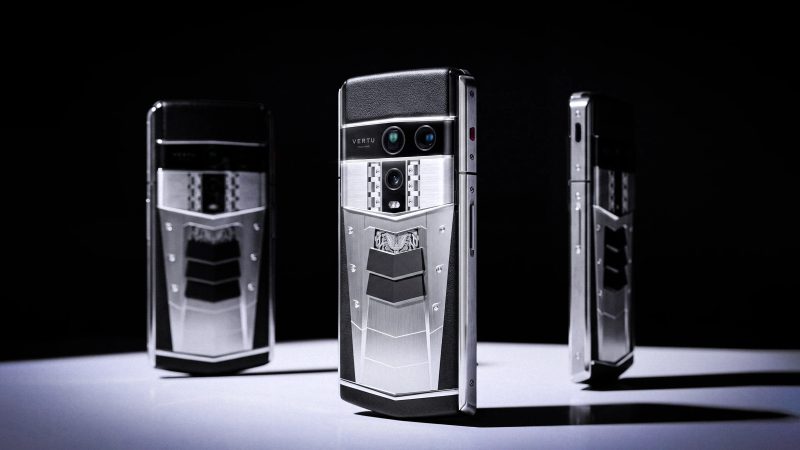
A useful example of this category is the VERTU Agent Q GT Limited Edition, positioned by VERTU as an “AI agent phone” with voice access to 200+ AI agents, a privacy-forward architecture framing, and 24/7 concierge service (VERTU Agent Q GT Limited Edition).
Two design ideas are worth paying attention to — regardless of which device you buy.
An “apps-to-agents” operating model
VERTU describes an agent-based model (rather than opening individual apps) and a cognitive loop covering perception, memory, planning, and execution in its broader overview of Agent Q (VERTU’s Agent Q overview (VAOS + agent ecosystem)).
For a buyer, the relevant question isn’t whether the framework sounds futuristic.
It’s whether the device can reliably convert:
a meeting into decisions
decisions into tasks
tasks into follow-ups
…without you babysitting every step.
A hybrid model: AI speed + human judgment
VERTU’s Ruby Talk is positioned as a gateway between AI agents and human concierge support, emphasizing routing a request to the “optimal combination” of AI and human expertise (Ruby Talk and hybrid AI + concierge).
That hybrid model is the most luxury-native approach to personal intelligence: the machine handles the scale; people handle the edge cases.
Key Takeaway: In luxury, the best technology doesn’t replace service. It makes service faster, more discreet, and more consistent.
FAQs
Is “personal intelligence” just another term for an AI assistant?
Not quite. An assistant can answer questions; a personal intelligence system is designed to retain your context and help you act on it. The practical test is whether it can reliably support repeatable workflows — not just produce fluent text.
What matters more: specs or architecture?
For this category, architecture tends to matter more. You want a system that is predictable, permissioned, and privacy-aware. Specs are meaningful only when they improve your workflow outcomes.
How do I evaluate privacy claims without being a security engineer?
Ask for behavior, not slogans: does it work offline for private tasks, does it have clear permissions, does it separate spaces, and can it show you what it accessed and what it sent?
Will a personal intelligence luxury smartphone integrate with my existing ecosystem?
Integration is a legitimate deciding factor. Evaluate what matters to you (mail, calendar, messaging, docs, travel, banking workflows), then test the top two scenarios you run every week.
What’s a sensible first use case?
Start with one high-frequency, high-cost workflow: meeting follow-ups, travel rebooking, or briefing preparation. If it can handle one workflow with confidence, expansion becomes natural.
Next steps
If you’re evaluating this category, do one thing first: write down the three workflows you want to protect and accelerate.
Then choose a device and test those workflows for a week — privately, with intent, and with a low tolerance for vague behavior.
If you want to see one implementation that pairs an AI agent operating model with concierge support, start with the product overview for VERTU Agent Q GT Limited Edition.
Disclosure: This article references VERTU pages. Editorial judgment remains the priority.