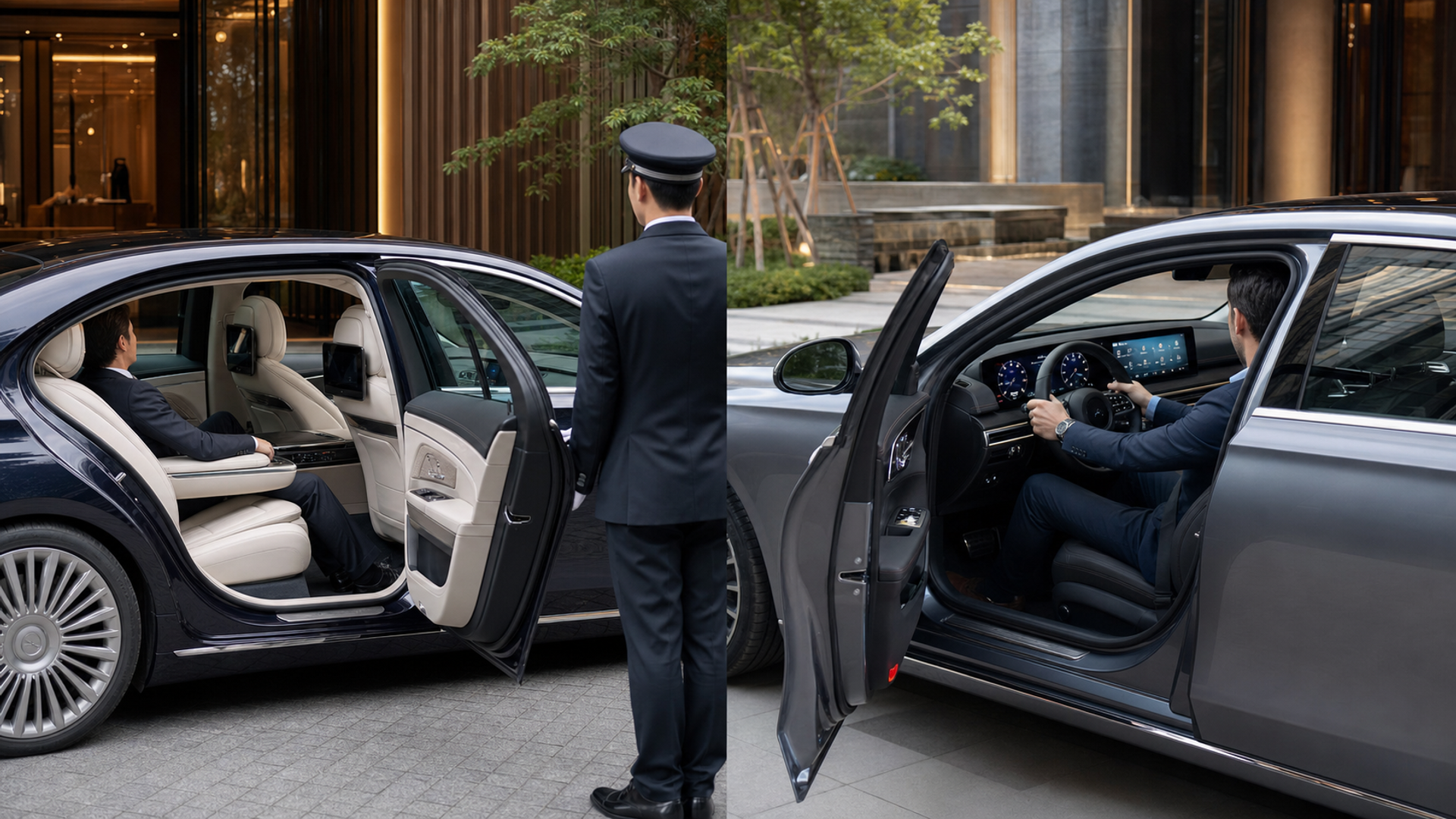
The Mercedes-Benz S-Class is usually the better fit when rear-seat calm, ride isolation and a restrained sense of effort are the priority. The BMW 7 Series is usually stronger for buyers who want more driver involvement, a highly theatrical digital cabin and an electric i7 route within the same flagship family. The right choice depends on whether the owner spends most journeys in the front left or rear right seat.
This Mercedes S-Class vs BMW 7 Series comparison uses an ownership test rather than a specification contest. Exact engines, wheelbases, equipment and prices vary by market, and options can alter comfort dramatically. Compare the cars you can actually order.
S-Class vs 7 Series at a glance
| Decision factor | Mercedes-Benz S-Class | BMW 7 Series / i7 | Practical winner |
|---|---|---|---|
| Rear-seat character | Protective, calm and traditionally limousine-like | Spacious, technology-led and more theatrical | S-Class for quiet; 7 for entertainment |
| Ride | Strong emphasis on isolation | Comfort with a slightly more connected feel | Specification and wheel dependent |
| Driver experience | Effortless and measured | More overtly driver-oriented | 7 Series for engaged owner-drivers |
| Interface | Screen-rich but organised around Mercedes logic | BMW iDrive ecosystem with extensive digital functions | Personal preference after a long test |
| Powertrain | Market-dependent combustion and electrified choices | Combustion/electrified choices plus i7 | Route and charging decide |
| Exterior signal | Recognisable but comparatively conservative | Bold, highly visible flagship design | Depends on desired discretion |
| Best use | Chauffeur, long-distance calm, mixed duty | Mixed duty, technology and electric option | Start with the primary seat |
Rear seat: comfort is a system
Rear luxury is not the length of the option list. It is the combined effect of entry, seat shape, foot space, ride, noise, climate, light and control effort. The S-Class has long been engineered around that system. The current Mercedes-Benz S-Class overview shows how seating and assistance packages are layered by specification.
BMW answers with a rear environment that can be more visually dramatic. The current BMW 7 Series places large displays, connected controls and theatre-like entertainment at the centre of the proposition. Those features are useful for a passenger who watches media or works during long journeys; they are less important for someone who wants darkness and uninterrupted sleep.
Test both cars with the front passenger seat in a realistic position. Recline the rear seat, place feet naturally, use a laptop and close the door without assistance. Check whether the headrest supports rather than pushes, whether the belt remains comfortable and whether the screen creates reflections at night.
Ride quality: wheel and tyre choices can reverse the result
A flagship on the largest available wheels may look resolved in a configurator and ride worse on broken city surfaces. Low-profile tyres transmit sharper impacts and can increase road noise. Suspension technology cannot eliminate the basic relationship between tyre sidewall, unsprung mass and a pothole.
Drive the exact wheel size you plan to order. Include patched asphalt, a speed hump, a concrete motorway and a tight car park. Sit in the rear while another person drives over the same route. The driver may experience a well-controlled body while the rear passenger notices vertical movement.
The S-Class generally favours isolation; the 7 Series can feel more tied down. Either can be the more comfortable car in a particular configuration. Tyres, pressure, run-flat construction, rear steering and suspension options must be recorded alongside the impression.
Driver’s seat: effort versus engagement
From the front, the Mercedes aims to reduce workload. Steering, assistance and power delivery are calibrated to make the car feel smaller and calmer than its dimensions suggest. It suits an owner who wants to arrive fresh rather than entertained by every corner.
The BMW tends to invite more involvement. Steering and chassis responses can feel more immediate, and the driving position places the car’s digital system around the driver. That does not make it a sports saloon; it makes the compromise between limousine and owner-driver car more explicit.
Drive at low speed before the open road. Brake modulation in traffic, camera latency and accelerator smoothness influence every journey. A flagship that surges from a stop or hides core controls behind unfamiliar menus will feel less luxurious than its materials suggest.
Interface and digital life
Both cars are software-defined environments. Spend thirty minutes configuring climate, seat, navigation, media and assistance settings. Pair two phones, create a profile and ask what data is stored in the vehicle or cloud. If a chauffeur and owner share the car, confirm that profiles switch cleanly.
BMW’s rear entertainment can be a decisive advantage for frequent long journeys, especially with children or executives consuming media. Mercedes may suit passengers who prefer individual screens or a less dominant display. In either car, check whether a screen blocks forward visibility, produces motion discomfort or becomes distracting at night.
Ask how long connected services are included, what continues without a subscription and how updates are delivered. A feature that depends on a paid service should be valued over the expected ownership period, not as a permanent inclusion.
S-Class powertrains versus 7 Series and i7
Engine choice changes the character more than acceleration rankings imply. Smooth low-speed response, quiet transitions and effortless motorway speed matter more than a dramatic launch. A plug-in hybrid can be excellent when charged daily and driven in urban electric mode; without regular charging it carries complexity without using the intended benefit.
The BMW i7 creates a distinct electric proposition. Near-silent progress and immediate torque suit flagship travel, particularly with home or office charging. The trade is route planning, charging time, winter or high-heat variation and the weight of the battery-electric platform.
Compare an i7 with the S-Class configuration that matches its use, not simply the nearest purchase price. If most journeys begin at a private charger and stay within predictable corridors, electric operation may remove significant friction. If the car frequently covers remote cross-border routes, infrastructure may favour another powertrain.
Design and discretion
The S-Class communicates status through a familiar silhouette and a relatively conservative flagship vocabulary. It is recognisable without being the most confrontational object at a hotel entrance. That can be desirable for professional and diplomatic use.
The 7 Series is more visually assertive. Its scale, lighting and front design make the flagship intention clear. Some buyers see confidence; others see excess. This is not a minor concern because the exterior affects where the car feels appropriate and how visible the owner wishes to be.
View both cars away from the showroom, preferably in the colour and trim family you intend to buy. Dark paint can reduce or magnify mass depending on light, and two-tone or bright trim can change the signal substantially.
Luggage, access and everyday geometry
Bring representative luggage. Battery placement, rear-seat packages and audio equipment can alter boot shape. A large quoted volume may still be awkward if the opening is narrow or the floor stepped. Test airport cases, a folded wheelchair or golf equipment as relevant.
Measure the garage and turning path. Rear-wheel steering can transform manoeuvrability, but it needs to be on the ordered vehicle. Check door length in narrow spaces and whether the rear passenger can exit without a wide opening.
The best luxury electric cars comparison adds an electric flagship and charging perspective. Buyers moving from an SUV should also read the luxury SUV comfort and capability guide before assuming the higher seating position is automatically better.
A two-seat test protocol
Use the same 45-minute route for both cars. Spend the first half in the driver’s seat and the second in the rear. Score each area from one to five immediately after the drive:
Entry and seat comfort after twenty minutes.
Broken-road isolation and motorway noise.
Low-speed control and brake smoothness.
Interface effort for five common tasks.
Rear workspace, media and privacy.
Parking visibility and garage fit.
Confidence in local service and support.
Do not average blindly. Weight the scores according to use. A chauffeur-driven buyer might give rear comfort three times the weight of steering; an owner-driver might reverse that.
Ownership and service
Ask both dealers for a written five-year estimate covering scheduled maintenance, service plans, tyres and warranty. Obtain insurance quotes using the exact derivative. Large wheels, complex lighting and body panels can make minor damage expensive.
Service logistics matter as much as workshop quality. Collection, replacement car, appointment lead time and software support can determine how much owner time is consumed. A technically superior car with weak local support may be the inferior luxury purchase.
Final decision
Choose the Mercedes-Benz S-Class when rear-seat calm, ride isolation, restrained presentation and mixed chauffeur use are central. Choose the BMW 7 Series when the owner drives more often, wants a bolder digital environment or can use the i7’s electric strengths.
The deciding test is simple: reproduce a real journey in both primary seats, on the intended wheel and powertrain specification. The car that removes more effort from that journey is the better flagship for you.
Sources
Mercedes-Benz, S-Class Sedan, accessed 1 August 2026.
BMW, 7 Series Sedan, accessed 1 August 2026.
Mercedes-Benz, EQS SUV technology context, accessed 1 August 2026.