

Introduction
In 2026, the most consequential smartphone advances are happening closer to the metal. For many buyers, the practical question is what counts as luxury smartphone technology in 2026 when privacy, resilience, and trust matter more than benchmarks. AI workloads that once defaulted to the cloud are increasingly split—processed on-device when privacy and speed matter, and escalated to the cloud only when they truly need it.
For U.S. high-net-worth buyers, that shift is more than a technical footnote. Discretion, durability, global reach, and security tend to out-rank raw specs—especially when your phone is used for travel coordination, sensitive conversations, and approvals that shouldn’t linger on third-party servers.
This brief offers a practical way to judge four pillars that now define luxury: on-device AI, materials, connectivity, and security.
Key TakeawayIn 2026, “luxury” is less about peak specs—and more about trusted systems that stay reliable when conditions are imperfect.
On-device AI in 2026
Hybrid privacy architectures
Most flagship AI stacks are becoming hybrid by design: the phone handles low-latency tasks (like intent detection, summarization, and context retrieval) while the cloud handles heavier generation when needed. The point isn’t novelty—it’s control.
Hybrid approaches are increasingly discussed as the pragmatic middle-ground between full-cloud intelligence and fully local models, especially for privacy- and latency-sensitive workflows (see “Hybrid AI Explained: On-Device vs Cloud Intelligence” — Turing Post (2026)).
A simple rule of thumb: when an AI feature touches confidential material (names, itineraries, contracts, voice notes), you want a clear on-device path by default, plus a transparent escalation model when cloud compute is invoked.
A buyer question that tends to surface the truth quickly: Where does the data go when the assistant can’t answer? If the vendor can’t explain that plainly, the architecture likely isn’t designed for your risk profile.
Multimodal, context-aware assistants
In 2026, assistants aren’t “chat windows” anymore. The useful ones can move across modalities—voice, text, camera, and documents—without forcing you into a brittle app-by-app workflow.
That matters in luxury use because many high-stakes moments are mixed-modality: a photo of a document that needs a quick risk check; a voice note from a PA that needs to become a structured plan; a travel message that needs to become a set of confirmed reservations.
The bar to set: the assistant should be context-aware without being context-hungry. It should ask before it stores, shares, or trains. It should support compartmentalization (work vs. personal, business vs. family office). And it should degrade gracefully when permissions are limited.
Executive value and offline resilience
The luxury test isn’t whether an assistant can write a paragraph. It’s whether it reduces cognitive load under pressure.
Look for practical executive outcomes: faster triage (turn long threads into decisions and next steps), cleaner approvals (highlight what changed, what’s risky, what’s missing), and lower friction (fewer app hops to complete a task).
Then apply the resilience test: what still works in a hangar, on a remote estate, or offshore? Offline capability won’t replace cloud intelligence, but it should cover the essentials—so you’re not stranded without basic retrieval, translation, and summarization.
Premium materials
Titanium, ceramic, and sapphire
Luxury materials aren’t decoration. They’re long-term wear decisions.
Titanium is valued for strength-to-weight and a subdued, technical tactility—the “cold” feel and brushed finish tend to wear in quietly rather than loudly.
Ceramic earns its place when you want scratch resistance and a stable surface finish that doesn’t pick up micro-scuffs the way softer metals can.
Sapphire crystal remains a true luxury signal because it is expensive to manufacture at scale and unforgiving of shortcuts. It’s less about bragging rights and more about staying pristine under real use.
Materials are also where craftsmanship becomes visible: tolerances, fit lines, button travel, hinge feel, and how surfaces meet. A luxury phone should feel like it was assembled, not merely manufactured.
Foldable durability progress
Foldables used to be a novelty tax. In 2026, durability has improved, but it still varies by implementation.
What to look at, practically:
- Hinge design disciplinesmooth action, no grit, consistent resistance
- Ingress protectionany dust resistance is meaningful; full protection is rare
- Screen protection philosophyhow the maker handles internal display fragility (and what they warranty)
If you’re buying foldable luxury, don’t let “thin” seduce you. Ask for service terms, replacement pathways, and whether the device is designed for multi-year ownership. In this category, support is part of the product.
Sustainable, recycled alloys
Sustainability in this tier isn’t about virtue signaling—it’s about provenance and confidence.
The smart question is not “Is it recycled?” but:
What proportion is recycled, and where is that stated?
Is the sourcing auditable?
Are finishes and coatings repairable, or do they force full replacements?
Luxury is often about keeping objects longer. Materials that can be maintained, refinished, or serviced without compromising structural integrity are the quiet win.
Next-gen connectivity
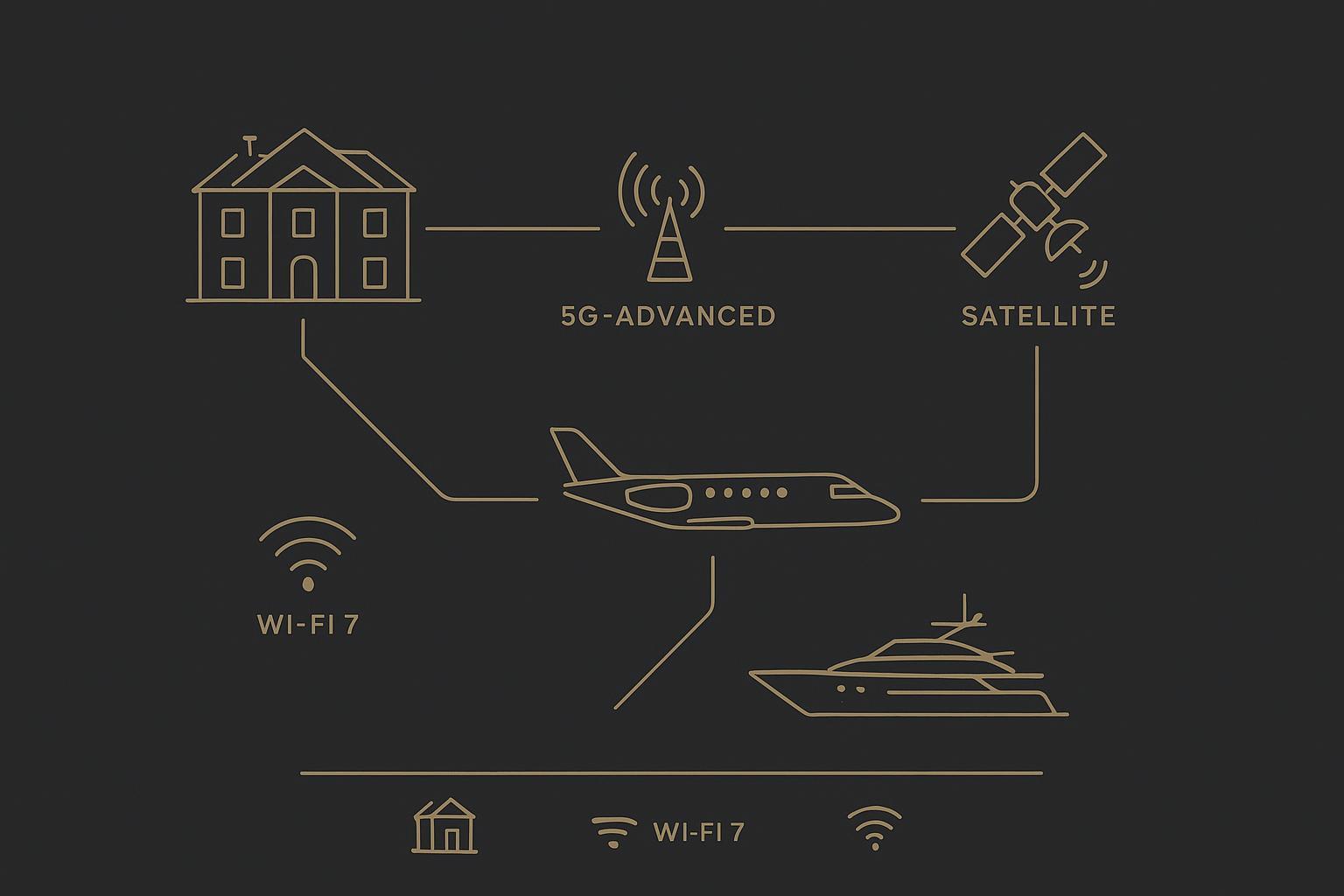
5G-Advanced and Wi‑Fi 7 readiness
In 2026, connectivity isn’t “fast internet.” It’s continuity across environments.
5G-Advanced (the evolution of 5G beginning with 3GPP Release 18) is described by network vendors as the next step in 5G capability expansion (see Nokia’s overview of 5G-Advanced standards and Ericsson’s 5G Advanced explainer).
Wi‑Fi 7 is defined by IEEE 802.11be; practical benefits come from better capacity and responsiveness in dense environments.
For the buyer, “readiness” means the device supports the right bands and radios and the software handles switching without drama. The best network is the one you don’t have to think about.
Satellite messaging coverage
Satellite messaging is no longer a marketing stunt. It’s a legitimate resilience layer—especially for emergency or low-coverage situations.
But coverage is not uniform, and capability differs:
Some implementations focus on emergency use only.
Others support limited messaging.
Plans, regions, and device partnerships vary.
A luxury buyer should treat satellite as a fail-safe, not a primary channel. You want it there when nothing else is.
eSIM, UWB, and global travel
For frequent global travel, the luxury advantage is less “new feature” and more “fewer failure modes.”
eSIM reduces dependency on physical SIM handling and makes multi-region provisioning cleaner.
UWB enables precise proximity features (keys, access, tracking) where supported.
Together, they can simplify travel setups where multiple numbers, devices, and access credentials need to coexist.
Security foundations
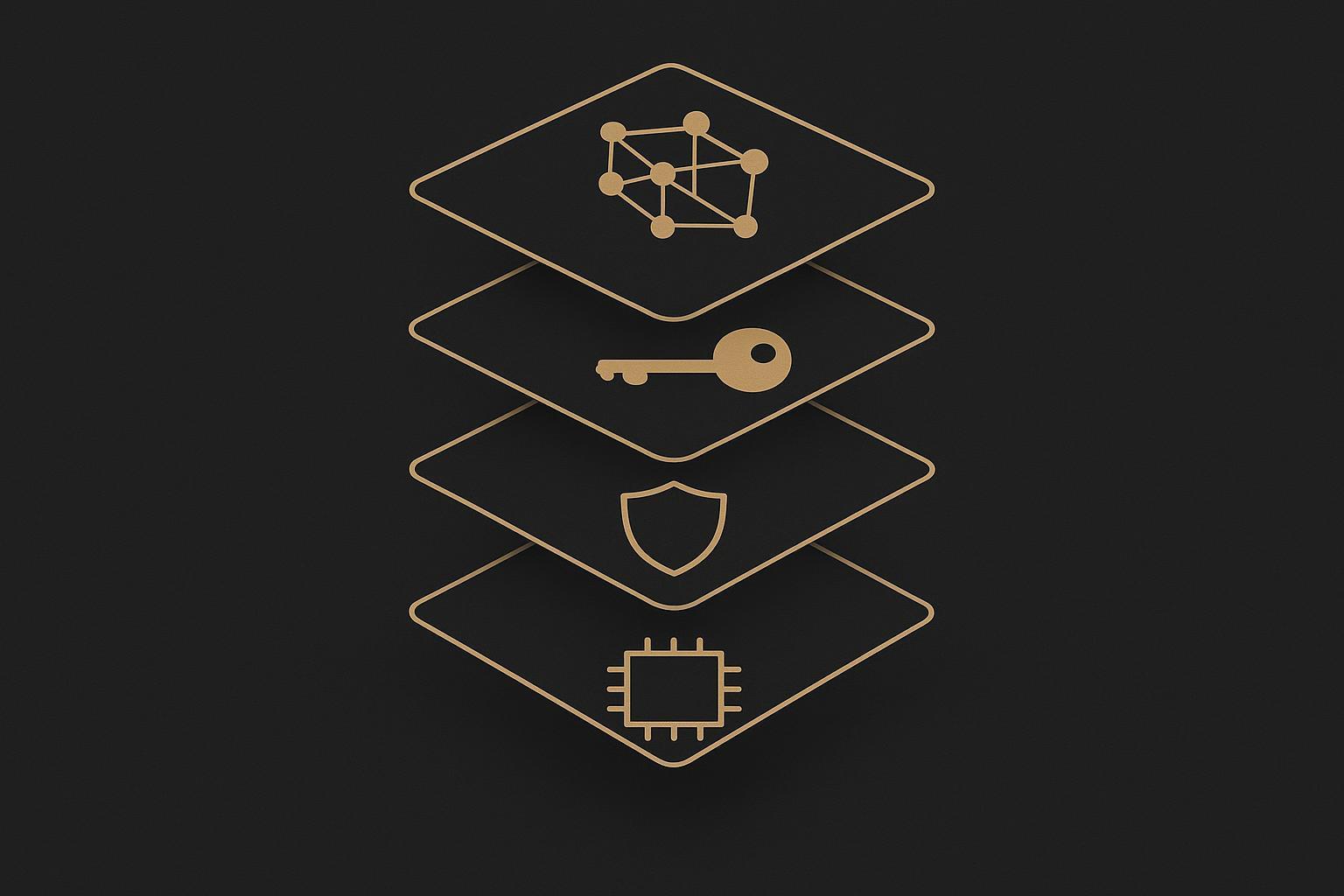
Security, in luxury, is not a single feature. It is a layered system designed to fail gracefully.
Hardware root of trust and enclaves
Start with the base layer: a hardware root of trust. In plain terms, it’s the device’s immutable anchor for secure boot and integrity—what allows the phone to verify that the software running at startup is authorized (see Synopsys’ overview of hardware root of trust).
Above that sits an isolated security domain—often described as a secure enclave or trusted execution environment (TEE)—where sensitive operations and secrets can live even if the main OS is compromised (see Evervault’s definition of a Trusted Execution Environment (TEE)). This is where biometrics, key material, and attestation tend to matter.
A practical buyer question: If malware compromises the main OS, what still stays protected—and how? Strong answers reference isolation, secure boot chains, and hardware-backed keys, not vague “military-grade” phrasing.
How to verify: Ask whether the device supports hardware-backed key storage and attestation, and whether critical authentication secrets ever leave the secure boundary.
Passkeys and strong authentication
Passwords are fragile because they’re shareable and phishable. Passkeys are built to remove that weakness by using public-key cryptography: the private key stays on your device and is unlocked by biometrics or a PIN.
They are standardized through the approach described by the FIDO Alliance passkeys standard and are designed to be phishing-resistant because the credential is bound to the legitimate service.
For luxury buyers, passkeys matter because they reduce the most common compromise path: an executive credential captured on a convincing fake login page.
PQC trajectory and future-proofing
Post-quantum cryptography (PQC) is no longer theoretical planning. In August 2024, NIST released its first finalized post-quantum encryption standards, which effectively starts the clock on migration.
A sensible 2026 expectation is not “the phone is quantum-proof,” but “the security architecture is crypto-agile.” In practice, that means:
Long-term keys and secure update systems are designed to swap algorithms.
Vendors acknowledge the transition timeline and have a roadmap.
Sensitive workflows can be upgraded without replacing the entire device.
Luxury buying playbook
Decision criteria that matter
If you want a single way to judge luxury smartphone technology 2026—without getting distracted by spec sheets—use these criteria:
- Privacy posture of AIon-device by default for sensitive content; explicit consent for cloud escalation.
- Resiliencewhat works offline; what works under weak coverage; what happens when a service is down.
- Materials that age wellsurfaces that maintain integrity, not just shine on day one.
- Security layeringhardware root of trust, isolated enclave/TEE, phishing-resistant auth, and a PQC roadmap.
- Service and support realitywarranty clarity, global service pathways, and how fast a human resolves edge cases.
Scenario-based recommendations
Use scenarios to keep yourself honest:
Cross-border travel week (multiple time zones, rapid SIM changes): prioritize eSIM management, Wi‑Fi 7 stability, and a credible satellite fail-safe.
Sensitive communications (deals, legal, family office): prioritize on-device AI paths, enclave-backed keys, and passkeys.
High-wear ownership (multi-year use): prioritize titanium/ceramic/sapphire choices, and service terms that assume you’ll keep the device.
Concierge ecosystem and services
This is where luxury separates from “premium.” The phone is the object; the ecosystem is the experience.
For HNWIs, the most valuable feature is often the one that doesn’t look like a feature: a discreet human layer that can handle complexity when automation shouldn’t.
A concierge-grade ecosystem can cover:
Multi-leg travel changes handled quietly, across time zones
Access and reservations managed with context and preference memory
That is the lens through which VERTU tends to make sense: not as a specs race, but as a secure, crafted portal into a service relationship—anchored by VERTU Concierge and supported by the broader VERTU services ecosystem.
The buying advice here is simple: if you’re paying for rarity and support, verify the support. Ask how requests are handled, what discretion policies look like, and what the global service pathway is when you’re not near a flagship city.
Conclusion
Luxury in 2026 is defined less by headline specs and more by four quiet pillars: discreet AI that stays local when it should, premium materials that age well, resilient connectivity that follows you, and a security architecture that is layered and upgradeable.
Use this playbook to choose flagships built to last—and to avoid “premium” devices that look impressive until conditions become imperfect.
Next step: If you’re evaluating at the ultra-luxury tier, prioritize a short private consultation and ask to see the security model, service terms, and materials provenance in writing.
Disclosure: This article references VERTU pages. Editorial judgment remains the priority.
![How to Scan Receipts and Documents with Your Phone [Full Guide]](https://cdn.sanity.io/images/e0gp1l2g/production/0db13feec1d5e72b8a8a5f976d1f3e86619c9228-3840x1860.webp?w=180&h=180&q=78&auto=format&fit=crop)
![How to Scan Receipts and Documents with Your Phone [Full Guide]](https://cdn.sanity.io/images/e0gp1l2g/production/0db13feec1d5e72b8a8a5f976d1f3e86619c9228-3840x1860.webp?w=800&h=450&q=82&auto=format&fit=crop)
![Top 10 Two-Tone Carbon-Fibre Watches for Men [2026 List]](https://cdn.sanity.io/images/e0gp1l2g/production/18870799ba33fab0e038968359cd5772d7d7db30-1024x576.webp?w=800&h=450&q=82&auto=format&fit=crop)
![Top 10 Luxury Watches with Digital Complication Displays for Men [Latest]](https://cdn.sanity.io/images/e0gp1l2g/production/c4f6bf8c080f291c39f7cc85c7344ecff2fd3799-1024x553.webp?w=800&h=450&q=82&auto=format&fit=crop)