


Introduction
Mobile phone privacy protection tips work best when they’re treated like a quick audit, not a lifestyle change.
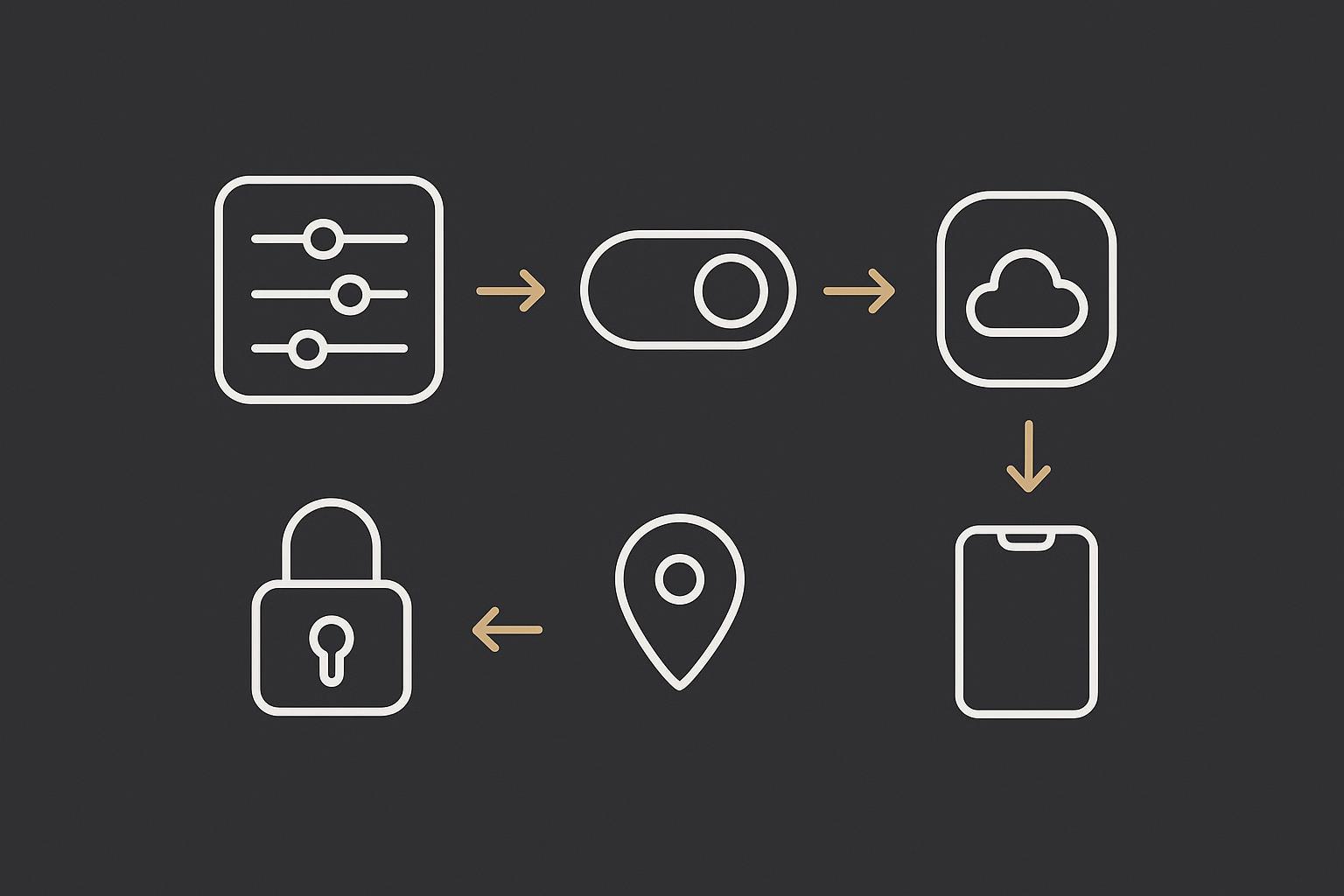
If you only do five things, make them these mobile phone privacy protection tips: tighten permissions, cut tracking, harden account access, secure backups, and prepare for loss/theft.
Your phone leaks data in quiet, ordinary ways: an app that keeps location access “always,” a browser that shares your IP address with trackers, a backup setting you never revisited, a SIM that can be socially engineered at the carrier.
The good news is that mobile phone privacy protection tips don’t have to start with new apps or extreme lockdowns. A few small setting changes can cut exposure quickly—often in minutes.
In this guide, you’ll get a cross-platform sequence: first, an iPhone privacy setup pass; then an Android privacy setup pass; and finally, a travel-focused threat check for public networks, SIM risks, and high-scrutiny situations.
For deeper reading and OS-level specifics, the Electronic Frontier Foundation’s guides for iPhone and Android privacy settings are excellent references.
Key TakeawayPrivacy improves fastest when you reduce three things: unnecessary permissions, unwanted tracking, and account takeover paths.
iPhone privacy setup
A simple rule: start with what leaks by default (permissions and tracking), then harden what attackers target (accounts and recovery).
Permissions and tracking controls
Start with the settings that decide what your apps can see.
In Settings → Privacy & Security, review the big three first—Location Services, Photos, and Microphone/Camera—and tighten anything that doesn’t clearly earn its access.
A practical standard:
Location: “While Using the App” for maps and ride-hailing; “Never” for most everything else.
Photos: “Limited Access” unless an app truly needs your entire library.
Microphone/Camera: deny by default; grant only when the app’s purpose requires it.
Then address ad tracking.
In Settings → Privacy & Security → Tracking, turn off “Allow Apps to Request to Track.” This doesn’t make you invisible, but it does remove a major consent layer many apps use to follow you across other companies’ apps and websites.
Finally, in Settings → Privacy & Security → Apple Advertising, disable personalized ads.
Passkeys, 2FA, and encrypted backups
If you’re choosing where to spend effort, spend it here. Most privacy failures start as account failures.
Prefer passkeys when they’re offered. They’re designed to be phishing-resistant compared to passwords.
Enable two-factor authentication (2FA) on your Apple account and remove any unfamiliar “trusted devices.”
Backups are the tradeoff that matters.
Cloud backups are convenient, but your risk becomes “What happens if my account is compromised?”
Local encrypted backups (to a Mac/PC) reduce cloud exposure, but they shift the risk to “What happens if I lose the backup password or the device storing it?”
If you enable stronger encryption modes (for example, iCloud’s end-to-end options where available), do it only after you’ve made recovery explicit: recovery key, recovery contact, and a plan that doesn’t depend on a single phone number.
Collector’s note: The more you harden backups and recovery, the more your process matters. A secure setup without a recovery plan is just a delayed outage.
Find My, Stolen Device Protection, Safety
The moment your phone is out of your hands, privacy becomes physical.
Enable Find My (Settings → your name → Find My). It’s how you locate, lock, or wipe a missing device.
Turn on Stolen Device Protection (where available) so sensitive account changes require stronger verification and can add protective delays. See the EFF’s iPhone privacy and security settings guide for the broader context around Safety Check and sharing controls.
Use Safety Check if you need to review sharing and access quickly—especially after a loss, a suspicious login, or a situation where you want to reset who can see what.
Android privacy setup
If you use multiple Android devices (or switch brands often), aim for settings that are portable: permission discipline, account security, and network hygiene you can repeat anywhere.
Permission Manager and ad ID controls
Android gives you granular control, but only if you use it.
Open Settings → Privacy (wording varies by device) and go to Permission Manager. Review permissions by category—Location, Camera, Microphone, Contacts, Photos/Files—and downgrade anything that feels like “nice to have.”
Then deal with ad identifiers.
In modern Android builds, you can delete the advertising ID (AAID). That reduces the stability of ad-based profiling across apps. Expect tradeoffs: some ad-funded apps may become more repetitive or ask you to re-consent.
A quick permission mindset that holds up:
“Ask every time” is excellent for one-off access (camera, mic) when you don’t want a permanent grant.
“Allow only while using” is often the right balance for location.
Private DNS, Wi‑Fi, and Bluetooth hygiene
Network metadata is a privacy leak even when the content is encrypted.
On Android, enable Private DNS (Settings → Network & Internet → Private DNS on many devices). This encrypts DNS lookups and can reduce certain kinds of network-level tracking.
Then clean up the radio habits that quietly expose you:
Turn off Wi‑Fi auto-join for networks you don’t trust.
Disable Bluetooth when you don’t need it—especially in crowded, high-churn environments like airports.
If your device supports it, disable 2G to reduce exposure to older-network risks.
Pro TipMake a “Travel” quick-settings tile set (Wi‑Fi, Bluetooth, hotspot) so you can change posture in seconds, not menus.
Find My Device and secure backups
Android’s equivalents matter for the same reason: you can’t protect what you can’t recover.
Enable Find My Device and theft protections (menu names vary by version). This is your route to remote lock and wipe.
Review backup settings carefully. Convenience is high, but confidentiality depends on what you back up and how your account is protected. For a careful walkthrough, see EFF’s Android privacy and security settings guide.
A clean approach for high-sensitivity users:
Back up what you can’t replace.
Keep your authenticator/passkey recovery separate from your phone number.
Treat your primary email account as a “root key” and harden it accordingly.
Travel and modern threats
Public Wi‑Fi, charging, and nearby sharing
When you travel, the threat model changes: you’re tired, rushed, and surrounded by networks you don’t control.
- Public Wi‑Fiassume monitoring is possible. If you must use it, limit activity (no account recovery, no financial logins) and prefer cellular data for sensitive sessions.
- Public charginguse an AC outlet with your own adapter, or a power bank. Rutgers IT’s travel guidance on public charging risks (2025) summarizes practical mitigations.
- Nearby sharing / quick-share featuresset them to “contacts only” or disable them when you’re moving through crowded areas.
SIM‑swap, phishing, and eSIM hygiene
Two modern realities:
Your phone number is still treated as identity.
Attackers know it.
A SIM swap attack is designed to steal your number so the attacker can intercept SMS-based verification codes and reset accounts. Proofpoint’s SIM swapping prevention guide is blunt about the best mitigation: reduce reliance on SMS as a security factor.
On both iOS and Android, you can also reduce the blast radius by using authentication methods that don’t depend on your phone number in the first place (passkeys, authenticator apps, and—in higher-risk cases—hardware security keys).
Practical steps:
Move critical accounts to passkeys or authenticator-based 2FA where possible.
Add a carrier account PIN and ask about a port-out freeze.
Treat unexpected “Your account was locked” texts as suspicious. Don’t click; navigate to the service directly.
For eSIM, the hygiene is simple but strict:
Keep carrier support numbers and account details stored securely (not only in your email inbox).
Avoid leaving screenshots of QR codes or activation details in your photo library.
Borders, Lockdown Mode, and data minimization
Border crossings and high-scrutiny environments are about minimizing what’s on the device, not just hiding it.
If you’re at unusually high risk of targeted attacks, consider iPhone Lockdown Mode—but treat it as a deliberate choice with tradeoffs. Apple’s own page, Apple Support: About Lockdown Mode, lists the restrictions (Messages attachments, some web technologies, certain connection behaviors).
Data minimization that works on both platforms:
Travel with fewer apps.
Sign out of accounts you don’t need on the road.
Keep a separate, encrypted note of recovery steps that does not depend on your phone number.
This is also where a discreet concierge can matter—quietly and operationally. For VERTU clients, a concierge-style workflow can help preconfigure “travel profiles” (which accounts and apps are active), stage a recovery kit (carrier PINs, device identifiers, remote-wipe steps), and coordinate an emergency response plan if a device is lost—without turning your privacy posture into a public performance. If you want a reference point for how VERTU frames security and support, see VERTU and its overview of information security protection services.
Conclusion
The highest-impact changes are rarely exotic. You tightened:
app permissions (especially location, photos, microphone, camera)
tracking and ad identifiers
account takeover paths (passkeys/2FA) and backup choices
theft recovery posture (Find My / Find My Device)
travel-specific exposure (public Wi‑Fi, charging, SIM swap risk)
A simple 15‑minute plan to recheck settings quarterly:
Review your top 10 apps’ permissions.
Confirm tracking/ad personalization is still off.
Verify Find My / Find My Device is enabled and reachable.
Check your backup posture and recovery settings.
Before travel, switch into “Travel mode”: fewer radios, fewer accounts, fewer surprises.
Disclosure: This article references VERTU pages. Editorial judgment remains the priority.
![How to Scan Receipts and Documents with Your Phone [Full Guide]](https://cdn.sanity.io/images/e0gp1l2g/production/0db13feec1d5e72b8a8a5f976d1f3e86619c9228-3840x1860.webp?w=180&h=180&q=78&auto=format&fit=crop)
![How to Scan Receipts and Documents with Your Phone [Full Guide]](https://cdn.sanity.io/images/e0gp1l2g/production/0db13feec1d5e72b8a8a5f976d1f3e86619c9228-3840x1860.webp?w=800&h=450&q=82&auto=format&fit=crop)
![Top 10 Two-Tone Carbon-Fibre Watches for Men [2026 List]](https://cdn.sanity.io/images/e0gp1l2g/production/18870799ba33fab0e038968359cd5772d7d7db30-1024x576.webp?w=800&h=450&q=82&auto=format&fit=crop)
![Top 10 Luxury Watches with Digital Complication Displays for Men [Latest]](https://cdn.sanity.io/images/e0gp1l2g/production/c4f6bf8c080f291c39f7cc85c7344ecff2fd3799-1024x553.webp?w=800&h=450&q=82&auto=format&fit=crop)