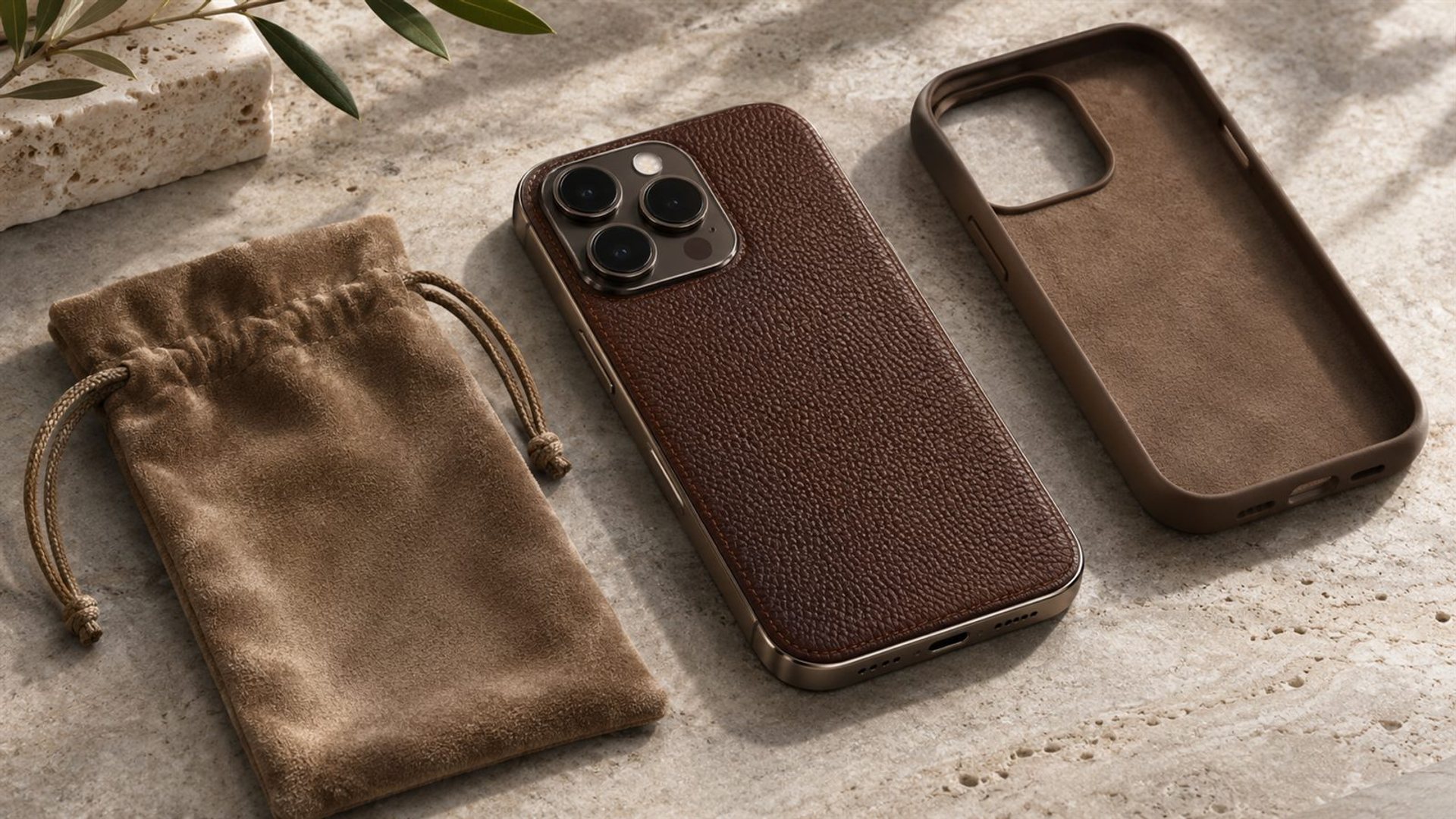
Leather phone pouch vs case: a pouch is often the simpler answer to scuffs during transport, while a fitted case stays on the phone during use. Neither is automatically safer for an expensive leather finish. A rough lining, tight fit, trapped grit, or damp storage can turn either accessory into the source of wear. Start with the exact handset and finish, then choose for the way it is carried.
What is the difference in protection?
A pouch surrounds the phone only while it is put away. It separates the exterior from keys, bag hardware, coins, and the lining of a briefcase. The benefit disappears the moment the handset comes out. A case stays attached and may cover exposed edges, but it also sits against the leather for hours. The material and pressure of that contact matter more than the word “protective” on a listing.
Think of three different risks: surface abrasion, impact from a fall, and exposure to moisture or heat. A soft barrier may help with abrasion without changing the result of a drop. A case may help with handling yet cannot be assumed to absorb impact unless its maker has tested it for that precise phone. Neither accessory is a substitute for secure handling.
When is a pouch the more sensible choice?
Choose a pouch when the principal problem is contact during travel. A phone loose in a bag is repeatedly moved against hard objects. A smooth, clean inner surface creates a separation layer. That is particularly useful for a distinctive leather back that the owner wants to leave visible when using the device. The pouch should let the phone slide in without forcing its corners or rubbing raised trim.
Inspect the inside, not only the outside. Stiff seams, exposed zip teeth, coarse fabric, loose dye, and accumulated sand can mark a finish. A drawstring that compresses a corner or a magnetic clasp that presses against a detail is another reason to reject an otherwise attractive design. Test an accessory gently and stop if insertion requires pressure. A pouch that is too roomy can let the phone tumble; one that is too narrow makes every retrieval an abrasion event.
There is also a practical cost. A pouch requires two-handed retrieval in some situations and leaves the device bare while you take a photograph, call, or type. If the phone is constantly in and out, that handling may outweigh the benefit of protected storage. For a short move between a car and a meeting, the trade-off differs from a day spent opening the phone dozens of times.
When might a fitted case be better?
A case suits a person who wants a continuous layer around edges during ordinary handling. It may add grip and reduce contact with a tabletop if its geometry is compatible. Those are possible design benefits, not verified performance claims about every case. For a rare-leather phone, fit is unusually important: a generic shell can press on curved surfaces, seams or decorative hardware, and a hard inner face can trap particles against the finish.
Check camera, port, button and screen clearance on the exact model and version. Check that the case neither rocks nor requires force to attach. Ask the manufacturer whether the liner is suitable for contact with finished leather and whether any adhesives, dyes, or plasticisers can migrate. If a seller cannot identify the compatible handset precisely, the risk of poor fit is material. Do not buy on a shared screen size alone.
Remove a removable case periodically, following the case maker's directions, to inspect for grit and moisture. If removal itself pulls on leather or trim, stop and ask the phone maker for guidance. A rigid cover that is difficult to take off could preserve the outside from bag contact while creating wear beneath it. This is why a case should be judged as an interface with the phone, not as an abstract protection grade.
Does rare leather change the decision?
Yes. Leather is a natural material with a finished surface, and different skins and finishes do not respond identically to friction, liquids, heat, or light. The Canadian Conservation Institute's leather guidance explains how environmental conditions and handling affect leather collections. Museum guidance is useful for understanding material risks; it is not a cleaning prescription for a modern phone.
Likewise, Hermès leather care guidance concerns its own goods. The broad lesson is to avoid casual exposure to moisture, heat, and harsh treatment; it does not tell us which cream or cleaner is safe for a VERTU finish. Do not apply conditioning oils, polish, alcohol, or water to an unfamiliar handset finish on the assumption that “leather care” is universal. Obtain model-specific care instructions first.
Enclosed storage raises another question: is the phone dry and cool when it enters the pouch? A phone that feels warm after charging or navigation should be allowed to cool in a suitable place before prolonged enclosure. If the pouch becomes wet, take the phone out and follow the manufacturer's care advice. Do not seal moisture against leather in the hope that a cover will shelter it.
How does this apply to the METAVERTU Curve?
VERTU lists METAVERTU Curve variants in rare leathers, including alligator and calfskin. The Race Track alligator product page identifies a specific alligator-skin finish. That makes the exact configuration relevant: a case suitable for a different Curve finish or another VERTU model should not be presumed compatible with this one.
These official pages establish the product and material category. They do not publish a universal impact rating for third-party accessories, a list of approved pouch linings, or a promise that a covering will prevent patina. Treat this as a purchase checklist: confirm your precise version, ask VERTU which contact materials and fit are recommended, and inspect how the proposed accessory meets the phone's raised and curved details. The maker's current instructions should govern cleaning and aftercare.
Which option fits your routine?
For a handbag or briefcase with keys and metal fittings, a clean, separate pouch is often a reasonable first step. For frequent one-handed use, a well-fitted case may be more convenient, provided the phone maker confirms compatibility with the finish. For a carefully managed pocket with no other objects, an owner may prefer neither; that choice accepts more exposed contact in exchange for the original feel and appearance.
Travel adds changes in temperature, crowded surfaces, and faster retrieval. Consider whether the pouch is easy to open without dropping the phone and whether a case makes the handset harder to hold. At a desk, place the phone on a clean, dry, stable surface rather than assuming a sleeve solves every contact problem. A useful accessory should reduce the dominant risk in the owner's actual day, not merely look protective in a product photograph.
If the phone is already marked, do not cover damage and forget it. Photograph the condition, identify whether the mark is on the finish, trim, or accessory contact point, and consult VERTU or an authorised service channel before trying a treatment. A minor-looking colour transfer may require different handling from a scratch; improvised cleaning can make both more visible.
How should you assess an accessory before buying?
Request the precise model compatibility, interior material, opening dimensions, closure type, and return terms. Ask for a photograph of the inside. For a case, ask how it is installed and removed, whether it contacts leather continuously, and what protects the phone from trapped debris. For a pouch, ask whether the lining sheds, bleeds colour when damp, or has exposed stitching or hardware. These questions are more informative than a generic “luxury” label.
On arrival, examine the accessory before putting the phone inside. Run a clean fingertip around seams and edges; check for loose particles. Try the fit slowly over a clean surface. If pressure is needed, return it. Recheck after a short period of ordinary use for transfer, impressions, or grit. The test is an ownership precaution, not a guarantee that the accessory will remain safe indefinitely.
Frequently asked questions
Can a pouch prevent a cracked screen?
No pouch should be assumed to prevent a crack. It may separate the device from hard objects during transport, but a fall or compression can still damage the screen. Look for product-specific impact evidence if drop protection is the priority.
Will a fitted case damage leather?
It can if the fit is tight, the lining is abrasive, or debris is trapped. A properly compatible case may avoid those problems, but suitability depends on the exact finish and design. Ask VERTU for model-specific advice.
Should I clean leather before placing it in a pouch?
Keep the phone free of loose grit and dry, but do not apply a cleaner without approved instructions. Leather treatments designed for other goods may alter a phone's finish or surrounding components.
Is bare pocket carry ever reasonable?
Yes, if the owner accepts the greater exposure and uses a clean, otherwise empty pocket. A pouch or case is a decision about particular risks and convenience, not a universal requirement.
Conclusion
Choose a pouch to separate a leather phone from other objects while it is carried; choose a verified compatible case when an attached layer matters more. Inspect fit, lining and the exact handset before either choice. The best accessory is the one that reduces your real source of wear without creating sustained pressure, trapped grit or moisture against the finish.