

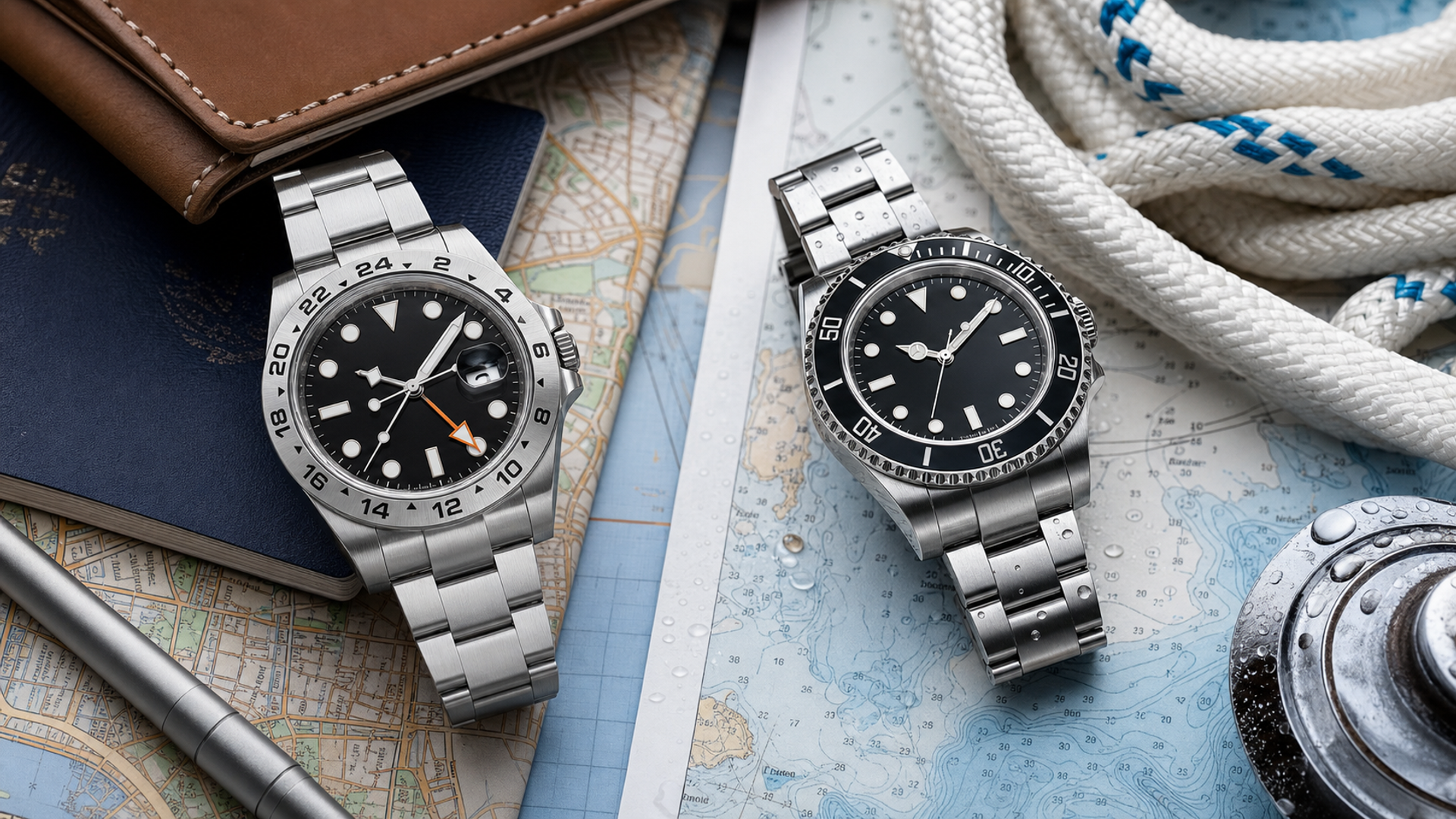
Choose a GMT watch if you cross time zones often enough to use a second time display every week. Choose a dive watch if your life asks more of water resistance, instant elapsed-time timing and a simple, highly legible dial. For most frequent flyers, GMT is the more useful complication; for a one-watch owner who swims, sails, hikes or treats a watch as daily equipment, the dive watch is usually the more forgiving choice.
That direct answer is more useful than declaring one category universally “better”. Both began as professional tools, both have become luxury-watch staples, and both can be engineered for serious daily use. The real difference is the information available at a glance: a GMT watch answers what time is it somewhere else? A dive watch answers how much time has passed?
The best choice therefore starts with a week in your life, not a prestige hierarchy.
The functional difference in one minute
A full traveller-style GMT watch combines the normal 12-hour display with a hand that circles the dial once every 24 hours. On designs such as the Rolex GMT-Master II, the conventional hour hand can be moved in one-hour steps without disturbing the reference-time hand. That makes arrival practical: move local time forwards or backwards, leave home time intact, and keep the minutes running.
A rotating 24-hour bezel can add another reference. With the bezel centred, the 24-hour hand may show home time. Rotate the bezel and the same hand can be read against an offset scale for a third location. The exact operation varies by movement, so “GMT” on a dial does not automatically mean independent local-hour adjustment.
A dive watch replaces that travel interface with an elapsed-time one. Its bezel carries a 60-minute scale and normally turns in one direction. Align the zero marker with the minute hand and the bezel shows how many minutes have passed. The one-way action is a safety convention: if the bezel is knocked, it should indicate more elapsed time rather than less. The public abstract for ISO 6425:2018 describes divers' watches as designed for at least 100 metres and equipped with a secured, darkness-readable system for measuring dive time. A watch can be water-resistant without being represented or certified as a diver's watch.
GMT watch vs dive watch: the decision matrix
| Decision factor | GMT watch | Dive watch | Advantage |
|---|---|---|---|
| Crossing time zones | Displays reference time; a traveller GMT makes local-hour changes easy | Requires mental calculation or resetting the main display | GMT |
| Calling another country | Home/office time remains visible | No second display unless added digitally elsewhere | GMT |
| Timing parking, cooking or meetings | Possible, but a 24-hour bezel is less intuitive for minutes | 60-minute bezel is immediate and visual | Dive |
| Swimming and water use | Entirely model-specific; some are highly water-resistant | Category is designed around water, legibility and timing | Dive |
| Dial simplicity | Extra hand and scale add information | Usually fewer competing indications | Dive |
| Travel symbolism | Explicit aviation and global-time identity | Maritime and exploration identity | Personal |
| One-watch versatility | Excellent for offices, airports and international work | Excellent for active use and informal wardrobes | Depends on life |
| Setting after landing | Best traveller GMTs adjust local hour independently | Main time normally needs resetting | GMT |
| Bracelet over clothing | Model-specific | Many purpose-built designs offer extension systems | Dive |
This matrix is about category logic, not a promise about every reference. A rugged GMT may outperform a delicate vintage diver in water. A thin, elegant dive-inspired watch may be less capable than a purpose-built tool. Compare the actual case, crown, seals, bezel, movement and manufacturer's stated rating after choosing the function.
When a GMT watch is the right travel instrument
GMT earns its place when time-zone friction is a repeated problem rather than an occasional novelty. The most obvious buyer is the person who crosses two or more zones several times a month. There are subtler cases too: an executive who works between London, New York and Singapore; a parent with family abroad; a portfolio manager following an overseas market; or a traveller who wants home time visible without opening a phone at dinner.
The strongest implementation is often called a “traveller” or “flyer” GMT. Its local hour hand jumps independently while the 24-hour hand remains on reference time. The Rolex newsroom's explanation traces this architecture to the GMT-Master II introduced in 1982. Other movements instead make the 24-hour hand independently adjustable. Those “caller” GMTs can be perfectly useful for tracking a remote office from home, but they are slower to reset each time the wearer lands.
Before buying, perform three actions at the counter:
Set home time on the 24-hour display.
Move local time across midnight and confirm how the date changes.
Rotate the bezel to a third zone and explain the result without help.
If that sequence feels natural, the complication will probably become part of your routine. If it feels like arithmetic performed for its own sake, a simpler watch may bring more satisfaction.
GMT watches also carry an emotional argument. Their visual language—an arrow hand, day/night bezel and map-like scale—turns distance into something tangible. That appeal is legitimate, but it should come after ergonomic checks. Look for clear separation between the 12-hour and 24-hour hands, enough contrast to read the reference time quickly, a crown that makes local-hour adjustment positive, and a bezel that will not move too freely in daily wear.
When a dive watch is the better one-watch choice
A dive watch's greatest everyday talent is not extreme depth; it is low-friction timing. A 60-minute bezel can mark a boarding window, a connection, a presentation, a walk, a child's lesson or the time remaining on a parking meter. It works without menus, modes or remembering which hand represents which city.
The design is also optimised around legibility. The Rolex Submariner features page, used here as a familiar category example rather than a universal specification, pairs a unidirectional 60-minute bezel with a luminous display and 300-metre water resistance. The large markers and differentiated hands are not merely stylistic: they express a category built to be read quickly in poor conditions.
For an owner who swims regularly, spends weekends on boats, travels to humid climates or simply wants fewer reasons to remove a watch, that design emphasis can matter more than a second zone. A modern dive watch often pairs a protected crown, robust bracelet and strong clasp with a dial that remains coherent from a hotel lobby to a beach.
Water resistance still requires discipline. Use only the manufacturer's current rating for the exact reference. Check whether the crown is fully secured, follow service guidance, avoid operating crowns or pushers underwater unless the maker expressly permits it, and remember that seals age. A depth number is not a lifetime guarantee or a substitute for inspection before serious water use.
There is also a comfort trade-off. Purpose-built dive watches can be thick, heavy and visually assertive. A bezel designed for gloves may catch a shirt cuff. A large luminous dial can dominate a small wrist. Try the watch with the clothes and activities that define most of your year, not only under boutique lighting.
The categories overlap more than the labels suggest
The cleanest comparison is functional, but the market is full of hybrids. The TUDOR Black Bay GMT family, for example, shows how a 24-hour travel display can coexist with a stated 200-metre water-resistance rating. Conversely, some dive watches add GMT complications while retaining a unidirectional timing bezel. These designs can reduce the need to choose—at the cost of more visual information, greater thickness or a higher price.
Three labels deserve scrutiny:
GMT: confirm whether the local hour or the 24-hour hand adjusts independently.
Dive: confirm the maker's actual claim and, when relevant, certification; do not infer professional capability from a rotating bezel alone.
Water-resistant: read the exact depth and usage guidance for the reference, not the reputation of the collection.
This distinction also protects against buying the wrong version of a good idea. A frequent traveller may love the appearance of a GMT but resent a movement that requires stopping and resetting after every flight. A casual swimmer may buy far more depth capability than needed while tolerating unnecessary weight. The complication should remove friction from life, not add ritual to ownership.
Use the seven-day test before you buy
For one week, log every occasion when either function would have helped. Do not count imagined expeditions.
| Situation | Mark GMT | Mark dive |
|---|---|---|
| You checked another city's time before calling | 1 | 0 |
| You crossed a time zone | 1 | 0 |
| You timed an activity under 60 minutes | 0 | 1 |
| You entered water without wanting to remove a watch | 0 | 1 |
| You needed both functions | 1 | 1 |
Then add the ownership filters: wrist comfort, thickness under a cuff, crown operation, bracelet adjustment, dial legibility, service access and the manufacturer's water-use instructions. If GMT wins on use but every candidate feels cluttered, keep looking rather than buying the category abstractly. If dive wins but you never enter water, decide whether the timing bezel and design still justify the extra bulk.
Collectors should also separate the first-watch decision from the second-watch decision. As a sole mechanical watch, a dive model's simplicity and physical versatility often make it easier to live with. In a collection that already contains a robust everyday piece, GMT can add genuinely different information and a stronger travel identity. Our existing guide to the best GMT watches for frequent travellers is the next step once that functional decision is made; readers comparing two famous Rolex interpretations can use the narrower Submariner versus GMT-Master II guide.
Verdict: buy the instrument you will operate
For regular international travel, buy the GMT: visible reference time and independent local-hour adjustment solve a real, repeated problem. For water, rough use and quick timing, buy the dive watch: its bezel and legibility are useful far beyond the sea. If both appeal, prefer the category whose primary control you can explain and operate in seconds.
The wrong choice is not GMT or dive. It is buying a function for its mythology, then never using it.
Related VERTU reading
Sources and verification
Sources were checked for this 3 August 2026 publication package. Terms and specifications can change; recheck the linked source before acting.
![How to Scan Receipts and Documents with Your Phone [Full Guide]](https://cdn.sanity.io/images/e0gp1l2g/production/0db13feec1d5e72b8a8a5f976d1f3e86619c9228-3840x1860.webp?w=180&h=180&q=78&auto=format&fit=crop)
![How to Scan Receipts and Documents with Your Phone [Full Guide]](https://cdn.sanity.io/images/e0gp1l2g/production/0db13feec1d5e72b8a8a5f976d1f3e86619c9228-3840x1860.webp?w=800&h=450&q=82&auto=format&fit=crop)
![Top 10 Two-Tone Carbon-Fibre Watches for Men [2026 List]](https://cdn.sanity.io/images/e0gp1l2g/production/18870799ba33fab0e038968359cd5772d7d7db30-1024x576.webp?w=800&h=450&q=82&auto=format&fit=crop)
![Top 10 Luxury Watches with Digital Complication Displays for Men [Latest]](https://cdn.sanity.io/images/e0gp1l2g/production/c4f6bf8c080f291c39f7cc85c7344ecff2fd3799-1024x553.webp?w=800&h=450&q=82&auto=format&fit=crop)