

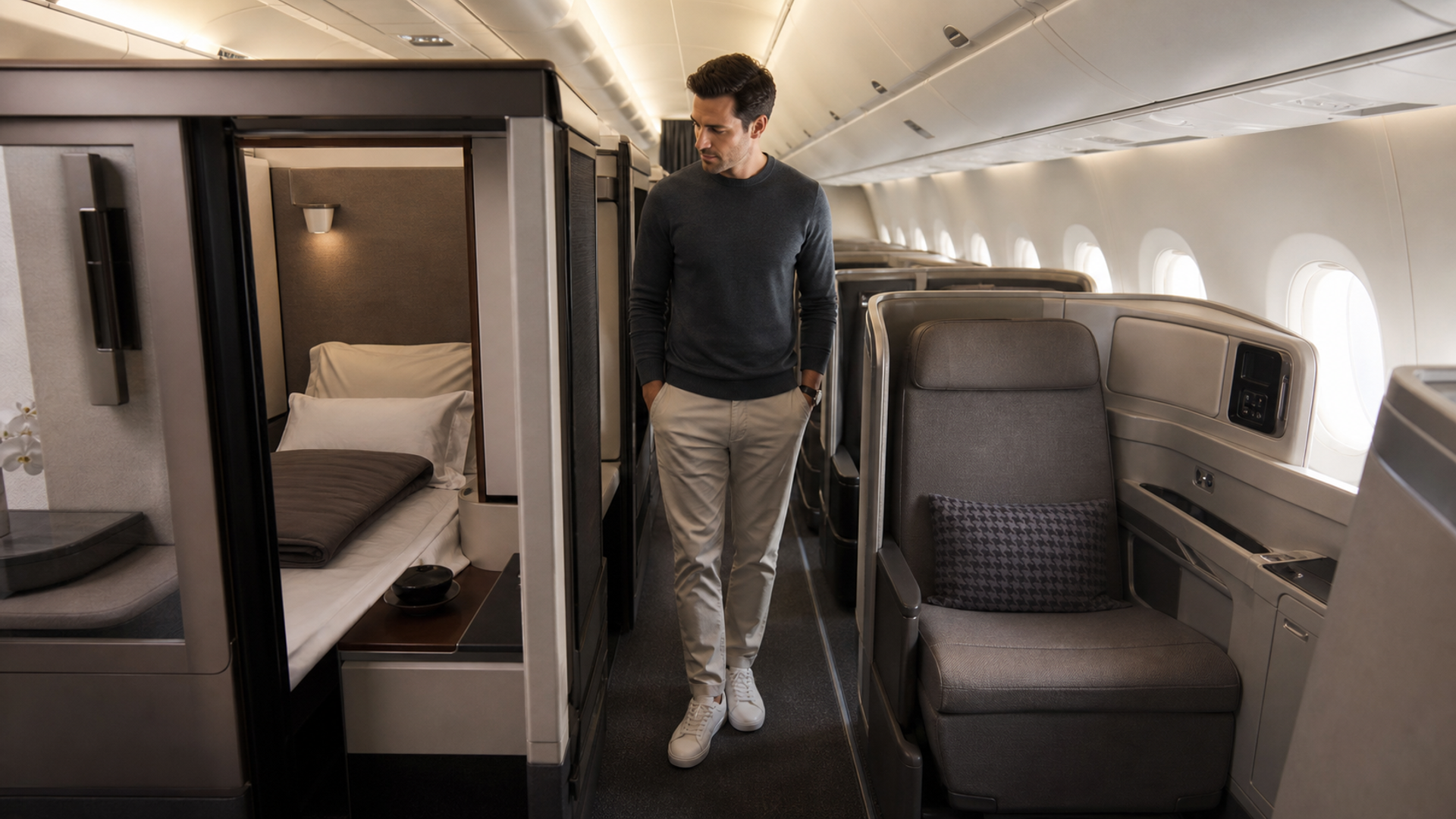
First Class is worth paying over Business Class when it changes the journey in a way you will genuinely use: a more private seat or enclosed suite, a quieter cabin, more individual service, a materially better ground journey, or enough control over sleep and arrival time to justify the fare gap. If both options provide a private lie-flat bed and direct aisle access on the same route, Business Class is usually the stronger value.
That answer sounds simple, but cabin names are not standard. “First Class” on a short domestic flight may be a wide recliner with no lounge. International First may be a separate suite with dedicated check-in and highly individual service. Business Class can range from an angled seat to a door-equipped suite. The correct comparison is therefore not label against label. It is the two products operating your exact sectors, under the exact fares available when you pay.
The short version:** buy Business Class for the bed, productive space and dependable premium journey. Buy First Class only when its extra privacy, scarce service, ground handling or schedule protection is worth more to you than the live difference in price or points.
The First Class versus Business Class decision matrix
| Decision factor | Strong Business Class | Genuine international First Class | What to verify |
|---|---|---|---|
| Sleep | Lie-flat bed, usually direct aisle access | Wider or separate bed, quieter cabin, more bedding control | Aircraft, seat map, bed length and overnight timing |
| Privacy | Shell or door on newer suites | Larger enclosed suite or exceptionally small cabin | Door does not always mean floor-to-ceiling enclosure |
| Ground journey | Priority check-in, lounge and boarding | Dedicated check-in, First lounge, escort or transfer on selected routes | Airport, departure direction and fare eligibility |
| Service | Premium but standardised sequence | Lower passenger-to-crew ratio and more individual pacing | Route length and airline operating model |
| Dining | Multi-course menu and flexible choices on leading airlines | More extensive choice, premium ingredients and greater timing control | Catering varies by station and flight duration |
| Baggage and flexibility | Depends on airline and fare brand | Often generous, but not automatically fully flexible | Exact ticket conditions, not cabin name |
| Availability | Broad on long-haul networks | Limited airlines, routes and aircraft | Every sector, including connections |
| Best fit | Travellers buying sleep and work capacity | Travellers buying space, discretion and a complete occasion | Value the usable difference, not the prestige |
First identify what “First Class” means on your route
There are at least three different comparisons hidden inside the search for “First Class vs Business Class”.
The first is domestic First versus international Business. On many short-haul networks, First is primarily a wider seat, extra legroom, priority treatment and enhanced catering. It may not convert into a bed. A long-haul Business product can be far more private and comfortable even though its label appears lower.
The second is regional First versus long-haul Business. A premium cabin on a short or medium flight may be excellent for its market but still be designed around sitting rather than sleeping. Here, schedule, airport experience and connection protection can matter more than the seat itself.
The third is international Business versus genuine international First. This is the luxury decision most readers have in mind: a lie-flat Business suite against a larger First suite, often with more elaborate ground service. Airlines such as Emirates, Singapore Airlines and Air France publish separate cabin pages, but each also warns through its booking flow or product presentation that features depend on route and aircraft. Start with the flight number and operating aircraft, then open the current seat map.
Do not assume that a codeshare uses the marketing carrier’s cabin. Confirm the operating airline. Do not assume a connection retains the same cabin. Confirm each sector. Do not assume an aircraft type guarantees one seat generation: several airlines operate multiple configurations within the same fleet.
Calculate the First Class gap per useful hour
The most practical test is to convert the upgrade gap into the time or control it may recover.
Let:
F be the total First Class fare;
B be the total Business Class fare under comparable ticket conditions;
G = F − B be the upgrade gap;
R be the number of additional useful hours First may recover through better sleep, faster ground handling or private work;
V be your personal value for one recovered hour.
The first test is:
First Class cost per recovered hour = G ÷ R
Suppose First costs US$4,800 more than Business on a long overnight sector. If the larger bed and quieter cabin are realistically likely to add two useful hours of rest, and the ground process saves another 30 minutes, the gap is US$1,920 per recovered hour. That may be rational before a critical arrival-day engagement and excessive before a holiday with no fixed morning plan. This example is a decision method, not a fare quote.
Run the calculation for each direction. The outbound may cross your normal sleep window while the return is mostly daylight. A mixed-cabin itinerary—First in the sleep-critical direction and Business on the daytime return—can preserve most of the benefit without paying twice for symmetry.
Then add benefits you would otherwise purchase: a private airport transfer, paid lounge access or an extra hotel night to recover after arrival. Subtract benefits you will not use. Champagne has no monetary value in your calculation if you do not drink it; an elaborate lounge meal has little value when you arrive 50 minutes before boarding.
Business Class has absorbed many old First Class advantages
The strongest argument for Business in 2026 is product convergence. Leading Business cabins now offer direct aisle access, fully flat beds and, on selected aircraft, doors. Qatar Airways states that Qsuite is available only on selected routes and may change for operational reasons, but where it operates the product provides enclosed suites and flexible configurations for solo passengers, pairs and groups. That narrows the practical gap with First for many journeys.
The convergence is not universal. An airline may have a celebrated new Business seat on one aircraft and an older open seat on another. A door can improve visual privacy without changing seat width, footwell space, bed firmness or noise. The useful questions are concrete:
Can you lie flat without bending your knees?
Is the footwell restrictive for your height or sleeping position?
Can you reach the aisle without stepping over another passenger?
Is there storage for a laptop, glasses and phone?
Can the meal be paced around sleep?
Does the flight depart at a time when a bed is actually useful?
When Business answers those questions well, First needs to offer more than ceremony.
What First Class can still change
A smaller, quieter cabin
A First cabin may contain only a handful of passengers. Fewer conversations, service movements and door openings can improve rest even when the Business bed is technically similar. Cabin location also matters: proximity to galleys, lavatories or stairs can erase part of the advantage.
More personal space
International First may provide a wider seat, separate bed or enough floor area to change clothes and work without constantly rearranging belongings. Singapore Airlines distinguishes Suites and First on selected aircraft and routes, while Air France positions La Première as a highly private end-to-end product on selected long-haul services. Compare the exact layout rather than assuming every First cabin resembles the airline’s flagship imagery.
Greater control over time
The meaningful luxury is often control: when to dine, when to sleep and how much interaction to have. A small First cabin can make individual pacing easier. Yet a short overnight flight may leave too little time to use a long meal and a full sleep. In that case, the most luxurious decision may be to eat in the lounge, board ready to sleep and choose the cabin with the most reliable bed.
A different airport experience
Some First products include dedicated check-in, a separate lounge, escort services or transfers between lounge and aircraft. These are not consistent across airports or directions. A home-hub departure may deliver the complete experience; an outstation may share facilities with Business passengers. Check the airline’s airport page for your departure point.
Ground benefits also depend on your schedule. A First lounge can be a destination during a four-hour connection and nearly irrelevant during a 70-minute transfer. Assign value to the time available, not to the longest list of amenities.
Fare rules can outweigh the cabin
Cabin and ticket are separate purchasing decisions. A discounted First fare can be more restrictive than a flexible Business fare. An award ticket may have different change rules, surcharges or cancellation deadlines. An upgrade may preserve the original ticket’s restrictions and may not include every ground service attached to a paid First fare.
Before comparing prices, align:
change and cancellation conditions;
no-show consequences;
baggage allowance;
lounge eligibility;
chauffeur or transfer eligibility;
mileage earning;
upgrade method and wait-list status;
connection protection across all sectors.
If plans can move, the flexible Business fare may be the more luxurious product because it preserves control. If the trip is fixed and the fare gap is unusually narrow, First may become easier to justify.
Paying with points does not make the upgrade free
Points have an opportunity cost. Compare the additional miles or points with what they could buy on another journey, and add taxes and carrier charges. A First redemption that consumes enough points to eliminate a future Business trip may not improve your annual travel as much as two comfortable Business journeys.
Availability is also part of the cost. If First requires an undesirable connection or a much worse departure time, value the extra travel hours. A direct Business flight can beat a connecting First itinerary when arrival time, baggage risk and sleep fragmentation are included.
Avoid transferring flexible points until award space is genuinely bookable and the programme’s transfer conditions are clear. Transfers are commonly irreversible. Hold functionality, ticketing speed and partner availability differ by programme.
Four journey scenarios
Overnight before a critical morning
Choose the cabin that maximises confirmed sleep. If Business provides a long, private bed and the First gap is large, Business is usually sufficient. First becomes rational when the Business footwell or cabin is likely to reduce rest and the arrival has material consequences.
Daytime leisure flight
Business commonly wins. You receive space, service and a comfortable seat, while much of First’s bed advantage goes unused. Spend the difference on the hotel, dining or an extra day unless the flight itself is the occasion.
Long connection at the airline’s hub
First can gain value through a distinct lounge and smoother transfer, but only after verifying eligibility and terminal logistics. Calculate the usable lounge time after immigration, security and walking.
Two people travelling together
Multiply the gap by two. A seemingly manageable US$3,000 upgrade becomes US$6,000 for the pair. Some Business products are particularly good for couples, while some First suites are designed for isolation. Compare the social layout as well as privacy.
The ten-minute booking check
Before paying:
Verify the operating airline and aircraft for every sector.
Open the current seat map and identify the exact seat generation.
Check whether First exists on the whole itinerary.
Compare fares with equivalent flexibility.
Calculate the gap per realistic recovered hour.
Confirm departure-airport lounge and ground-service eligibility.
Price each direction separately.
Read upgrade and award-ticket conditions.
Save the product and fare details that influenced the purchase.
Accept that operational aircraft swaps remain possible.
The verdict
Business Class is the rational default for premium long-haul travel because the best products already deliver the benefits that matter most: a flat bed, direct aisle access, workspace and a calmer airport journey. First Class earns its premium when the actual flight adds scarce space, a quieter cabin, meaningful privacy and useful ground control—not simply more elaborate service.
The correct answer is itinerary-specific. Compare the products operating your flights, align the fare rules and calculate the price per hour of rest or control that First may genuinely recover. If the number feels compelling before prestige enters the discussion, buy First. If not, choose the strongest Business seat on the best schedule and arrive with both comfort and optionality intact.
For an airline-specific example, the VERTU guide to Emirates Premium Economy versus Business Class in 2026 applies the same fare-gap logic to one live network.
Sources and verification
Qatar Airways Qsuite — suite configuration, privacy features and select-route caveat.
Emirates cabin features — current airline presentation of First and Business products.
Singapore Airlines cabins — cabin availability and aircraft-dependent products.
Verification note: Cabin products, aircraft assignments, fares, lounges, award space and fare rules are volatile. Check the operating flight and ticket conditions immediately before purchase.
![How to Scan Receipts and Documents with Your Phone [Full Guide]](https://cdn.sanity.io/images/e0gp1l2g/production/0db13feec1d5e72b8a8a5f976d1f3e86619c9228-3840x1860.webp?w=180&h=180&q=78&auto=format&fit=crop)
![How to Scan Receipts and Documents with Your Phone [Full Guide]](https://cdn.sanity.io/images/e0gp1l2g/production/0db13feec1d5e72b8a8a5f976d1f3e86619c9228-3840x1860.webp?w=800&h=450&q=82&auto=format&fit=crop)
![Top 10 Two-Tone Carbon-Fibre Watches for Men [2026 List]](https://cdn.sanity.io/images/e0gp1l2g/production/18870799ba33fab0e038968359cd5772d7d7db30-1024x576.webp?w=800&h=450&q=82&auto=format&fit=crop)
![Top 10 Luxury Watches with Digital Complication Displays for Men [Latest]](https://cdn.sanity.io/images/e0gp1l2g/production/c4f6bf8c080f291c39f7cc85c7344ecff2fd3799-1024x553.webp?w=800&h=450&q=82&auto=format&fit=crop)