

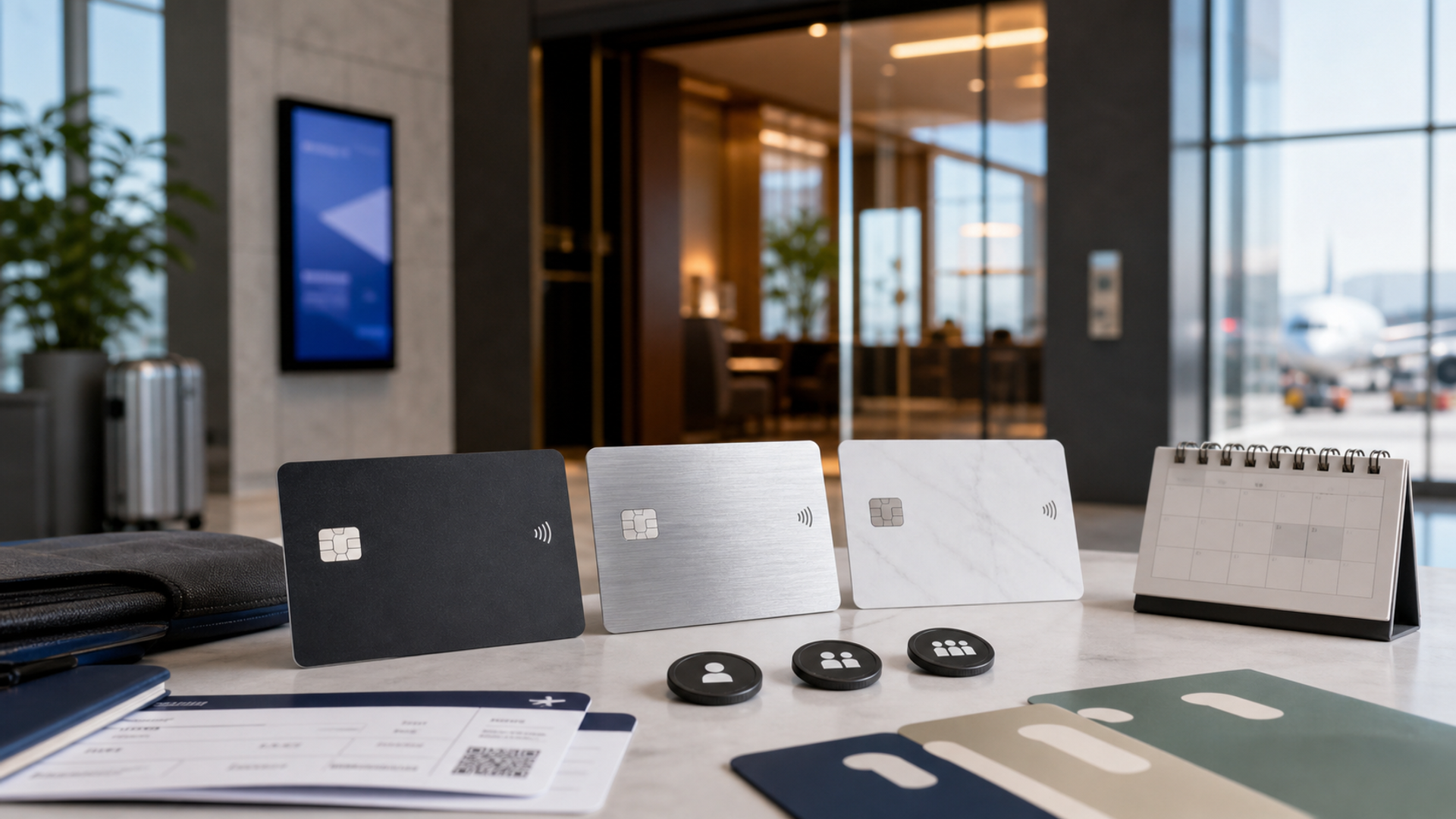
A credit card with airport lounge access is worthwhile only when its real annual value exceeds its fee and the access works at the airports, terminals and times you actually use. A headline such as “more than 1,500 lounges” is not enough. You need to know how many visits are included, what guests cost, whether entry is subject to capacity, which cardholder must be present and whether the lounge sits airside in the correct terminal.
This guide is a comparison framework, not a recommendation to borrow or apply for a particular financial product. Card terms, eligibility and benefits vary by country and can change. Check the issuer's current documents and consider independent financial advice where appropriate.
The four kinds of lounge benefit
Airport-lounge cards usually provide one of four structures.
Unlimited membership for the primary cardholder, sometimes with a guest allowance.
A fixed number of complimentary visits each membership year.
Pay-per-visit access at a published rate.
Access to an issuer's own lounges, occasionally combined with a network.
The most generous-looking structure is not always best. Unlimited access to a network absent from your home terminal has little value. A four-visit allowance may be sufficient for a traveller who takes two return trips and normally travels alone.
Confirm whether a supplementary cardholder receives a separate entitlement or shares the primary allowance.
Annual-fee and visit break-even matrix
| Your travel pattern | Visits per year | Guest pattern | Most relevant benefit | Main risk |
|---|---|---|---|---|
| Occasional solo traveller | 2–4 | Rare | Included visit bundle | Paying a high fee for unused benefits |
| Monthly solo traveller | 10–14 | Rare | Unlimited primary access | Weak coverage at regular airports |
| Couple travelling together | 8 trips | Same guest each time | Included guest or two memberships | Repeated guest charges |
| Family traveller | 4–6 trips | Two or more guests | Explicit family allowance | Child rules and capacity limits |
| Multi-airport executive | 20+ | Variable | Broad network plus issuer lounges | Terminal mismatches |
| Domestic commuter | 20+ | None | Strong home-airport presence | Impressive global count, poor local fit |
Calculate with conservative values. If you would pay £35 for a lounge only on a three-hour connection, do not value every 45-minute visit at £35.
Calculate the real annual cost
Start with the card's annual fee. Subtract only benefits you would otherwise purchase: a travel credit you can reliably use, insurance that genuinely replaces an existing policy, or rewards redeemed at a realistic value. Do not subtract the face value of every coupon.
Then add lounge-specific costs: guest visits, supplementary-card fees, enrolment charges and pre-booking. Some programmes charge the payment card after the visit, so the lounge receptionist may not state the guest price. Currency conversion can change the final amount.
Finally, include the cost of holding or using the card: interest, foreign-transaction charges and the opportunity cost of a less suitable reward structure. MoneyHelper's credit-card guide explains why rewards do not justify carrying expensive debt.
Network size versus airport fit
Network totals count lounges across the world, but a traveller uses a route. List the ten airports visited most often, then identify the terminal and whether the lounge is before or after security. A lounge in Terminal 1 is not useful for a departure from Terminal 4 if passengers cannot move airside between them.
Mastercard Airport Experiences says eligible cards can use a network of more than 1,600 lounges, but eligibility depends on the issuing card and individual lounge terms apply. Priority Pass likewise offers broad coverage, while access remains subject to availability under its current terms.
Score each regular airport as: dependable, conditional, inconvenient or absent. That route-weighted score is more informative than the global total.
Guests, children and supplementary cards
Guest wording is where many comparisons fail. “Cardholder plus guest access” may mean one complimentary guest, a guest charged at a fixed rate, or simply permission to bring a paying guest. Children may count as guests, receive a reduced rate or be admitted free below a lounge-specific age.
Check whether the primary cardholder must enter with the guest. If a partner often travels alone, a supplementary card with its own membership can be more valuable than a single card with two guest passes. Confirm whether supplementary access has the same network and visit limit.
Record guest use in the annual calculation. Eight return journeys with one paid guest can turn a seemingly low-fee card into an expensive lounge strategy.
Capacity, pre-booking and denied entry
Network membership usually does not guarantee admission. Lounges can restrict members at busy periods, prioritise airline passengers or require pre-booking for a fee. The LoungeKey conditions state that access is subject to individual lounge rules and capacity.
Consider when you travel. A weekday mid-morning user may have a very different experience from a family departing during school holidays. Search the current programme app for the exact date and terminal, and check whether the lounge accepts reservations.
Maintain a fallback: an airline lounge bought with the ticket, a quiet paid restaurant area or an airport hotel day room on a long disruption.
Lounge quality and useful dwell time
Lounge value depends on the time available after check-in, security and the walk to the gate. For a 60-minute domestic departure, the usable stay may be 20 minutes. For a four-hour international connection, showers, quiet work areas and reliable power can matter substantially.
List the facilities that replace a real cost or solve a problem: a meal, shower, secure call booth, children's area or late opening. Do not value free alcohol if you would not buy it. Read current lounge details because operating hours and facilities change.
VERTU's best airport lounges decision guide applies the same route-and-dwell-time logic to specific airports.
Compare cards without naming a universal winner
| Criterion | Weight for a solo executive | Weight for a couple | Weight for a family |
|---|---|---|---|
| Home-airport lounge coverage | 30% | 25% | 25% |
| Visit allowance | 20% | 15% | 10% |
| Guest policy | 10% | 25% | 30% |
| Annual net cost | 20% | 20% | 20% |
| International network | 10% | 10% | 5% |
| Pre-booking and reliability | 10% | 5% | 10% |
Score each card from one to five on current official terms, multiply by the weights and keep a note of the evidence date. The weighting should reflect your travel, not a publisher's affiliate economics.
Card access versus airline status
Airline status or a premium-cabin ticket may provide access to a different lounge with clearer priority, particularly at the carrier's hub. A network card is more flexible across airlines, but may use a contract lounge with capacity restrictions.
If most travel is with one alliance, compare the cost of earning status and buying the appropriate fare against the card's net fee. Do not double-count access already included in business class. The recent Emirates premium economy versus business class guide illustrates how lounge access can be one part of a broader fare decision rather than a standalone benefit.
A mixed strategy is common: card network for independent trips, airline lounge for hub departures.
Credit, eligibility and consumer protection
Reward cards often require stronger credit profiles and may carry high interest rates. Paying interest can quickly erase lounge value. Settle balances in full where that is the chosen and affordable strategy; otherwise a lounge reward should not drive the borrowing decision.
Application rules, income criteria and credit reporting differ by country. Use the issuer's eligibility checker where it does not create a hard search, read the summary box or equivalent disclosure, and understand cancellation consequences. If a lounge membership ends immediately when the card closes, do not rely on it for a trip after the renewal date.
This article cannot assess an individual's affordability, tax position or credit risk.
A five-minute pre-application audit
Write down the annual fee, renewal date, included visits, supplementary-card rules, guest price, network name and the five lounges you would use most. Open each lounge in the current app and verify terminal, hours, capacity wording and pre-booking.
Calculate a low, expected and high annual value. In the low case, assume two trips are cancelled and one lounge denies entry. In the high case, never count a visit you would not have purchased. Compare the result with a direct Priority Pass plan or pay-per-visit alternative.
If the card still produces clear value without optimistic assumptions, the lounge benefit may be a rational part of the package.
Renewal and cancellation discipline
Set a calendar reminder six weeks before renewal. Export the previous year's lounge-visit history, including guests and denied entries, then calculate realised value using what you actually used. Recheck the airports in the network because lounges and issuer partnerships can change. Compare the new fee and terms with a direct membership or pay-as-you-go access.
Before cancelling, understand what happens to reward points, insurance, supplementary cards and pending lounge charges. Move recurring payments carefully and do not close a card merely to chase a new benefit without considering credit history and affordability. A benefit that worked last year should earn its place again; it should not renew through inertia.



![Top 10 Luxury Smartwatches for Business Travel [2026]](https://cdn.sanity.io/images/e0gp1l2g/production/8b5e5b21db42a1c5f040e828bd041857353a8eb2-2560x1382.webp?w=800&h=450&q=82&auto=format&fit=crop)