When buying a transparent smartwatch, first establish which part is transparent: the case, a decorative section, the back or the display itself. Then assess the actual watch for readable information, comfortable fit and practical ownership. A clear exterior is a design attribute; it does not, on its own, establish a see-through display, a mechanical movement or a particular level of durability.
Key Takeaways
- Ask the seller to identify the transparent component on the exact model.
- Distinguish a clear case from the lens and the electronic display beneath it.
- Check the watch with its screen on and off, from several angles and on your wrist.
- Confirm care, strap fit, software requirements and service support separately from the appearance.
What exactly is transparent?
Request a component-by-component explanation rather than accepting the word transparent as a complete specification. Ask where you can see through the exterior and what you are seeing beyond it. Keep each answer attached to the exact product and configuration under consideration.
| Part being described | Question to ask | Evidence to request |
|---|---|---|
| Case | Which exterior surfaces are transparent? | Current material description and photographs from several angles. |
| Lens | What material covers the display? | The model's lens specification and care instructions. |
| Display | Is the electronic panel itself described as see-through? | An explicit display specification and an actual demonstration. |
| Back or visible interior detail | Which parts are visible, and what are they? | A labelled explanation of the view rather than an assumed function. |
This is an editorial purchasing framework, not a claim that every clear watch has all four features. It helps keep separate questions from collapsing into one attractive photograph. If the description identifies a transparent case but says nothing about a transparent display, leave the latter unconfirmed.
Separate visible construction from digital decoration
Ask which details belong to the physical object and which appear on its screen. A useful demonstration should show the same watch from the front, side and back, with the screen both active and inactive. Avoid using a change of camera angle or a different promotional image as a substitute for that explanation.
Where an image shows gears, openwork shapes or layered elements, ask whether they are actual visible parts, decoration or digital artwork. Do not infer a mechanical calibre from a watch face that resembles one. Equally, do not assume that everything seen through a clear exterior is a moving component.
For a product video, ask whether it shows the production watch, a demonstration interface or an illustrative sequence. Keep that distinction when comparing it with the written specification. An image can help you understand a description, but it should not silently add a function the manufacturer has not documented.
If transparency is your main reason for buying, decide which particular view appeals to you. The answer might be the case edges, the contrast with the strap or the presentation of the dial. That preference is useful even when the display itself is not specified as transparent.
How does VERTU Agent Watch describe its design?
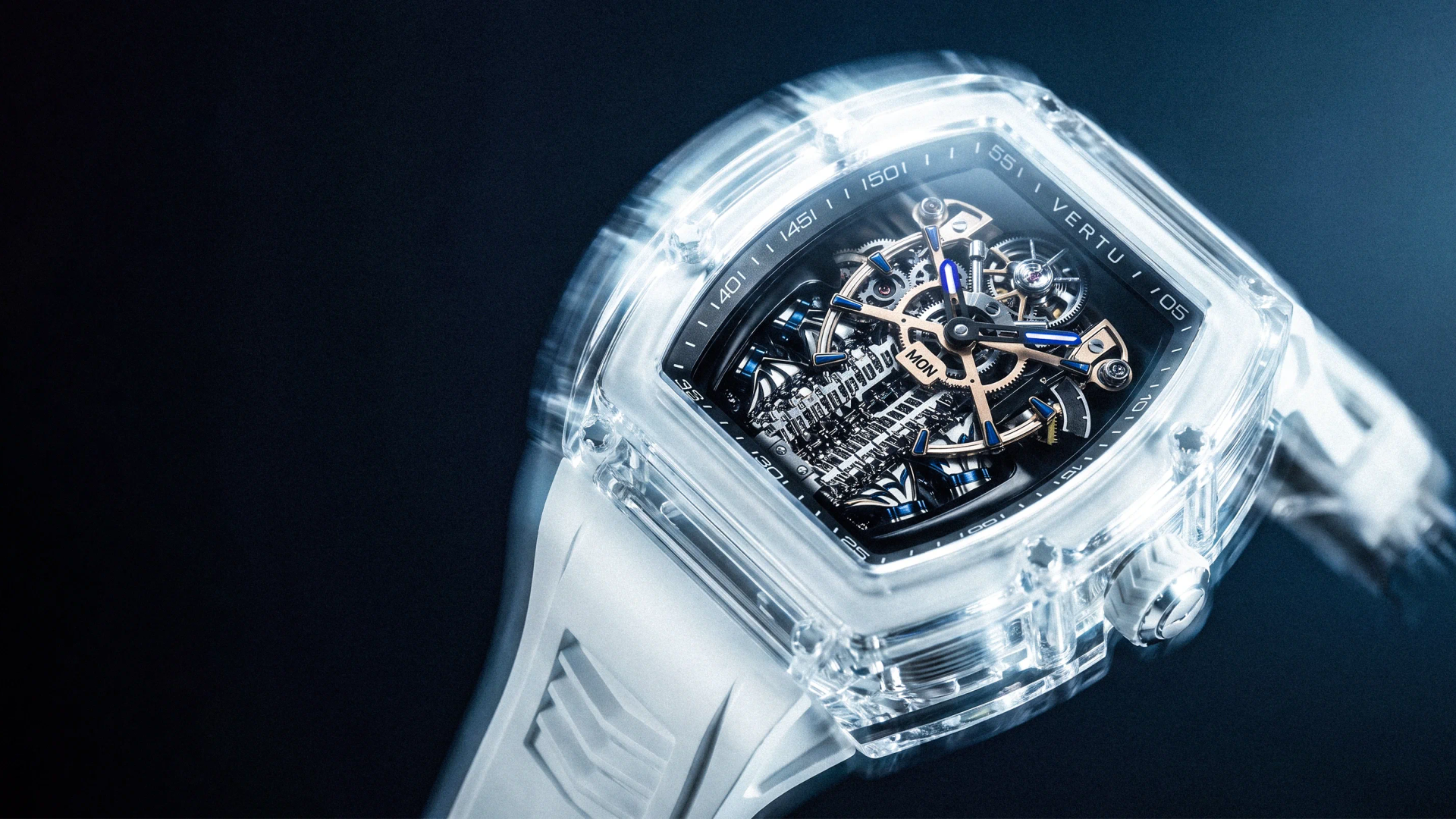
The current official description of VERTU Agent Watch identifies a hand-polished transparent crystal case with a tonneau silhouette. Its documentation separately identifies a Corning glass lens, an AMOLED display and a fluoroelastomer strap. Those are descriptions of different parts, so they should remain separate in a buying decision.
The documented watch faces are digital designs with mechanical-inspired layers and animated detail. That establishes a screen-based presentation, not evidence that the displayed gears are an exposed mechanical movement. The transparent-case description likewise does not establish that the AMOLED panel is itself see-through.
Use this example to ask precise questions about the component that interests you. Request a current view of the actual case colour and strap configuration, then check the display behaviour independently. A material name for the case should not be carried over to the lens, strap or entire watch.
This guide assesses published descriptions and purchasing questions, rather than reporting a hands-on product test. It does not establish scratch resistance, impact performance or long-term colour behaviour for Agent Watch.
Can you read the information you actually need?
Choose a few everyday items to examine during a demonstration: the time, a short notification and an ordinary menu. Ask to see them at a normal wrist distance rather than judging only a large promotional close-up. Use the face or interface you would genuinely select.
Check the viewing angles you expect to use while seated and standing. If possible, look in more than one ordinary lighting setting. The purpose is to make your own judgement about readability, not to derive a display-brightness figure or compare performance without equivalent conditions.
Ask how brightness and screen behaviour are adjusted on that model. Confirm which settings the demonstrator used, and avoid assuming that a particular presentation is the default or that it carries no battery trade-off. Any numerical brightness or battery claim needs its own applicable specification.
Decide whether the decorative face you prefer still presents the information you need clearly. If you would change to a simpler face for daily use, include that appearance in the buying decision. You are choosing the whole ownership experience, not a single screenshot.
Check the fit beyond the case photograph
Try the exact watch and strap configuration when possible. Position it as instructed by the maker, then assess the fit while sitting at a desk, bending the wrist and moving a sleeve over the case. These are suggested comfort checks, not a clinical fitting method or a product-performance test.
Pay attention to the strap's usable adjustment range, the fastening and the way the case sits on your own wrist. Ask for the model's actual dimensions and clarification of what any quoted weight includes. A clear exterior does not answer those fit questions.
If trying it on is impossible, request measurements and the applicable return or sizing policy before ordering. Do not substitute photographs of a different wrist for your own measurements. Check whether the policy covers the configuration and market in which you intend to buy.
Consider your preferred colour in relation to your normal clothing and jewellery. Ask to see the actual version beside a neutral background and on a wrist. Treat the result as a personal aesthetic judgement rather than a claim that one colour suits every occasion.
What care and support should you confirm?
Ask for the care instructions applicable to the case, lens and strap individually. Confirm the permitted cleaning method and what to do if the exterior is marked. Avoid choosing a cleaner or polishing method simply because the watch looks like another transparent object.
Request a clear service route for damage, a strap replacement or a concern about the exterior finish. Ask which parts can be inspected or replaced, who carries out the work and whether an estimate is provided before it begins. These are questions to confirm, not promises of a particular repair service.
Finally, review the smartwatch functions you expect to use. Confirm the supported phone, required app, relevant permissions and any service terms. Judge these separately from the transparent styling: a product can meet your visual preference while leaving an important practical requirement unconfirmed.
Frequently asked questions
Does a transparent case mean a transparent screen?
No. Treat them as separate claims. Request an explicit display specification and demonstration before describing the electronic panel as see-through.
Do visible gears prove that a smartwatch is mechanical?
No. Ask whether the view shows physical components or screen artwork. Agent Watch's documented mechanical-inspired faces are digital designs.
Can I assess comfort from the case material alone?
No. Check the actual dimensions, strap adjustment and position on your wrist. Use the relevant sizing and return information if a try-on is unavailable.
Conclusion
Buy the transparent smartwatch whose documented construction and everyday use match your priorities. Identify the clear component, verify the display separately and assess fit, readability, care and support on the actual model. The strongest buying decision is a precise description of what you will receive, with visual appeal and practical requirements both accounted for.