An office chair is not comfortable in the abstract; it fits a person, a desk and a pattern of movement. A celebrated chair can still fail when the seat is too deep, arms collide with the desktop or lumbar support presses the wrong point. The best purchase starts with dimensions and adjustment range, then survives a real workday rather than a five-minute showroom sit.
The short answer by body and work
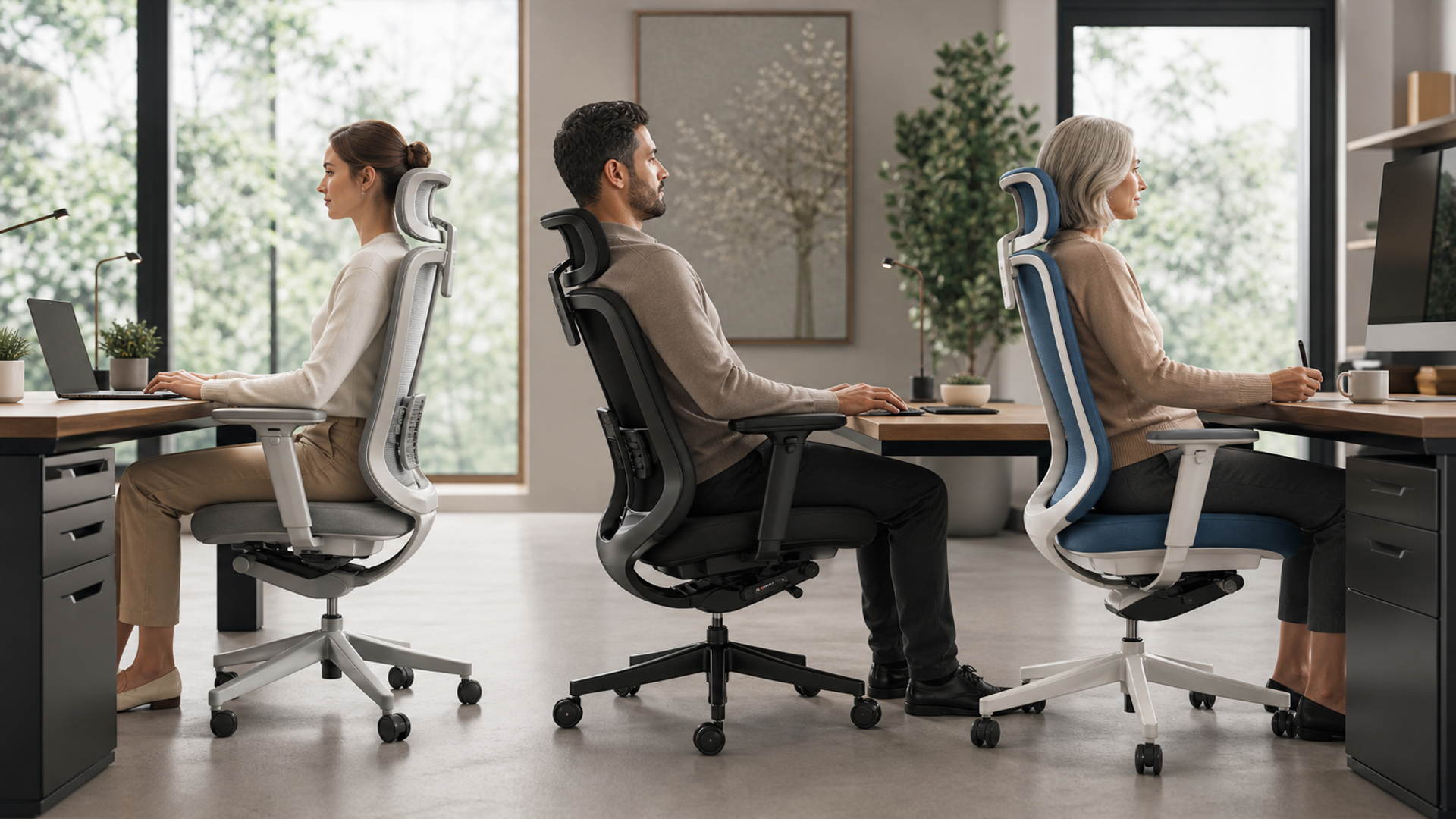
Choose a sized suspension chair when breathable support and an exact size match are priorities, an adjustable padded task chair when seat depth and broad tuning matter, or a flexible high-back chair when movement and upper-back support suit the user. Trial the exact configuration with the real desk, footwear and devices, and preserve the right to return it.
| Decision factor | Sized suspension chair | Adjustable padded task chair | Flexible high-back chair |
|---|---|---|---|
| Seat fit | A defined size matches the body | Sliding depth and foam suit varied users | Flexible seat and back support movement |
| Back support | Tensioned suspension and sacral support fit | Adjustable lumbar can be positioned | Upper-back flex supports changing postures |
| Arm interaction | Arm range clears desk and supports input | Multi-axis arms match keyboard and phone | Arm caps follow broader movement |
| Thermal preference | Breathable suspension is valued | Upholstery warmth is acceptable | Open back and flexible surfaces suit room |
| Shared use | Size is assigned to one primary user | Wide adjustment supports multiple users | Controls are intuitive for changing users |
| Trial and service | Correct size can be exchanged | Replaceable parts and warranty are clear | Local dealer can tune and service configuration |
This best office chairs 2026 matrix is the article's working value object. Read the best office chairs 2026 rows together: the decisive failure mode depends on this topic's evidence, operating context and reader objective.
Translate chair controls into fit
Evidence 1. OSHA's computer-workstation guidance describes chair elements including adjustable seat height, back support, seat depth and armrests as parts of fitting a workstation to the user.
Evidence 2. The UK Health and Safety Executive emphasises workstation assessment and changes in activity, showing that a chair does not replace breaks, task variation and correct desk setup.
Evidence 3. Herman Miller publishes separate Aeron sizes and dimensions, illustrating why a famous chair still requires a body and desk fit decision.
Evidence 4. Chair configuration affects dimensions and controls; buyers should verify the exact arms, lumbar option, casters, fabric and warranty rather than relying on a model-family name.
Reader-visible sources checked for this article:
osha.gov — reader-visible current or official evidence
hse.gov.uk — reader-visible current or official evidence
hermanmiller.com — reader-visible current or official evidence
hermanmiller.com — reader-visible current or official evidence
For best office chairs 2026, these sources establish only the claims inside their documented scope. Recheck every changeable specification, availability condition, price, policy or service term in the relevant market before acting.
Measure desk, floor and movement together
A buyer can resolve seat fit without starting from a brand preference. Ask whether a defined size matches the body; compare that with whether sliding depth and foam suit varied users; then use flexible seat and back support movement as the third route's safeguard. An unknown condition stays unknown.
On back support, popularity is not enough. The evidence for option one is that tensioned suspension and sacral support fit. Option two means adjustable lumbar can be positioned. Option three is rational where upper-back flex supports changing postures. Recheck any changeable term immediately before commitment.
The decision changes at arm interaction. Choose the first path only if arm range clears desk and supports input; move to the second when multi-axis arms match keyboard and phone; use the third when arm caps follow broader movement. Save the downside that would make this row fail.
For thermal preference, the first route works when breathable suspension is valued; the second requires upholstery warmth is acceptable. The control for the third is open back and flexible surfaces suit room. Verify this row against the exact product, property, account or environment before it can reverse the decision.
The shared use row exposes a practical boundary. Route one assumes size is assigned to one primary user, while route two is defensible only when wide adjustment supports multiple users. Route three depends on controls are intuitive for changing users. If that evidence is absent, keep the more reversible option.
Read trial and service as a stop/go test: correct size can be exchanged supports the first option; replaceable parts and warranty are clear supports the second; and local dealer can tune and service configuration supports the third. Record which source proves the condition and when it was checked.
Facts that would reverse the current choice
Reversal control 1 — Seat fit. Before choosing Sized suspension chair, write down how the decision changes if “A defined size matches the body” proves false. Do the same for Adjustable padded task chair and “Sliding depth and foam suit varied users”. Keep the Flexible high-back chair route available until “Flexible seat and back support movement” is verified. This control belongs to best office chairs 2026; update it from the cited source or exact supplier rather than copying a generic checklist.
Reversal control 2 — Back support. Before choosing Sized suspension chair, write down how the decision changes if “Tensioned suspension and sacral support fit” proves false. Do the same for Adjustable padded task chair and “Adjustable lumbar can be positioned”. Keep the Flexible high-back chair route available until “Upper-back flex supports changing postures” is verified. This control belongs to best office chairs 2026; update it from the cited source or exact supplier rather than copying a generic checklist.
Reversal control 3 — Arm interaction. Before choosing Sized suspension chair, write down how the decision changes if “Arm range clears desk and supports input” proves false. Do the same for Adjustable padded task chair and “Multi-axis arms match keyboard and phone”. Keep the Flexible high-back chair route available until “Arm caps follow broader movement” is verified. This control belongs to best office chairs 2026; update it from the cited source or exact supplier rather than copying a generic checklist.
Reversal control 4 — Thermal preference. Before choosing Sized suspension chair, write down how the decision changes if “Breathable suspension is valued” proves false. Do the same for Adjustable padded task chair and “Upholstery warmth is acceptable”. Keep the Flexible high-back chair route available until “Open back and flexible surfaces suit room” is verified. This control belongs to best office chairs 2026; update it from the cited source or exact supplier rather than copying a generic checklist.
Reversal control 5 — Shared use. Before choosing Sized suspension chair, write down how the decision changes if “Size is assigned to one primary user” proves false. Do the same for Adjustable padded task chair and “Wide adjustment supports multiple users”. Keep the Flexible high-back chair route available until “Controls are intuitive for changing users” is verified. This control belongs to best office chairs 2026; update it from the cited source or exact supplier rather than copying a generic checklist.
Reversal control 6 — Trial and service. Before choosing Sized suspension chair, write down how the decision changes if “Correct size can be exchanged” proves false. Do the same for Adjustable padded task chair and “Replaceable parts and warranty are clear”. Keep the Flexible high-back chair route available until “Local dealer can tune and service configuration” is verified. This control belongs to best office chairs 2026; update it from the cited source or exact supplier rather than copying a generic checklist.
Measure the body-chair interface
Sit with feet supported and shoulders relaxed. Check whether the seat edge leaves comfortable space behind the knee, whether the back support meets the pelvis and lumbar region, and whether armrests support the forearms without lifting shoulders. Record seat height, depth and arm range. Do not infer fit from height alone; leg proportions, torso length and preferred posture differ. If the chair comes in sizes, use the maker's current chart and trial the boundary size before deciding.
Fit the chair to the desk, not beside it
Measure desk height, underside clearance, keyboard position and monitor distance. Arms that feel supportive can prevent the chair moving close enough to the desk. Thick carpet, soft flooring or the wrong caster changes rolling effort and seat height. A footrest may solve a high fixed desk, but a better solution can be an adjustable desk. Test laptop, external keyboard, phone and writing tasks because each pulls the body forward differently.
Use recline and movement deliberately
A chair should support more than one posture. Learn tension, tilt lock, forward tilt and lumbar controls, then alternate rather than freezing the spine in a supposedly perfect pose. Short standing and walking intervals remain important. Check whether headrests or deep side bolsters restrict natural movement. A chair that moves smoothly can reduce the temptation to perch at the edge, but only if controls are easy enough to use during a busy day.
Buy the service horizon
Premium chairs justify price partly through parts, warranty and repair. Ask which components are covered, who performs service, whether upholstery and arms can be replaced and what return freight costs. Inspect refurbished chairs for correct model, manufacture label and unauthorised parts. Keep the configuration receipt. After delivery, photograph settings and review fit after two weeks; discomfort that persists despite correct adjustment is evidence to use the trial, not a reason to endure the chair.
Three workdays that change the recommendation
The warm-climate single-user office
A correctly sized suspension chair can provide ventilation and stable support when its dimensions match the user. Define the fact that would reverse this recommendation before committing.
The shared executive workspace
A padded task chair with clear seat-depth, arm and lumbar adjustment adapts more readily between users. Define the fact that would reverse this recommendation before committing.
The movement-led creative studio
A flexible high-back design can suit frequent recline and posture changes if desk clearance and upper-back shape fit. Define the fact that would reverse this recommendation before committing.
Action checklist
Measure seat height and depth needs.
Check back support position.
Measure desk underside and keyboard height.
Test armrests against the actual desk.
Choose casters for the floor.
Use the chair for a complete workday.
Practise recline and movement controls.
Confirm exact configuration and warranty.
Read return freight and collection terms.
Reassess fit after two weeks.
Continue the decision
The linked VERTU articles expand adjacent parts of the best office chairs 2026 decision. They do not substitute for the external evidence above.
The office-chair verdict
Choose a sized suspension chair when breathable support and an exact size match are priorities, an adjustable padded task chair when seat depth and broad tuning matter, or a flexible high-back chair when movement and upper-back support suit the user. Trial the exact configuration with the real desk, footwear and devices, and preserve the right to return it.
Keep the best office chairs 2026 decision reversible until its material cost, safety, access, privacy and compatibility facts are verified. Unknown evidence stays unknown; it is never silently scored as favourable.