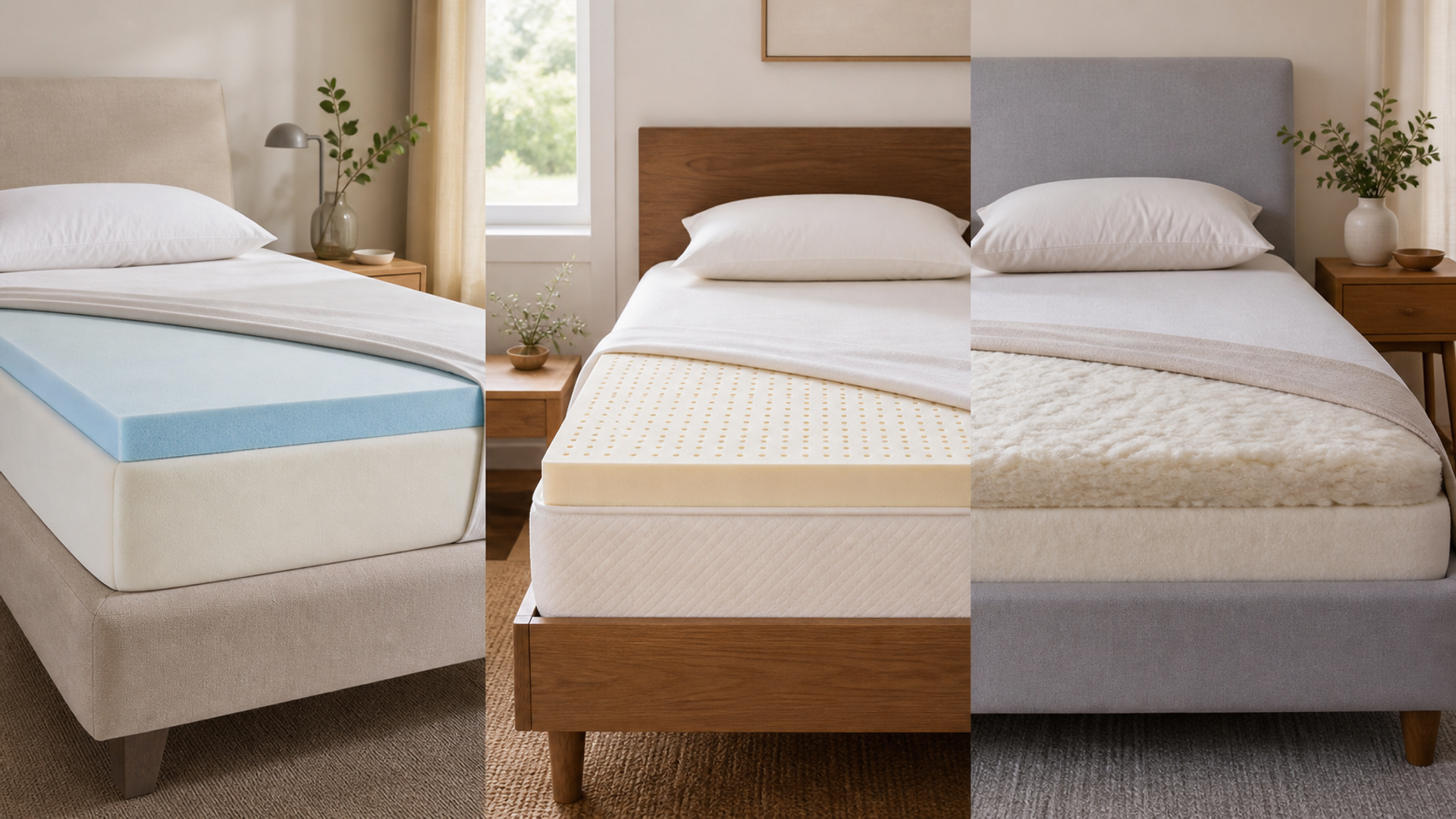
A mattress topper can change surface feel, temperature and the first layer of pressure distribution, but it cannot repair a broken support core or make the wrong mattress structurally right. The useful question is not which topper feels most luxurious in a showroom. It is whether a particular material and thickness solve a defined problem without creating heat, unstable edges or awkward sheet fit.
The short answer by sleep problem
Choose resilient foam when contouring and motion isolation are priorities, latex when a more buoyant response and easier movement matter, or a fibre or wool layer when modest softness and moisture management are the goal. Replace the mattress instead when sagging, edge failure or deep support—not surface feel—is the real problem.
| Decision factor | Resilient foam | Latex topper | Fibre or wool layer |
|---|---|---|---|
| Surface response | Slow contouring is desired | Buoyant support and easier movement are desired | Gentle cushioning is enough |
| Heat strategy | Ventilation and cover design are verified | Open structure and room temperature suit latex | Moisture management matters more than deep contour |
| Thickness | Extra sink does not disturb alignment | Moderate lift preserves stability | Low-profile change preserves sheet fit |
| Existing mattress | Core is level and supportive | Core is firm but sound | Only a small comfort correction is needed |
| Care | Removable cover and rotation are practical | Weight and handling are manageable | Cleaning instructions suit the household |
| Trial risk | Return terms cover opened bedding | Material sensitivity and odour are checked | Compression and loft loss are accepted |
This best mattress toppers 2026 matrix is the article's working value object. Read the best mattress toppers 2026 rows together: the decisive failure mode depends on this topic's evidence, operating context and reader objective.
What a topper can and cannot change
Evidence 1. The US Consumer Product Safety Commission's mattress guidance shows that mattresses and related bedding can be subject to flammability requirements; labels and construction should not be altered casually.
Evidence 2. The US Federal Trade Commission explains textile and wool labelling requirements, which helps buyers distinguish a verified fibre statement from an ambiguous marketing name.
Evidence 3. Topper dimensions and material composition are product-specific, so the manufacturer's current label and care instructions control the actual purchase rather than a generic material description.
Evidence 4. A topper adds height to the sleep surface; buyers should measure mattress depth, fitted-sheet capacity, bed-frame clearance and edge access before ordering.
Reader-visible sources checked for this article:
cpsc.gov — reader-visible current or official evidence
ftc.gov — reader-visible current or official evidence
hse.gov.uk — reader-visible current or official evidence
cpsc.gov — reader-visible current or official evidence
For best mattress toppers 2026, these sources establish only the claims inside their documented scope. Recheck every changeable specification, availability condition, price, policy or service term in the relevant market before acting.
Measure the existing bed before adding height
A buyer can resolve surface response without starting from a brand preference. Ask whether slow contouring is desired; compare that with whether buoyant support and easier movement are desired; then use gentle cushioning is enough as the third route's safeguard. An unknown condition stays unknown.
On heat strategy, popularity is not enough. The evidence for option one is that ventilation and cover design are verified. Option two means open structure and room temperature suit latex. Option three is rational where moisture management matters more than deep contour. Recheck any changeable term immediately before commitment.
The decision changes at thickness. Choose the first path only if extra sink does not disturb alignment; move to the second when moderate lift preserves stability; use the third when low-profile change preserves sheet fit. Save the downside that would make this row fail.
For existing mattress, the first route works when core is level and supportive; the second requires core is firm but sound. The control for the third is only a small comfort correction is needed. Verify this row against the exact product, property, account or environment before it can reverse the decision.
The care row exposes a practical boundary. Route one assumes removable cover and rotation are practical, while route two is defensible only when weight and handling are manageable. Route three depends on cleaning instructions suit the household. If that evidence is absent, keep the more reversible option.
Read trial risk as a stop/go test: return terms cover opened bedding supports the first option; material sensitivity and odour are checked supports the second; and compression and loft loss are accepted supports the third. Record which source proves the condition and when it was checked.
Facts that would reverse the current choice
Reversal control 1 — Surface response. Before choosing Resilient foam, write down how the decision changes if “Slow contouring is desired” proves false. Do the same for Latex topper and “Buoyant support and easier movement are desired”. Keep the Fibre or wool layer route available until “Gentle cushioning is enough” is verified. This control belongs to best mattress toppers 2026; update it from the cited source or exact supplier rather than copying a generic checklist.
Reversal control 2 — Heat strategy. Before choosing Resilient foam, write down how the decision changes if “Ventilation and cover design are verified” proves false. Do the same for Latex topper and “Open structure and room temperature suit latex”. Keep the Fibre or wool layer route available until “Moisture management matters more than deep contour” is verified. This control belongs to best mattress toppers 2026; update it from the cited source or exact supplier rather than copying a generic checklist.
Reversal control 3 — Thickness. Before choosing Resilient foam, write down how the decision changes if “Extra sink does not disturb alignment” proves false. Do the same for Latex topper and “Moderate lift preserves stability”. Keep the Fibre or wool layer route available until “Low-profile change preserves sheet fit” is verified. This control belongs to best mattress toppers 2026; update it from the cited source or exact supplier rather than copying a generic checklist.
Reversal control 4 — Existing mattress. Before choosing Resilient foam, write down how the decision changes if “Core is level and supportive” proves false. Do the same for Latex topper and “Core is firm but sound”. Keep the Fibre or wool layer route available until “Only a small comfort correction is needed” is verified. This control belongs to best mattress toppers 2026; update it from the cited source or exact supplier rather than copying a generic checklist.
Reversal control 5 — Care. Before choosing Resilient foam, write down how the decision changes if “Removable cover and rotation are practical” proves false. Do the same for Latex topper and “Weight and handling are manageable”. Keep the Fibre or wool layer route available until “Cleaning instructions suit the household” is verified. This control belongs to best mattress toppers 2026; update it from the cited source or exact supplier rather than copying a generic checklist.
Reversal control 6 — Trial risk. Before choosing Resilient foam, write down how the decision changes if “Return terms cover opened bedding” proves false. Do the same for Latex topper and “Material sensitivity and odour are checked”. Keep the Fibre or wool layer route available until “Compression and loft loss are accepted” is verified. This control belongs to best mattress toppers 2026; update it from the cited source or exact supplier rather than copying a generic checklist.
Diagnose the mattress before buying an accessory
Place a straight edge across the unloaded mattress and inspect the support base. A permanent hollow, broken edge or damaged foundation will remain beneath a topper. Record the current firmness problem in one sentence: too hard at shoulder and hip, too much heat, partner movement, or a small gap in guest-room comfort. If the complaint changes every night or includes severe sagging, preserve the topper budget for a mattress replacement evaluation.
Compare material behaviour, not adjectives
Memory-type foams generally emphasise contour and motion absorption; latex often feels quicker and more buoyant; fibre and wool layers make a shallower change. Density, formulation, perforation, cover and thickness modify those categories. Ask for exact composition and country-specific labels. Avoid treating cooling language as a guarantee: room temperature, bedding, protector and sleeper physiology can dominate the result. A breathable cover does not automatically cool the whole bed.
Control added height and edge geometry
Measure from the top of the support deck to the current mattress surface, then add the topper's uncompressed height. Check headboard, bedside table, guard rail and fitted sheets. A thick, soft topper can change how easily a shorter user gets out of bed and may make the edge feel less stable. Use a correctly sized non-slip design rather than tightening straps that distort the mattress. Recheck alignment after several nights, once materials have settled.
Read trial, hygiene and care terms before opening
Bedding returns often have hygiene conditions, collection charges or exclusions once packaging is opened. Confirm the trial start, required protector, return route, warranty scope and who pays freight. Photograph the label and packaging. Follow airing and cleaning instructions and avoid adding electric heat unless explicitly compatible. For a guest room or seasonal residence, choose a topper that can be handled, stored and inspected without damaging heavy foam or compressing natural fill.
Three sleepers who need different materials
The side sleeper on a sound firm mattress
A contouring foam layer may reduce surface pressure if the support core remains level and added sink does not disturb alignment. Define the fact that would reverse this recommendation before committing.
The combination sleeper who dislikes being held
A latex route may be easier to move on, provided thickness and material sensitivity fit the user. Define the fact that would reverse this recommendation before committing.
The guest bed needing a modest correction
A lower-profile fibre or wool layer can add softness without committing to a deep change or complex fitted sheets. Define the fact that would reverse this recommendation before committing.
Action checklist
Inspect mattress and foundation for structural failure.
Define the single surface problem to solve.
Measure mattress depth and sheet capacity.
Compare exact composition and thickness.
Check flammability and fibre labels.
Read cleaning and protector requirements.
Confirm trial and opened-product return terms.
Check bed height and edge access.
Test temperature with normal bedding.
Reassess after the material has settled.
Continue the decision
The linked VERTU articles expand adjacent parts of the best mattress toppers 2026 decision. They do not substitute for the external evidence above.
The topper verdict
Choose resilient foam when contouring and motion isolation are priorities, latex when a more buoyant response and easier movement matter, or a fibre or wool layer when modest softness and moisture management are the goal. Replace the mattress instead when sagging, edge failure or deep support—not surface feel—is the real problem.
Keep the best mattress toppers 2026 decision reversible until its material cost, safety, access, privacy and compatibility facts are verified. Unknown evidence stays unknown; it is never silently scored as favourable.