

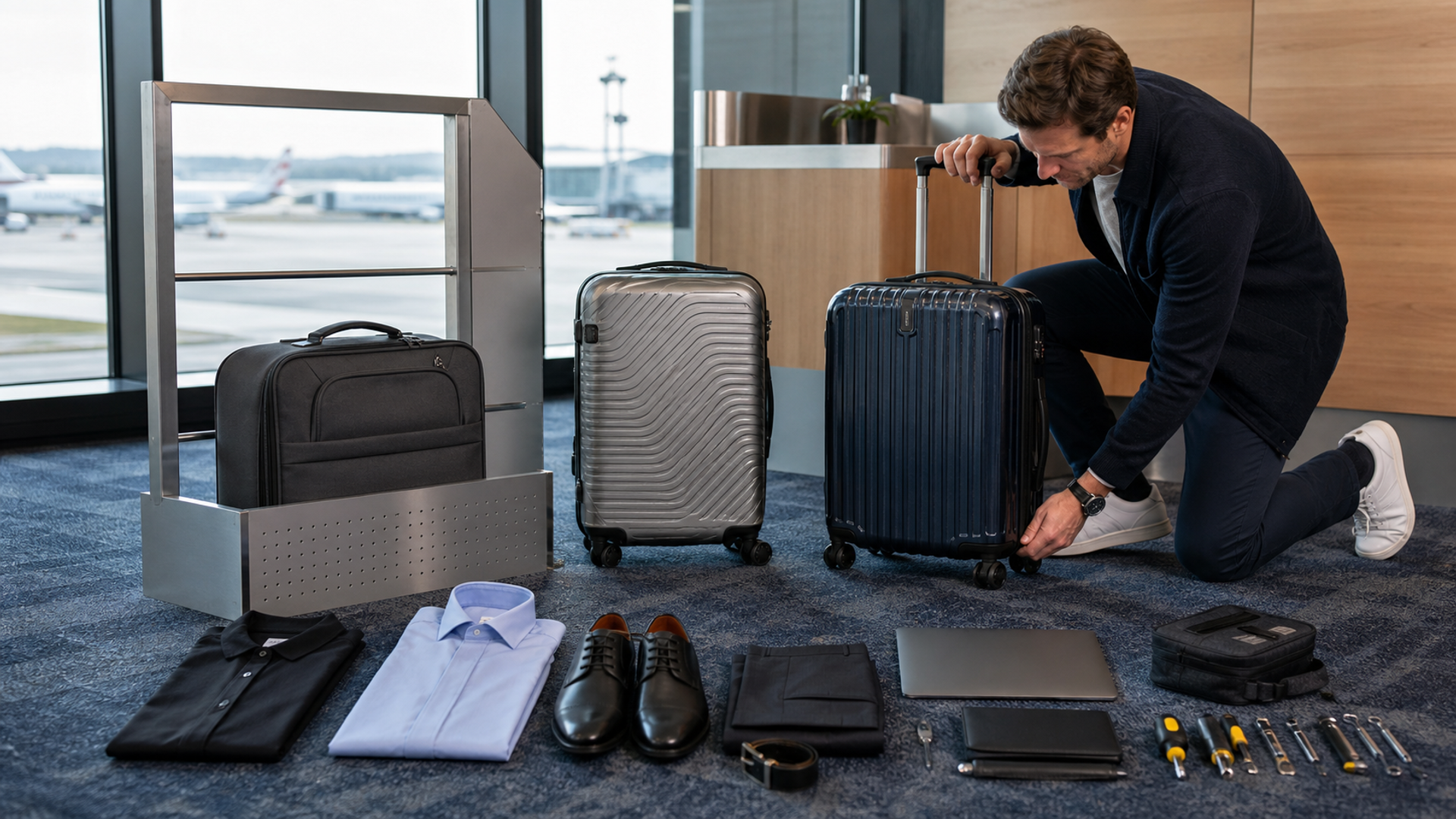
The best carry-on for business travel is not a single suitcase. It is the smallest case that reliably fits the airlines you use, protects the work kit you carry and can be repaired without derailing the next trip. Frequent flyers should choose in this order: airline fit, packing style, wheel and handle design, repair pathway, then material and appearance.
Airline limits are not universal. The International Air Transport Association’s baggage guidance explains that allowances are set by airlines and can depend on route, cabin and aircraft. Before buying, record the strictest cabin-bag dimensions and weight used across your likely carriers. Product dimensions must then be checked on the manufacturer’s live page, including wheels and handles.
The short answer
Choose a compact soft-sided two-wheel or four-wheel case if maximum packing flexibility, exterior access and lower visual wear matter. Choose a hard-shell spinner if structure, smooth airport movement and protection from compression are priorities. Choose a premium case only after confirming that its repair coverage, service geography and parts pathway work where you travel.
A suitcase that fits one generous long-haul allowance but fails a strict regional flight is not a dependable business carry-on. Fit is the first luxury.
Carry-on ownership decision matrix
| Traveller pattern | Best starting format | Main advantage | Main risk to check |
|---|---|---|---|
| Mixed global airlines | Compact international-size case | Better chance of meeting stricter dimensions | Reduced internal capacity |
| Weight-restricted routes | Lightweight soft or hard case | Preserves more allowance for contents | Durability and handle rigidity |
| Weekly short-haul commuter | Durable compact spinner | Easy movement through stations and terminals | Wheel exposure and overhead fit |
| Cobblestones and kerbs | Two-wheel case | Larger recessed wheels can handle rough ground | Less manoeuvrable in tight aisles |
| Laptop-heavy traveller | Case plus removable work bag | Keeps devices accessible and protected | Personal-item rules and stacking stability |
| Suits and formal clothing | Rectangular case with restrained compression | Reduces hard creases and overpacking | Garment length and interior layout |
| Samples or fragile work kit | Structured hard shell with organisers | Better resistance to compression | Shell cracking and repair options |
| Frequent repair concern | Brand with documented global service | Clearer ownership pathway | Coverage exclusions and travel distance to service |
| Maximum exterior access | Soft-sided case with front pocket | Fast access to documents and layers | Overstuffing beyond measured size |
| Minimalist one-bag trip | Precisely measured compact case | Fewer handoffs and less baggage risk | Discipline required for liquids and laundry |
Measure against your airline portfolio
Create a table of the airlines and aircraft types you expect to use over the next year. Record the published maximum dimensions, weight and personal-item rule from each airline’s official site. Use the strictest recurring limit as the target; do not optimise for an airline you use once if another carrier governs most trips.
Measure the case externally at its widest points, including wheels, feet, side handles and any expanded panel. Manufacturer capacity figures do not determine airline compliance. An expansion zip is useful at a hotel but can make the bag too deep for the return flight.
Understand why no universal size exists
IATA provides industry context, but individual airlines control acceptance. A bag may be permitted on one flight and gate-checked on another because of dimensions, weight, cabin, fare or limited overhead space. Even a compliant case is not guaranteed cabin placement.
Regional aircraft can have smaller bins than long-haul aircraft. If a forced gate check would be problematic, keep medication, documents, batteries, valuables and an essential work layer in a removable personal item that remains within the airline’s rules.
Two wheels or four
Four-wheel spinners move easily beside the traveller, turn in lifts and negotiate narrow queues. Their wheels sit outside the shell and can take impacts. Check wheel attachment, ground clearance and whether individual wheels can be serviced.
Two-wheel cases usually use larger, partly recessed wheels. They sacrifice sideways movement but can be steadier on uneven pavement and kerbs. The fixed wheel housings also reduce some usable interior depth. Choose based on the whole journey, not only the airport floor.
Hard shell or soft side
A hard shell gives structure and resists external compression. It can work well for carefully organised electronics or samples, although sensitive devices still need padded protection. Scratches and dents are normal wear, and different shell materials behave differently under impact.
Soft-sided luggage often offers exterior pockets, some packing tolerance and a less conspicuous pattern of wear. Overfilling can push it beyond the airline’s permitted dimensions, so measure it packed. Water resistance is not the same as waterproofing; protect documents and electronics separately.
Match the interior to your packing style
Compression panels suit travellers who fold clothing into defined halves. Deep single cavities work better for packing cubes or irregular equipment. Formal clothing needs enough flat area to avoid aggressive rolling and crushing.
Simulate a real three-day trip before removing labels. Pack shoes, laptop accessories, toiletries, gym kit and one formal outfit. Lift the packed case into an overhead-height position and roll it over several surfaces. A beautifully finished empty case can feel very different at the airline’s weight limit.
Separate the work bag decision
Many business travellers benefit from a two-piece system: a measured cabin case and a personal item containing laptop, passport, medication, chargers and one change of essentials. The personal item must comply with the airline’s own allowance and should attach securely to the suitcase handle.
Avoid placing every critical item in the roller. Gate checking can happen even when the case meets published limits. A removable work bag preserves continuity if the suitcase goes into the hold.
Examine handles, wheels and closures
The telescopic handle should resist twisting when extended and stop at a comfortable height. Test it with the case loaded. A wide handle can improve control but may divide the interior and reduce flat packing space.
Inspect wheel housings, zip tracks, latches, corner protection and grab handles. These are common stress points. Latches can be elegant but offer less tolerance when packing volume changes; zips are flexible but should move without forcing. No closure makes checked baggage immune to damage.
Read the repair policy before purchase
RIMOWA publishes a lifetime guarantee for qualifying new suitcases purchased from the stated date, with terms and exclusions on its site. Briggs & Riley publishes its Simple as That lifetime guarantee, also subject to its current conditions. These are useful primary sources, but a headline guarantee is not the same as instant worldwide repair.
Read what is covered, what is excluded, whether proof of purchase or registration is needed, where service is available, who pays shipping and how long assessment may take. Confirm the policy that applies in the country of purchase and residence. Save the receipt, serial number and photographs.
Calculate ownership cost, not prestige
Use a simple annualised model: purchase price plus likely shipping or service costs, divided by realistic years of use. Add the cost of downtime if the case must travel to a repair centre. Do not assume a high price automatically creates a better service network.
This is a framework, not a price quote. Obtain current prices and written repair terms before purchase. A moderately priced case with local parts and a straightforward repair shop may be more dependable than a premium case whose nearest service point is abroad.
Pack for airline weight checks
Some airlines focus mainly on dimensions; others enforce cabin-bag weight. Weigh the case fully packed, including laptop power supply, adapters and liquids. A lightweight case creates more usable allowance, but weight should not be reduced by choosing a handle or wheel assembly that cannot survive frequent use.
Keep dense items low and near the wheel end so the case remains stable. Do not use expansion as a routine substitute for editing the packing list. If samples or equipment make the case consistently overweight, plan a checked-baggage or shipping solution rather than relying on inconsistent enforcement.
Build a repair-continuity plan
Photograph the empty case and its identifier before an important trip. Carry the manufacturer’s service link and know whether common components are locally replaceable. If a wheel or handle fails abroad, a temporary repair may be enough to finish the journey, but it can affect later warranty assessment.
Keep an alternative bag available at home for the next departure. Frequent business travel makes turnaround time part of product performance. The best warranty on paper has limited value if the case cannot be used for the next scheduled trip.
A pre-purchase test
Before committing:
Compare external measurements with the strictest recurring airline.
Weigh the case empty and with a representative load.
Confirm laptop and personal-item strategy.
Roll the loaded case over carpet, thresholds and rough pavement.
Lift it to overhead height safely.
Inspect wheel, handle and closure serviceability.
Read the complete guarantee and repair terms.
Check service locations in your home market and regular destinations.
Save the model number, receipt and dimensions.
Confirm the return policy before conducting the packing test.
Where VERTU fits
For eligible users, VERTU Concierge may help coordinate travel research or itinerary changes when luggage failure becomes one part of a wider disrupted journey. Availability varies, significant external actions require user authorisation, and no inventory or outcome is guaranteed. Airlines, luggage brands, repair centres and insurers control acceptance, service and claims.
The AI-agent and human-concierge disruption matrix is relevant when a damaged bag affects flights, ground transport or meetings. Coordination can organise options; it cannot override an airline allowance or manufacturer warranty.
Final recommendation
Buy by your strictest airline, then by the way you pack, then by the repair path you can actually use. For smooth terminals and compact trips, a measured spinner is often the practical default. For rougher ground, a robust two-wheel case deserves consideration. Hard shell and soft side are both defensible when their trade-offs match the journey.
The winner is the case that stays compliant, keeps essential work accessible and returns to service quickly. Brand reputation matters only when those three tests are passed.
![How to Scan Receipts and Documents with Your Phone [Full Guide]](https://cdn.sanity.io/images/e0gp1l2g/production/0db13feec1d5e72b8a8a5f976d1f3e86619c9228-3840x1860.webp?w=180&h=180&q=78&auto=format&fit=crop)
![How to Scan Receipts and Documents with Your Phone [Full Guide]](https://cdn.sanity.io/images/e0gp1l2g/production/0db13feec1d5e72b8a8a5f976d1f3e86619c9228-3840x1860.webp?w=800&h=450&q=82&auto=format&fit=crop)
![Top 10 Two-Tone Carbon-Fibre Watches for Men [2026 List]](https://cdn.sanity.io/images/e0gp1l2g/production/18870799ba33fab0e038968359cd5772d7d7db30-1024x576.webp?w=800&h=450&q=82&auto=format&fit=crop)
![Top 10 Luxury Watches with Digital Complication Displays for Men [Latest]](https://cdn.sanity.io/images/e0gp1l2g/production/c4f6bf8c080f291c39f7cc85c7344ecff2fd3799-1024x553.webp?w=800&h=450&q=82&auto=format&fit=crop)