


Introduction
The modern wellness stack is quietly becoming a surveillance stack.
Your wearable knows when you sleep, where you train, how your heart responds to stress, and—through correlation—when you travel, when you recover, and when you’re vulnerable. The question is no longer whether this data exists. It’s who can access it, reuse it, and profit from it.
This is the core question behind sovereign wellness data ownership: you decide what gets shared, with whom, for how long, and for what purpose.
For affluent early adopters and innovation leaders, the stakes are higher than “targeted ads.” Health signals can become reputational risk, negotiating leverage, or a security liability. Sovereign wellness is the counter-move: you keep control of the data and grant access deliberately.
Implementation translation: treat the system as off-chain biometrics, on-chain consent and audit. The wearable produces signals, but the ledger only records the governance proofs.
User-owned health and safety data matters now for three reasons:
Data is more revealing than it used to be. Even “simple” metrics (heart rate, sleep stages, location) become sensitive when combined.
The ecosystem is fragmented. Wearables, apps, insurers, concierge services, clinics, and travel providers all touch adjacent data.
Regulators are closing gaps. In the U.S., many consumer wearables sit outside HIPAA—but not outside enforcement expectations, including the FTC’s Health Breach Notification Rule guidance.
The practical path forward is hybrid over hype.
Hybrid over hype means off-chain biometrics, on-chain consent and audit.
That’s also the decision-grade core of blockchain consent management healthcare: you use the ledger to prove authorization and integrity, while keeping clinically sensitive payloads private and deletable.
Put differently: off-chain biometrics on-chain consent audit is how you keep governance verifiable without turning personal data into permanent metadata.
Keep biometrics off-chain (encrypted, access-controlled, deletable).
Put consent, policy, and audit on-chain (minimal, tamper-evident, verifiable).
This isn’t “blockchain as a database.” It’s blockchain as a disciplined accountability layer.
Hybrid architecture blueprint
This blueprint is designed for decision-makers evaluating integrated Web3 health wearables with strong privacy and auditability—without putting sensitive biometrics on a public ledger.
Off-chain biometrics, on-chain proofs
Start with a principle that survives both security review and regulatory scrutiny:
If a data element could harm a person if exposed, don’t write it to an immutable public ledger.
In a well-designed system, raw biometric payloads—heart-rate series, sleep epochs, stress indicators, incident triggers—stay off-chain in encrypted storage (or in a regulated repository when applicable). What goes on-chain is the minimum required to prove governance:
hashes (integrity anchors)
consent receipts (who granted what, when, for which purpose)
revocation state
audit references (proof that an access event was logged and can’t be silently altered)
The hybrid pattern is now widely discussed in healthcare blockchain literature: blockchain is used as a coordination and auditing layer, while sensitive health information remains off-chain, with only hashed references and minimal metadata written to the ledger.
Key TakeawayThe chain should let you prove control—not expose what you’re controlling.
Device identity and consent flows
Decision-stage wearables fail most often at the seams: device identity, user identity, and authorization drift apart.
A robust consent flow ties four things together:
A device identity you can attest (this exact wearable, this firmware, this hardware root).
A human identity you can authenticate strongly (without relying on brittle passwords).
A consent policy that is scoped and purpose-limited.
An audit trail that is tamper-evident, but privacy-preserving.
In practice:
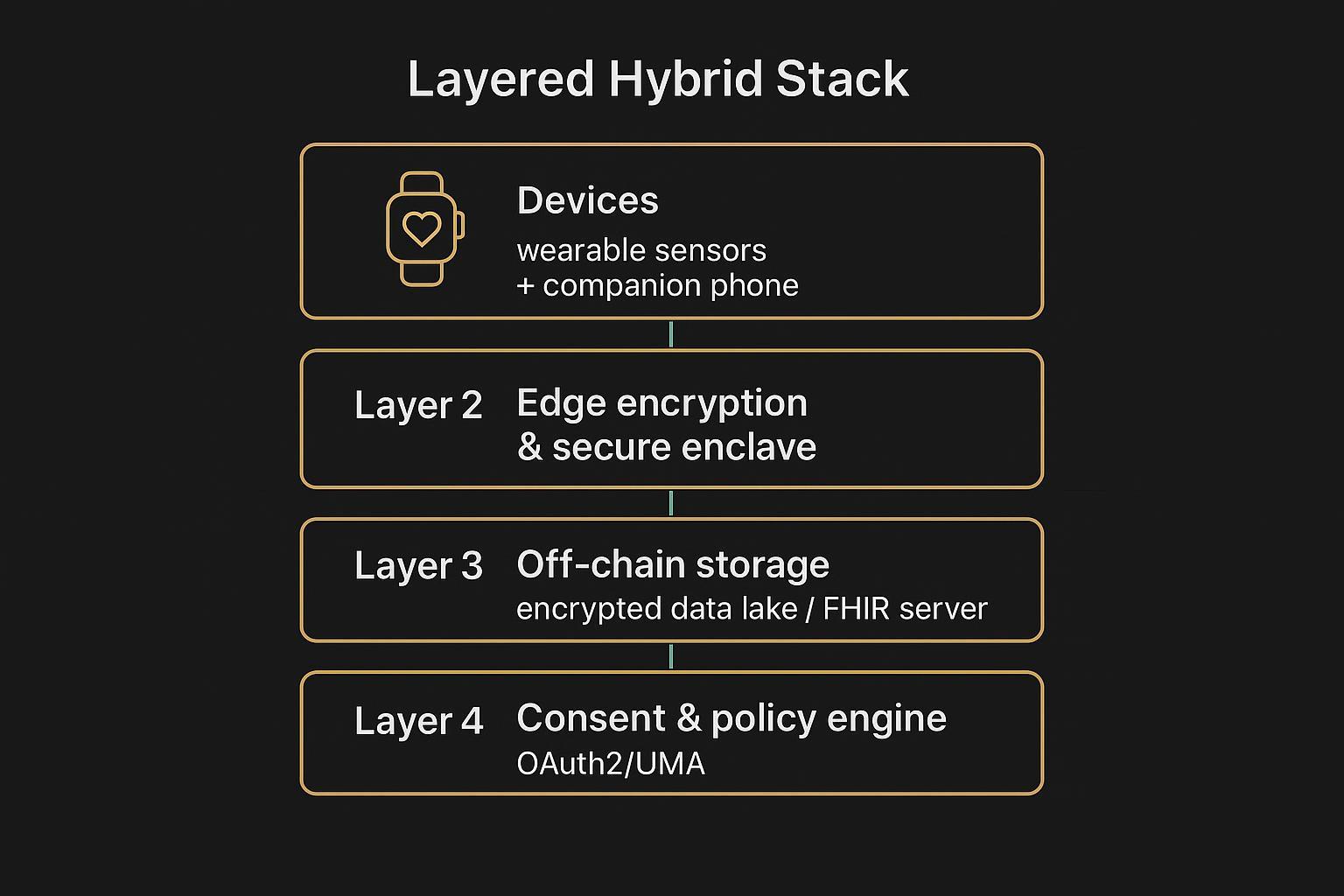
The wearable produces signals; the phone (or edge hub) performs encryption.
Consent is granted through an authorization flow (OAuth2/UMA patterns are common in healthcare access management).
The on-chain layer records “consent state + proof,” not the biometric content.
Collector’s note: For a high-trust system, device identity isn’t marketing. It’s evidence—measurable, auditable, and revocable when supply chain or firmware trust breaks.
Integrated Web3 health and security wearables design
If you want a clean architectural shorthand for stakeholders, use this phrase in your technical documentation and procurement language: integrated Web3 health wearables.
Integrated design treats wellness and security as one system, not two apps.
At minimum, you want:
Edge encryption before data leaves the device/phone boundary.
A secure execution zone for keys and signing operations (secure element / TEE patterns).
Off-chain storage that supports granular access control and retention rules.
An on-chain consent/audit layer that can be inspected without exposing the user.
When evaluating vendors or designing your own stack, ask a blunt question:
If I revoke access today, what exactly stops access tomorrow?
If the answer depends on “trust us,” you don’t have sovereign wellness—you have outsourced risk.
Standards that interoperate
Decision-stage buyers should treat standards as an escape hatch. Standards reduce lock-in, make audits easier, and give you a common language across security, healthcare, and identity teams.
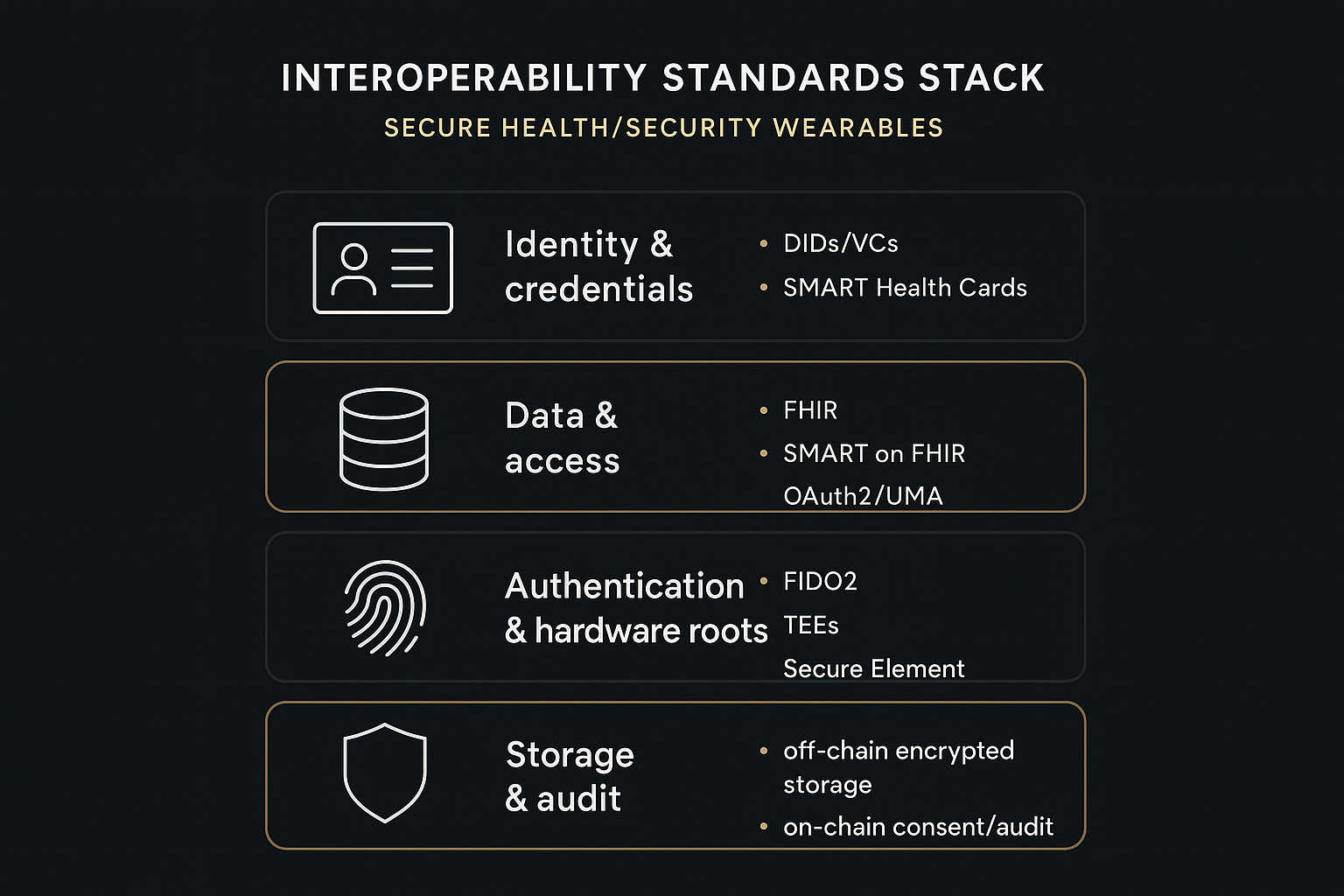
Identity and credentials (DIDs/VCs, SHC)
Identity is not one thing here. It’s a bundle:
a durable identifier
a set of verified claims (age bracket, eligibility, membership, device ownership)
a way to prove those claims without oversharing
Decentralized identifiers and verifiable credentials (DIDs/VCs) are often used to represent portable identity and attestations. In healthcare-adjacent workflows, SMART Health Cards (SHC) can serve as a practical credential format for certain verified claims.
The design goal is controlled disclosure:
prove what is necessary
avoid leaking what is merely interesting
Data and access (FHIR, SMART on FHIR, OAuth2/UMA)
For health data portability, HL7 FHIR is the backbone: it defines how health data is represented and exchanged via APIs.
SMART on FHIR sits on top of FHIR and defines how applications securely connect to FHIR servers using OAuth2 and OpenID Connect. The SMART on FHIR documentation is the canonical reference for how this ecosystem fits together.
Where “sovereign wellness” becomes operational is authorization.
- OAuth2 / OpenID Connectstandardized consent and authentication patterns.
- UMA (User-Managed Access)an OAuth-based profile that supports more patient-managed, policy-driven authorization, including dynamic consent patterns. The OpenID Foundation’s HEART UMA profile specification is a widely cited reference.
The point isn’t to worship standards. It’s to prevent a single vendor from becoming the only party who can interpret your own data.
Authentication and hardware roots (FIDO2, TEEs)
If your system uses world-class cryptography but weak authentication, it will still fail.
FIDO2 (passkeys/WebAuthn) provides phishing-resistant authentication and is increasingly used to harden logins for portals and wallets. The FIDO Alliance passkeys overview is a good baseline.
For hardware-rooted trust, use:
Secure elements or equivalent key-isolation hardware
Trusted execution environments (TEEs) for sensitive operations where software-only isolation is insufficient
Regulation and risk reality
This section is not medical, legal, or compliance advice. It’s a design prompt: if you ignore these constraints, your architecture will be refactored later—under pressure.
HIPAA, FTC HBNR, FDA scope
In the U.S., many consumer wearables are not covered by HIPAA unless you are acting as a covered entity or business associate. That often surprises buyers.
But “not HIPAA” does not mean “not regulated.” The FTC has been explicit that certain health apps and connected devices not covered by HIPAA may still have breach notification obligations under the Health Breach Notification Rule.
On the FDA side, scope is driven by intended use and claims. If you market the wearable as diagnosing, treating, or preventing disease, you can move into medical device territory.
GDPR, MDR/IVDR, cross-border nuance
In the EU, assume GDPR applies when you process personal data of individuals in the EEA, and that wellness signals may qualify as special category data.
Even with strong cryptography, cross-border operations introduce practical friction:
where data is stored
who can access it under what lawful basis
how you respond to data subject requests
MDR/IVDR scope is again driven by intended use: consumer wellness devices often sit outside the strictest medical regimes, but claims can change the analysis.
Immutability vs deletion rights
Immutability collides with deletion rights in predictable ways.
The most defensible pattern is:
store sensitive data off-chain, under a retention policy you can enforce
keep on-chain records minimal, avoiding personal data and avoiding metadata that reveals health context
treat the ledger as a “consent state machine” and an integrity anchor—not a clinical record
If an auditor asks whether you can delete user data, your answer should be practical and testable.
Collector’s note: In sovereign wellness, “delete” is an operational capability, not a privacy statement.
Security and operations playbook
Decision-stage wearables are operations-heavy. The best architecture collapses if you can’t patch, rotate, recover, and respond.
Network, firmware, and update hygiene
Focus on the three failure modes that end programs:
silent firmware drift (devices running untracked versions)
weak update paths (updates without integrity checks)
third-party SDK exposure (analytics/ads libraries pulling sensitive signals)
Baseline expectations:
signed firmware and verified updates
SBOMs and dependency monitoring where feasible
network segmentation for enterprise pilots
aggressive minimization of third-party telemetry
Device and key management
Key management is where “sovereignty” becomes real.
At minimum, you need clarity on:
who can initiate key recovery
what happens on loss/theft
how revocation works across device, app, and on-chain consent state
whether signing keys are isolated from the main OS
A strong implementation treats this as wearable security key management—not a UI feature. Keys govern identity, consent, and in some cases safety workflows. If recovery is weak, everything downstream becomes a social-engineering problem.
A privacy-first concierge perspective (non-promotional) is useful here: when high-sensitivity users need support, the safest operational model reduces the number of parties who ever see identifiers, documents, and recovery secrets.
That’s why approaches like single-point, access-controlled assistance—with explicit approval gates, tight retention rules, and strong authentication for any recovery action—tend to outperform “email support” when the asset is both personal and security-critical.
For a practical illustration of Web3-as-entitlements framing (rather than hype), see VERTU.
Auditability without exposure
Auditability is not the same as transparency.
A sovereign wellness system should allow an auditor to answer:
what was accessed
under which consent scope
by whom (role/credential)
when
and whether logs were altered
…without exposing the biometric content.
Design patterns that help:
on-chain anchoring of log hashes (proves integrity)
off-chain detailed logs with strict access controls
privacy-preserving identifiers (avoid leaking user identity in ledger metadata)
⚠️ WarningA public audit trail that reveals patterns of access can still become sensitive—even if the underlying data is encrypted.
Adoption and ROI by 2026
“ROI” here is rarely a single number. For decision-makers, it’s reduced downside plus improved execution.
Near-term wins and pilots
Pilots that succeed tend to be tightly scoped:
executive travel safety + incident workflows
opt-in wellness programs with strict consent boundaries
high-trust clinical partnerships where data portability is an explicit requirement
Define success as governance outcomes, not “more data.” For example:
revocation tested end-to-end
recovery tested under realistic conditions
audit logs independently verifiable
Enterprise integration paths
Most wearables fail integration because they treat the enterprise as an afterthought.
A workable path typically looks like:
identity integration (SSO + strong auth)
consent/policy integration (OAuth2/UMA patterns)
data integration (FHIR where health data is in scope)
incident response integration (ticketing + security operations workflows)
If you can’t explain where consent is enforced, you don’t have an integration plan.
Procurement and due diligence
Procurement should ask questions that force precision:
Where does data live, and what is truly off-chain?
What exactly is written on-chain (fields, metadata, identifiers)?
How does deletion work for off-chain data, backups, and derived analytics?
What is the breach response playbook (including FTC HBNR obligations where applicable)?
How are firmware updates signed, verified, and rolled back?
How is key recovery handled, and what prevents social-engineering recovery attacks?
How to verify: Run one tabletop exercise: “device lost abroad + recovery request + consent revocation + audit request.” If the vendor can’t execute the workflow cleanly, they’re not ready.
Conclusion
Sovereign wellness is not a slogan. It’s an architecture and an operating model.
The decision-grade principles are consistent:
- Privacykeep biometrics off-chain; encrypt early; minimize metadata.
- Controlconsent must be scoped, revocable, and enforced in the data path.
- Verifiable trustauditability should be tamper-evident without becoming exposure.
Action steps for HNWIs and innovation leads:
Insist on a hybrid design: off-chain biometrics, on-chain consent and audit.
Prioritize standards (FHIR/SMART on FHIR, OAuth2/UMA, FIDO2) over proprietary glue.
Treat key management and recovery as a first-class procurement domain.
Pilot with a scenario that includes loss, recovery, and revocation—not just “normal operation.”
Disclosure: This article references VERTU pages. Editorial judgment remains the priority.

![Top 10 Luxury Smartwatches for Business Travel [2026]](https://cdn.sanity.io/images/e0gp1l2g/production/8b5e5b21db42a1c5f040e828bd041857353a8eb2-2560x1382.webp?w=800&h=450&q=82&auto=format&fit=crop)