

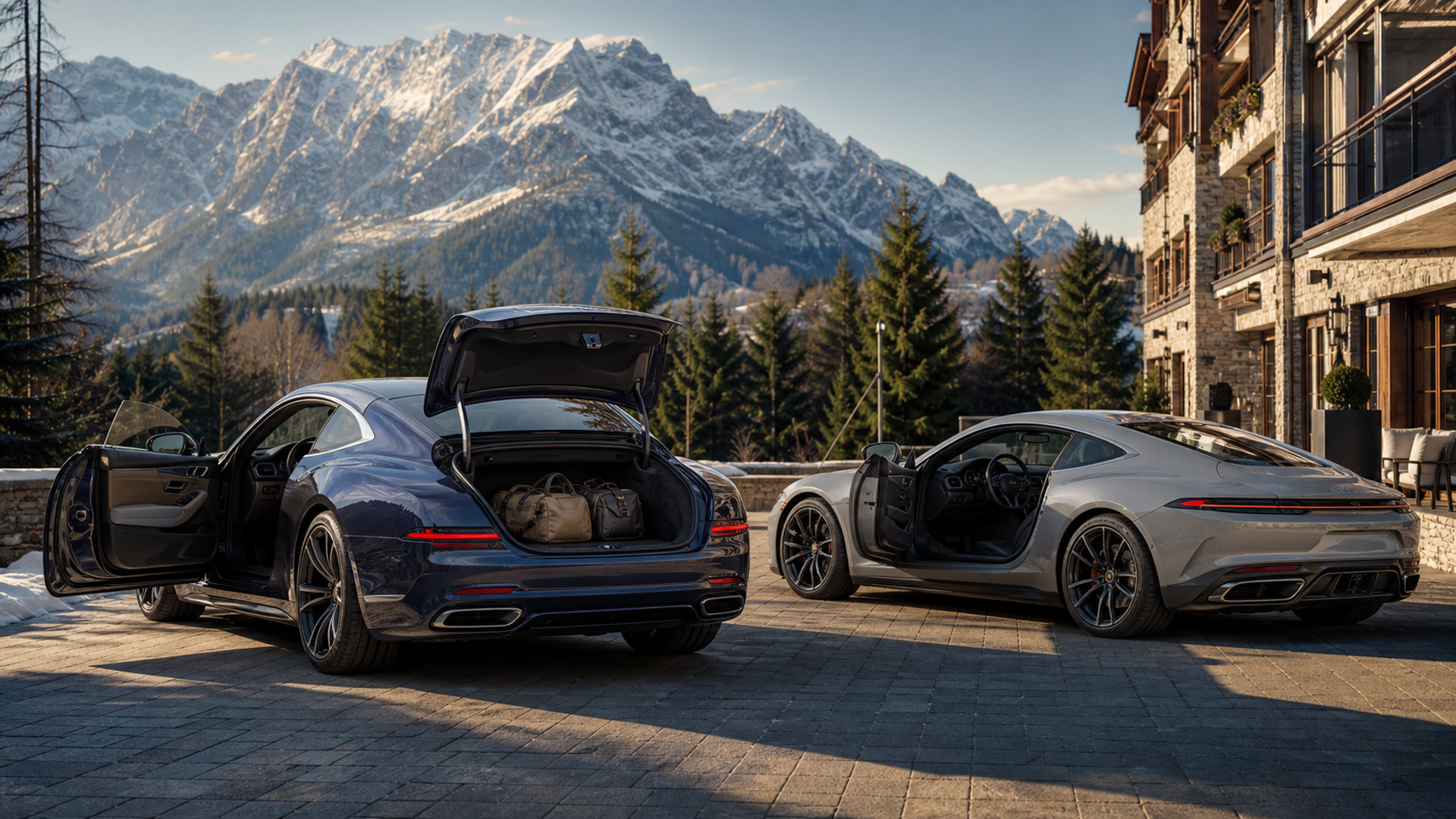
The Bentley Continental GT and Aston Martin DB12 are both front-engined luxury coupes designed to cross countries quickly, but they interpret grand touring differently. The Continental GT emphasises all-weather traction, isolation, cabin craft and the ability to make distance feel smaller. The DB12 puts more emphasis on a leaner, more communicative sports-car character while retaining a refined two-plus-two cabin.
Headline power figures do not settle this decision. On public roads, luggage, seating, ride behaviour, visibility, control logic, dealer access and the way the car feels after four hours matter more than a tenth of a second. Specifications, options and market equipment change, so confirm the exact model year and local configuration before ordering.
The short answer
Choose the Continental GT if you want the more cocooning, substantial and all-weather grand tourer, regularly carry meaningful luggage or occasional rear passengers, and value a broad luxury experience. Choose the DB12 if you prioritise steering response, a more compact-feeling driving position and a sports-car edge without moving to a strict two-seater.
Neither is a substitute for a representative test drive. Drive the same roads, include a motorway section and bring the luggage and passengers that matter.
Grand-touring decision matrix
| Decision factor | Bentley Continental GT | Aston Martin DB12 | Better fit when… |
|---|---|---|---|
| Overall character | Powerful, planted, insulated | Lighter-feeling, sharper, more intimate | You know whether calm or communication leads |
| Powertrain | Current Continental GT range includes high-performance hybrid positioning | Twin-turbo V8 grand-tourer architecture | You compare response, sound and energy routine rather than badges |
| Traction | All-wheel-drive focus | Rear-drive sports-coupe character | Climate and road surfaces differ |
| Cabin | Deep material customisation and substantial ambience | Driver-centred contemporary cockpit | You prefer lounge-like richness or focused theatre |
| Rear seats | Occasional seating; test access and legroom | Occasional seating; test with actual passengers | Adults or children will use them at all |
| Luggage | Grand-touring boot, but shape matters | Useful touring space, with different aperture and shape | Your cases fit without sacrificing rear seats |
| Ride | Broad bandwidth, substantial mass | More agile brief; option and wheel choice matter | Your route is motorway-heavy or road-focused |
| Daily use | Width, parking and weight need consideration | Still wide and low; visibility and access matter | The car must handle cities and garages |
Power is not the differentiator it appears to be
Bentley's current Continental GT page presents the model as a high-performance grand tourer, with the wider Bentley model range showing how variants sit together. Aston Martin describes the DB12 as a super tourer and supplies reference material through its DB12 brochure. These official pages are the appropriate source for the current market specification.
Both provide far more performance than can be used continuously on public roads. The useful difference is delivery. Test low-speed throttle calibration, response when overtaking, gearbox behaviour in automatic mode and whether the powertrain remains smooth in traffic. A dramatic full-throttle demonstration can hide hesitation or abruptness in the situations that occupy most ownership time.
For the Bentley's hybrid system, confirm local charging support, electric-operation behaviour and the usable routine for your home and travel destinations. Do not assume the published maximum range will match every climate, route or driving style. For the DB12, consider whether rear-wheel drive and its chassis character suit winter plans, tyres and local roads.
Ride quality depends on wheels, tyres and mode
The Continental GT's mass contributes to a planted sensation, while sophisticated suspension aims to control that mass. The DB12 seeks a more agile response. Neither description predicts comfort on the exact car because wheel diameter, tyre specification, seat, suspension mode and road surface change the result.
Drive over broken urban surfaces, expansion joints and a fast undulating road. Keep the car in its normal automatic settings before exploring sport modes. Listen for tyre roar on coarse asphalt and check whether large wheels introduce impacts that the showroom route avoids.
Ask how replacement tyres are sourced in the regions you visit and whether the exact specification is commonly stocked. A damaged performance tyre can interrupt a tour more effectively than any engine fault. If the car will cross snowy regions, plan a complete approved winter wheel-and-tyre solution before purchase.
Cabin: craft versus driver focus
Bentley makes material choice and tactile richness central to the experience. Veneer, leather, stitching and metal controls can create a cabin that feels closer to bespoke furniture. The risk is over-configuration. Several dramatic colours and textures may each look attractive in isolation but compete when assembled.
The DB12's cabin is also luxurious but aims for a more driver-centred relationship. Test whether essential climate, drive-mode and media operations can be completed without attention being pulled from the road. Screen quality matters less than control hierarchy, glare and the ease of connecting a phone repeatedly.
In both cars, inspect the actual seats. Photograph posture after adjusting wheel and pedals, then spend at least forty minutes driving. Bolsters that feel supportive for ten minutes can become restrictive; a soft seat can lack support after two hours. Test ventilation, heating and massage where equipped, but do not let features distract from fundamental shape.
Rear seats are a use case, not a line in a brochure
Both cars are two-plus-twos. That means rear-seat utility depends on occupant size, front-seat position, trip length and tolerance. Bring the people who will use them. Check entry past the front seat, headroom, foot space, seat-belt access, child-seat compatibility and whether the front passenger must compromise.
For occasional children or short urban lifts, either may work. For regular adult travel, neither should be assumed suitable without a full trial. Rear seats can also act as secure cabin storage, but loose items become hazards under braking.
If rear-seat usability is decisive, compare a four-door luxury performance car as a control. Buying a coupe and resenting its access is more costly than acknowledging the requirement early.
Luggage: conduct a physical loading test
Published boot volume does not reveal aperture width, floor shape, hinge intrusion or whether two structured cases fit. Bring your normal weekend cases, garment bag and any equipment. Load them yourself and close the boot. Check whether charging cables or tyre equipment consume useful space.
The Continental GT's long-distance brief suggests strong luggage capability, while the DB12 is designed to remain a practical tourer. The winner depends on object geometry. Soft bags can exploit corners; hard cases are easier to handle and protect but less forgiving. If two people take long trips, decide whether the rear seats may be used for luggage and how items will be concealed.
For broader category context, the best luxury convertibles guide explores the additional compromises of an open roof. The best luxury electric sedans guide provides a useful alternative if rear-seat comfort and urban operation outrank coupe theatre.
Dimensions, visibility and city use
The Bentley's width and visual mass require a realistic garage and parking check. Measure the narrowest point, including mirrors and door opening. Test surround-view cameras in low light and assess front-corner visibility. A car can feel manageable on an open test route and stressful in a familiar underground garage.
The DB12 may feel more compact from the driver's seat, but it is still a low, wide performance coupe. Check the nose over ramps, door length, kerbs and the ability to see cyclists or small vehicles in urban traffic. Drive both through the route you use most often if possible.
Low seating affects entry. Try it in the clothes and footwear used for work, not only casual shoes. A grand tourer should make departure inviting rather than turning each short trip into a negotiation.
Ownership, service and travel continuity
Dealer proximity matters more for a complex luxury car than it does for a simple commodity vehicle. Ask where routine service and accident repair occur, how long common parts take, what roadside assistance covers across borders and whether a courtesy vehicle is included. Review warranty terms for the actual market.
Insurance should be quoted before ordering, with declared options and expected annual distance. Confirm tyre, wheel and windscreen costs. For the Bentley, understand hybrid-system warranty and charging support; for both, consider battery maintenance during periods of storage.
Depreciation and resale vary with market, specification, mileage, colour and economic conditions. Neither manufacturer nor an article can guarantee an exit value. Configure for use, but avoid irreversible combinations unless you genuinely want them.
A two-hour comparison drive
Use the same route and sequence:
Fifteen minutes of urban traffic and parking.
Thirty minutes of motorway in the normal drive mode.
Twenty minutes on a rough secondary road.
A safe overtaking simulation within legal limits.
Rear-seat and luggage tests while stationary.
Night or tunnel check for lighting and screen glare.
Ten minutes with audio off to hear tyre and suspension noise.
Record observations immediately. Do not reduce the result to acceleration. Score seat comfort, visibility, control effort, ride, noise, luggage and emotional response separately.
Final verdict
The Bentley Continental GT is the stronger choice when grand touring means arriving rested inside a richly crafted, all-weather cocoon with meaningful luggage ability and occasional rear-seat flexibility. The Aston Martin DB12 is the stronger choice when the journey should feel more like driving a sports car, with a more intimate cockpit and sharper responses, while retaining enough comfort and storage for real tours.
The final decision should be made with the exact options, roads, passengers and bags that define your life. Power parity makes the practical differences more important, not less. The best grand tourer is the one you would still choose after the destination stops being glamorous and the next 300 miles begin.
![How to Scan Receipts and Documents with Your Phone [Full Guide]](https://cdn.sanity.io/images/e0gp1l2g/production/0db13feec1d5e72b8a8a5f976d1f3e86619c9228-3840x1860.webp?w=180&h=180&q=78&auto=format&fit=crop)
![How to Scan Receipts and Documents with Your Phone [Full Guide]](https://cdn.sanity.io/images/e0gp1l2g/production/0db13feec1d5e72b8a8a5f976d1f3e86619c9228-3840x1860.webp?w=800&h=450&q=82&auto=format&fit=crop)
![Top 10 Two-Tone Carbon-Fibre Watches for Men [2026 List]](https://cdn.sanity.io/images/e0gp1l2g/production/18870799ba33fab0e038968359cd5772d7d7db30-1024x576.webp?w=800&h=450&q=82&auto=format&fit=crop)
![Top 10 Luxury Watches with Digital Complication Displays for Men [Latest]](https://cdn.sanity.io/images/e0gp1l2g/production/c4f6bf8c080f291c39f7cc85c7344ecff2fd3799-1024x553.webp?w=800&h=450&q=82&auto=format&fit=crop)