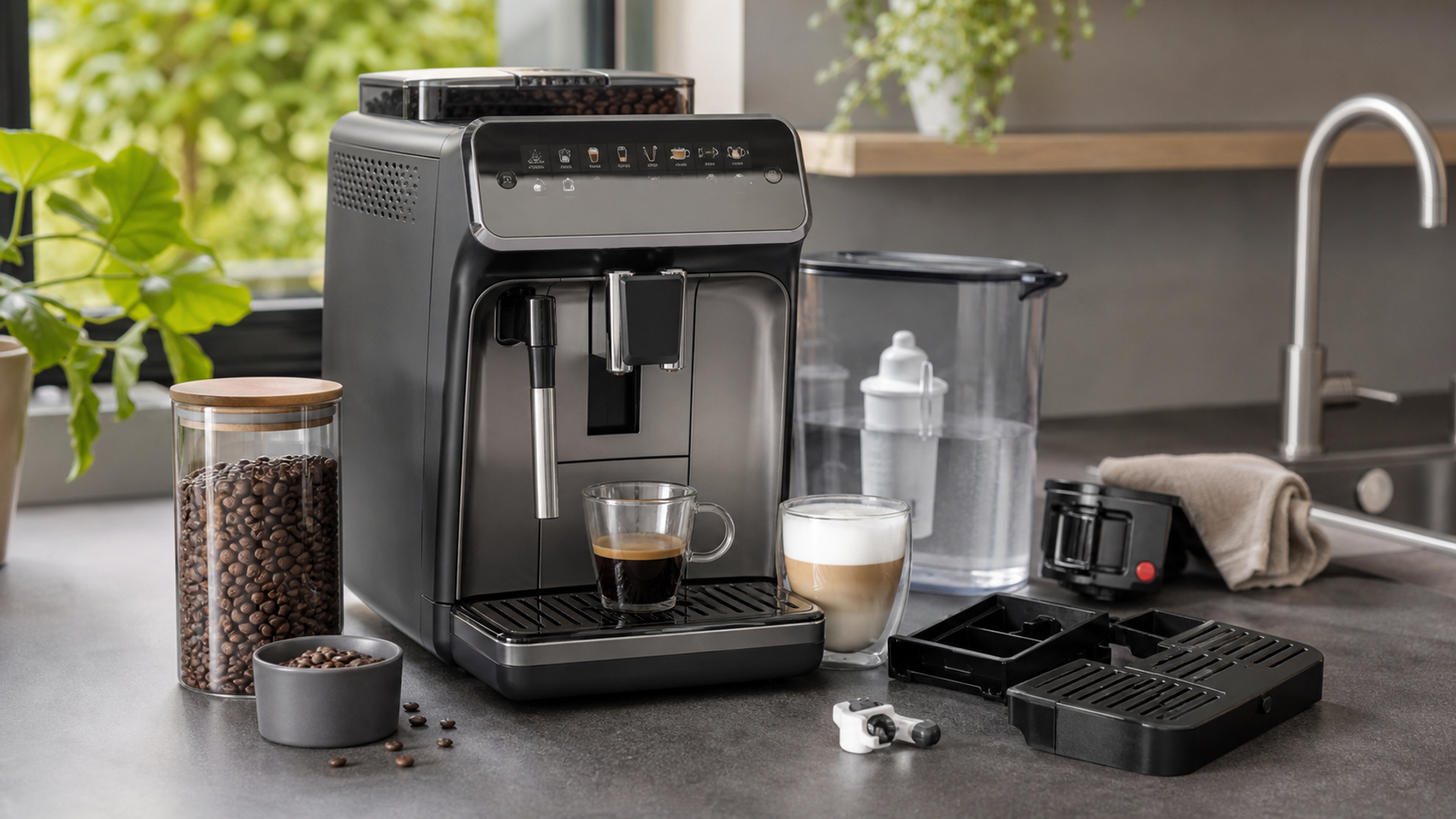
The promise of a bean-to-cup machine is one-touch consistency, but the ownership experience is determined by everything around the button: grinder adjustment, milk storage, rinse cycles, water hardness, waste capacity, noise and service access. The best machine is the one the household will clean correctly and use at its busiest hour, not the one with the longest drink menu.
Coffee workflow selector
Choose by daily workflow. For mostly espresso and black coffee, prioritise grinder control, brew consistency and easy rinsing. For frequent milk drinks, test the complete milk-cleaning routine and refrigerator plan. Confirm water filtration, consumables, service coverage and counter clearance before comparing decorative finishes or app features.
| Decision factor | Espresso-first machine | Milk-drink machine | Separate grinder and brewer |
|---|---|---|---|
| Daily strength | Fast repeatable black coffee | One-touch milk drinks for several users | Maximum manual control |
| Cleaning | Brew group, tray and rinse management | Adds milk circuit cleaning and storage | More loose parts but direct access |
| Grinder | Integrated with limited or broad adjustment | Integrated and tuned for automation | Independent grinder can be upgraded |
| Noise | Grinding and rinsing happen automatically | More cycles and pumps | User controls timing |
| Failure mode | Hidden residue or stale beans | Milk hygiene and blocked lines | Inconsistent technique |
| Best owner | Values speed over experimentation | Accepts strict cleaning for convenience | Enjoys learning and manual preparation |
This bean-to-cup coffee machine matrix is the article's working value object. Read the rows together: the decisive failure mode depends on this topic's evidence, operating context and reader objective.
What to verify before buying
Evidence 1. Specialty Coffee Association protocols emphasise controlled water, dose, grind and extraction when evaluating coffee.
Evidence 2. Current bean-to-cup product families vary materially in grinder, brew-unit access, milk systems and automated cleaning.
Evidence 3. Water hardness and cleaning routines affect taste, reliability and service cost even when drinks are fully automated.
Reader-visible sources checked for this article:
sca.coffee — current reader-visible source
jura.com — current reader-visible source
For bean-to-cup coffee machine, these sources establish only the claims inside their documented scope. Recheck every changeable specification, schedule, price, access condition or policy in the relevant market before acting.
Own the cleaning and service routine
A buyer can resolve daily strength without a brand preference. Ask whether fast repeatable black coffee; compare that with whether one-touch milk drinks for several users; then use maximum manual control as the third route's safeguard. An unknown condition stays unknown.
On cleaning, popularity is irrelevant. The evidence for option one is that brew group, tray and rinse management. Option two means adds milk circuit cleaning and storage. Option three is rational where more loose parts but direct access. Recheck any changeable term immediately before commitment.
The decision changes at grinder. Choose the first path only if integrated with limited or broad adjustment; move to the second when integrated and tuned for automation; use the third when independent grinder can be upgraded. Save the downside that would make this row fail.
For noise, the first route works when grinding and rinsing happen automatically; the second requires more cycles and pumps. The control for the third is user controls timing. Verify this row against the exact market, model, venue or itinerary before it can reverse the decision.
The failure mode row exposes a practical boundary. Route one assumes hidden residue or stale beans, while route two is defensible only when milk hygiene and blocked lines. Route three depends on inconsistent technique. If that evidence is absent, keep the more reversible option.
Read best owner as a stop/go test: values speed over experimentation supports the first option; accepts strict cleaning for convenience supports the second; and enjoys learning and manual preparation supports the third. Record which source proves the condition and when it was checked.
Facts that would reverse the current choice
Reversal control 1 — Daily strength. Before choosing Espresso-first machine, write down how the decision changes if 'Fast repeatable black coffee' proves false. Do the same for Milk-drink machine and 'One-touch milk drinks for several users'. The Separate grinder and brewer path should remain available until 'Maximum manual control' is verified. This control belongs to bean-to-cup coffee machine; it should be updated from the cited source or the exact supplier, device, venue or operator rather than copied from a generic checklist.
Reversal control 2 — Cleaning. Before choosing Espresso-first machine, write down how the decision changes if 'Brew group, tray and rinse management' proves false. Do the same for Milk-drink machine and 'Adds milk circuit cleaning and storage'. The Separate grinder and brewer path should remain available until 'More loose parts but direct access' is verified. This control belongs to bean-to-cup coffee machine; it should be updated from the cited source or the exact supplier, device, venue or operator rather than copied from a generic checklist.
Reversal control 3 — Grinder. Before choosing Espresso-first machine, write down how the decision changes if 'Integrated with limited or broad adjustment' proves false. Do the same for Milk-drink machine and 'Integrated and tuned for automation'. The Separate grinder and brewer path should remain available until 'Independent grinder can be upgraded' is verified. This control belongs to bean-to-cup coffee machine; it should be updated from the cited source or the exact supplier, device, venue or operator rather than copied from a generic checklist.
Reversal control 4 — Noise. Before choosing Espresso-first machine, write down how the decision changes if 'Grinding and rinsing happen automatically' proves false. Do the same for Milk-drink machine and 'More cycles and pumps'. The Separate grinder and brewer path should remain available until 'User controls timing' is verified. This control belongs to bean-to-cup coffee machine; it should be updated from the cited source or the exact supplier, device, venue or operator rather than copied from a generic checklist.
Reversal control 5 — Failure mode. Before choosing Espresso-first machine, write down how the decision changes if 'Hidden residue or stale beans' proves false. Do the same for Milk-drink machine and 'Milk hygiene and blocked lines'. The Separate grinder and brewer path should remain available until 'Inconsistent technique' is verified. This control belongs to bean-to-cup coffee machine; it should be updated from the cited source or the exact supplier, device, venue or operator rather than copied from a generic checklist.
Reversal control 6 — Best owner. Before choosing Espresso-first machine, write down how the decision changes if 'Values speed over experimentation' proves false. Do the same for Milk-drink machine and 'Accepts strict cleaning for convenience'. The Separate grinder and brewer path should remain available until 'Enjoys learning and manual preparation' is verified. This control belongs to bean-to-cup coffee machine; it should be updated from the cited source or the exact supplier, device, venue or operator rather than copied from a generic checklist.
Audit the morning queue
Count drinks in the busiest 20 minutes and note sizes, milk types and decaf needs. A machine can be fast per drink yet slow when it requires repeated tray emptying or milk-system attention. Test the sequence rather than a single showroom espresso. Households with competing beans or decaf may need a bypass chute or a different architecture.
Milk convenience creates a hygiene contract
Ask exactly which parts must be rinsed after each use, daily and weekly. Check whether tubes, carafes and connectors can be disassembled and whether replacement parts are available. A one-touch cappuccino is not convenient if the owner avoids cleaning and produces stale flavours or a hygiene risk. The routine must fit the actual evening schedule.
Water and beans are part of the machine
Use fresh beans suited to automatic brewing and avoid very oily roasts when the manufacturer warns against them. Test local water hardness and follow the approved filter or descaling plan. Record filter cost and availability. A premium machine using unsuitable water and old beans cannot deliver a premium cup consistently.
Serviceability outranks a long menu
Confirm local warranty, turnaround, loan policy, spare parts and whether the brew group is user-removable. App control and dozens of recipes are secondary when a blocked line or worn seal takes the machine offline. Calculate ownership cost over several years, including filters, cleaners, milk parts and professional service.
Three household patterns
Two-person espresso household
Choose a compact machine with good grinder adjustment, accessible cleaning and minimal milk complexity. Define the fact that would reverse the choice before committing.
Busy family with milk drinks
Prioritise queue speed, profiles, milk hygiene and large enough water, bean and waste capacity. Define the fact that would reverse the choice before committing.
Coffee enthusiast
Compare a semi-automatic setup; automation may be the wrong compromise if dialling-in and texture control are part of the pleasure. Define the fact that would reverse the choice before committing.
Action checklist
Count peak-hour drinks.
List milk and decaf needs.
Measure counter and overhead clearance.
Test the cleaning routine.
Check water hardness.
Price filters and cleaners.
Confirm local service.
Taste the exact machine setup.
Related VERTU reading
The linked VERTU reading expands adjacent parts of the bean-to-cup coffee machine decision. It does not substitute for the external evidence above, and brand relevance is kept out when it adds no reader value.
The bean-to-cup verdict
Choose by daily workflow. For mostly espresso and black coffee, prioritise grinder control, brew consistency and easy rinsing. For frequent milk drinks, test the complete milk-cleaning routine and refrigerator plan. Confirm water filtration, consumables, service coverage and counter clearance before comparing decorative finishes or app features.
Keep the bean-to-cup coffee machine decision reversible until its material cost, safety, access and compatibility facts are verified. Unknown evidence stays unknown; it is never silently scored as favourable.