If you’re close to buying a smart ring, the questions are simple: fit, water, battery, sleep, stress, steps, and whether the data is reliable enough to act on.
This hub consolidates fragmented long-tail questions into one place. You get broader coverage without publishing five near-identical posts.
Key TakeawayThe best “smart rings for sleep” win on consistency, comfort, and sensor contact. Fit is not a detail; it is the tracking.
Key takeaways
Waterproof claims are only useful when they come with limits. “5ATM” and “100 m” are not the same promise.
Sizing is the single biggest driver of sleep and stress signal quality. Take it seriously.
Battery life varies more than brands admit. Your ring size, settings, and how often you sync can change real-world results.
Stress tracking is an estimate of physiological strain, not a mind-reading feature.
Accuracy improves when you wear the ring consistently, on the right finger, and you interpret trends instead of obsessing over single-night numbers.
FAQ hub basics: what does a smart ring track?
What does the Oura Ring track?
It tracks sleep, activity, and recovery, using signals such as heart rate, heart rate variability, temperature trends, movement, and (on some models) blood oxygen. Oura describes this as 50+ metrics feeding daily scores and insights. For the official overview, see Oura’s explainer on how the ring works.
What does Oura ring track that actually matters for sleep?
For sleep decisions, the metrics that tend to be most actionable are sleep timing consistency, overnight heart rate patterns, and HRV trends, plus temperature trends when you’re watching recovery or travel strain. In other words: pattern over time, not a single “sleep score.”
What does the Oura Ring track vs what an Aura Ring tracks?
Category-wide, most smart rings use PPG-based heart signals plus movement and temperature trends to estimate sleep, recovery, and stress.
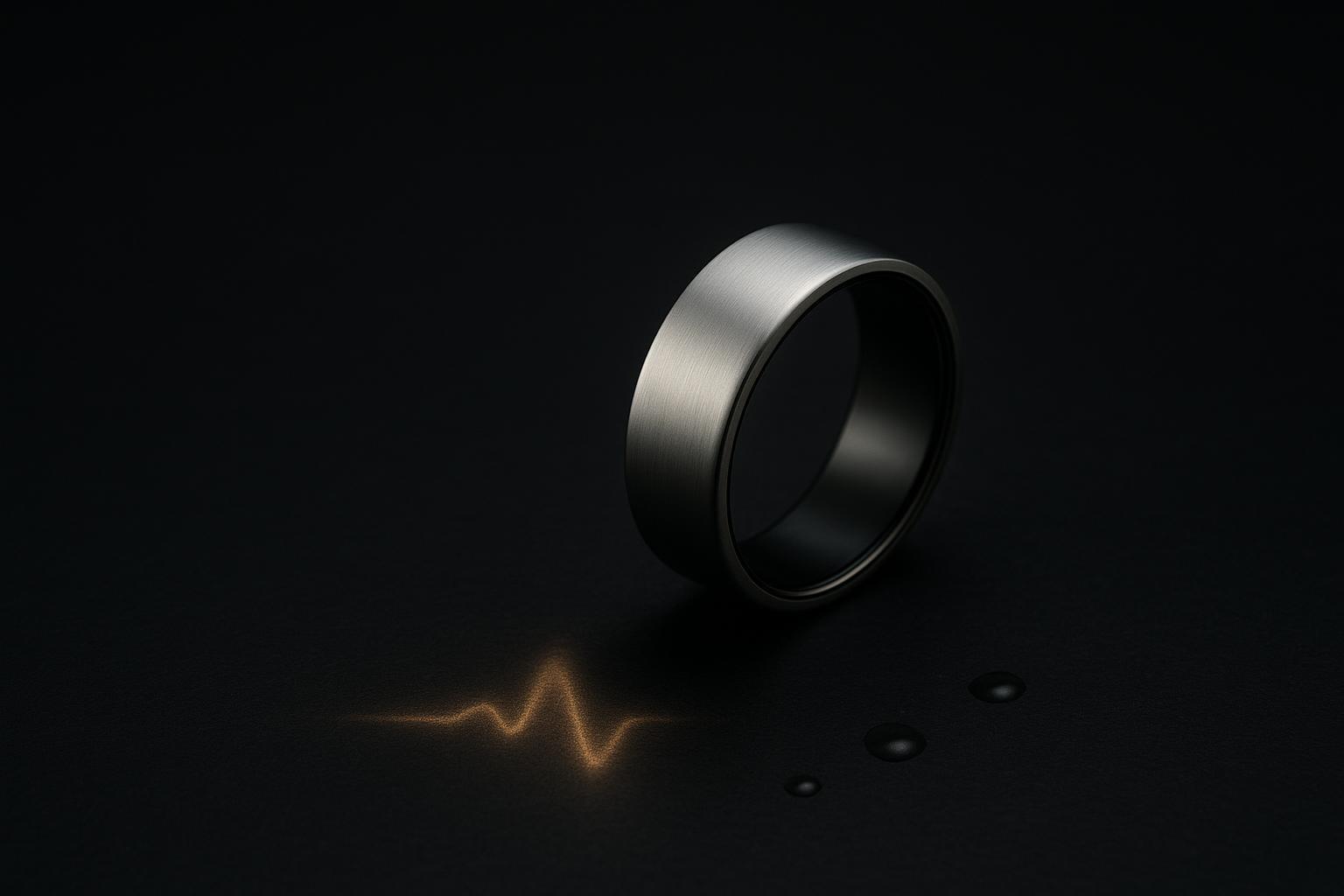
For VERTU, the Vertu Aura Ring Ultra is positioned as an ultra-thin ring with a high-precision PPG sensor and no subscription fee. It’s also explicitly labeled as not being a medical device, which matters for how you interpret any tracking output.
Waterproofing FAQ
Is the Aura Ring waterproof?
The Vertu Aura Ring Ultra is described as “5ATM water-resistant,” and the product page notes it is suitable for swimming but not designed for diving or high-pressure water sports. That’s the practical interpretation, not just the rating number.
Is the Oura Ring waterproof?
Oura’s official guidance is that the ring is water-resistant up to 100 meters and suitable for showering and swimming, but it is not recommended for scuba diving, and Oura advises avoiding keeping it submerged for more than 12 hours. See Oura’s Product Safety & Use water-resistance guidance.
What to do before you swim with any smart ring
Rinse after salt water or chlorine.
Avoid “high-pressure water” scenarios (think jet skis, pressure washers, hard impacts) even if the rating looks high.
If your ring has a charger pin/dock system, keep the contacts dry before charging.
Collector’s note: Water resistance is a materials and sealing conversation, not a marketing badge. The limit clauses are the real spec.
Sizing FAQ
Oura ring sizing: do I need a sizing kit?
Yes. Oura explicitly recommends using a sizing kit because its sizes differ from standard ring sizing. Oura also recommends wearing the sizing ring for at least 24 hours, including while sleeping, before finalizing your size. See Oura’s official How to Choose the Right Oura Ring Size.
How tight should a smart ring fit?
Snug, not painful. You want consistent sensor contact without cutting off circulation. A good fit should resist easy spinning and sliding, but still be removable (soap and water helps).
Which finger is best for sleep and stress tracking?
Oura recommends the index finger for best accuracy, with middle or ring finger as good options. The bigger point is consistency: pick a finger you can wear all night, every night.
What if I’m between sizes?
Oura recommends choosing the smaller size for a more secure fit. This matters because loose fit causes micro-gaps, and those gaps are where signal quality degrades first.
What about Vertu Aura Ring Ultra sizing?
The Vertu Aura Ring Ultra product page shows inner size options and emphasizes an ultra-slim 2 mm profile and lightweight build. If you’re choosing between sizes, prioritize the fit that stays stable through sleep, travel swelling, and temperature changes. You can start at the Vertu Aura Ring Ultra page and confirm sizing before purchase.
Battery and charging FAQ
How long does a smart ring battery last?
Expect multiple days, not multiple weeks. Oura’s General FAQs list typical battery ranges that vary by model, and explicitly note that size, app settings, and usage affect real battery life. See Oura’s General FAQs on battery and charging.
How long does the Aura Ring Ultra battery last?
The Vertu Aura Ring Ultra product page states “up to 7 days of battery life,” and also lists “Battery Life: 5-7 days.” See the specs on the Vertu Aura Ring Ultra page.
How long does it take to charge?
Charging time varies by device and current battery level. Oura says a full charge can take 20-80 minutes depending on battery level. See Oura’s General FAQs.
Battery habits that protect tracking consistency
Top up during predictable windows (shower, desk time) instead of running to 0%.
Sync daily if your ring model stores limited offline data.
If you travel constantly, pack the charger. Your sleep data is only as continuous as your charging discipline.
Sleep FAQ
Are smart rings for sleep actually better than a watch?
For many people, yes, simply because a ring is easier to wear overnight. Comfort is not cosmetic. If you don’t wear it, you don’t track.
That said, a watch can still be better for workout metrics with lots of arm movement. The decision is about what you need to wear 24/7.
Aura ring for sleep: what should I look for?
Prioritize three things: comfort, stable fit, and battery that lasts through your normal week. If a ring is thin, light, and doesn’t demand a subscription to unlock basics, the odds you’ll actually keep wearing it go up.
The Vertu Aura Ring Ultra is positioned around an ultra-thin 2 mm profile and no subscription fee, which tends to matter for long-term wear.
What should I do if my sleep data looks wrong?
First, check fit. Most “bad sleep tracking” complaints trace back to a ring that shifts at night. Then check wear consistency, and finally check whether you’re interpreting a single-night anomaly as a trend.
How to verify: Compare your ring’s sleep start and wake time to what you remember for a week. If the timing is consistently off, fix the fit before you blame the algorithm.
Stress tracking FAQ
How does the Aura Ring measure stress?
Smart rings generally do not measure psychological stress directly. They estimate physiological strain by looking at changes in heart signals (from PPG), HRV patterns, temperature trends, and motion context.
For a concrete, well-documented example, Oura’s Daytime Stress feature is based on physiological inputs, and Oura describes it as tracking your individual physiological stress during waking hours. Oura also documents that contributors to Daytime Stress values include HRV, heart rate, motion/activity context, and skin temperature, with baselines based on your personal data. See Oura’s Daytime Stress support article and the Oura white paper PDF.
For VERTU, the Vertu Aura Ring Ultra lists a high-precision PPG sensor and “fatigue insights.” Without more published methodology on the product page, the responsible interpretation is that stress and fatigue outputs are wellness insights based on physiological signals, not medical diagnoses.
Why does my ring say I’m stressed when I feel fine?
Because it’s reading the body, not your subjective state. Caffeine, dehydration, travel, low sleep, and even a hard conversation can all produce physiological responses that look similar in the sensors.
What’s the difference between stress and recovery?
Stress is a strain signal. Recovery is the rebound. When your sleep quality, HRV trends, and resting heart rate patterns improve, many ring ecosystems interpret that as better readiness.
Steps, activity, and “is it accurate?” FAQ
Do smart rings track steps?
Many do. Step counts on rings are typically estimated from movement sensors and pattern recognition. They’re useful for consistency, but they’re not a courtroom-grade record.
Are smart rings accurate?
Accurate enough for trend decisions, as long as you interpret them correctly. The safest way to use a smart ring is to compare you to you: your baseline this month versus your baseline last month.
Also note the medical boundary. The Vertu Aura Ring Ultra explicitly states it is not a medical device and should not be used for diagnosis or treatment. See the disclaimer on the Vertu Aura Ring Ultra page.
The simplest accuracy upgrade you can do
Commit to one finger, one fit, and consistent wear. Then look at seven-day patterns, not one-night swings.
Next steps (for buyers)
If you’re at the decision point, don’t over-optimize. Pick the ring you’ll actually wear every night, that fits your lifestyle, and that doesn’t hide core insights behind a paywall.
- Find Your Aura RingStart with the Vertu Aura Ring Ultra.
- Learn More About Aura Ring UltraReview the full specs and FAQ on the Vertu Aura Ring Ultra page.
If you want a broader category comparison first, VERTU’s guide on best smart rings with no subscription is a good place to calibrate what matters.
And if purchase safety matters more than discounts, use this Where to buy Vertu Smart Ring guide to avoid grey-market risk.
Disclosure: This article references VERTU pages. Editorial judgment remains the priority.