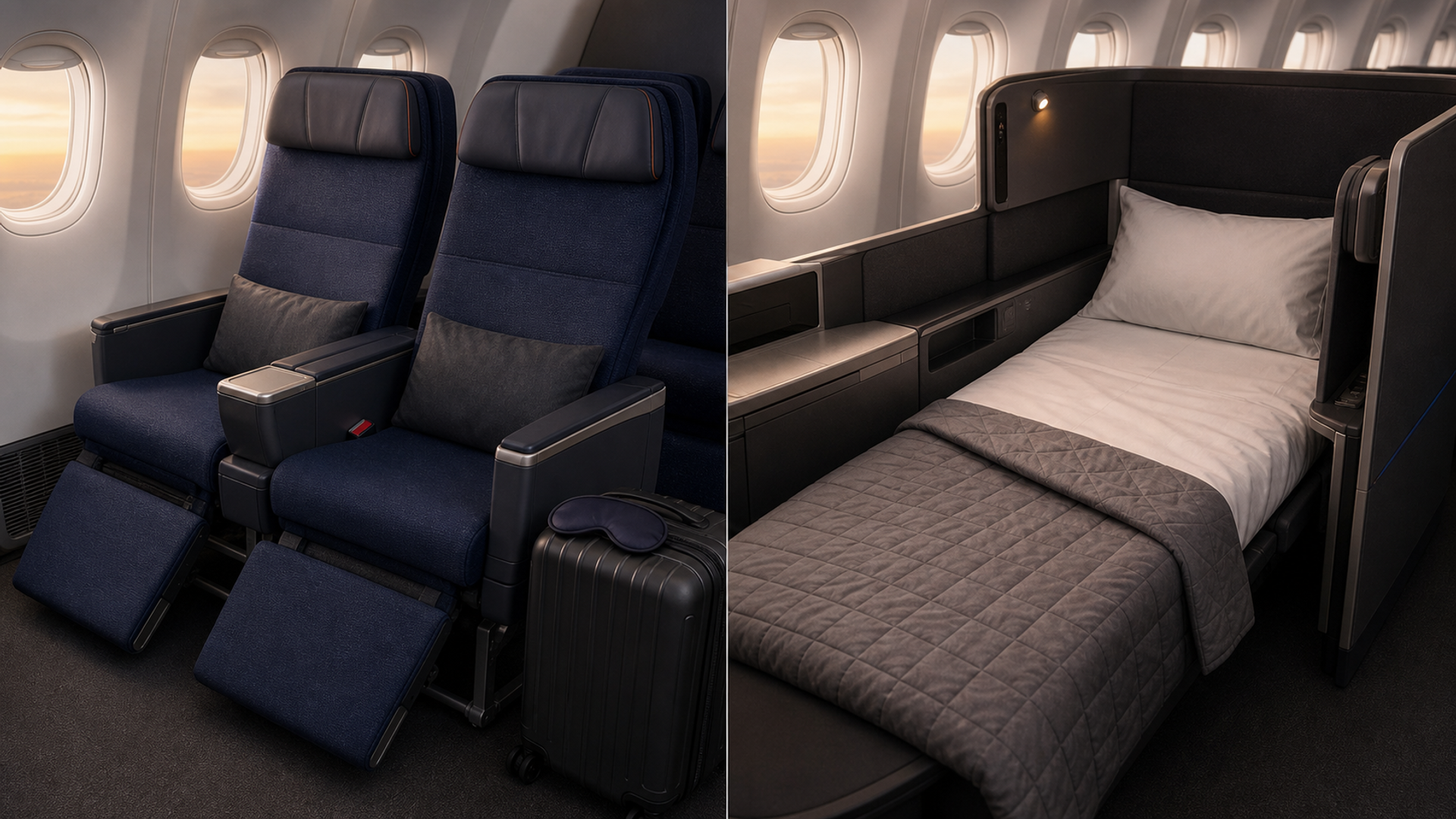
American Airlines Premium Economy is the rational choice when you want a wider recliner, priority treatment and an improved meal without paying for a lie-flat bed. Business Class is the meaningful upgrade on the right long-haul aircraft because it adds horizontal sleep, more privacy, direct aisle access in many configurations and qualifying lounge access. Route, aircraft and arrival schedule decide whether that difference is worth the fare.
This guide compares American Airlines Premium Economy vs Business Class as a complete journey. It does not assume every Business ticket has the same seat or every airport provides the same lounge benefit.
Quick answer
Choose Premium Economy for daytime long-haul flights, comfortable leisure arrivals and large fare gaps. Choose Business Class for overnight flights, immediate commitments, privacy-sensitive work or a useful connection at an airport where your ticket qualifies for premium lounge access.
The upgrade is easiest to justify when three conditions align: the confirmed aircraft has a lie-flat Business seat, the flight contains a meaningful sleep window, and your arrival day has little recovery time. If one condition is missing, Premium Economy often captures most of the useful comfort at a much lower cost.
Comparison at a glance
| Decision factor | Premium Economy | Business Class | What to confirm |
|---|---|---|---|
| Seat | Wider adjustable leather recliner with leg and foot support | Wider premium seat; lie-flat on relevant long-haul aircraft | Exact aircraft and seat map |
| Sleep | Improved seated rest | Flat-bed potential on long-haul configuration | Route, aircraft and sleep window |
| Aisle access | Usually shared by paired seats | Commonly direct on the long-haul product | Seat map, not cabin photo |
| Airport | Priority privileges | Priority plus qualifying lounge access | Ticket designation and airport |
| Dining | Chef-inspired meal and complimentary drinks on relevant service | Larger menu and premium dining | Flight and service schedule |
| Baggage | Often two checked bags on relevant international ticket | Business allowance, often two or more by route | Current booking-specific rule |
| Best value | Day flight and budget discipline | Night flight and arrival readiness | Fare gap and cancellation terms |
Start with the operating aircraft
American’s official Premium Economy page lists the product on selected international and domestic flights using aircraft including the 777-300, international 787-8, 787-9 and 777-200. It describes wider adjustable seats, more legroom, footrests and headrests. Those are substantial changes from Main Cabin, but the seat remains a recliner.
American’s Business Class overview is deliberately route-aware: the product and seat depend on where and how you fly. Long-haul Flagship Business and shorter international Business should not be treated as identical. Some shorter services do not offer lie-flat seating.
Open the seat map before buying. Confirm the operating carrier, aircraft type, seat orientation and direct aisle access. Then recheck after a schedule-change notice. A codeshare sold by American but operated by a partner follows the partner’s aircraft and onboard product.
The practical difference is sleep autonomy
Premium Economy improves body angles. The wider seat, extra pitch, adjustable support and smaller cabin can reduce fatigue. It works well for travellers who can nap upright and want to arrive less stiff without buying a bed.
On a qualifying long-haul aircraft, Business changes the sleep proposition. A lie-flat surface lets you choose when to sleep and move without crossing a neighbour. The value is not luxury theatre; it is autonomy. You can skip dinner, convert the seat early, stand when needed and preserve a larger uninterrupted block.
The bed is most valuable on an eastbound overnight flight where local time compresses the night. It is less important on a westbound daytime flight when most passengers remain awake. Direction can therefore reverse the answer on the outbound and return of the same ticket.
Calculate the premium by protected outcome
Do not ask whether Business is “twice as good”. Compare the extra fare with the specific outcome it protects.
Build a four-line ledger:
Sleep hours gained: your realistic recliner sleep versus flat-bed sleep.
Ground time gained: only confirmed lounge, priority or connection benefits.
Arrival value: what happens in the first eight hours after landing.
Failure cost: what an exhausted arrival, missed connection or inflexible fare would cost.
If the upgrade adds $900 and protects three useful hours, the cost is $300 per hour. That may be poor value on holiday and entirely rational before a negotiation. If an airline sale reduces the difference, run the calculation again. Cabin hardware is fixed; fare value is not.
Also compare flexibility. A lower Business fare with harsh cancellation terms can be less useful than a flexible Premium Economy fare on an uncertain itinerary. Include seat fees, change conditions, baggage and mileage only when they differ for the actual ticket.
Lounge access: Business has the advantage, with conditions
American states that qualifying Business itineraries may access a Flagship Lounge at selected hubs or an Admirals Club elsewhere. The official Business page defines qualifying long-haul and selected transcontinental contexts. Premium Economy does not carry the same cabin-based lounge proposition.
That difference matters during a long connection, especially when you need a meal, power, a shower or a quieter workspace. It matters little when your connection is 45 minutes or the lounge is far from the gate. Check the airport, terminal and same-day ticket before assigning a cash value.
American also offers premium assistance in selected markets, but it is a separate service and should not be assumed to be included with the cabin. Airline services, third-party airport handling and a personal concierge each have different responsibilities.
For eligible users, VERTU Concierge may help coordinate flights, airport fast-track options, chauffeurs, hotels or dining where available and subject to terms. It cannot override American’s fare rules, guarantee lounge entry, secure an unavailable seat or prevent an equipment swap. The value is coordinating the itinerary around the airline, not claiming control over it.
Baggage and priority benefits are close, not identical
American’s current product overview gives Premium Economy priority check-in, security and boarding, plus priority bag handling. Business provides similar priority treatment, with a stronger ground proposition on qualifying Flagship itineraries. The difference can be smaller than buyers expect if they already hold elite status.
American’s fees and baggage information shows that allowances depend on region, cabin, issue date and itinerary. The airline’s 2026 agency product overview lists two checked bags for Premium Economy and Business in its US-point-of-commencement framework, while some premium tickets can differ. Use the booking confirmation as the governing evidence.
Do not double-pay for status benefits. If your loyalty tier already provides priority, baggage and lounge access, the incremental ground value of Business may shrink. The bed may still justify it; the checklist simply prevents counting the same benefit twice.
Dining matters more on daylight sectors
Premium Economy includes a more considered meal and complimentary beverages on eligible service. Business offers a larger menu and premium presentation. On a daylight flight, meal pacing, workspace and attentive service can be a meaningful part of the journey.
On an overnight flight, food can compete with sleep. A two-hour meal service may consume half a short eastbound sleep window. Decide whether you will eat before departure, take a quick meal or skip it. A cabin should be valued for what you will use, not what the menu promises.
Special meals, specific wines and individual dishes can change. They should be treated as variable amenities. Seat category, lounge eligibility and baggage rules are more durable decision factors.
Three scenarios that change the answer
Overnight to London before a meeting
Business is usually stronger if the exact aircraft offers a flat bed and the morning cannot move. Premium Economy may save money but leaves the traveller seated during the most valuable recovery window.
Daytime return to the United States
Premium Economy can capture most of the comfort benefit when you plan to remain awake. A direct schedule may matter more than a flat bed, particularly if Business requires an extra connection.
Couple travelling for leisure
Two adjacent Premium Economy seats can provide a calm shared experience without paying for two Business fares. The savings may buy better accommodation or a longer trip. Business becomes stronger when one traveller cannot sleep upright or the arrival day is tightly scheduled.
Internal comparisons worth making
Do not compare only cabins on one airline. Compare the complete itinerary against another carrier with a better schedule, aircraft or connection. The best business-class airlines guide provides a route-seat-lounge framework rather than a brand ranking.
The Singapore Airlines Premium Economy vs Business Class comparison shows why aircraft and route can change the answer. Use it as a method, not as evidence for American’s product.
Pre-booking checklist
Is the flight American-operated?
Which aircraft and Business seat does the seat map show?
Is the sector overnight in your body clock?
How many useful hours can the flat bed protect?
Does the exact Business ticket qualify for the lounge you intend to use?
Do status or a credit card already provide overlapping benefits?
What are the cancellation, change and equipment-substitution terms?
Is the arrival day valuable enough to justify the premium?
If those questions do not produce clear answers, keep the booking flexible. A cabin decision based on verified facts is more valuable than an impressive fare that solves the wrong problem.
Final verdict
American Airlines Premium Economy is the disciplined choice for better space and service on a journey that does not require a bed. Business Class earns its premium when the confirmed aircraft, sleep window, lounge access and arrival day all make use of the difference. Verify the operating product, count only non-duplicated benefits and buy for the journey’s hardest segment.
Sources
American Airlines, Premium Economy, accessed 2 August 2026.
American Airlines, Business, accessed 2 August 2026.
American Airlines, Bag and optional fees, accessed 2 August 2026.