

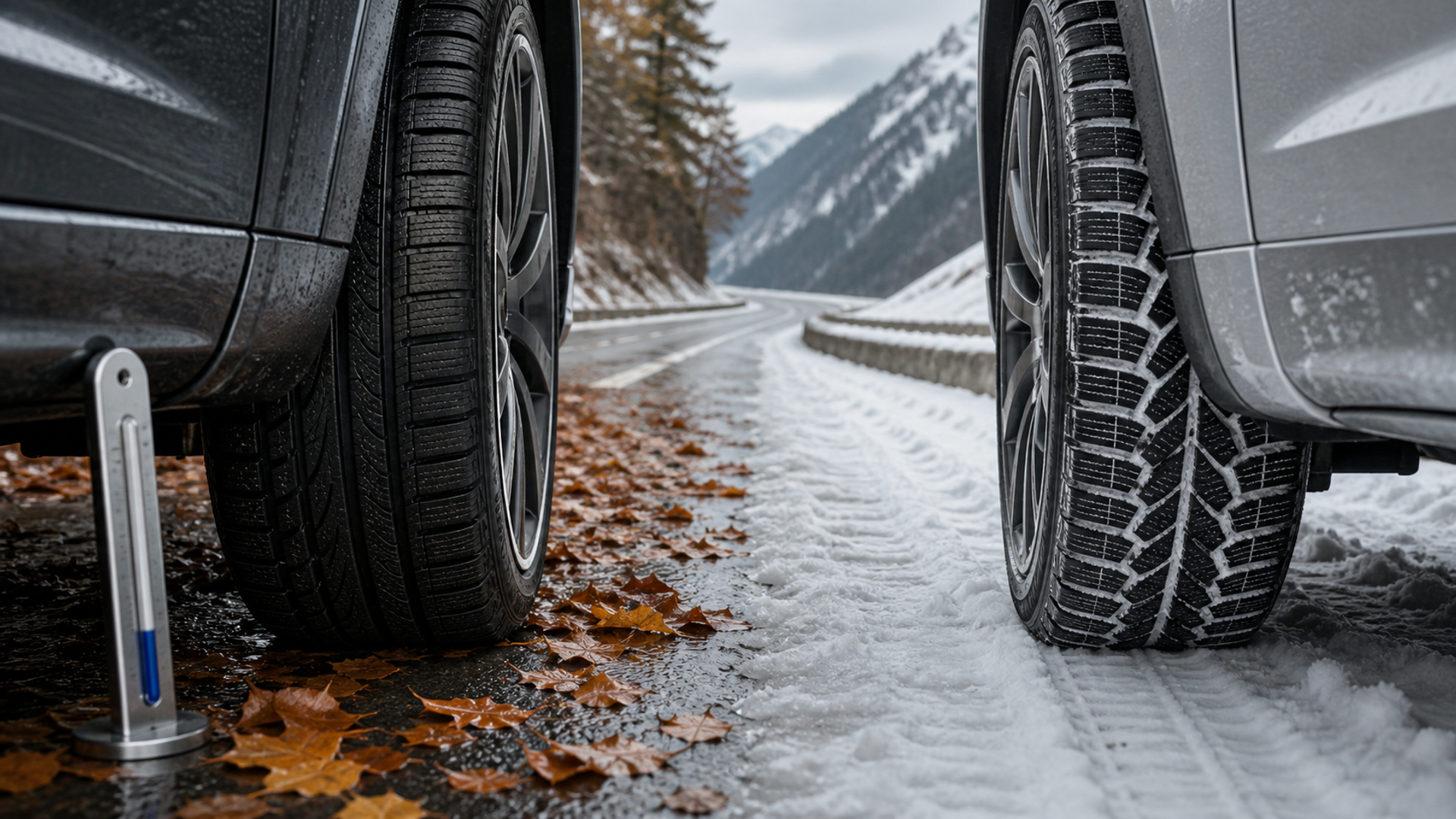
All-season and winter tyres are not a simple durability-versus-grip trade. Their compounds, tread patterns and certification targets are designed for different temperature and surface envelopes, while exact models within each category vary. Winter capability also depends on tread depth, age, pressure and whether all four positions match. The defensible plan starts with the coldest routine journey, frequency of snow and ice, legal requirements, storage and changeover access—not the mildest day of the year.
Temperature and road define the tyre brief
Choose all-season tyres where winters are mainly mild and wet, severe conditions are rare and the exact model meets the route. Choose winter tyres for repeated cold, snow or ice when four matched tyres can be installed and stored correctly. Use a seasonal or qualified all-weather strategy when conditions cross both envelopes and model-specific independent tests support it.
| Decision factor | All-season tyres | Winter tyres | Use a seasonal or all-weather strategy |
|---|---|---|---|
| Temperature | Designed for a broad compromise | Compound and tread target colder conditions | Use local daily minima, not annual average |
| Deep snow | Capability varies and may be limited | Winter designs are generally more effective | Confirm exact certification and test |
| Wet mild roads | Can perform strongly by exact model | Some winters trade warm-weather response | Compare the intended temperature range |
| Changeover | One set reduces logistics | Two sets require timing, storage and inspection | Book before seasonal demand peaks |
| Wear | Year-round use concentrates wear on one set | Warm use can accelerate winter wear | Log tread at fixed intervals |
| Vehicle systems | ABS and AWD still depend on tyre contact | The same dependency applies | Fit four compatible tyres |
This all season vs winter tyres matrix is the article's working value object. Read the all season vs winter tyres rows together: the decisive failure mode depends on this topic's evidence, operating context and reader objective.
Category names do not replace model tests
Evidence 1. Michelin's seasonal-tyre guidance links winter compounds and tread to cold, snow and ice while describing all-season designs as a broader compromise.
Evidence 2. NHTSA tyre guidance states that winter tyres are more effective than all-season tyres in deep snow and recommends choosing for local weather.
Evidence 3. AWD can help distribute drive torque but cannot recreate the braking and cornering grip of a tyre suited to the surface.
Evidence 4. Mixing categories, sizes, wear levels or incompatible constructions can disturb predictable handling and may conflict with vehicle guidance.
Reader-visible sources checked for this article:
michelinman.com — reader-visible current or official evidence
michelinman.com — reader-visible current or official evidence
For all season vs winter tyres, these sources establish only the claims inside their documented scope. Recheck every changeable specification, availability condition, price, policy or service term in the relevant market before acting.
Measure a full cold-season route
A buyer can resolve temperature without starting from a brand preference. Ask whether designed for a broad compromise; compare that with whether compound and tread target colder conditions; then use use local daily minima, not annual average as the third route's safeguard. An unknown condition stays unknown.
On deep snow, popularity is not enough. The evidence for option one is that capability varies and may be limited. Option two means winter designs are generally more effective. Option three is rational where confirm exact certification and test. Recheck any changeable term immediately before commitment.
The decision changes at wet mild roads. Choose the first path only if can perform strongly by exact model; move to the second when some winters trade warm-weather response; use the third when compare the intended temperature range. Save the downside that would make this row fail.
For changeover, the first route works when one set reduces logistics; the second requires two sets require timing, storage and inspection. The control for the third is book before seasonal demand peaks. Verify this row against the exact product, property, account or environment before it can reverse the decision.
The wear row exposes a practical boundary. Route one assumes year-round use concentrates wear on one set, while route two is defensible only when warm use can accelerate winter wear. Route three depends on log tread at fixed intervals. If that evidence is absent, keep the more reversible option.
Read vehicle systems as a stop/go test: aBS and AWD still depend on tyre contact supports the first option; the same dependency applies supports the second; and fit four compatible tyres supports the third. Record which source proves the condition and when it was checked.
Facts that would reverse the current choice
Reversal control 1 — Temperature. Before choosing All-season tyres, write down how the decision changes if “Designed for a broad compromise” proves false. Do the same for Winter tyres and “Compound and tread target colder conditions”. Keep the Use a seasonal or all-weather strategy route available until “Use local daily minima, not annual average” is verified. This control belongs to all season vs winter tyres; update it from the cited source or exact supplier rather than copying a generic checklist.
Reversal control 2 — Deep snow. Before choosing All-season tyres, write down how the decision changes if “Capability varies and may be limited” proves false. Do the same for Winter tyres and “Winter designs are generally more effective”. Keep the Use a seasonal or all-weather strategy route available until “Confirm exact certification and test” is verified. This control belongs to all season vs winter tyres; update it from the cited source or exact supplier rather than copying a generic checklist.
Reversal control 3 — Wet mild roads. Before choosing All-season tyres, write down how the decision changes if “Can perform strongly by exact model” proves false. Do the same for Winter tyres and “Some winters trade warm-weather response”. Keep the Use a seasonal or all-weather strategy route available until “Compare the intended temperature range” is verified. This control belongs to all season vs winter tyres; update it from the cited source or exact supplier rather than copying a generic checklist.
Reversal control 4 — Changeover. Before choosing All-season tyres, write down how the decision changes if “One set reduces logistics” proves false. Do the same for Winter tyres and “Two sets require timing, storage and inspection”. Keep the Use a seasonal or all-weather strategy route available until “Book before seasonal demand peaks” is verified. This control belongs to all season vs winter tyres; update it from the cited source or exact supplier rather than copying a generic checklist.
Reversal control 5 — Wear. Before choosing All-season tyres, write down how the decision changes if “Year-round use concentrates wear on one set” proves false. Do the same for Winter tyres and “Warm use can accelerate winter wear”. Keep the Use a seasonal or all-weather strategy route available until “Log tread at fixed intervals” is verified. This control belongs to all season vs winter tyres; update it from the cited source or exact supplier rather than copying a generic checklist.
Reversal control 6 — Vehicle systems. Before choosing All-season tyres, write down how the decision changes if “ABS and AWD still depend on tyre contact” proves false. Do the same for Winter tyres and “The same dependency applies”. Keep the Use a seasonal or all-weather strategy route available until “Fit four compatible tyres” is verified. This control belongs to all season vs winter tyres; update it from the cited source or exact supplier rather than copying a generic checklist.
Map the coldest route
Log temperature, snow depth, ice, untreated roads, gradients and emergency obligations for a whole season. Mark journeys that cannot be postponed. For this all-season versus winter tyres decision, keep the exact item, setting, date and test condition in one evidence log. Separate a measured result from category shorthand and repeat the check in the intended environment. If severe exposure is frequent, reverse a convenience-led all-season choice. If that reversal condition appears, reopen the decision instead of defending the earlier preference.
Verify exact markings
Record size, load, speed rating, date code, tread depth and recognised winter or severe-snow marking. Cross-check the vehicle manual and local law. For this all-season versus winter tyres decision, keep the exact item, setting, date and test condition in one evidence log. Separate a measured result from category shorthand and repeat the check in the intended environment. If the exact tyre lacks required certification, reject it regardless of category copy. If that reversal condition appears, reopen the decision instead of defending the earlier preference.
Compare model tests
Use tests at relevant temperatures and surfaces rather than one aggregated score. Separate braking, lateral grip, aquaplaning, noise and wear. For this all-season versus winter tyres decision, keep the exact item, setting, date and test condition in one evidence log. Separate a measured result from category shorthand and repeat the check in the intended environment. If the result changes by surface, choose for the highest-consequence condition. If that reversal condition appears, reopen the decision instead of defending the earlier preference.
Plan the changeover
Secure storage, transport, torque checks, pressure checks and appointment windows. Photograph tread and damage at every swap. For this all-season versus winter tyres decision, keep the exact item, setting, date and test condition in one evidence log. Separate a measured result from category shorthand and repeat the check in the intended environment. If logistics make timely fitting unreliable, redesign the strategy. If that reversal condition appears, reopen the decision instead of defending the earlier preference.
Audit ageing and wear
Measure all four tyres at fixed points and record rotations and repairs. Replace by condition and legal or maker limits, not visual optimism. For this all-season versus winter tyres decision, keep the exact item, setting, date and test condition in one evidence log. Separate a measured result from category shorthand and repeat the check in the intended environment. If one axle differs materially, restore a matched set before comparison. If that reversal condition appears, reopen the decision instead of defending the earlier preference.
Four climates, four answers
Mild coastal winter
A strong all-season model may cover wet and occasional cold use. Define the fact that would reverse this recommendation before committing.
Mountain commute
Four winter tyres and disciplined timing can be the defensible plan. Define the fact that would reverse this recommendation before committing.
City driver able to stay home in snow
Convenience may outweigh capability that is rarely used. Define the fact that would reverse this recommendation before committing.
Long-distance mixed climate
A seasonal plan should follow the most consequential route, not the home postcode alone. Define the fact that would reverse this recommendation before committing.
Action checklist
Log winter temperatures.
Map untreated roads.
Check local law.
Read vehicle manual.
Verify size and load.
Verify winter marking.
Compare exact tests.
Plan four matching tyres.
Book changeover.
Plan storage.
Measure tread.
Record reversal threshold.
Continue the decision
The linked VERTU articles expand adjacent parts of the all season vs winter tyres decision. They do not substitute for the external evidence above.
The all-season-versus-winter-tyre verdict
Choose all-season tyres where winters are mainly mild and wet, severe conditions are rare and the exact model meets the route. Choose winter tyres for repeated cold, snow or ice when four matched tyres can be installed and stored correctly. Use a seasonal or qualified all-weather strategy when conditions cross both envelopes and model-specific independent tests support it.
Keep the all season vs winter tyres decision reversible until its material cost, safety, access, privacy and compatibility facts are verified. Unknown evidence stays unknown; it is never silently scored as favourable.
![How to Scan Receipts and Documents with Your Phone [Full Guide]](https://cdn.sanity.io/images/e0gp1l2g/production/0db13feec1d5e72b8a8a5f976d1f3e86619c9228-3840x1860.webp?w=180&h=180&q=78&auto=format&fit=crop)
![How to Scan Receipts and Documents with Your Phone [Full Guide]](https://cdn.sanity.io/images/e0gp1l2g/production/0db13feec1d5e72b8a8a5f976d1f3e86619c9228-3840x1860.webp?w=800&h=450&q=82&auto=format&fit=crop)
![Top 10 Two-Tone Carbon-Fibre Watches for Men [2026 List]](https://cdn.sanity.io/images/e0gp1l2g/production/18870799ba33fab0e038968359cd5772d7d7db30-1024x576.webp?w=800&h=450&q=82&auto=format&fit=crop)
![Top 10 Luxury Watches with Digital Complication Displays for Men [Latest]](https://cdn.sanity.io/images/e0gp1l2g/production/c4f6bf8c080f291c39f7cc85c7344ecff2fd3799-1024x553.webp?w=800&h=450&q=82&auto=format&fit=crop)