

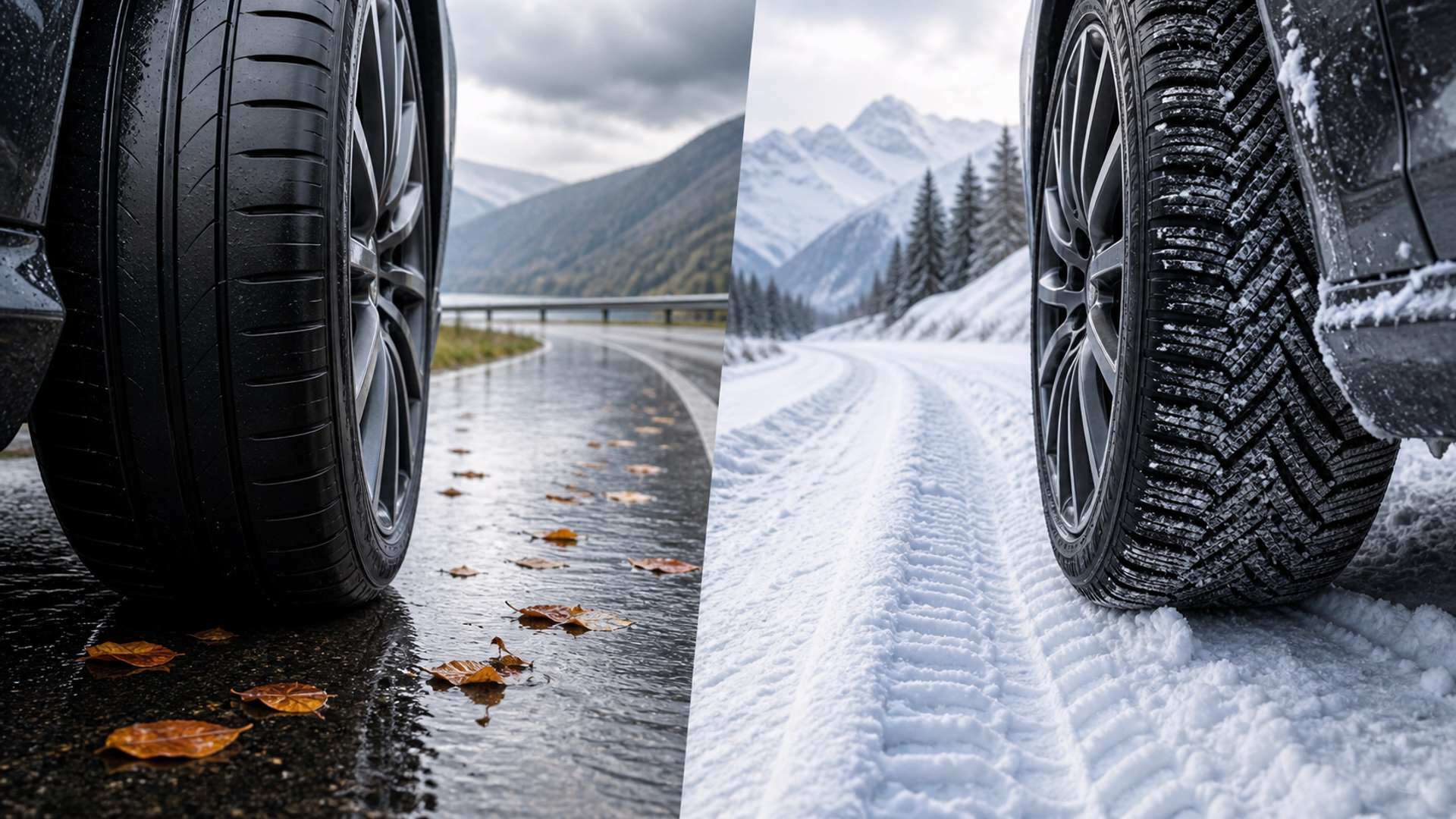
All-season and all-weather are market terms, not a universal performance guarantee. In North American usage, all-weather tyres commonly add severe-snow certification while retaining year-round intent; many all-season tyres prioritise mild conditions and longer warm-weather use. The sidewall marks, exact model tests, local law and temperature range matter more than the category name.
Start with temperature and law
Choose all-season tyres for mild climates without sustained winter conditions. Choose all-weather tyres when one set must cover meaningful cold and certified snow capability. Choose dedicated summer and winter sets when seasonal extremes, mountain travel, braking margin or local rules justify the storage and changeover burden.
| Decision factor | All-season tyres | All-weather tyres | Dedicated seasonal sets |
|---|---|---|---|
| Winter severity | Freezing and snow are rare | Cold and moderate snow recur | Severe or prolonged winter justifies a winter set |
| Certification | The required local marks are not needed | The exact tyre carries the required severe-snow mark | Winter certification and compound suit the harsh season |
| Summer demand | Heat and dry-road response dominate | Balanced year-round performance is acceptable | A dedicated summer set protects warm-season response |
| Driving route | Maintained urban roads dominate | Mixed roads require one-set resilience | Mountain or remote routes demand greater margin |
| Storage and swaps | One set is operationally simplest | One certified set avoids changeovers | Secure storage and timely swaps are available |
| Replacement | Tread and age are monitored for mild use | Winter capability is rechecked as tread wears | Both sets are tracked separately |
This all season vs all weather tires matrix is the article's working value object. Read the all season vs all weather tires rows together: the decisive failure mode depends on this topic's evidence, operating context and reader objective.
Read the tyre, not the marketing phrase
Evidence 1. Michelin distinguishes summer, all-season and winter-oriented tyre categories while directing buyers to exact model, climate and vehicle requirements.
Evidence 2. The three-peak mountain snowflake mark indicates that a tyre met a defined severe-snow acceleration test; it does not guarantee equal braking and ice performance across all models.
Evidence 3. Tyre performance changes with tread depth, age, pressure, load and temperature, so a certification mark is not a lifetime guarantee.
Evidence 4. Vehicle placard size, load index and speed rating remain mandatory constraints even when a different seasonal category appears attractive.
Reader-visible sources checked for this article:
michelinman.com — reader-visible current or official evidence
michelinman.com — reader-visible current or official evidence
For all season vs all weather tires, these sources establish only the claims inside their documented scope. Recheck every changeable specification, availability condition, price, policy or service term in the relevant market before acting.
Model a full year of grip
The decision changes at winter severity. Choose the first path only if freezing and snow are rare; move to the second when cold and moderate snow recur; use the third when severe or prolonged winter justifies a winter set. Save the downside that would make this row fail.
For certification, the first route works when the required local marks are not needed; the second requires the exact tyre carries the required severe-snow mark. The control for the third is winter certification and compound suit the harsh season. Verify this row against the exact product, property, account or environment before it can reverse the decision.
The summer demand row exposes a practical boundary. Route one assumes heat and dry-road response dominate, while route two is defensible only when balanced year-round performance is acceptable. Route three depends on a dedicated summer set protects warm-season response. If that evidence is absent, keep the more reversible option.
Read driving route as a stop/go test: maintained urban roads dominate supports the first option; mixed roads require one-set resilience supports the second; and mountain or remote routes demand greater margin supports the third. Record which source proves the condition and when it was checked.
A buyer can resolve storage and swaps without starting from a brand preference. Ask whether one set is operationally simplest; compare that with whether one certified set avoids changeovers; then use secure storage and timely swaps are available as the third route's safeguard. An unknown condition stays unknown.
On replacement, popularity is not enough. The evidence for option one is that tread and age are monitored for mild use. Option two means winter capability is rechecked as tread wears. Option three is rational where both sets are tracked separately. Recheck any changeable term immediately before commitment.
Facts that would reverse the current choice
Reversal control 1 — Winter severity. Before choosing All-season tyres, write down how the decision changes if “Freezing and snow are rare” proves false. Do the same for All-weather tyres and “Cold and moderate snow recur”. Keep the Dedicated seasonal sets route available until “Severe or prolonged winter justifies a winter set” is verified. This control belongs to all season vs all weather tires; update it from the cited source or exact supplier rather than copying a generic checklist.
Reversal control 2 — Certification. Before choosing All-season tyres, write down how the decision changes if “The required local marks are not needed” proves false. Do the same for All-weather tyres and “The exact tyre carries the required severe-snow mark”. Keep the Dedicated seasonal sets route available until “Winter certification and compound suit the harsh season” is verified. This control belongs to all season vs all weather tires; update it from the cited source or exact supplier rather than copying a generic checklist.
Reversal control 3 — Summer demand. Before choosing All-season tyres, write down how the decision changes if “Heat and dry-road response dominate” proves false. Do the same for All-weather tyres and “Balanced year-round performance is acceptable”. Keep the Dedicated seasonal sets route available until “A dedicated summer set protects warm-season response” is verified. This control belongs to all season vs all weather tires; update it from the cited source or exact supplier rather than copying a generic checklist.
Reversal control 4 — Driving route. Before choosing All-season tyres, write down how the decision changes if “Maintained urban roads dominate” proves false. Do the same for All-weather tyres and “Mixed roads require one-set resilience”. Keep the Dedicated seasonal sets route available until “Mountain or remote routes demand greater margin” is verified. This control belongs to all season vs all weather tires; update it from the cited source or exact supplier rather than copying a generic checklist.
Reversal control 5 — Storage and swaps. Before choosing All-season tyres, write down how the decision changes if “One set is operationally simplest” proves false. Do the same for All-weather tyres and “One certified set avoids changeovers”. Keep the Dedicated seasonal sets route available until “Secure storage and timely swaps are available” is verified. This control belongs to all season vs all weather tires; update it from the cited source or exact supplier rather than copying a generic checklist.
Reversal control 6 — Replacement. Before choosing All-season tyres, write down how the decision changes if “Tread and age are monitored for mild use” proves false. Do the same for All-weather tyres and “Winter capability is rechecked as tread wears”. Keep the Dedicated seasonal sets route available until “Both sets are tracked separately” is verified. This control belongs to all season vs all weather tires; update it from the cited source or exact supplier rather than copying a generic checklist.
Build a temperature calendar
Use actual overnight and driving temperatures, snow days, mountain trips and road-clearing patterns. Avoid deciding from one unusual storm or the word all in a product name.
Read the sidewall
Verify size, load index, speed rating, production date and required snow mark on the exact tyre. Save the model code because a family can contain different specifications.
Compare independent tests
Look for braking, wet grip, snow and wear results at relevant sizes and temperatures. Treat one acceleration test or retailer rating as incomplete evidence.
Plan replacement before winter
Measure tread depth, inspect ageing and book changeovers early. A once-capable tyre can lose useful winter margin before it reaches the legal minimum.
Three climate patterns
Warm coastal city
All-season tyres can provide the strongest balance when freezing conditions are genuinely rare. Define the fact that would reverse this recommendation before committing.
Variable four-season region
All-weather tyres can suit a one-set owner who verifies snow certification and accepts warm-season trade-offs. Define the fact that would reverse this recommendation before committing.
Mountain winter travel
Dedicated winter and summer sets may provide the safer seasonal margin when storage and swaps are practical. Define the fact that would reverse this recommendation before committing.
Action checklist
Check local tyre law.
Record winter temperatures.
List mountain journeys.
Read vehicle placard.
Verify sidewall marks.
Check exact model tests.
Measure tread depth.
Inspect production date.
Plan storage.
Set seasonal review dates.
Continue the decision
The linked VERTU articles expand adjacent parts of the all season vs all weather tires decision. They do not substitute for the external evidence above.
The seasonal-tyre verdict
Choose all-season tyres for mild climates without sustained winter conditions. Choose all-weather tyres when one set must cover meaningful cold and certified snow capability. Choose dedicated summer and winter sets when seasonal extremes, mountain travel, braking margin or local rules justify the storage and changeover burden.
Keep the all season vs all weather tires decision reversible until its material cost, safety, access, privacy and compatibility facts are verified. Unknown evidence stays unknown; it is never silently scored as favourable.
![How to Scan Receipts and Documents with Your Phone [Full Guide]](https://cdn.sanity.io/images/e0gp1l2g/production/0db13feec1d5e72b8a8a5f976d1f3e86619c9228-3840x1860.webp?w=180&h=180&q=78&auto=format&fit=crop)
![How to Scan Receipts and Documents with Your Phone [Full Guide]](https://cdn.sanity.io/images/e0gp1l2g/production/0db13feec1d5e72b8a8a5f976d1f3e86619c9228-3840x1860.webp?w=800&h=450&q=82&auto=format&fit=crop)
![Top 10 Two-Tone Carbon-Fibre Watches for Men [2026 List]](https://cdn.sanity.io/images/e0gp1l2g/production/18870799ba33fab0e038968359cd5772d7d7db30-1024x576.webp?w=800&h=450&q=82&auto=format&fit=crop)
![Top 10 Luxury Watches with Digital Complication Displays for Men [Latest]](https://cdn.sanity.io/images/e0gp1l2g/production/c4f6bf8c080f291c39f7cc85c7344ecff2fd3799-1024x553.webp?w=800&h=450&q=82&auto=format&fit=crop)