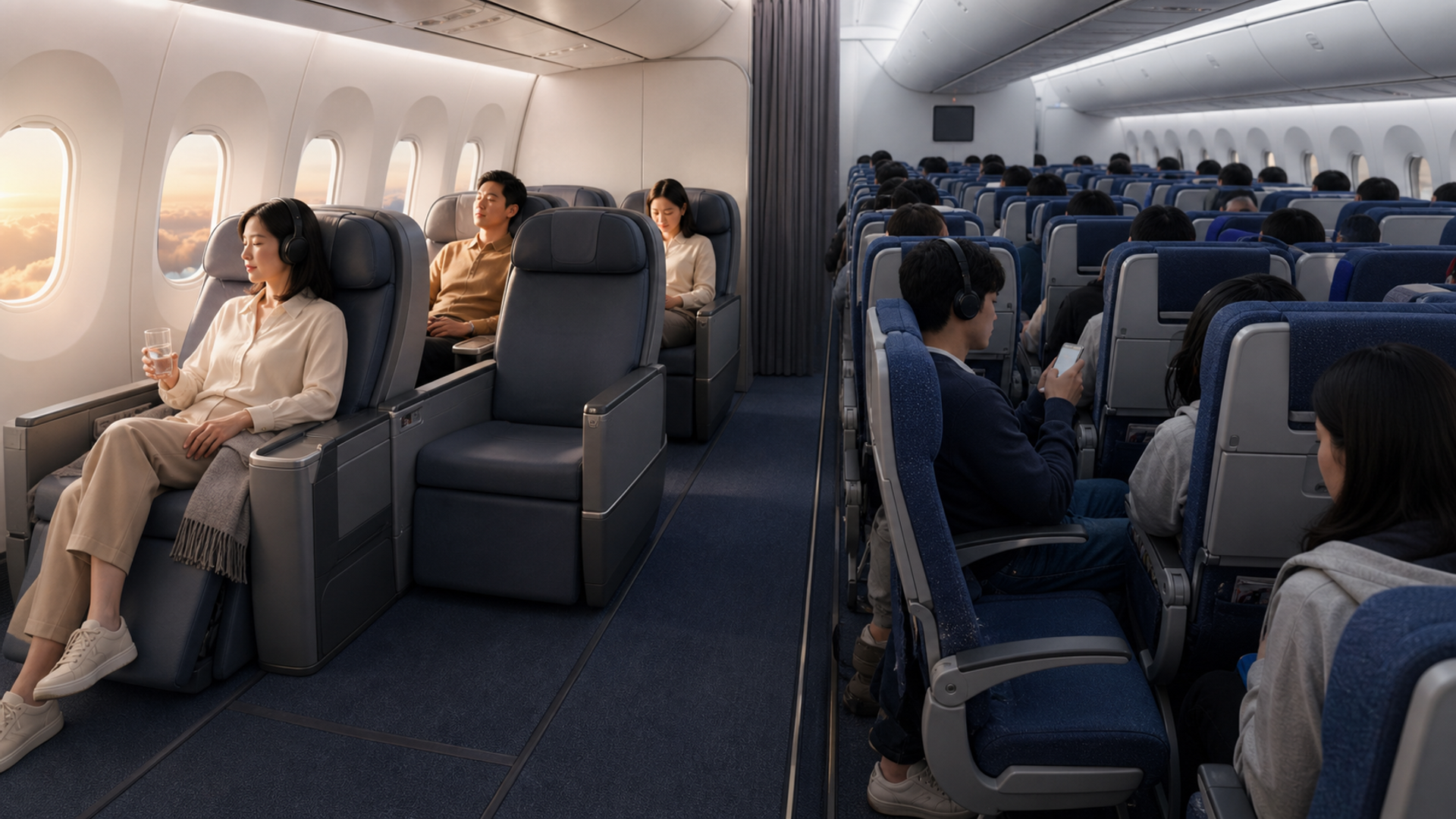
Premium-air-travel decisions often fail because a familiar brand name is treated as a complete product specification. In reality, the useful choice is narrower: Wide Premium, Economy or another carrier's business class on a particular itinerary, date and fare. The difference can affect sleep, connection risk, privacy, airport time and the condition in which a traveller arrives.
This guide is built for that decision. It uses current official material, a live inventory check and a concrete value matrix. It does not promise a particular aircraft, seat, lounge admission, hotel, tour, route or schedule. Operational details can change, so the final verification must happen against the exact booking.
The short answer
Choose Wide Premium when its defining advantage is central to the journey and the live booking confirms it. Choose Economy when it solves the main problem at a lower or more practical total cost. Choose another carrier's business class when schedule, simplicity or value matters more than the headline premium feature. The correct answer can change between an overnight flight, a daytime sector, a short connection and a leisure stop.
Decision matrix
| Decision | Wide Premium | Economy | another carrier's business class |
|---|---|---|---|
| Best use | When the defining premium feature will be used | When the middle option solves most of the need | When schedule or simplicity dominates |
| Main risk | Paying for a feature not confirmed on the exact itinerary | Assuming a similar name means an identical product | Saving money but creating an avoidable comfort or timing problem |
| Verification | Exact flight, date, operating carrier and live seat or service page | Fare bundle, location and current availability | Connection, restrictions and total journey cost |
| Value test | Would the trip outcome materially improve? | Is the incremental benefit sufficient? | Is the compromise acceptable for this duration? |
The matrix is deliberately conditional. It prevents a one-size-fits-all verdict and keeps schedule, fare rules and operational certainty in the same frame as comfort.
What the official material confirms
Air Premia's official 787 information lists Wide Premium with a 42-inch pitch and 20-inch width in a 2-3-2 layout on a referenced 309-seat configuration, compared with Economy at 35 inches and 18 inches in 3-3-3. The carrier also lists priority processes, a larger baggage allowance and included meal or beverage elements for Wide Premium. Configuration and fare conditions must be checked for the exact flight. The source set is reader-visible here: airpremia.com and airpremia.com and airpremia.com.
Official pages describe the intended product. They do not guarantee that a particular aircraft, lounge, benefit or service remains unchanged on the day of travel. That is why the decision workflow below separates a published specification from a live booking check.
What 42 inches changes
The seven-inch pitch difference over the listed 35-inch Economy row changes knee clearance, recline conflict and the ability to move during a long flight. It does not create a flat bed.
Use the number as a space indicator, then check footrest, row and seat width. A bulkhead may feel different from a standard row even with the same cabin label. For a premium-cabin purchase, the practical unit of comparison is the exact flight and seat map, not the airline's best publicity image. Compare Wide Premium, Economy, another carrier's business class on the same itinerary conditions so the decision is not distorted by different dates, fare rules or connection risks. A strong result is one that still makes sense after a schedule change, an aircraft substitution or a busy travel day.
Two-three-two versus three-three-three
Wide Premium reduces the number of seats across, making side pairs attractive and reducing middle-seat probability. Economy's 3-3-3 layout is efficient but creates more neighbour interaction.
Pairs should target the two-seat side. A solo traveller should compare aisle availability and price before assuming the small cabin is always worth it. For a premium-cabin purchase, the practical unit of comparison is the exact flight and seat map, not the airline's best publicity image. Compare Wide Premium, Economy, another carrier's business class on the same itinerary conditions so the decision is not distorted by different dates, fare rules or connection risks. A strong result is one that still makes sense after a schedule change, an aircraft substitution or a busy travel day.
Width and armrests
The listed 20-inch Wide Premium seat offers more personal space than the 18-inch Economy seat in the referenced layout, with independent armrests adding separation.
Check the exact configuration and whether fixed consoles narrow usable hip space. Published width is useful, but body fit is personal. For a premium-cabin purchase, the practical unit of comparison is the exact flight and seat map, not the airline's best publicity image. Compare Wide Premium, Economy, another carrier's business class on the same itinerary conditions so the decision is not distorted by different dates, fare rules or connection risks. A strong result is one that still makes sense after a schedule change, an aircraft substitution or a busy travel day.
Ground and baggage benefits
Dedicated check-in, priority boarding, baggage handling and a larger allowance can turn the upgrade into an airport-product decision as well as a seat decision.
Value only the benefits that solve a real problem. A hand-luggage-only traveller on a quiet departure may gain little from extra baggage. For a premium-cabin purchase, the practical unit of comparison is the exact flight and seat map, not the airline's best publicity image. Compare Wide Premium, Economy, another carrier's business class on the same itinerary conditions so the decision is not distorted by different dates, fare rules or connection risks. A strong result is one that still makes sense after a schedule change, an aircraft substitution or a busy travel day.
Meals and long-haul routine
Included meal and beverage service reduces uncertainty, while Economy inclusions vary by route and fare. The seat remains the durable difference.
Read the route-specific service page and carry essentials. Catering should not be the main reason for a four-figure upgrade gap. For a premium-cabin purchase, the practical unit of comparison is the exact flight and seat map, not the airline's best publicity image. Compare Wide Premium, Economy, another carrier's business class on the same itinerary conditions so the decision is not distorted by different dates, fare rules or connection risks. A strong result is one that still makes sense after a schedule change, an aircraft substitution or a busy travel day.
Where it sits in the market
Wide Premium is designed as a premium-economy proposition, not a budget business-class bed. Its value comes from unusually generous recliner space at the right price.
Compare it first with other premium-economy fares, then with discounted business only when sleep value justifies the larger jump. For a premium-cabin purchase, the practical unit of comparison is the exact flight and seat map, not the airline's best publicity image. Compare Wide Premium, Economy, another carrier's business class on the same itinerary conditions so the decision is not distorted by different dates, fare rules or connection risks. A strong result is one that still makes sense after a schedule change, an aircraft substitution or a busy travel day.
Match the choice to the traveller
| Traveller scenario | Priority | Recommended approach |
|---|---|---|
| Solo overnight traveller | Sleep, privacy and certainty | Target Wide Premium only when the exact product is confirmed and the schedule creates a real sleep window |
| Couple or colleagues | Adjacency and communication | Compare seat or space geometry before defaulting to Wide Premium |
| Daytime leisure trip | Space and experience | Price Economy against the actual hours of use |
| Time-critical executive | Arrival condition and disruption risk | Put schedule reliability and change flexibility ahead of novelty; another carrier's business class can be correct |
| Family or mobility-sensitive traveller | Access, assistance and reach | Verify assistance, seat restrictions and physical layout before payment |
A recommendation becomes useful only when it names the traveller and consequence. 'Best' without an itinerary is packaging, not a decision. A traveller arriving for a board meeting values rest and schedule protection differently from someone beginning a holiday. Similarly, a short daytime sector cannot monetise a bed or extended stop in the same way as an overnight journey.
Exact-itinerary verification checklist
Confirm the marketing and operating carrier; codeshares can change the product and benefit rules.
Record the aircraft, cabin, seat map, terminal or programme shown for the exact flight and date.
Read the fare conditions, including changes, refunds, baggage, seat selection and upgrade treatment.
Check whether the key feature is guaranteed, scheduled, capacity-controlled or merely described as available.
Recheck before the free-change or cancellation deadline and again at check-in.
Keep essential medicine, chargers, documents and overnight items in hand luggage.
Build a fallback that still works after a late aircraft swap, lounge closure, weather delay or missed connection.
Do not make a non-refundable purchase solely because an article, review or old seat map showed the preferred product.
This process does not eliminate operational change. It reduces the chance that a traveller pays for a promise the booking never made. It also makes a later service conversation easier because the original evidence and conditions are documented.
How to decide whether the premium is worth it
Start with the incremental cost, then divide it by the hours in which the benefit can actually be used. That is only the first pass. Add the value of sleep, reduced recovery time, a safer connection, baggage, flexibility and ground handling when those outcomes matter. Subtract the value of benefits that duplicate status, credit-card access or services already included elsewhere.
Use three thresholds. Below the first, take the better product because the downside is small. Between the first and second, require the exact preferred configuration and a meaningful travel consequence. Above the second, choose only when the trip is unusually important or the alternative creates a known problem. Set those thresholds before searching so scarcity and attractive cabin photography do not move the budget.
Points require the same discipline. A low mileage figure can hide surcharges, inflexibility or a poor schedule. Compare the complete itinerary and the opportunity cost of the points, not just the cabin label.
Final verdict
The best choice is not automatically the newest or most expensive. Wide Premium wins when its defining feature is live, usable and consequential. Economy wins when it captures most of the benefit without the full premium. another carrier's business class wins when timing, certainty or simplicity protects the journey better than a headline upgrade.
For adjacent planning, see our best premium-economy airlines guide. For adjacent planning, see our business travel luggage guide. Recheck the official source and live booking before payment, because this guide is a decision framework rather than a promise of availability.