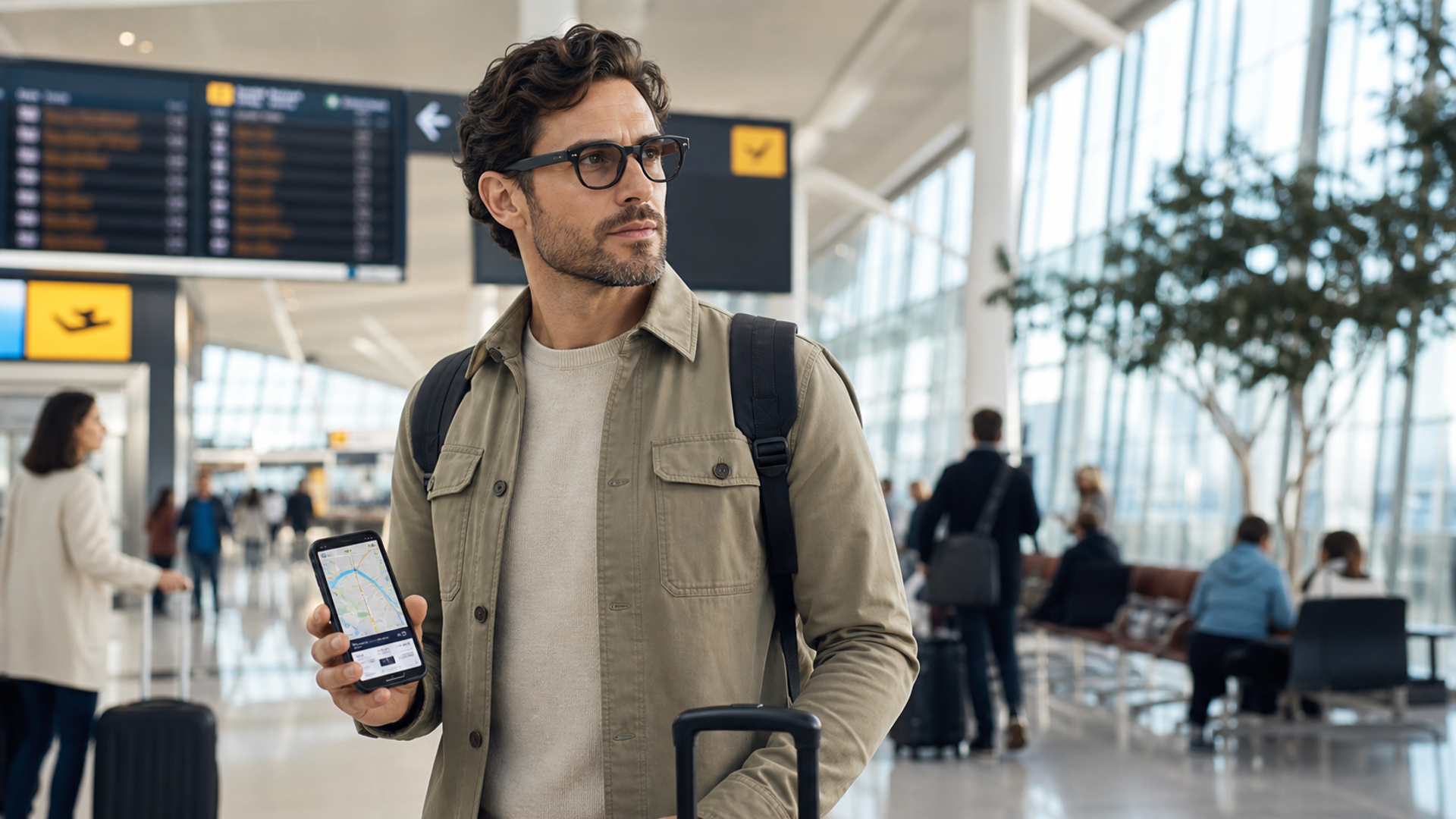
AI glasses can replace some of the moments when a traveller reaches for a phone: taking a quick point-of-view photo, asking a simple question, listening to directions, translating a short exchange or playing audio. They cannot yet replace the phone as the dependable centre of a journey. Tickets, identity documents, payments, detailed maps, hotel apps, secure messages, camera review and emergency communication still make the smartphone essential. This analysis is supported by Apple iPhone 17 Pro specifications. For the adjacent decision, see our AI-glasses capture LED privacy guide.
The sensible 2026 setup is not glasses instead of a phone. It is glasses for low-friction capture and assistance, with the phone retained for confirmation, transactions and anything sensitive.
The travel capability matrix
| Task | AI glasses | Smartphone | Better choice |
|---|---|---|---|
| Quick hands-free photo | Immediate point-of-view capture | Better framing, zoom and review | Glasses for spontaneity; phone for control |
| Translation | Natural for brief face-to-face exchanges where supported | Easier to read, correct and show to another person | Phone for consequential conversations |
| Walking directions | Audio prompts keep eyes up | Full map, route alternatives and transport details | Glasses for simple final steps; phone for planning |
| Boarding pass and booking | Limited display or no display on many models | Mature airline, rail and hotel apps | Smartphone |
| Payment | Not a universal glasses function | Established wallet and banking support | Smartphone |
| Calls and messages | Convenient audio, but socially exposed | Better privacy and message control | Smartphone for confidential communication |
| Long-form research | Short contextual answers | Large screen, browser tabs and source checking | Smartphone |
| Battery management | Another device to charge | Larger battery and wider charging options | Smartphone as the primary device |
Where AI glasses genuinely improve a trip
The strongest use case is reducing interruption. A traveller walking through a market can capture a short clip without stopping, unlocking a phone and viewing the scene through a screen. Someone carrying luggage can hear a turn without holding a map. A short translation can happen while both people maintain eye contact.
Meta's current AI glasses overview describes hands-free capture, AI assistance, live translation and forthcoming pedestrian navigation across supported markets and languages. Those functions are meaningful because they change posture and attention, not because they reproduce every phone application on the face.
Glasses also create a more natural audio layer than repeatedly wearing and removing earbuds. For museum notes, a remembered landmark or a quick voice query, that can make the journey feel less mediated.
Why the smartphone remains the travel anchor
Travel is full of high-consequence screens. A passenger needs to inspect the spelling on a visa form, compare two train routes, find a booking reference, confirm a payment amount or show a hotel address to a driver. These tasks benefit from a stable display and deliberate confirmation.
A phone is also the recovery device when another service fails. It can open email when an airline app loses a booking, call a bank when a payment is declined, download an offline map, tether a laptop and store copies of documents. AI glasses generally rely on a paired phone, a network connection or both for their broadest functions. Leaving the phone behind can therefore remove the system that makes the glasses useful.
The camera difference matters as well. Glasses capture what the wearer sees, but not necessarily what the wearer intended. A phone provides lens choice, exposure control, a review screen and the ability to frame without turning one's head. For a fleeting memory, glasses may be better. For architecture, food, portraits or a photograph worth keeping, the phone is usually the more controllable tool.
Translation: convenience is not confirmation
Live translation is compelling in a café or while asking for directions. It should not be treated as an invisible interpreter for medical, legal, immigration or financial conversations. Accents, background noise, names and local expressions can change meaning. Language availability also varies by market and software release.
Use glasses for low-risk exchanges, then move consequential text to a phone where both parties can read it. Save the original wording, check names and numbers, and ask a human interpreter when an error would materially affect the traveller.
Privacy changes when the camera is worn
A phone raised at arm's length is a familiar social signal. A camera in eyewear is easier for another person to miss. Meta says its glasses use a white capture LED and that covering or disabling the LED disables the camera. That is a useful design boundary, but etiquette still belongs to the wearer.
Do not record airport security, private meetings, hotel staff, children, religious spaces or strangers in close conversation merely because capture is effortless. Local rules and venue policies differ. The safest habit is direct consent before recording a person and a visible switch back to the phone when the purpose needs to be obvious.
For executives, the privacy question extends inward. Voice queries may contain itinerary, client or location information. Review which account stores requests, what is retained, which permissions are enabled and whether the glasses can be used without exposing information through open speakers. Sensitive work belongs on an approved device and channel, not whichever wearable is most convenient.
Battery and failure planning
Treat glasses as a companion battery, not the last battery. Continuous capture, calls, translation and audio can consume power differently from occasional use. Charging cases help but add another object to track. Before departure, test a realistic day rather than relying on a headline figure: airport, flight, navigation, several photos and an evening call.
The minimum resilient kit is:
a phone with offline maps and key bookings downloaded;
AI glasses for optional hands-free moments;
a compact power bank and the correct cables;
one written or printed route and accommodation address;
account recovery methods that do not depend on the glasses.
Who should buy AI glasses for travel?
They make sense for travellers who already wear glasses or sunglasses, take frequent point-of-view photos, use audio navigation and accept that some features depend on region and connection. They are also useful when hands are often occupied: parents, cyclists where lawful, photographers carrying other equipment and people moving through unfamiliar streets.
They are a weaker purchase for someone who dislikes voice interfaces, spends most travel time in confidential meetings, wants a zoom camera, or expects one wearable to replace tickets, wallet, phone and headphones. Prescription availability, fit, lens options and repair arrangements should be confirmed before purchase.
The packing verdict
Bring both, but give them different authority. AI glasses can own capture, short questions and simple audio guidance. The smartphone should own identity, money, detailed navigation, source checking, secure communication and recovery.
That division preserves what is attractive about glasses—the ability to remain present—without pretending that travel has become simple enough to run from a device with little or no screen. The phone stays in the pocket more often, but it does not stay at home.