Introduction
Battery life is still the fastest way to turn a “flagship” phone into a liability. For business teams, that usually shows up as missed calls at the wrong time, a dead 2FA prompt at the airport, or a field tech finishing the last hour of a shift in low-power mode.
This guide is for IT leaders, procurement, and role owners who need to choose business smartphones with best battery performance in 2026, without relying on marketing claims or one-off “battery drain” videos. Use it as a framework first, and as a short list second.
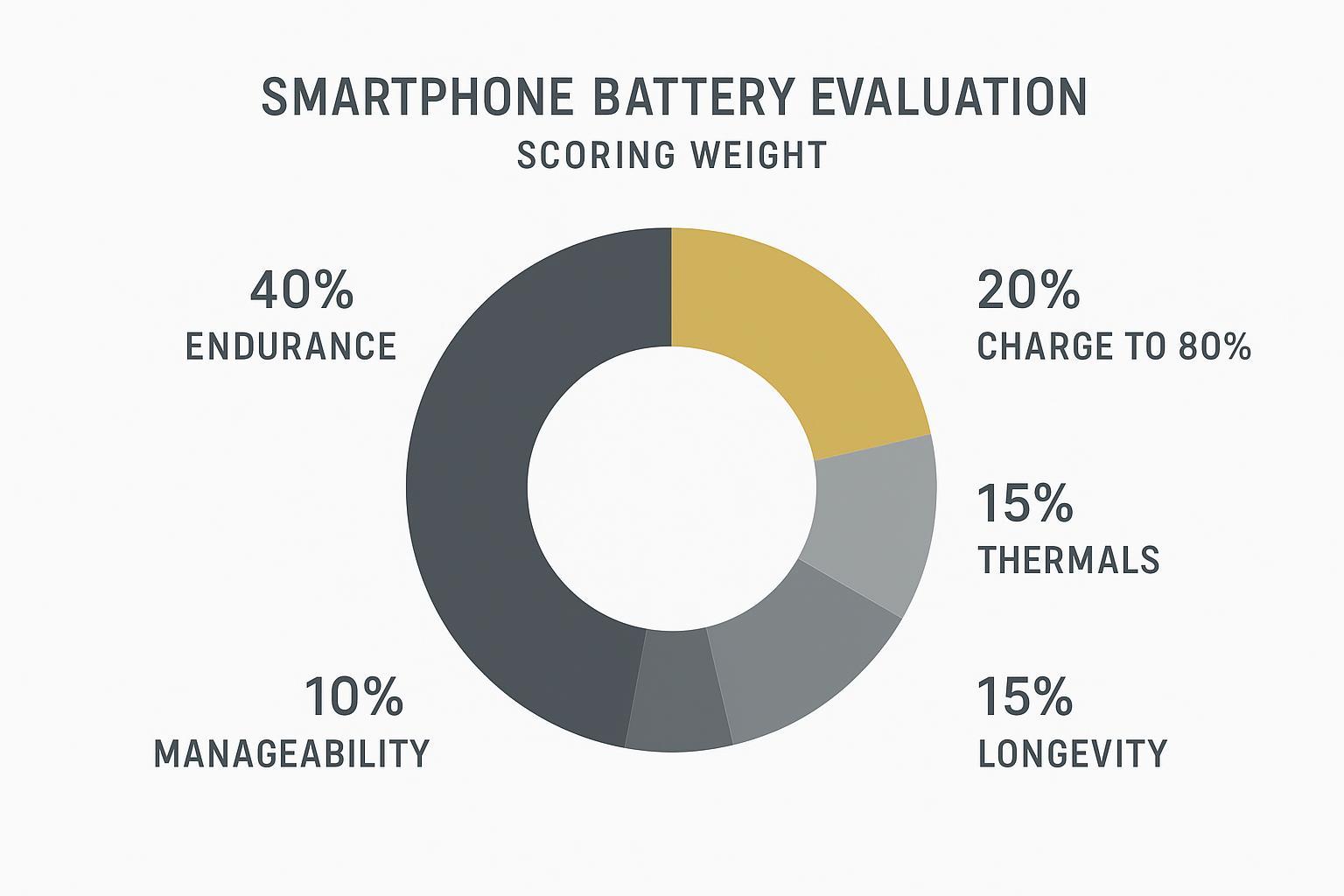
In 2026, “best battery performance” isn’t just maximum screen-on time. For business use it means:
Endurance across mixed workloads (mail, messaging, maps, camera, hotspot, calls)
Fast charging that doesn’t run hot or age the battery prematurely
Predictable battery health over a multi-year support window
Fleet manageability, because battery drain is often an app-policy problem, not a hardware problem
The scoring approach below weights endurance most, then treats charging behavior, thermals, longevity, and manageability as enterprise-grade tie-breakers.
How we test and score
We are not running a single synthetic test and calling it a day. Business battery performance is situational: signal strength, background policies, display settings, and charging routines matter. The goal is repeatable evaluation, not a single “winner.”
Endurance metrics
We score endurance based on three repeatable patterns that map to real work:
- Web + comms loopbrowsing, email sync, chat, and notifications
- Video + conferencingstreaming plus camera/mic use at realistic brightness
- High-drain burstsnavigation, hotspot, camera capture, and file upload
If you want a public benchmark methodology to sanity-check your own internal testing, PhoneArena documents a simple three-test model (browsing, video, gaming) in its Phone Battery Test Results & methodology.
Charging & safety
For business devices, charging speed is only useful if it stays controlled.
What we look for:
Time to 80%, not time to 100% (most fast-charge curves slow down after ~80%)
Thermal behavior under fast charge (heat is the enemy of longevity)
- Charging options that match policywired fast charge at desks, predictable car charging, and safe travel adapters
Longevity & manageability
Endurance on day one is less important than endurance in month eighteen.
We score longevity and manageability by checking whether the platform and vendor ecosystem supports:
Battery health visibility (and whether it is actionable)
Background app controls and MDM enforcement
Update window clarity and parts/service paths
Key TakeawayIn enterprise fleets, battery complaints often point to background policy drift (chat apps, location wakes, VPN behavior), not a “bad battery.”
2026 battery tech brief
Battery progress in 2026 comes from two directions: better chemistry in the same space, and better efficiency under mixed workloads.
Silicon–carbon status
Silicon–carbon (often discussed as silicon-anode or Si/C) batteries are one reason many recent flagships can fit higher capacity without making devices unreasonably thick.
In plain terms: silicon can store more lithium than graphite, but it expands during charge. Manufacturers stabilize it with carbon structures and other engineering controls. The result is higher energy density, with trade-offs that depend on thermal management and long-term cycle behavior.
For a grounded overview of why this is showing up in more phones (and why not every vendor adopts it at the same time), see CNET’s explainer Phone Batteries Keep Getting Better… and what silicon-carbon changes and Tom’s Guide’s reporting on the shift in flagships Silicon-carbon batteries are the next big thing in phones.
Capacity vs efficiency
For business buyers, capacity numbers are a starting point, not a conclusion.
A larger battery helps, but radio conditions (5G vs Wi‑Fi, travel roaming, weak indoor signal) can erase the advantage.
Efficiency gains come from modem behavior, CPU scheduling, and display power management. That is why two phones with similar “headline capacity” can feel different at the end of a long day.
A practical way to evaluate efficiency without trusting spec sheets: run a controlled workday script with fixed brightness, standardized conferencing time, and a defined navigation window, then repeat it in weak-signal conditions.
Thermals & stability
If you only track one non-obvious metric, track heat.
Hot charging, hot car dashboards, and constant high-power fast charging are the patterns that quietly shorten battery health. For business fleets, the hidden cost is operational: a phone that needs a mid-day top-up after 18 months forces different workflows than one that does not.
How to verifyDuring a standard fast-charge session, feel for sustained warmth around the upper back of the phone and check whether the device throttles (screen dimming, slowed charging). Thermal control is often more important than peak wattage.
Role-based picks
Different roles drain phones in different ways. Pick by usage shape first.
Executive travel
Executive travel is a battery trap: navigation, roaming radios, VPN, camera scanning, and a full day of messaging. The phone also becomes a security token, not just a handset.
If you travel with a higher privacy posture, the goal is straightforward: a device and service model that supports secure workflows without turning power management into a daily negotiation.
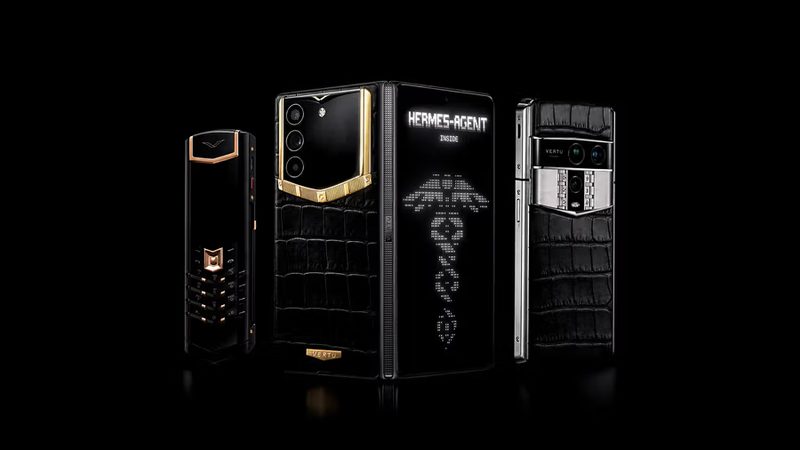
This is one context where a luxury-oriented device like VERTU can be relevant without changing your evaluation criteria. The practical point is not status. It is the expectation that the phone is part of a managed security-and-service relationship, with the user assuming:
A consistent security posture for sensitive comms and account access
Predictable all-day power for travel days, where charging access is intermittent
Support that behaves more like concierge escalation than consumer troubleshooting
Keep the same battery discipline: test your actual travel day (roaming, hotspot bursts, boarding passes, VPN) and focus on thermal behavior while charging in transit.
Field operations
Field operations need phones that survive long shifts, harsh radio conditions, and high-drain bursts.
Prioritize:
Stable endurance under navigation + camera capture
Fast charging that does not overheat in vehicles or on portable power
A clear battery service path (repairable battery or fast swap device pool)
If your field teams carry multiple managed apps, battery performance is often decided by policy. The best phone is the one where your MDM can actually enforce the background rules that stop silent drain.
Road warriors
Road warriors are not “executives,” but they live on conference calls and car charging.
Prioritize:
Strong efficiency on mixed Wi‑Fi/5G days
Predictable charge-to-80% when you have 15–25 minutes between meetings
Long update windows, because replacement churn is expensive
Road warriors also reveal the most common battery killer in enterprises: unmanaged notifications + always-on location + “just install this one more app.” Your device choice should assume that reality.
Top picks and specs
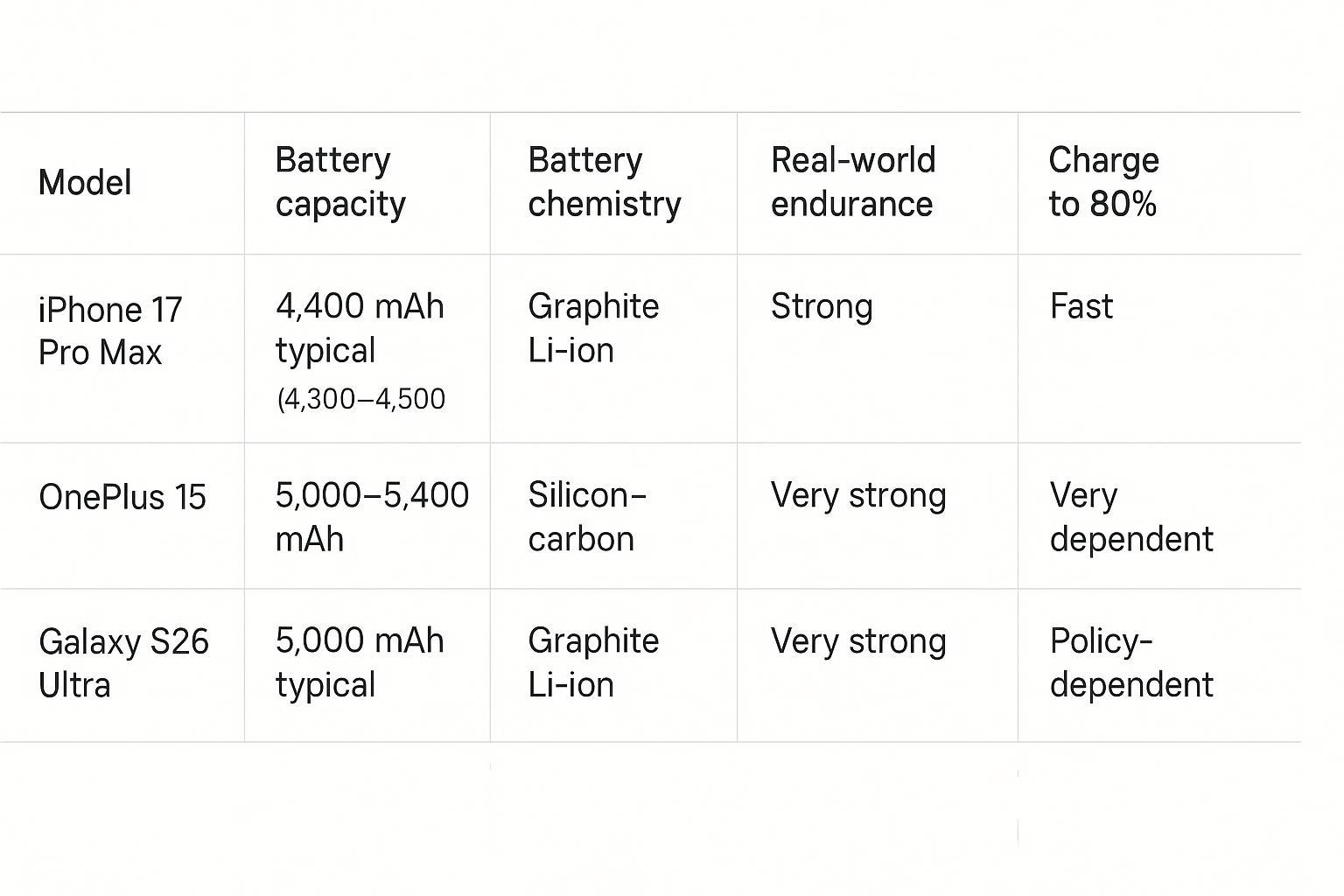
The goal here is not to claim exact battery numbers for unreleased or region-dependent configurations. It is to map what each flagship category tends to do well for business, and what to validate in your own tests.
iPhone 17 Pro Max
Why it is often a business battery pick:
Historically strong efficiency under mixed workloads
Predictable battery health reporting and user-visible controls
Broad accessory ecosystem that supports controlled charging habits
What to validate in your environment:
Roaming and weak-signal endurance (travel and dense office buildings)
Conferencing drain patterns with your stack (Teams/Zoom + VPN)
Whether your management tools can enforce background rules across the apps your team actually uses
OnePlus 15
Why it is often a battery value pick for demanding users:
Tends to push faster charging behavior and high-capacity designs
Often competitive on endurance under heavy daily use when tuned well
Enterprise watch-outs:
Ensure the fast-charge setup you standardize (chargers/cables) stays within thermal comfort during real use
Confirm long-term support and service paths match your refresh cadence
Validate your MDM capabilities for the exact regional firmware you deploy
Galaxy S26 Ultra
Why it is commonly shortlisted:
Strong battery tuning potential with power profiles and display controls
Mature enterprise positioning in many organizations
What to validate:
Thermal behavior during repeated top-ups (desk + car charging)
Consistency across settings (always-on display, high refresh, dual SIM)
Battery health tracking and your preferred replacement threshold policy
Enterprise buying checklist
Treat battery as a lifecycle decision, not a launch-day spec.
Update windows
Battery performance is tied to software. Power management changes, modem tuning, and app background controls often improve (or regress) over time.
Procurement steps:
Confirm the vendor’s stated security update window for your specific SKU and region.
Align refresh cadence with support end dates, not with “phone age.”
Serviceability & warranty
Decide now how you handle battery degradation:
Do you replace devices at a battery-health threshold, or service the battery?
Do you keep a swap pool for roles that can’t tolerate downtime?
Collector’s noteFor certain high-value users, the service relationship matters as much as hardware specs. That is true whether you buy consumer flagships at scale or maintain a smaller pool of executive devices.
Network strategy
Battery performance collapses when radios struggle.
Checklist items that actually move outcomes:
Map where weak-signal happens (offices, plants, basements, travel hubs).
Decide when devices should prefer Wi‑Fi calling.
Standardize eSIM/dual-SIM policies for travelers to reduce roaming drain.
Conclusion
Key takeaways
“Best battery” in 2026 is a bundle: endurance, controlled charging heat, multi-year battery health, and fleet policies.
Pick by role. Travel days, field shifts, and conference-heavy schedules stress batteries in different ways.
Treat manageability as a battery feature. Background policy discipline often beats chasing a larger cell.
Procurement next steps:
Write a one-day test script per role (travel, field, road) and run it on shortlisted devices under both normal and weak-signal conditions.
Decide a battery-health threshold policy and a service path before rollout.
Re-evaluate battery outcomes quarterly as app stacks and OS updates change.
Disclosure: This article references VERTU pages. Editorial judgment remains the priority.