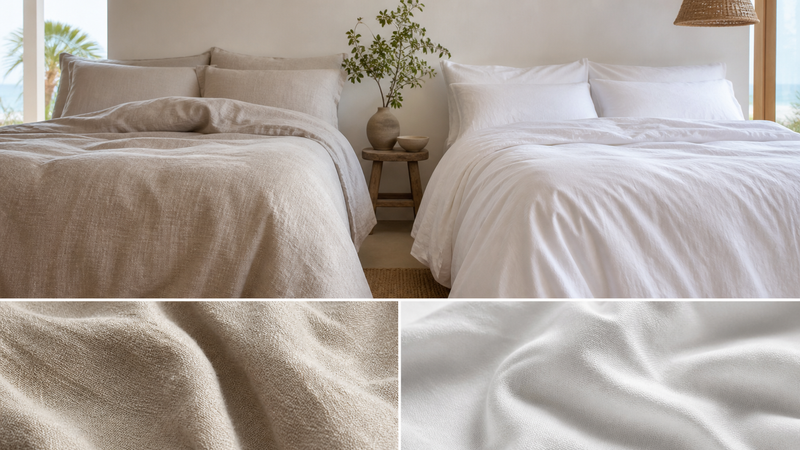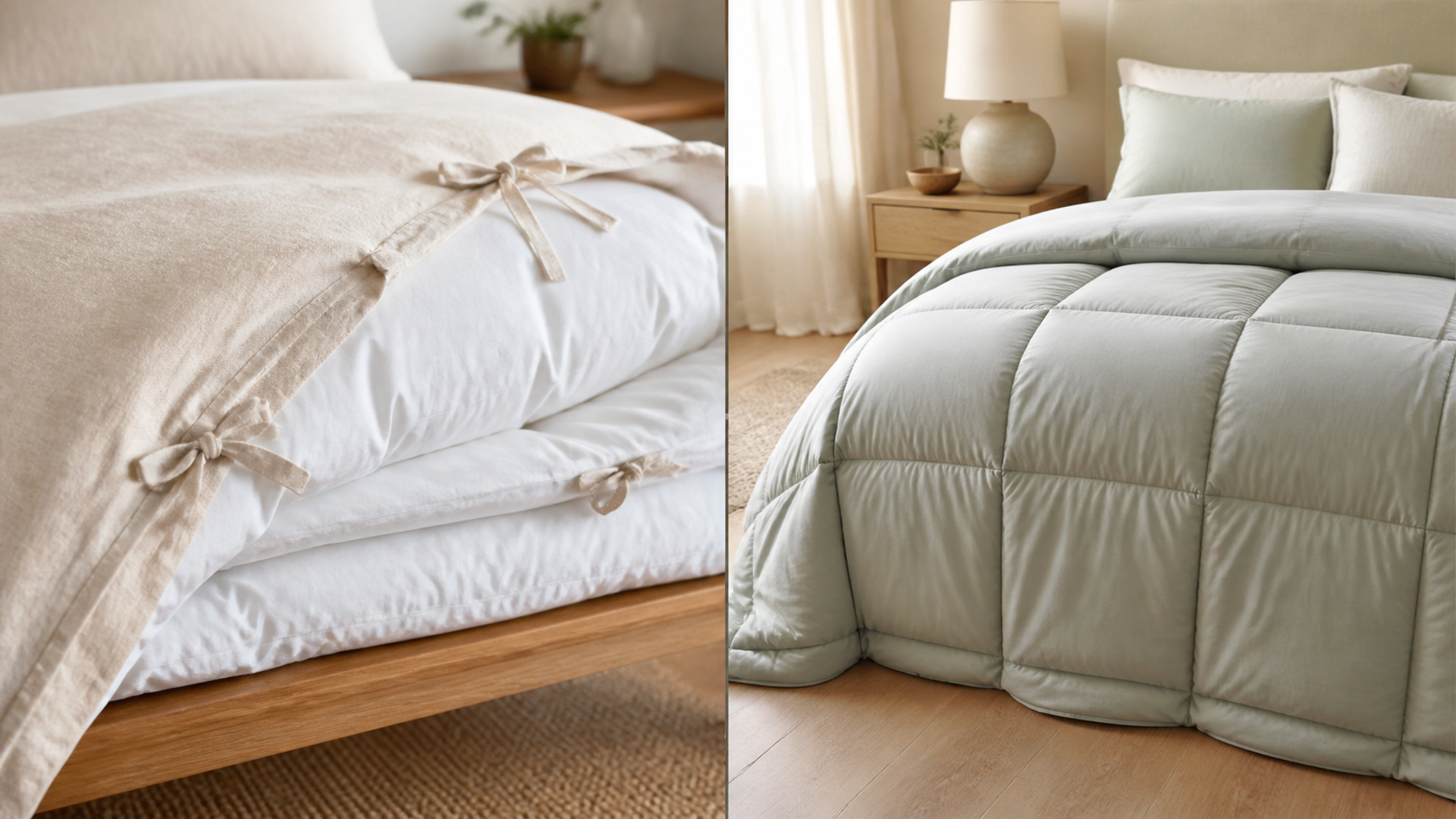
A duvet and a comforter can create a similar finished bed, yet they organise warmth, washing and seasonal changes differently. A duvet normally separates an insert from a removable cover; a comforter is usually a single filled, quilted piece. The useful decision is not which word sounds more luxurious, but which system fits the sleeper, laundry capacity and willingness to remake the bed.
Start with the sleep system
Choose a duvet system when removable covers, seasonal insert changes and restyling are recurring advantages. Choose a comforter when one-piece simplicity and a predictable finished shape matter more. Keep and test the current bedding when temperature, fill, room climate or laundering—not the category—is the unresolved problem.
| Decision factor | Duvet system | One-piece comforter | Keep and test the current bedding |
|---|---|---|---|
| Sleep climate | Insert weight can change by season | One chosen fill suits most of the year | Measure room and sleeper temperature first |
| Laundry | The cover fits the normal wash routine | The whole piece can be cleaned as labelled | A protector or service solves the current burden |
| Bed making | Ties, corners and cover changes are acceptable | One piece is faster to spread and align | Keep the current system until the workflow is tested |
| Style | Covers change without replacing the insert | A stable quilted design is preferred | Decorative layers provide the desired change |
| Household wear | Covers can be replaced after spills or pet wear | The exact shell and quilting tolerate use | Repair or protect the existing bedding |
| Total ownership | Insert, covers and storage earn repeated use | One complete purchase controls cost | No replacement without a measured benefit |
This duvet vs comforter matrix is the article's working value object. Read the duvet vs comforter rows together: the decisive failure mode depends on this topic's evidence, operating context and reader objective.
What construction and care really change
Evidence 1. Sleep Foundation distinguishes a duvet's removable-cover system from a comforter's commonly integrated shell and fill, while noting that market language can vary.
Evidence 2. Fill material, fill weight, baffle construction, shell fabric and room temperature can change warmth more than the category label alone.
Evidence 3. A removable cover may reduce how often an insert needs cleaning, but every component still follows its own care label and capacity limits.
Evidence 4. Oversized filled bedding can exceed a domestic washer or dryer even when a cover fits, so cleaning access belongs in the purchase decision.
Reader-visible sources checked for this article:
sleepfoundation.org — reader-visible current or official evidence
saatvahelp.saatva.com — reader-visible current or official evidence
For duvet vs comforter, these sources establish only the claims inside their documented scope. Recheck every changeable specification, availability condition, price, policy or service term in the relevant market before acting.
Run a seven-night ownership test
The sleep climate row exposes a practical boundary. Route one assumes insert weight can change by season, while route two is defensible only when one chosen fill suits most of the year. Route three depends on measure room and sleeper temperature first. If that evidence is absent, keep the more reversible option.
Read laundry as a stop/go test: the cover fits the normal wash routine supports the first option; the whole piece can be cleaned as labelled supports the second; and a protector or service solves the current burden supports the third. Record which source proves the condition and when it was checked.
A buyer can resolve bed making without starting from a brand preference. Ask whether ties, corners and cover changes are acceptable; compare that with whether one piece is faster to spread and align; then use keep the current system until the workflow is tested as the third route's safeguard. An unknown condition stays unknown.
On style, popularity is not enough. The evidence for option one is that covers change without replacing the insert. Option two means a stable quilted design is preferred. Option three is rational where decorative layers provide the desired change. Recheck any changeable term immediately before commitment.
The decision changes at household wear. Choose the first path only if covers can be replaced after spills or pet wear; move to the second when the exact shell and quilting tolerate use; use the third when repair or protect the existing bedding. Save the downside that would make this row fail.
For total ownership, the first route works when insert, covers and storage earn repeated use; the second requires one complete purchase controls cost. The control for the third is no replacement without a measured benefit. Verify this row against the exact product, property, account or environment before it can reverse the decision.
Facts that would reverse the current choice
Reversal control 1 — Sleep climate. Before choosing Duvet system, write down how the decision changes if “Insert weight can change by season” proves false. Do the same for One-piece comforter and “One chosen fill suits most of the year”. Keep the Keep and test the current bedding route available until “Measure room and sleeper temperature first” is verified. This control belongs to duvet vs comforter; update it from the cited source or exact supplier rather than copying a generic checklist.
Reversal control 2 — Laundry. Before choosing Duvet system, write down how the decision changes if “The cover fits the normal wash routine” proves false. Do the same for One-piece comforter and “The whole piece can be cleaned as labelled”. Keep the Keep and test the current bedding route available until “A protector or service solves the current burden” is verified. This control belongs to duvet vs comforter; update it from the cited source or exact supplier rather than copying a generic checklist.
Reversal control 3 — Bed making. Before choosing Duvet system, write down how the decision changes if “Ties, corners and cover changes are acceptable” proves false. Do the same for One-piece comforter and “One piece is faster to spread and align”. Keep the Keep and test the current bedding route available until “Keep the current system until the workflow is tested” is verified. This control belongs to duvet vs comforter; update it from the cited source or exact supplier rather than copying a generic checklist.
Reversal control 4 — Style. Before choosing Duvet system, write down how the decision changes if “Covers change without replacing the insert” proves false. Do the same for One-piece comforter and “A stable quilted design is preferred”. Keep the Keep and test the current bedding route available until “Decorative layers provide the desired change” is verified. This control belongs to duvet vs comforter; update it from the cited source or exact supplier rather than copying a generic checklist.
Reversal control 5 — Household wear. Before choosing Duvet system, write down how the decision changes if “Covers can be replaced after spills or pet wear” proves false. Do the same for One-piece comforter and “The exact shell and quilting tolerate use”. Keep the Keep and test the current bedding route available until “Repair or protect the existing bedding” is verified. This control belongs to duvet vs comforter; update it from the cited source or exact supplier rather than copying a generic checklist.
Reversal control 6 — Total ownership. Before choosing Duvet system, write down how the decision changes if “Insert, covers and storage earn repeated use” proves false. Do the same for One-piece comforter and “One complete purchase controls cost”. Keep the Keep and test the current bedding route available until “No replacement without a measured benefit” is verified. This control belongs to duvet vs comforter; update it from the cited source or exact supplier rather than copying a generic checklist.
Measure the existing sleep system
Record bedroom temperature, humidity, pyjamas, mattress topper and every layer for seven nights. Note waking heat, cold spots and movement rather than blaming the top layer immediately.
Audit the laundry route
Measure washer and dryer capacity, line-drying space and professional-cleaning access. Time a cover change and inspect closures, corner ties and insert migration after normal sleep.
Compare seasonal storage
List the inserts, covers or complete comforters required across the year. Measure dry storage and calculate replacement cost for the part most likely to stain or wear.
Test the finished bed
Make both systems at realistic scale, sit and move on the bed, then photograph edge drop and loft. A styled showroom fold should not decide a daily maintenance system.
Three bedrooms, three answers
Hot sleeper in a humid climate
A lightweight, breathable duvet system can make seasonal tuning easier if the cover-change routine is acceptable. Define the fact that would reverse this recommendation before committing.
Guest room with rapid turnovers
A washable one-piece comforter or commercial-style cover system may win according to the actual laundry process. Define the fact that would reverse this recommendation before committing.
Household with pets or children
A replaceable washable cover can reduce risk, but only if closures and fabric withstand frequent care. Define the fact that would reverse this recommendation before committing.
Action checklist
Log seven nights of temperature.
Read every care label.
Measure laundry capacity.
Time a cover change.
Check corner ties.
Price a spare cover.
Plan seasonal storage.
Inspect fill distribution.
Check opened-return terms.
Define the replacement trigger.
Continue the decision
The linked VERTU articles expand adjacent parts of the duvet vs comforter decision. They do not substitute for the external evidence above.
The duvet-comforter verdict
Choose a duvet system when removable covers, seasonal insert changes and restyling are recurring advantages. Choose a comforter when one-piece simplicity and a predictable finished shape matter more. Keep and test the current bedding when temperature, fill, room climate or laundering—not the category—is the unresolved problem.
Keep the duvet vs comforter decision reversible until its material cost, safety, access, privacy and compatibility facts are verified. Unknown evidence stays unknown; it is never silently scored as favourable.