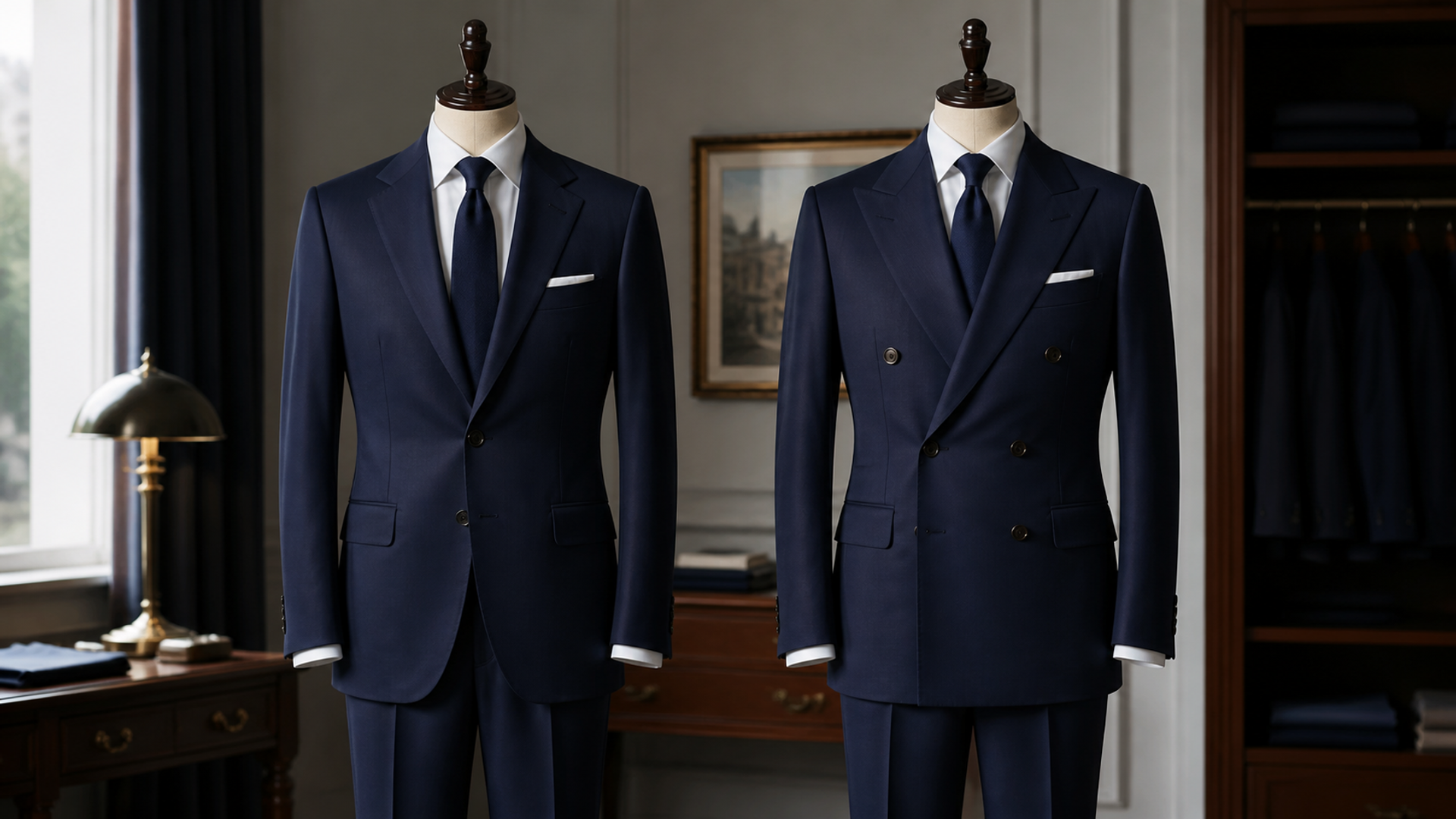
Double-breasted and single-breasted suits are not simply bold and safe versions of one garment. Button geometry, overlap, lapel line, fastening stance and front balance change how each jacket frames the torso and behaves when seated. Cloth, canvas, shoulder and alteration quality can still outweigh the button count.
Choose the line before the lapel
Choose double-breasted when its stronger front architecture suits the wearer's proportions, climate and formal calendar. Choose single-breasted when layering flexibility, easier alterations and broad business rewear matter more. Alter or defer when neither sample has a clean collar, balanced front and comfortable seated position.
| Decision factor | Double-breasted suit | Single-breasted suit | Alter or defer |
|---|---|---|---|
| Silhouette | The overlapping front and peak-lapel line balance the wearer | A cleaner open front gives the preferred proportion | A fitter corrects balance before style is chosen |
| Formality | A more declarative tailored presence suits the room | Business and social versatility dominate | The event calendar is too uncertain |
| Seated comfort | The jacket remains balanced when fastened as intended | The front opens and settles comfortably | Neither jacket passes a full seated test |
| Climate | Cloth and overlap remain comfortable | Less front overlap supports heat management | A lighter separate or unstructured option wins |
| Alterations | Button stance and front balance already work | Conventional waist and sleeve work is sufficient | Major recutting makes the purchase poor value |
| Rewear | The wearer will use the statement cut repeatedly | One suit must cover more dress codes | Existing tailoring already covers the need |
This double breasted vs single breasted suit matrix is the article's working value object. Read the double breasted vs single breasted suit rows together: the decisive failure mode depends on this topic's evidence, operating context and reader objective.
What cut and construction change
Evidence 1. Woolmark's tailoring material explains that suit form depends on cloth and construction as well as visible styling details.
Evidence 2. A double-breasted jacket's overlapping front and button layout create a different balance from a single-breasted jacket, so nominal chest size cannot settle fit.
Evidence 3. Lapel width, gorge, button stance, jacket length and trouser rise interact; changing one isolated detail can distort the intended proportion.
Evidence 4. Sleeve and trouser alterations are common, while correcting collar balance, armholes or a misplaced button stance can be more invasive and costly.
Reader-visible sources checked for this article:
woolmark.com — reader-visible current or official evidence
tailorsingapore.sg — reader-visible current or official evidence
For double breasted vs single breasted suit, these sources establish only the claims inside their documented scope. Recheck every changeable specification, availability condition, price, policy or service term in the relevant market before acting.
Fit both suits through a working day
A buyer can resolve silhouette without starting from a brand preference. Ask whether the overlapping front and peak-lapel line balance the wearer; compare that with whether a cleaner open front gives the preferred proportion; then use a fitter corrects balance before style is chosen as the third route's safeguard. An unknown condition stays unknown.
On formality, popularity is not enough. The evidence for option one is that a more declarative tailored presence suits the room. Option two means business and social versatility dominate. Option three is rational where the event calendar is too uncertain. Recheck any changeable term immediately before commitment.
The decision changes at seated comfort. Choose the first path only if the jacket remains balanced when fastened as intended; move to the second when the front opens and settles comfortably; use the third when neither jacket passes a full seated test. Save the downside that would make this row fail.
For climate, the first route works when cloth and overlap remain comfortable; the second requires less front overlap supports heat management. The control for the third is a lighter separate or unstructured option wins. Verify this row against the exact product, property, account or environment before it can reverse the decision.
The alterations row exposes a practical boundary. Route one assumes button stance and front balance already work, while route two is defensible only when conventional waist and sleeve work is sufficient. Route three depends on major recutting makes the purchase poor value. If that evidence is absent, keep the more reversible option.
Read rewear as a stop/go test: the wearer will use the statement cut repeatedly supports the first option; one suit must cover more dress codes supports the second; and existing tailoring already covers the need supports the third. Record which source proves the condition and when it was checked.
Facts that would reverse the current choice
Reversal control 1 — Silhouette. Before choosing Double-breasted suit, write down how the decision changes if “The overlapping front and peak-lapel line balance the wearer” proves false. Do the same for Single-breasted suit and “A cleaner open front gives the preferred proportion”. Keep the Alter or defer route available until “A fitter corrects balance before style is chosen” is verified. This control belongs to double breasted vs single breasted suit; update it from the cited source or exact supplier rather than copying a generic checklist.
Reversal control 2 — Formality. Before choosing Double-breasted suit, write down how the decision changes if “A more declarative tailored presence suits the room” proves false. Do the same for Single-breasted suit and “Business and social versatility dominate”. Keep the Alter or defer route available until “The event calendar is too uncertain” is verified. This control belongs to double breasted vs single breasted suit; update it from the cited source or exact supplier rather than copying a generic checklist.
Reversal control 3 — Seated comfort. Before choosing Double-breasted suit, write down how the decision changes if “The jacket remains balanced when fastened as intended” proves false. Do the same for Single-breasted suit and “The front opens and settles comfortably”. Keep the Alter or defer route available until “Neither jacket passes a full seated test” is verified. This control belongs to double breasted vs single breasted suit; update it from the cited source or exact supplier rather than copying a generic checklist.
Reversal control 4 — Climate. Before choosing Double-breasted suit, write down how the decision changes if “Cloth and overlap remain comfortable” proves false. Do the same for Single-breasted suit and “Less front overlap supports heat management”. Keep the Alter or defer route available until “A lighter separate or unstructured option wins” is verified. This control belongs to double breasted vs single breasted suit; update it from the cited source or exact supplier rather than copying a generic checklist.
Reversal control 5 — Alterations. Before choosing Double-breasted suit, write down how the decision changes if “Button stance and front balance already work” proves false. Do the same for Single-breasted suit and “Conventional waist and sleeve work is sufficient”. Keep the Alter or defer route available until “Major recutting makes the purchase poor value” is verified. This control belongs to double breasted vs single breasted suit; update it from the cited source or exact supplier rather than copying a generic checklist.
Reversal control 6 — Rewear. Before choosing Double-breasted suit, write down how the decision changes if “The wearer will use the statement cut repeatedly” proves false. Do the same for Single-breasted suit and “One suit must cover more dress codes”. Keep the Alter or defer route available until “Existing tailoring already covers the need” is verified. This control belongs to double breasted vs single breasted suit; update it from the cited source or exact supplier rather than copying a generic checklist.
Photograph the balance
Wear the intended shirt and shoes, stand naturally and photograph front, profile and back. Check collar contact, lapel roll, hem level and whether the fronts pull or cross cleanly.
Run a seated test
Sit at a desk, in a car and at dinner for at least twenty minutes. Reach, type and stand again; record pressure, wrinkling and whether the fastening recovers.
Build a rewear calendar
List twelve real meetings, ceremonies, dinners and travel days. Assign each suit only where it would genuinely be worn, then price alterations and cleaning per credible use.
Use cloth as climate control
Record fibre, weave, weight, lining and ventilation. Compare equivalent cloths before crediting a cut for comfort that actually comes from material choice.
Three tailoring calendars
Client-facing formal wardrobe
Double-breasted can earn its place when the wearer uses the stronger silhouette often and the fit is already convincing. Define the fact that would reverse this recommendation before committing.
First serious business suit
Single-breasted usually offers the widest dress-code range and simpler layering for a limited wardrobe. Define the fact that would reverse this recommendation before committing.
Hot-climate traveller
Cloth weight, lining and rotation can overrule the visual appeal of extra front overlap. Define the fact that would reverse this recommendation before committing.
Action checklist
Bring intended shoes.
Photograph natural posture.
Check collar contact.
Test lapel roll.
Sit for twenty minutes.
Price alterations.
Record cloth weight.
List twelve real wears.
Check trouser balance.
Reject major recutting.
Continue the decision
The linked VERTU articles expand adjacent parts of the double breasted vs single breasted suit decision. They do not substitute for the external evidence above.
The double-single verdict
Choose double-breasted when its stronger front architecture suits the wearer's proportions, climate and formal calendar. Choose single-breasted when layering flexibility, easier alterations and broad business rewear matter more. Alter or defer when neither sample has a clean collar, balanced front and comfortable seated position.
Keep the double breasted vs single breasted suit decision reversible until its material cost, safety, access, privacy and compatibility facts are verified. Unknown evidence stays unknown; it is never silently scored as favourable.