Agentic OS · Multi-Agent · Sovereignty
By JG · June 2, 2026
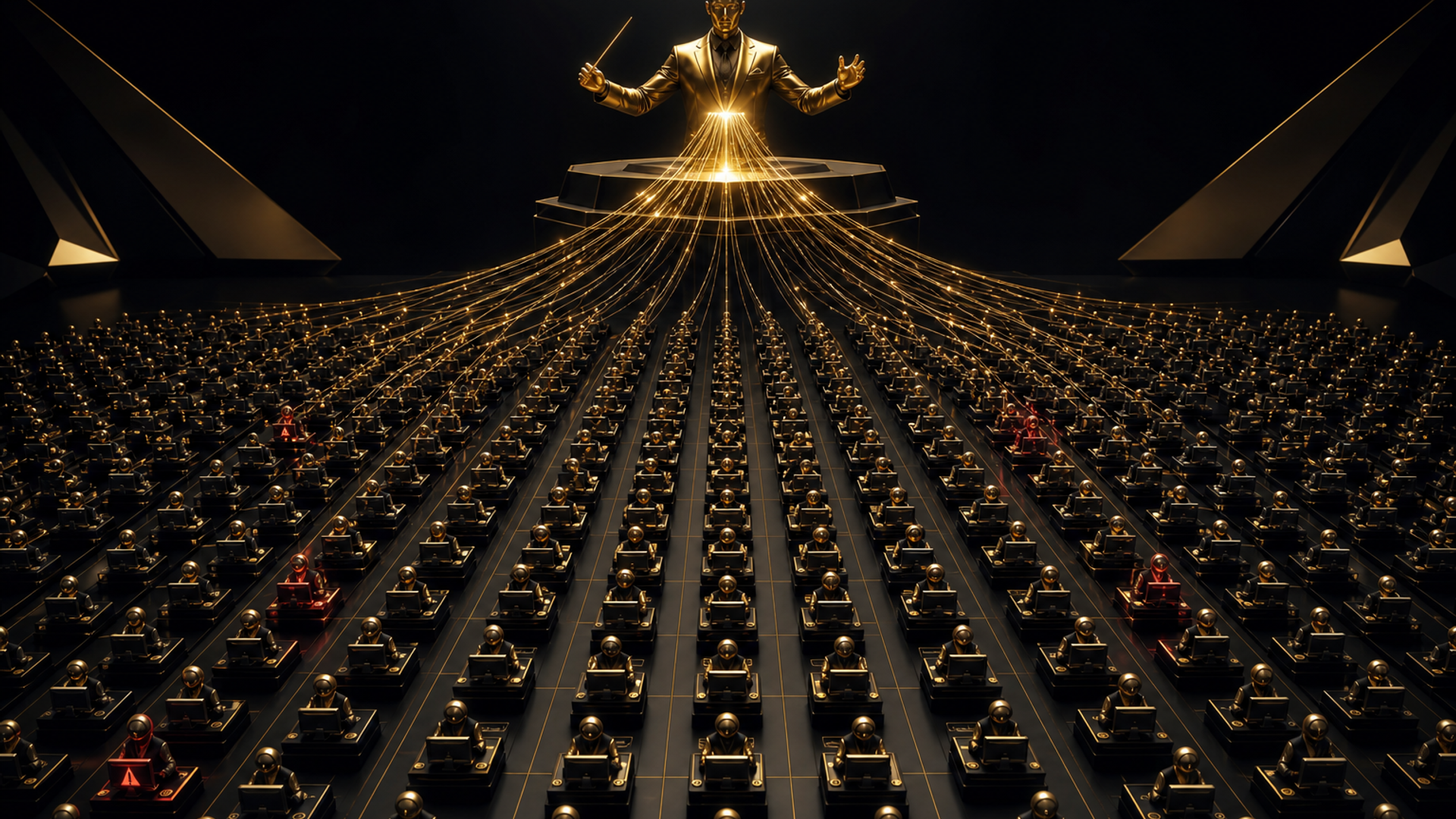
Ask one AI to do a truly large job—migrate an entire codebase, refactor a whole library—and watch it stall. Not for lack of compute, but because every intermediate step floods the context window until it forgets where it was. The breakthrough of 2026 is not a smarter model; it is a model that stops working alone and starts orchestrating an organization of sub-agents. The shift from "using AI" to "designing the organization of AI" is the real paradigm change—and it is the heart of what VERTU has been building.
The One-Agent Trap
When a single agent must reason, plan, and execute by itself, it is doing the work of several roles at once—the project manager doing the architect's job, the architect doing the programmer's. In simple tasks this is invisible; in complex ones it is fatal. The task needs more context; more context means more errors; more errors make the task harder to finish. This is not a flaw of any one model. It is the structural ceiling of single-agent architecture.
The Leap: From Prompting to Code-Driven Orchestration
The escape is to let the model write a script instead of grinding alone. Claude Code's Dynamic Workflows expose primitives—agent() to spawn a sub-agent, parallel() to run many at once, pipeline() to chain them, forEach() to fan out over a list. Loops, branches, and intermediate results live in script variables, not in the chat context. The context-length limit dissolves; work that used to take a quarter compresses into days. Bun's founder migrated roughly 750,000 lines from Zig to Rust in eleven days with a 99.8% test pass rate—a single person plus an orchestrated workforce.
The architecture is a three-layer pipeline: a top model decomposes the task into dozens or hundreds of sub-tasks; each runs its own line; at the execution layer one agent does the work while others act as adversarial reviewers trying to overturn the result, and another reworks against their critique. Only output that survives review is delivered. Verification is built into the org chart, not bolted on.
Skill vs Workflow: Prompt That Wavers vs Code That Reproduces
This clarifies a distinction every serious operator needs. A Skill is a structured prompt—a Markdown capability container; you change it by editing natural language, and execution can drift with model state. A Workflow is executable code—a scheduler; you change it by editing logic, and it reproduces identically every time. Skills are right for flexible single tasks; workflows are right for complex, repeatable, deterministic chains you save once and call forever. The lesson for any AI-native team: codify your repeatable multi-step chains as deterministic workflows, not as ever-longer prompts.
It is not a silver bullet. Workflows shine on decomposable work and waste effort on tasks that need deep, continuous reasoning; they burn far more tokens and still need human monitoring. The tool is a task dispatcher, not general intelligence—knowing the difference is how you use it well.
From Tool to Organization—The Sovereign Version
When AI divides labor, it stops being a tool and becomes an organization. The question shifts from "what can AI do" to "how do agents divide work, communicate, and collaborate"—and who owns that organization. This is exactly VERTU's thesis: the operating system around commodity models is the moat, and the most defensible version is the one you own. It is also why a one-person company becomes real—a founder orchestrating a workforce of specialized agents.
VERTU's Personal AI Harness is built to own that organization sovereignly, through the four duties: PROTECT on a hardware root of trust; UNDERSTAND through sovereign memory; HELP by executing across apps from AlphaFold; and ORCHESTRATE—dispatching sub-agents with adversarial review and a human merge gate, keeping durable state on a Sovereign Private Server (VPS) ERP rather than a shared cloud. Everyone can rent the same model. The sovereign organization you build around it—Harness over model—is what compounds.
Frequently Asked Questions
Why does a single AI agent hit a wall on large tasks?
When one agent must reason, plan, and execute alone, every intermediate step consumes the context window. The bigger the task, the more it forgets—accuracy drops and the loop stalls. It is the structural limit of single-agent architecture. The fix is dividing labor across specialized sub-agents and keeping their state out of the main context.
What is code-driven orchestration and why is it more stable than prompting?
The model writes a script with primitives like agent(), parallel(), pipeline(), forEach(); intermediate results live in script variables, not the chat context. A prompt-driven skill may waver with model state; a code-driven workflow reproduces 100% identically. Skills suit flexible single tasks; workflows suit complex, repeatable, deterministic chains.
How does VERTU apply this sovereignly?
VERTU treats the agent layer as an organization. A Personal AI Harness orchestrates specialized sub-agents with adversarial review and a human merge gate, keeps durable state on a Sovereign Private Server (VPS) ERP, and executes on AlphaFold—protect, understand, help, orchestrate. The model is commodity; the sovereign organization around it is the moat.