Agentic OS · AI-Native Organization · Sovereignty
By JG · June 4, 2026
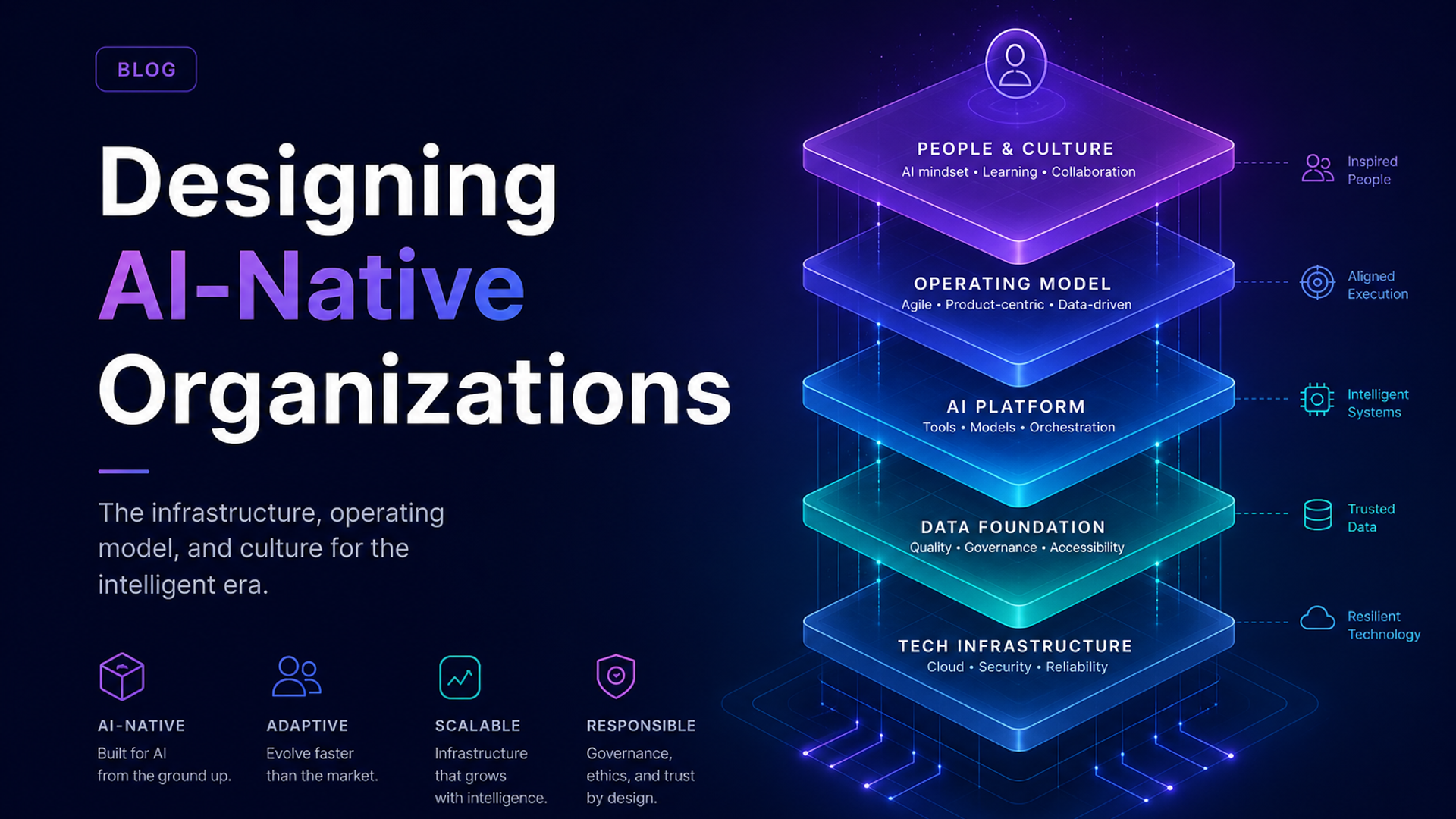
Most companies bolt a chatbot onto email and call it transformation. An AI-native company does the opposite: agents become the infrastructure layer that records, routes, and compounds every artifact—meetings, decisions, conversations—into reusable organizational memory. The shift is not "AI helps humans." It is "AI is how the organization runs."
Artifacts Are Fuel: Trust by Default, Access for Everyone
The raw material of an AI-native org is simple: everything worth knowing gets captured. Meeting recordings, agent dialogue logs, decision documents—these are not archives for compliance. They are training data for tomorrow's agents.
Two cultural prerequisites make this work—and both invert command-and-control defaults:
- Trust by default—agents receive broad context instead of being starved for security theater. Narrow context produces narrow intelligence.
- Egalitarian access—AI capability is open to every employee; agent conversations are visible org-wide by default. Silos kill compound learning.
This is uncomfortable for hierarchical firms. It is also the only way agents see enough of the business to be useful. VERTU's Sovereign Private Server (VPS) ERP turns sales, finance, and approval flows into structured productivity context—one of three data sources (body, behavior, productivity) that Personal AI must fuse to truly understand an executive or a company.
The Architecture Stays Minimal: Loop, Registry, Router
Complexity is the enemy of an agent harness that survives its tenth module. The core stack is deliberately small:
- One agent loop—observe, plan, act, verify.
- One tool registry—every capability registered once, callable like a method.
- One model router—route tasks to the right model without hard-coding vendor lock-in.
Start with roughly twenty tools. Add one each time an agent clearly improves a repeatable workflow. A mature AI-native operator may exceed three hundred—but only because each addition earned its place. This is the Harness > Model thesis in practice: the orchestration layer compounds; the base model commoditizes.
Skillify: Package Once, Govern Forever
When a workflow works, do not re-invent it tomorrow. Say "skillify it"—a meta-skill that wraps the successful run into a reusable skill and registers it in the resolver so any agent can invoke it like a function call.
The step most teams skip—and the one that separates order from chaos—is check-resolvable. After every Skillify, an auditor agent scans the full skill graph and asks:
- DRY—Are ten skills doing the same thing? Collapse them into one parameterized skill.
- MECE—Does the resolver cover the problem space without gaps or overlaps?
A resolver table that is both DRY and MECE is the optimal skill graph. Without governance, Skillify becomes Skill Sprawl—the harness equivalent of spaghetti code. VERTU's eighty-plus skills and skill-flywheel pipeline exist precisely to keep this graph healthy as the organization scales toward a protocol-native Agent Society.
Dream Cycle: Nightly Organizational Evolution
Skillify captures what worked today. Dream Cycle asks what could work better tomorrow. A general-purpose agent reads the day's agent conversations across the company, hunting for:
- Tasks that could have been shorter with better context.
- Decisions that would have been faster if a skill already existed.
- Meeting transcripts that reveal skill descriptions worth refining.
Feed a meeting transcript back into skill improvement and the delta is visible immediately—skills that exceed any single person's tacit knowledge. Most enterprises have not started this loop. If you begin now, you are already ahead.
Wrap Deterministic Tools; Do Not Wrap AI in Legacy Software
The winning pattern is agents wrapping deterministic tools—not deterministic software wrapping AI as a feature flag. The best AI software is the smallest surface: minimal pre-written code above the model, maximum judgment delegated to the agent.
That inversion moves software control from developers to users. A editor-in-chief who rewrites routing rules in natural language—without touching code—owns the system. Legacy monoliths that take ten times longer to change cannot compete with just-in-time software built on a sovereign harness. There is a one-time window to leapfrog incumbents: build dynamic, agent-native infrastructure now while change cost is still falling by orders of magnitude.
Jevons for Questions: Zero Friction, Exploding Curiosity
When the cost of asking a colleague drops to zero, the number and complexity of questions explode—Jevons paradox applied to organizational knowledge. Employees who would never interrupt a senior leader with a "stupid question" will ask an agent freely. That is not noise; it is compound learning. The harness must be built to absorb the volume: resolver hygiene, durable run ledgers, and quality gates that scale without human bottlenecks.
Delivered Sovereign: VERTU's Four Duties
An AI-native organization on rented cloud is still a tenant. VERTU delivers the playbook on infrastructure you own through Personal AI's four duties:
- PROTECT—artifacts and agent memory stay on a hardware root of trust; cloud models see redacted intent, not raw sovereignty.
- UNDERSTAND—fuse body (Care Suite), behavior (AlphaFold), and productivity (VPS ERP) into one executive or enterprise twin.
- HELP—AlphaFold is the hands; agents act across apps without surrendering the screen.
- ORCHESTRATE—the Harness routes models, skills, and tools; the model is the CPU, the Harness is the OS.
Skillify plus Dream Cycle plus a minimal loop-registry-router stack is how a one-person company (OPC) and an Agent Society scale without adding headcount proportional to complexity. The moat is not the model everyone rents. It is the infrastructure layer you compound nightly—and the sovereign server that keeps it yours.
Frequently Asked Questions
What does it mean for AI to be organizational infrastructure instead of an assistant?
Infrastructure means every artifact—meeting transcripts, agent conversations, decision memos—is recorded, searchable, and reusable by agents. Trust by default and egalitarian access unlock broad context. Without both, agents stay siloed and shallow.
What is Skillify and why does check-resolvable matter?
Skillify packages a successful workflow into a reusable skill. Check-resolvable audits the skill graph for DRY (no duplicates) and MECE (complete coverage). A clean resolver table is the optimal skill graph—without it, Skillify becomes sprawl.
How does VERTU deliver AI-native organization design sovereignly?
AlphaFold is the physical layer; Sovereign VPS ERP supplies productivity context; Personal AI Harness orchestrates agents, skills, and Dream Cycle improvements on hardware you own—protect, understand, help, and orchestrate without surrendering data to shared cloud.