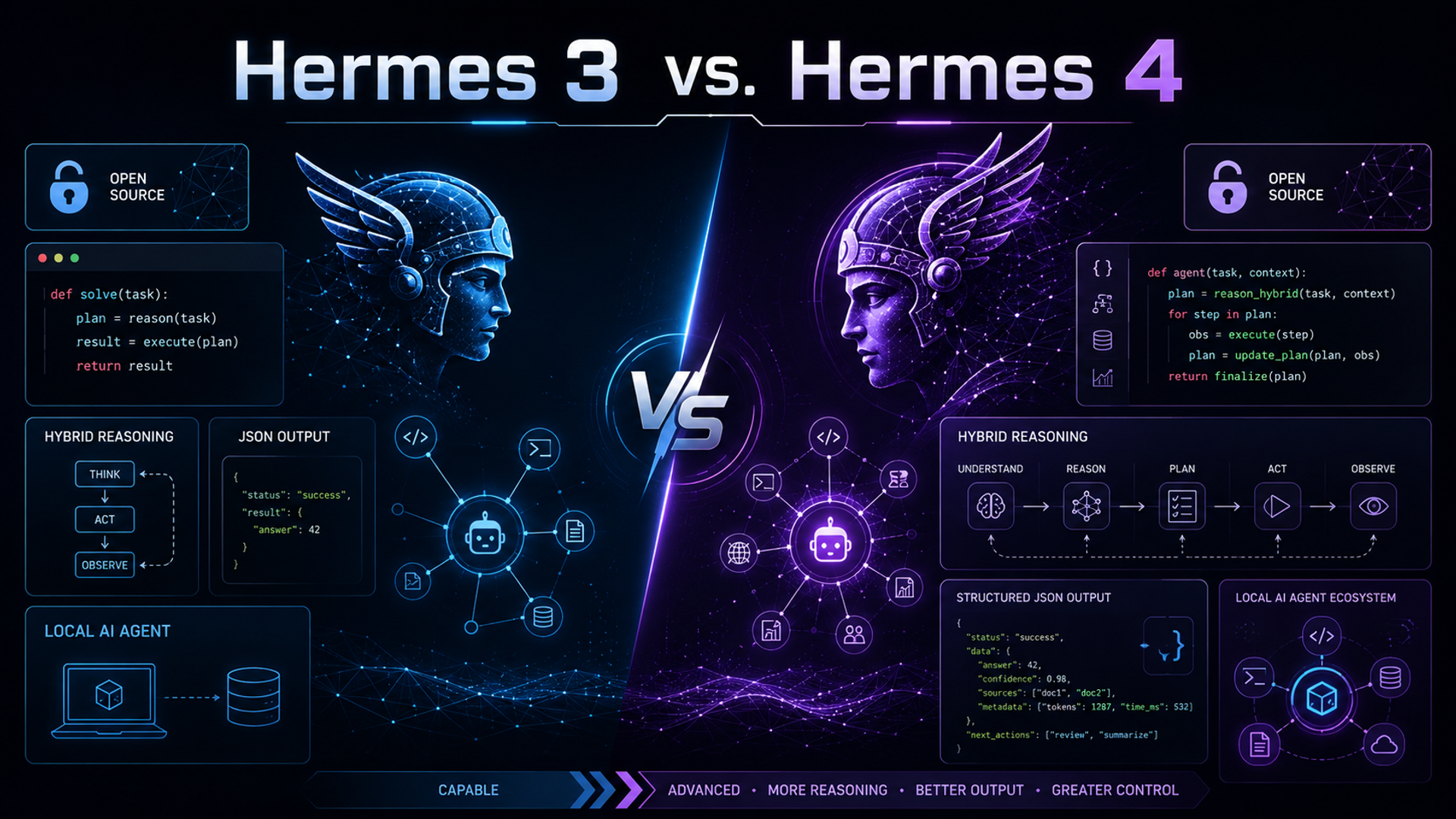
| Architectural Feature | Hermes 3 | Hermes 4 |
|---|---|---|
| Base Architecture | Llama 3.1 | Llama 3.1 |
| Post-Training Corpus | Focused SFT + RLHF refinement | ~60B Token specialized reasoning corpus |
| Context Window | 131,072 Tokens (Native) | 131,072 Tokens (Native) |
| Primary Design Focus | Steerability, roleplay, and standard tool use | Complex logic, coding, and multi-step reasoning |
| Flagship Strengths | Zero-refusal chat, fluid conversational patterns | Native JSON schema adherence, system execution |
| Reasoning Approach | Direct-to-answer responses | Hybrid deliberate internal reasoning token output |
The open-source AI landscape moves fast, but few model families have captured the community’s loyalty quite like the Hermes series by Nous Research. Known for its unmatched steerability, lack of corporate lecturing, and raw agentic potential, Hermes represents true freedom in large language models (LLMs). With the release of Hermes 4, built upon a massive post-training paradigm upgrade, developers and enterprise users are asking: Is it time to migrate?
Let's dive into a comprehensive comparison between Hermes 3 and Hermes 4, mapping out the architecture shifts, functional distinctions, and what these changes mean for your day-to-day deployment.
Core Architectural & Parameter Shifts
While both Hermes 3 and Hermes 4 stand on the shoulders of Meta’s foundational Llama 3.1 architecture, the training philosophy driving them has diverged significantly.
Hermes 3 was designed as a highly optimized generalist, fine-tuned to remove artificial refusals while delivering excellent multi-turn chat, structured output formatting, and dependable function calling across a vast array of model sizes, ranging from 8B to the massive 405B variants.
Hermes 4 pivots harder toward advanced logical scaffolding. Nous Research introduced an expansive post-training dataset of roughly 60 billion tokens into Hermes 4. This massive dataset focuses extensively on step-by-step reasoning traces, rigorous mathematics data, and code-heavy synthetic data. The goal wasn't just to make the model smarter, but to fundamentally alter how it processes multi-step logic under the hood.
The breakdown below highlights how the two model generations stack up side-by-side:
The Game Changer: "Hybrid Reasoning Mode" in Hermes 4
The defining distinction separating Hermes 4 from its predecessor is the introduction of its native Hybrid Reasoning Mode.
Traditional open-source models, including Hermes 3, operate on a direct-to-answer paradigm. When prompted with a complex coding bug or a multi-step financial formula, the model attempts to generate the correct code or answer immediately. For highly intricate tasks, this often causes structural hallucinations or logic breaks halfway through the response.
Hermes 4 handles this by integrating an internal deliberation trace. When complex prompts are detected—or when explicitly triggered via system configurations—the model enters an internal "thinking" loop. It writes out its logic, tests constraints, and catches logical flaws in a distinct scratchpad channel before outputting the final user-facing response.
This architectural change transforms Hermes 4 from a powerful text engine into a deeply autonomous, self-correcting brain. It bridges the gap between basic generative text and true autonomous execution.
Practical Impact: How They Feel Different in Real-World Use
Benchmark metrics are useful on paper, but how do these adjustments feel when deployed into local pipelines or agent frameworks? The differences become obvious across three distinct real-world use cases.
1. Complex Coding & Structured Outputs (JSON Mode)
Building automated infrastructure relies heavily on a model's ability to return flawless, predictable code blocks or JSON schemas.
- Hermes 3: It stands out at standard function calling. However, when integrated into complex loops where an agent must recursively call multiple APIs, Hermes 3 can occasionally drop commas, misinterpret deeply nested brackets, or drift from the strict structural formatting required by the system.
- Hermes 4: Thanks to its reasoning-heavy post-training, Hermes 4 demonstrates rock-solid stability in native JSON mode. It is far more resilient when executing complex data transformations, translating unstructured text into rigid data tables, or writing boilerplate code for web applications without missing dependencies.
2. Alignment, Neutrality, and "The Moral Wall"
The community initially rallied around Hermes because it stripped away the frustrating, repetitive corporate hand-wringing found in closed-source models.
- Hermes 3: It gained massive popularity for its open-ended flexibility. It executes user prompts directly without lecturing the user on ethics or claiming it "cannot fulfill the request as an AI assistant."
- Hermes 4: It elevates this philosophy by treating neutrality as a technical feature rather than a lack of safety boundaries. Instead of simply removing barriers, Hermes 4 is explicitly trained for precise steering. It acts as a pure calculator for your intentions. If you instruct it to adopt a highly technical, completely detached, or deeply specific voice for a private application, it follows those system instructions perfectly without pushing back.
3. Agentic Workflow Endurance
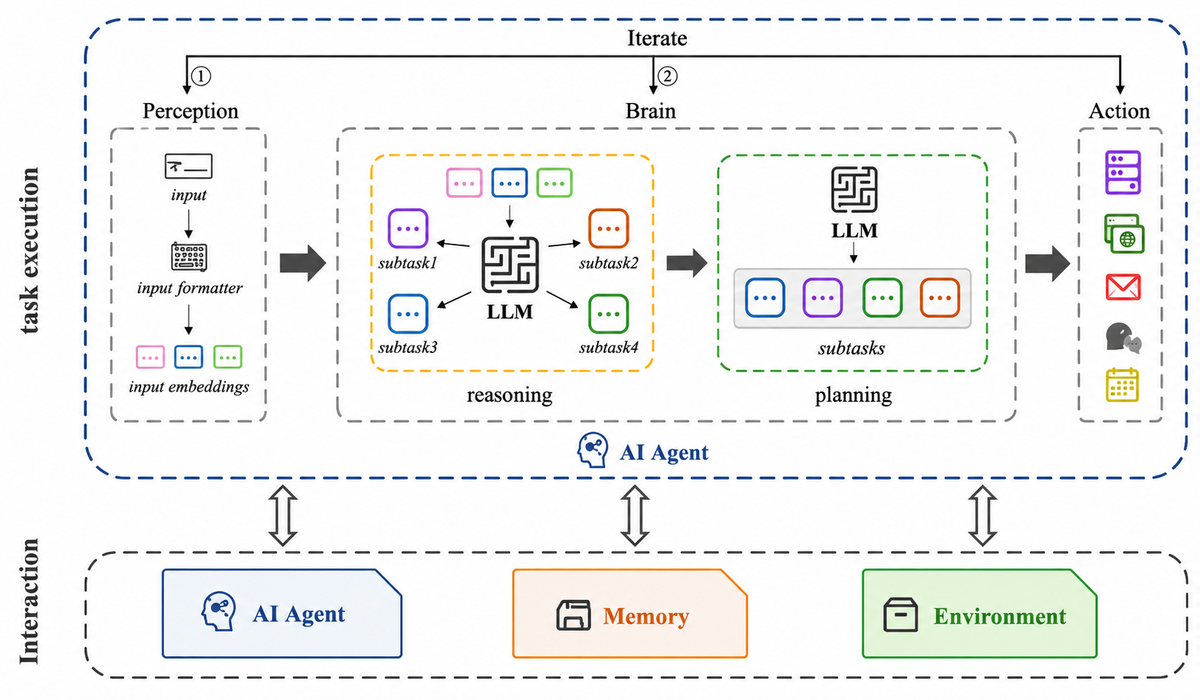
An autonomous workflow requires an LLM to read a terminal error, modify its own script, and try again until the task succeeds. When deploying these complex systems, understanding the architecture of an AI agent helps clarify why long-context stability is vital for persistent pipelines.
When testing both models inside autonomous frameworks like Cline or Auto-GPT, the behavioral contrast is clear. Hermes 3 often answers quickly but can lose track of long-term goals over 30 or 40 sequential terminal iterations.
Hermes 4 thrives in these high-friction, multi-hour loops. Because it evaluates its own plans before executing them, it avoids dead-ends, debugs its own syntax errors more effectively, and maintains a high success rate over extended execution chains.
The Verdict: When to Choose Which?
Choosing between these two powerhouses comes down to your specific technical requirements and compute constraints.
Stay with Hermes 3 if:
- You are running local, light creative writing platforms, interactive roleplay bots, or casual customer service chats where speed and low token latency are more critical than deep multi-step verification.
- Your local hardware setups require highly quantized, rapid-fire responses without the overhead of extra reasoning tokens.
Upgrade to Hermes 4 if:
- You are actively architecting multi-agent networks, complex tool integrations, or local code-generation pipelines.
- You require a model that will strictly adhere to complex JSON schemas under chaotic production conditions without breaking.
The Ultimate Implementation: Hermes Agent in Your Pocket via AlphaFold
For users looking to step away from fragile cloud setups and massive corporate servers, the ultimate way to experience this technology is right in your hand. The AlphaFold mobile ecosystem natively integrates a dedicated, on-device Hermes Agent, turning premium hardware into a decentralized command center.
By leveraging local computing power, AlphaFold allows you to run a fully functional, uncensored Hermes agent directly from your pocket, completely independent of cloud servers. Because the model is pre-installed at the system level, there is no tedious environment setup, token tracking, or configuration required. Whether you are conducting confidential market research, writing proprietary code, or organizing sensitive personal schedules, the agent operates entirely inside a secure hardware sandbox. It reads local files, calls built-in system tools, and processes complex reasoning chains while keeping your private data completely safe from external tracking.
Having the raw analytical reasoning of Hermes 4 inside AlphaFold gives you an uncompromising, highly intelligent assistant that works for you alone. It bypasses the infrastructure limits that traditionally slow down autonomous local AI pipelines.
Conclusion: Balancing Speed with Precision
Ultimately, the transition from Hermes 3 to Hermes 4 represents a profound evolution in how open-source models handle autonomy. Hermes 3 remains an exceptional, fast-firing option for creative exploration and predictable multi-turn dialogue. However, for those looking to build resilient, multi-step execution pipelines, Hermes 4's hybrid reasoning marks a massive leap forward.
Whether deployed on heavy enterprise servers or running natively via pocket hardware like the AlphaFold, the Hermes lineage continues to prove that open weights can rival—and outsteer—the most heavily guarded proprietary models on the market.