The smartphone in your hand is no longer just a passive communication device. Today, it is rapidly evolving into a hyper-personalized ecosystem driven by Artificial Intelligence. From text-generating assistants to autonomous tools that execute workflows on your behalf, mobile AI promises to save us hours of daily manual labor.
However, this incredible convenience presents a significant dilemma. For AI to truly understand you and anticipate your needs, it requires access to your most intimate data—your emails, schedule, location, and daily conversations. This opens up a critical question for the modern user: Is it possible to leverage cutting-edge mobile AI without completely surrendering your AI data privacy?
To stay protected, we must first understand how different types of mobile AI handle our information, what security gaps exist today, and how to reclaim digital sovereignty over our personal devices.
The New Mobile AI Privacy Threats: Chatbots vs. Autonomous Agents
When discussing AI privacy protection on smartphones, it is a mistake to view all AI tools the same way. The technology has shifted from reactive assistants to highly proactive, autonomous systems, and each carries vastly different privacy risks.
1. Generative AI Chatbots and Your Prompt History
Most users are familiar with generative AI chatbots like ChatGPT or Gemini. These are reactive tools: you type a specific prompt, and the AI replies.
The primary AI privacy risk here comes from data logging. When you copy-paste a corporate report, type an intimate question, or ask the AI to draft a sensitive email, that data is usually uploaded to third-party cloud servers. If your settings are not configured correctly, these tech companies can store your conversation history indefinitely and use it to train future public models, creating a massive risk for corporate espionage or personal data leaks.
2. Autonomous AI Agents (The Bigger Privacy Risk)
The game has changed with the rise of autonomous agentic AI, such as Hermes Agent. Unlike traditional chatbots that wait for your command, an autonomous agent is designed to execute multi-step tasks across different applications without constant human intervention.
For example, if you tell an AI agent, "Organize my travel itinerary for my business trip next Tuesday," it does not just write a list. It autonomously accesses your calendar to check your availability, reads your emails to track flight confirmations, pings your GPS location, and interacts with third-party travel APIs to book your hotel.
While this creates a seamless hands-free experience, it means the agent requires constant, deep access to your continuous personal context. Because these agents actively pull, move, and share data across the internet to get things done, they pose a much greater threat to your AI data privacy than a standard chat box ever could.
How Mobile AI Privacy is Currently Protected (And Where It Fails)
As these tools become more deeply embedded in our phones, the tech industry has introduced several mechanisms to defend user information. However, current mainstream solutions still have noticeable vulnerabilities.
On-Device vs. Cloud Architectures
Currently, companies attempt to protect you by processing simpler AI tasks "on-device" using the phone's native hardware. This keeps your data local. However, complex reasoning—especially the heavy workloads required by autonomous systems like a Hermes Agent—is too heavy for standard phone chips. The phone is forced to bundle your data and send it to an external cloud data center. The moment your unencrypted data leaves the device, true ownership is lost.
Data Anonymisation Gaps
Many platforms claim they anonymize user data before using it to improve their systems. They strip away obvious identifiers like your phone number or name. Yet, studies show that high-density behavioral data—like your exact daily GPS routes combined with your unique scheduling habits—can easily be reverse-engineered to identify exactly who you are, leaving high-net-worth individuals and corporate executives highly vulnerable.
VERTU ALPHAFOLD: Secure Integration for Autonomous Agents
For users who refuse to compromise between elite productivity and total privacy, the solution requires a fundamental shift in how smartphone hardware is engineered. This is where the VERTU ALPHAFOLD enters the market as a crucial case study. As the world's first smartphone natively optimized to run advanced autonomous systems like Hermes Agent, it provides a blueprint for how luxury hardware can successfully neutralize mobile AI risks.
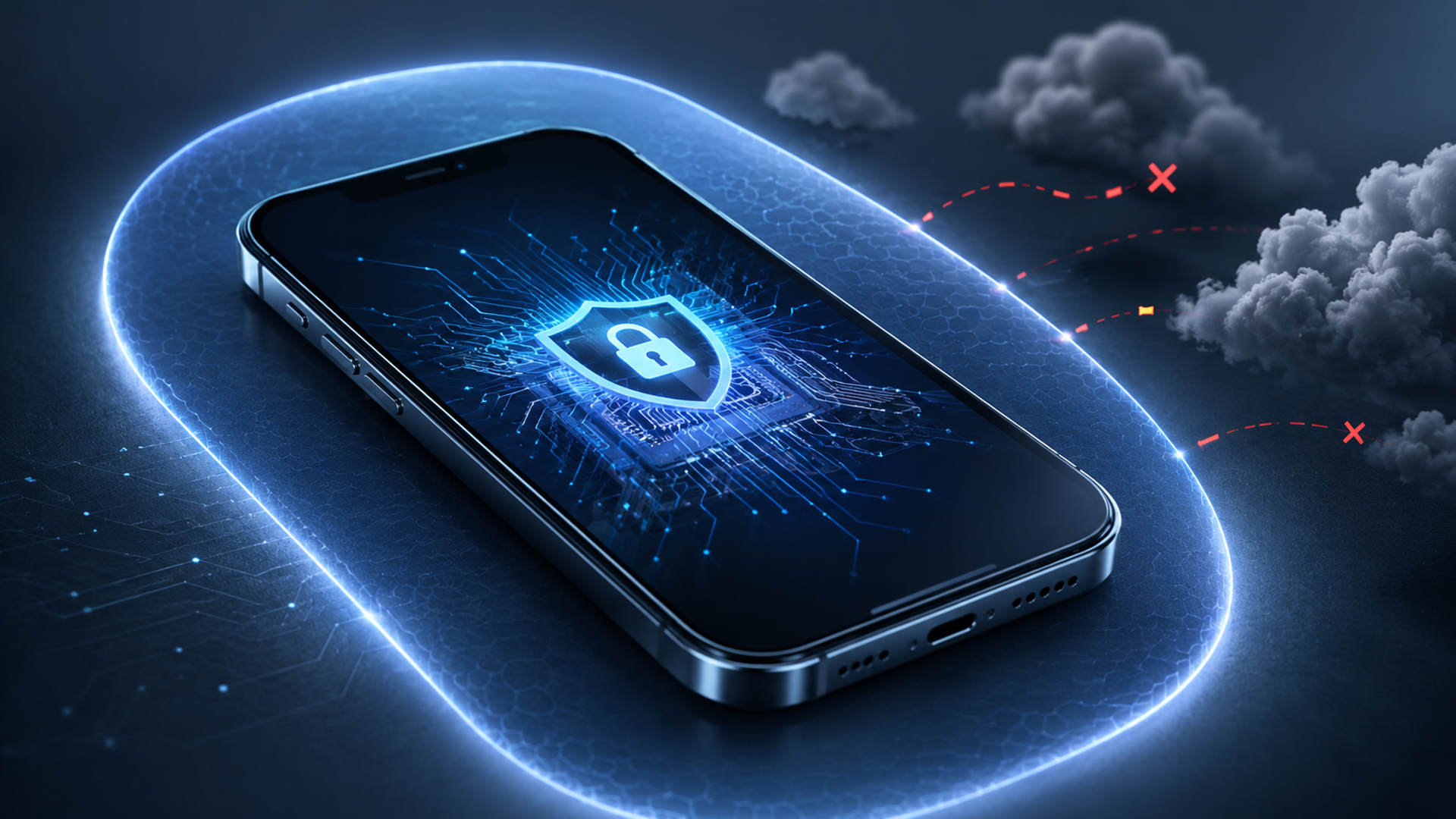
Rather than relying blindly on mass-market cloud networks, VERTU addresses the dangers of agentic AI through a dedicated hardware-and-software shield called the AlphaFold AI Privacy Fortress. It introduces three practical, non-technical layers of defense:
- On-Device Masking: When an autonomous agent gathers data from your phone to complete a task, the VERTU ALPHAFOLD system automatically intercepts it. It scrubs all Personally Identifiable Information (PII) on the device level, replacing your sensitive details with anonymous tokens before anything leaves the phone.
- Blind Inference: If a massive task must be sent to a cloud server, VERTU uses cryptographic blind processing. The external server processes the AI task perfectly but is mathematically locked from actually reading or viewing what the data says.
- Clean Session: Unlike standard phones that keep a permanent digital footprint of your AI activities, VERTU’s system triggers an immediate wipe of all cache files, prompt histories, and temporary operational memories the moment your task is complete.
By turning these advanced privacy protocols into standard, automated background features, it proves that you can run a highly active, self-improving AI assistant without handing over the keys to your private life.
Practical Guide: How to Protect Your Privacy When Using Mobile AI
Whether you are a corporate executive handling trade secrets or a standard user looking to secure your digital life, you should not wait for tech conglomerates to protect you. Here is an actionable checklist to secure your data right now:
1. Audit Your AI Permissions Weekly
Do not treat an AI agent like a standard app. Go into your smartphone's settings and meticulously control what data boundaries you allow the AI to cross. If an AI tool only needs to draft text, block its access to your real-time location, microphone, and photo gallery.
2. Explicitly Opt-Out of Model Training
Deep dive into the privacy settings of every AI app you use. Look for options labeled "Data Sharing," "Improve features for all users," or "Chat History & Training." Toggle these off. This forces the platform to treat your data as a single transaction rather than adding it to their permanent public training pools.
3. Isolate High-Risk Corporate and Financial Tasks
Never input unreleased financial data, passwords, legal contracts, or sensitive medical information into mass-market, cloud-reliant AI tools. If an autonomous agent must handle a sensitive workflow, ensure the underlying data is heavily sanitized first.
Conclusion: Digital Control is the Ultimate Luxury
Autonomous AI agents and intelligent chatbots are transforming how we manage businesses and personal lives. They offer incredible speed and efficiency, but they should never demand your digital sovereignty as the price of admission.
By implementing strict local data boundaries and auditing app permissions, and utilizing privacy-first hardware solutions like the VERTU ALPHAFOLD, you can confidently command the future of mobile AI while keeping total control exactly where it belongs: in your hands. Control over your personal context is no longer just a technical setting—it is your fundamental right.