| Feature | Generative AI | Agentic AI |
|---|---|---|
| Core Focus | Content Creation & Synthesis | Action, Execution & Goal Achievement |
| User Input Requirement | Highly specific, iterative prompts | High-level objectives and constraints |
| Operational State | Passive / Reactive | Active / Proactive |
| Tool Capabilities | Limited to internal knowledge base | Extensive (APIs, Databases, Web Browsing) |
| Workflow Nature | Single-turn response | Multi-step, iterative loops |
| Error Correction | Relies on the user to correct the prompt | Self-reflection and automated troubleshooting |
The artificial intelligence landscape is evolving at a breakneck pace. Just as organizations worldwide finished integrating Generative AI into their daily workflows, a new paradigm arrived: Agentic AI.
While Generative AI captured the world’s imagination by turning text prompts into stunning imagery, intricate code, and human-like essays, Agentic AI represents the next logical step in this technological evolution. It shifts the paradigm from technology that merely assists to technology that acts.
Understanding the difference between generative AI and agentic AI is no longer just an academic exercise; it is a strategic necessity for businesses looking to maintain a competitive edge. This article explores the core mechanisms, key distinctions, and synergistic potential of these two powerful AI frameworks.
What Is Generative AI? (The Foundation)
To understand where AI is going, we must first look at where it currently stands. Generative AI refers to a class of artificial intelligence algorithms—predominantly powered by Large Language Models (LLMs) and foundation models—that are trained on vast datasets to create entirely new content.
How Generative AI Works
Generative AI models operate on pattern recognition and probabilistic prediction. When a user inputs a prompt, the model analyses the sequence of words and predicts the next most statistically logical word, pixel, or note. It is essentially an advanced, highly sophisticated prediction engine.
Key Characteristics & Limitations
- Prompt-Driven: Generative AI is inherently reactive. It requires explicit, detailed instructions (prompt engineering) from a human user to produce an output.
- Content-Focused: The primary output is data creation—whether that involves text generation, image synthesis, or code drafting.
- Lack of Autonomy: A traditional generative model cannot make independent decisions, verify its own output against real-time external realities, or execute multi-step workflows without constant human intervention.
Common Generative AI Use Cases
Businesses heavily leverage standard generative AI use cases for content marketing, automated drafting, graphic design, and basic coding assistance. Tools like ChatGPT, Midjourney, and GitHub Copilot are quintessential examples of this technology. However, the structural limitations of generative artificial intelligence—such as data hallucinations and a lack of real-time environmental awareness—often require a persistent "human-in-the-loop" to ensure quality and accuracy.
What Is Agentic AI? (The Next Evolution)
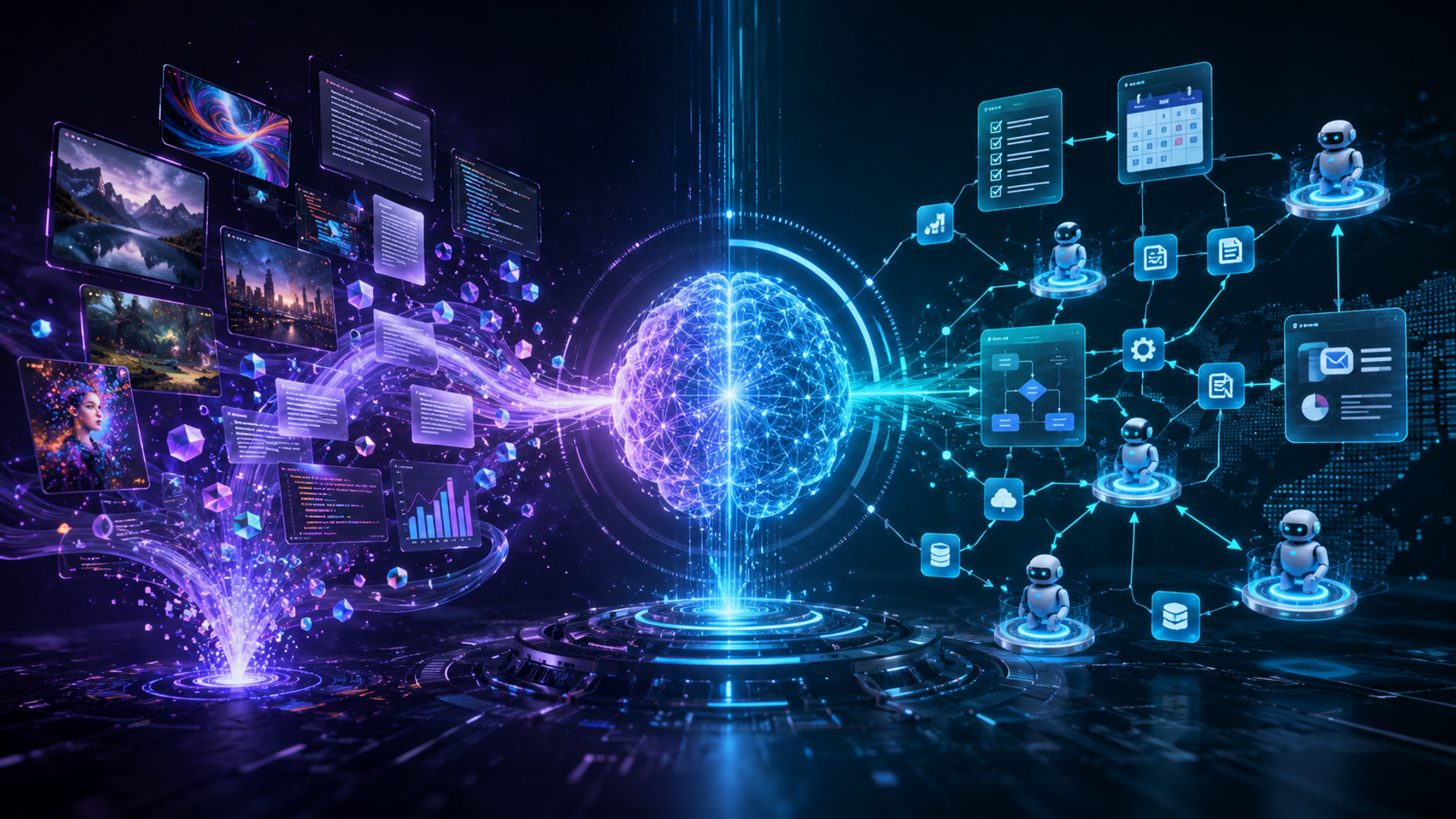
If Generative AI is the "brain" that thinks and writes, Agentic AI represents the brain, hands, and feet working in unison. What is agentic AI? At its core, Agentic AI refers to system architectures where autonomous AI agents are deployed to achieve specific, high-level goals with minimal human supervision.
The Mechanism of Agentic Workflows
Unlike a standalone model that responds to a single prompt, Agentic AI relies on complex agentic workflows. When given a high-level objective (e.g., "Analyse our top five competitors' Q1 pricing updates and adjust our software subscription tiers accordingly"), an agentic system breaks the objective down into a series of smaller, sequential tasks.
[High-Level Goal] ➔ [Planning & Reason] ➔ [Tool Use (Web/API)] ➔ [Self-Reflection] ➔ [Final Execution]
Key Characteristics of Autonomous Agents
- Goal-Oriented Autonomy: Users define the destination, not the turn-by-turn directions. The agent autonomously determines the best path forward.
- Tool Integration: Agentic systems are connected to external environments via APIs, web browsers, databases, and software suites. They can search the live web, run code in sandboxed environments, and read/write to corporate databases.
- Self-Reflection and Iteration: An autonomous agent can evaluate its own progress. If a specific API call fails or an unexpected error occurs, the agent can pivot, rewrite its internal logic, and try a different approach.
Common Agentic AI Use Cases
Deploying autonomous AI agents for business transforms operational efficiency. Examples include autonomous software engineers (capable of finding bugs, writing patches, and deploying code independently), automated supply chain managers that negotiate vendor contracts based on inventory levels, and hyper-advanced corporate travel assistants that book flights, hotels, and meetings based on a executive's calendar constraints.
Key Differences: Agentic AI vs Generative AI
To accurately assess how these technologies differ, we can look at them through a structured matrix. The fundamental divergence lies in capability versus execution.
From Prompt Engineering to Agentic Workflows
The practical difference between the two is best illustrated by how they handle tasks.
In a traditional setup, choosing agentic workflows vs prompt engineering changes the entire corporate pipeline. With standard Generative AI, a marketer must prompt the AI to write an email, copy that email into a marketing platform, manually segment the audience, hit send, and check the analytics dashboard days later.
With Agentic AI, the marketer simply instructs the agent: "Launch a re-engagement campaign for users who haven't logged in for 30 days." The agent identifies the user segment via database access, crafts personalized email copy tailored to each user's history, schedules the delivery, monitors the open rates, and adjusts the follow-up strategy based on real-time engagement data.
Why the Shift to Agentic AI Matters for Enterprises
The transition toward agentic frameworks marks a monumental paradigm shift in software architecture, driving immense value across multiple business verticals.
Maximizing ROI and True Automation
While Generative AI vastly improved individual productivity, it still required substantial human oversight, often shifting bottlenecks from "content creation" to "content editing." By establishing autonomous operational capabilities, businesses can achieve true end-to-end automation. This dramatically lowers operational costs and scales output exponentially.
Overcoming the Flaws of Foundation Models
One of the primary roadblocks to enterprise LLM adoption has been the issue of hallucinations. Agentic AI mitigates this systemic vulnerability through rigorous validation loops. By allowing an agent to verify facts via trusted external databases, test its own assumptions, and run automated cross-references before delivering a final result, enterprises can deploy AI systems with significantly higher trust scores.
Consequently, the benefits of agentic AI for enterprises extend far beyond mere text generation; they enable the creation of highly reliable, self-correcting digital workforces.
Synergy: How They Work Together
It is a common misconception that Agentic AI arrives to replace Generative AI. In reality, they enjoy a profoundly symbiotic relationship. Generative AI functions as the core cognitive layer—the reasoning engine—within an agentic system.
Without Generative AI, an autonomous agent would lack the natural language understanding required to interpret human goals, synthesize unstructured data, or communicate outcomes. Conversely, without an agentic architecture, Generative AI remains trapped within the confines of a chat interface, unable to interact meaningfully with the enterprise ecosystems around it.
Conclusion and Future Outlook
The debate of agentic AI vs generative AI is not about choosing one technology over the other; it is about charting the evolution of artificial intelligence. Generative AI gave machines a voice and an unparalleled creative capacity. Agentic AI gives those machines agency, purpose, and the ability to act within the physical and digital worlds.
As we look toward the horizon of the future of generative AI market, enterprise infrastructure will increasingly rely on fleets of specialized, interconnected autonomous agents. The organizations that successfully transition from deploying isolated AI tools to orchestrating comprehensive agentic ecosystems will define the next era of global industry leadership.