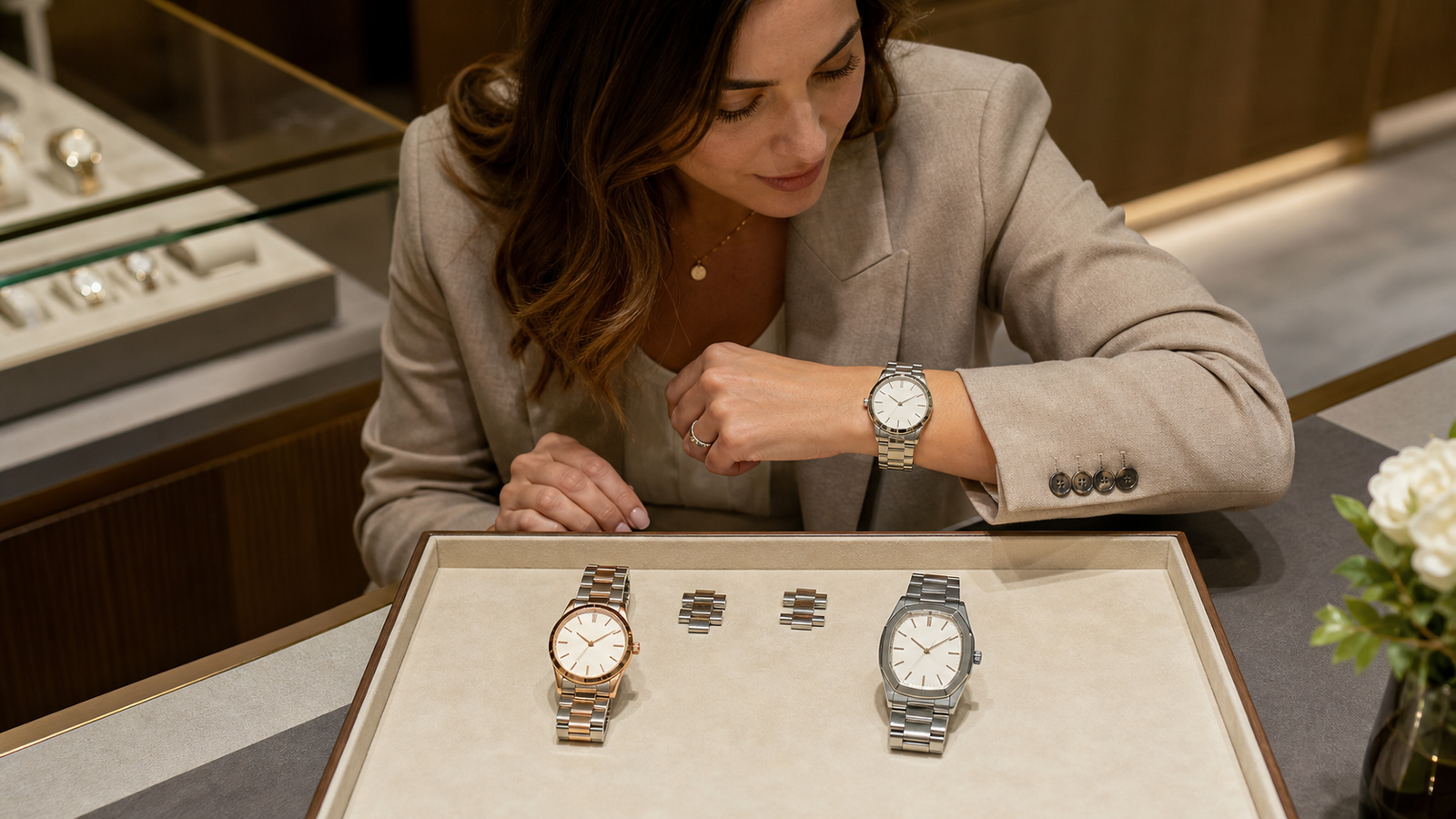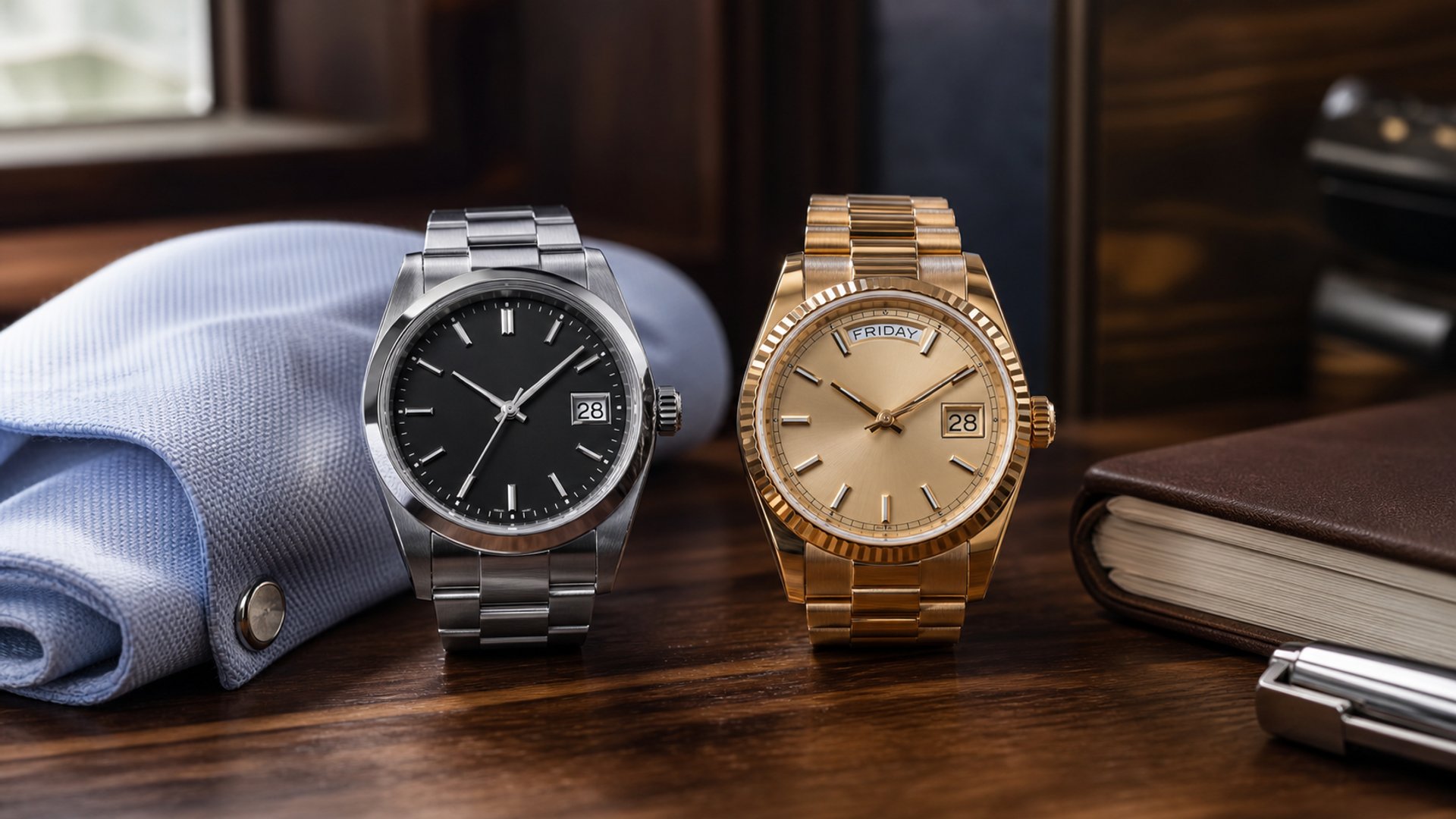
The Datejust and Day-Date share enough visual vocabulary to look like a simple good-better-best ladder: fluted bezels, date windows, Cyclops lenses and bracelets strongly associated with Rolex. Yet their ownership roles are different. The Datejust is a broad everyday family offered through many sizes, materials, bezels, dials and bracelets. The Day-Date is Rolex's precious-metal day-and-date statement, with the fully spelt weekday at 12 o'clock and the President bracelet central to its identity.
The decision is therefore not whether the Day-Date is ‘more Rolex’. It is whether the owner wants versatility and configuration breadth or an unmistakably precious-metal object whose weight, visibility and price are part of the experience. Current prices must be checked in the buyer's market and configuration because metal, dial and bracelet choices materially change the comparison.
Direct answer: Rolex Datejust vs Day Date
Choose the Datejust for a more adaptable daily watch, broader size and material choice, and a lower precious-metal commitment. Choose the Day-Date when the full weekday display, President bracelet and precious-metal presence are the reason to own it. Neither is a universal upgrade from the other; they serve different collection roles.
| Decision factor | Verified starting point | Why it changes the answer | Control before acting |
|---|---|---|---|
| Material | Datejust configurations include steel and Rolesor while Day-Date is positioned in precious metals | metal changes weight, visibility, price and repair exposure | try the exact metal and bracelet for a full day |
| Calendar | Datejust shows the date while Day-Date adds a fully written weekday | the extra display is either meaningful utility or visual identity | decide whether the day complication matters in daily use |
| Size and fit | both families have multiple references but proportions differ | diameter alone does not predict wrist presence | compare lug position, bracelet taper and total weight |
| Configuration | dial, bezel and bracelet choices can transform each watch | a specific Datejust may feel dressier than a specific Day-Date | compare exact references rather than family names |
| Price context | official market prices vary by configuration and country | internet averages can compare unlike watches | capture dated official retail and a condition-matched secondary quote |
| Collection role | Datejust often serves as an everyday watch; Day-Date communicates deliberate precious-metal presence | the wrong role creates low wear frequency | state when and where the watch will actually be worn |
This is the article-specific value object for Rolex Datejust vs Day Date. In this Rolex Datejust vs Day Date analysis, it keeps public evidence, owner preference and downside exposure in separate columns so that a prestigious name or dramatic price cannot silently become a recommendation.
Verified evidence baseline
Evidence 1. Rolex describes the Datejust as the archetype of the classic watch, with the date displayed in a window at 3 o'clock. Source.
Evidence 2. Rolex's Day-Date page identifies the day of the week written in full at 12 o'clock as the model's defining calendar feature. Source.
Evidence 3. Rolex's official watch finder exposes current market-specific configurations and prices, which must be matched by reference and material. Source.
Evidence 4. Rolex states that the President bracelet was created for the Day-Date at its 1956 launch. Source.
For Rolex Datejust vs Day Date, the sources establish only the facts within their published scope. Specifications relevant to Rolex Datejust vs Day Date depend on reference and configuration; prices, availability, tax and market values change. Private transactions, future appreciation and universal suitability are not inferred from manufacturer or institutional pages.
How each decision factor changes the result
Material. For Rolex Datejust vs Day Date, the verified starting point is that datejust configurations include steel and Rolesor while Day-Date is positioned in precious metals. This changes the decision because metal changes weight, visibility, price and repair exposure. Before committing, try the exact metal and bracelet for a full day. Preserve the dated result with the exact model, market, configuration and assumption that could reverse the conclusion.
Calendar. For Rolex Datejust vs Day Date, the verified starting point is that datejust shows the date while Day-Date adds a fully written weekday. This changes the decision because the extra display is either meaningful utility or visual identity. Before committing, decide whether the day complication matters in daily use. Preserve the dated result with the exact model, market, configuration and assumption that could reverse the conclusion.
Size and fit. For Rolex Datejust vs Day Date, the verified starting point is that both families have multiple references but proportions differ. This changes the decision because diameter alone does not predict wrist presence. Before committing, compare lug position, bracelet taper and total weight. Preserve the dated result with the exact model, market, configuration and assumption that could reverse the conclusion.
Configuration. For Rolex Datejust vs Day Date, the verified starting point is that dial, bezel and bracelet choices can transform each watch. This changes the decision because a specific Datejust may feel dressier than a specific Day-Date. Before committing, compare exact references rather than family names. Preserve the dated result with the exact model, market, configuration and assumption that could reverse the conclusion.
Price context. For Rolex Datejust vs Day Date, the verified starting point is that official market prices vary by configuration and country. This changes the decision because internet averages can compare unlike watches. Before committing, capture dated official retail and a condition-matched secondary quote. Preserve the dated result with the exact model, market, configuration and assumption that could reverse the conclusion.
Collection role. For Rolex Datejust vs Day Date, the verified starting point is that datejust often serves as an everyday watch; Day-Date communicates deliberate precious-metal presence. This changes the decision because the wrong role creates low wear frequency. Before committing, state when and where the watch will actually be worn. Preserve the dated result with the exact model, market, configuration and assumption that could reverse the conclusion.
Worked decision calculation
Build a five-year ownership sheet for the exact two references. Record dated official retail, any acquisition premium, insurance, expected service reserve and a conservative net exit value after selling costs. Then divide the net ownership cost by realistic wears, not by calendar days. A Datejust worn 180 days a year may deliver a lower cost per meaningful wear than a Day-Date reserved for ten formal occasions. The opposite can be true for an owner who genuinely prefers a heavy precious-metal watch every day. The calculation makes wear behaviour, not hierarchy, decide value.
The Datejust proposition is breadth
The Datejust can be configured across a wide spectrum, from restrained smooth-bezel combinations to fluted-bezel and Jubilee-bracelet references with stronger jewellery character. This breadth is its advantage and its trap. A generic comparison misses the fact that two Datejust references can feel like different products. Buyers should lock size, metal, bezel, dial and bracelet before comparing price or presence. A steel-and-white-gold Datejust is not a budget version of a yellow-gold Day-Date; it is a different balance of discretion, durability and visual signal.
The Day-Date proposition is concentrated identity
The full weekday, precious-metal case and President bracelet make the Day-Date immediately legible. That concentrated identity is why it can be compelling and why it can be the wrong choice. Weight, polished surfaces and recognisability may not suit every workplace, city or travel pattern. The buyer should test whether that visibility feels natural outside the boutique. If the watch will be hidden or left at home, paying for its defining presence has created an ownership mismatch.
Fit is more than case diameter
Bracelet construction, case material, dial openness, bezel reflection and the distribution of mass all change how a watch wears. Precious metal can make a familiar diameter feel much more substantial. Compare both watches sized correctly, then move the wrist through typing, driving and jacket-cuff positions. Photograph them in ordinary light. Boutique lighting can amplify polished surfaces; daily environments reveal whether the watch remains comfortable and proportionate.
Retail price and secondary price answer different questions
Official retail establishes what Rolex asks for an available configuration in a stated market. Secondary listings reflect availability, condition, completeness, dealer margin and current demand. Neither alone is the ownership cost. A watch obtained at retail may require time and relationship; a secondary watch may be available immediately but carry a premium or condition uncertainty. Record the all-in acquisition path and likely net exit, then avoid presenting an asking price as a transaction.
Which works as the only Rolex
For many owners, the Datejust is the more flexible single Rolex because it can move between business, travel and informal use with less visual commitment. The Day-Date can be the better only Rolex for someone who already knows that precious metal and the President bracelet are non-negotiable. The correct answer depends on frequency and context. A watch that is theoretically more valuable but practically unworn is a weaker personal asset.
A collection-level decision
If the collection already contains a steel sports watch, the Day-Date may add material and social contrast. If it already contains several precious-metal dress watches, a versatile Datejust may fill more days. Write the role before purchase: daily anchor, formal statement, milestone object or collectible configuration. Then reject options that duplicate an existing role without adding a distinct experience. This prevents the comparison from collapsing into a price ladder.
Risk-control checklist for Rolex Datejust vs Day Date
[ ] Choose exact references
[ ] Confirm current official price
[ ] Try both correctly sized
[ ] Assess precious-metal visibility
[ ] Model acquisition premium
[ ] Reserve for insurance and service
[ ] Estimate realistic wear frequency
[ ] Define the collection role
The Rolex Datejust vs Day Date checklist must be completed with evidence. An unchecked Rolex Datejust vs Day Date item remains an unknown rather than being scored as favourable.
Reader-visible sources and methodology
The Rolex Datejust vs Day Date source pages were observed for the current publication run. Competitor pages informed only the governed Rolex Datejust vs Day Date SERP-gap analysis and were not copied. Market-variable claims for Rolex Datejust vs Day Date must be reconfirmed in the buyer's location and on the exact date of action.
Continue with related VERTU editorial research
For Rolex Datejust vs Day Date, these internal links provide adjacent decision context from the live VERTU inventory. They do not replace the primary evidence or professional advice required for this particular Rolex Datejust vs Day Date decision.
Final judgement
Choose the Datejust for a more adaptable daily watch, broader size and material choice, and a lower precious-metal commitment. Choose the Day-Date when the full weekday display, President bracelet and precious-metal presence are the reason to own it. Neither is a universal upgrade from the other; they serve different collection roles.
The Rolex Datejust vs Day Date answer should be reopened whenever its intended use, model, route, source, market, condition or support environment materially changes. That is a stronger Rolex Datejust vs Day Date ownership discipline than treating the category label as a permanent winner.