The 2026 Perseids arrive with unusually favourable moonlight: NASA's sky calendar places the shower maximum on 13 August and a new moon on 12 August. That combination can improve darkness, but it cannot guarantee clear weather or a fixed meteor count. A useful plan works backwards from local darkness, cloud, horizon, travel time and the human need to let eyes adapt.
Your 2026 viewing plan
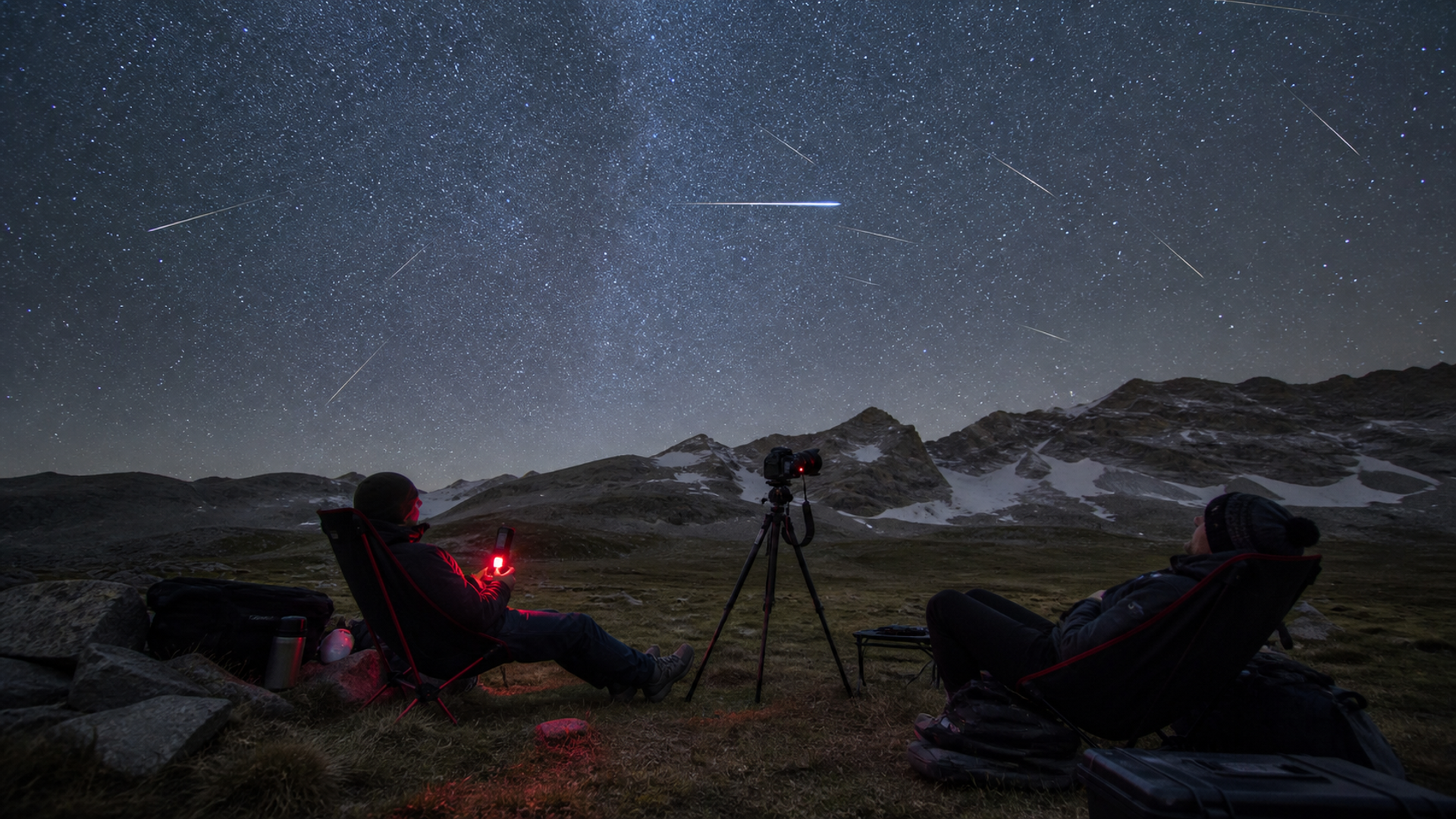
Plan for the night of 12–13 August, reach a safe dark site before the strongest pre-dawn hours and allow at least 30 minutes without bright screens. Use NASA's UTC timing as a reference, then convert it locally and check weather. Look across a broad area of sky rather than staring only at Perseus; binoculars and telescopes narrow the view and are usually counterproductive.
| Decision factor | Dark-sky trip | Local low-light site | Photography session |
|---|---|---|---|
| Sky quality | Lowest practical light pollution | Shield nearby lights and find open sky | Dark foreground with safe equipment area |
| Timing | Several hours after midnight | Best available clear window | Arrive early for composition and focus |
| Equipment | Reclining chair, layers and red light | Simple seating and weather protection | Tripod, wide lens, intervalometer and spare power |
| Main risk | Long drive and fatigue | Urban glow and obstructed horizon | Missing the experience while managing gear |
| Success measure | Comfortable sustained viewing | A safe glimpse without major travel | A sequence with stars and occasional meteors |
| Fallback | Move to a nearer clear zone | Return on an adjacent active night | Shoot starscape and time-lapse if rates are low |
This Perseid meteor shower 2026 matrix is the article's working value object. Read the rows together: the decisive failure mode depends on this topic's evidence, operating context and reader objective.
NASA timing and sky conditions
Evidence 1. NASA's 2026 sky calendar lists the Perseid shower maximum on 13 August at 01:56 UTC.
Evidence 2. The same calendar lists a new moon on 12 August, limiting moonlight around the peak night.
Evidence 3. NASA identifies comet 109P/Swift-Tuttle as the Perseids' parent and describes the shower as active across a broader mid-summer window.
Reader-visible sources checked for this article:
eclipse.gsfc.nasa.gov — current reader-visible source
science.nasa.gov — current reader-visible source
For Perseid meteor shower 2026, these sources establish only the claims inside their documented scope. Recheck every changeable specification, schedule, price, access condition or policy in the relevant market before acting.
Build a safe dark-sky night
A buyer can resolve sky quality without a brand preference. Ask whether lowest practical light pollution; compare that with whether shield nearby lights and find open sky; then use dark foreground with safe equipment area as the third route's safeguard. An unknown condition stays unknown.
On timing, popularity is irrelevant. The evidence for option one is that several hours after midnight. Option two means best available clear window. Option three is rational where arrive early for composition and focus. Recheck any changeable term immediately before commitment.
The decision changes at equipment. Choose the first path only if reclining chair, layers and red light; move to the second when simple seating and weather protection; use the third when tripod, wide lens, intervalometer and spare power. Save the downside that would make this row fail.
For main risk, the first route works when long drive and fatigue; the second requires urban glow and obstructed horizon. The control for the third is missing the experience while managing gear. Verify this row against the exact market, model, venue or itinerary before it can reverse the decision.
The success measure row exposes a practical boundary. Route one assumes comfortable sustained viewing, while route two is defensible only when a safe glimpse without major travel. Route three depends on a sequence with stars and occasional meteors. If that evidence is absent, keep the more reversible option.
Read fallback as a stop/go test: move to a nearer clear zone supports the first option; return on an adjacent active night supports the second; and shoot starscape and time-lapse if rates are low supports the third. Record which source proves the condition and when it was checked.
Facts that would reverse the current choice
Reversal control 1 — Sky quality. Before choosing Dark-sky trip, write down how the decision changes if 'Lowest practical light pollution' proves false. Do the same for Local low-light site and 'Shield nearby lights and find open sky'. The Photography session path should remain available until 'Dark foreground with safe equipment area' is verified. This control belongs to Perseid meteor shower 2026; it should be updated from the cited source or the exact supplier, device, venue or operator rather than copied from a generic checklist.
Reversal control 2 — Timing. Before choosing Dark-sky trip, write down how the decision changes if 'Several hours after midnight' proves false. Do the same for Local low-light site and 'Best available clear window'. The Photography session path should remain available until 'Arrive early for composition and focus' is verified. This control belongs to Perseid meteor shower 2026; it should be updated from the cited source or the exact supplier, device, venue or operator rather than copied from a generic checklist.
Reversal control 3 — Equipment. Before choosing Dark-sky trip, write down how the decision changes if 'Reclining chair, layers and red light' proves false. Do the same for Local low-light site and 'Simple seating and weather protection'. The Photography session path should remain available until 'Tripod, wide lens, intervalometer and spare power' is verified. This control belongs to Perseid meteor shower 2026; it should be updated from the cited source or the exact supplier, device, venue or operator rather than copied from a generic checklist.
Reversal control 4 — Main risk. Before choosing Dark-sky trip, write down how the decision changes if 'Long drive and fatigue' proves false. Do the same for Local low-light site and 'Urban glow and obstructed horizon'. The Photography session path should remain available until 'Missing the experience while managing gear' is verified. This control belongs to Perseid meteor shower 2026; it should be updated from the cited source or the exact supplier, device, venue or operator rather than copied from a generic checklist.
Reversal control 5 — Success measure. Before choosing Dark-sky trip, write down how the decision changes if 'Comfortable sustained viewing' proves false. Do the same for Local low-light site and 'A safe glimpse without major travel'. The Photography session path should remain available until 'A sequence with stars and occasional meteors' is verified. This control belongs to Perseid meteor shower 2026; it should be updated from the cited source or the exact supplier, device, venue or operator rather than copied from a generic checklist.
Reversal control 6 — Fallback. Before choosing Dark-sky trip, write down how the decision changes if 'Move to a nearer clear zone' proves false. Do the same for Local low-light site and 'Return on an adjacent active night'. The Photography session path should remain available until 'Shoot starscape and time-lapse if rates are low' is verified. This control belongs to Perseid meteor shower 2026; it should be updated from the cited source or the exact supplier, device, venue or operator rather than copied from a generic checklist.
Convert the peak without creating false precision
A meteor shower is not a one-minute event. Convert the published UTC maximum to local time, then inspect the whole night around it. The radiant rises and the observer's side of Earth turns into the stream toward dawn, so late-night and pre-dawn viewing often improves. Weather can make the mathematically perfect hour useless; choose the clearest safe block.
Dark adaptation is the highest-return upgrade
Bright phone screens constrict the pupil and reset visual adaptation. Put the phone in a red-light mode, lower brightness and use it only when necessary. Face away from roads and buildings, give the eyes time, and scan a large patch of sky. The meteor trails can appear far from the radiant, which is why a wide view beats magnification.
Build safety into the site choice
A remote site is not automatically a good site. Confirm legal access, parking, terrain, wildlife, mobile coverage, toilets and a fatigue plan. Tell someone the location and return time. In hot or cold regions, pack for the lowest overnight temperature. Do not stop on road shoulders or trespass for a darker horizon.
Photograph with realistic expectations
Use a wide, fast lens, manual focus on a bright star, repeated short exposures and an intervalometer. A single meteor may not cross the preferred composition. Preserve the experience by letting the camera run while watching away from it. Avoid compositing in a way that misrepresents direction or density unless the caption explains the method.
Viewing plans by traveller
US and Canada
The UTC maximum falls during the preceding evening in some zones, but the broader overnight window and pre-dawn geometry still matter; use a local astronomy forecast. Define the fact that would reverse the choice before committing.
UK and Western Europe
The official maximum occurs overnight, making weather and access the main constraints under favourable moonlight. Define the fact that would reverse the choice before committing.
Gulf and Singapore travellers
Humidity, cloud and urban light can dominate; prioritise a safe open site and treat a clear adjacent night as a valid fallback. Define the fact that would reverse the choice before committing.
Action checklist
Convert 01:56 UTC to local time.
Check cloud and smoke forecasts.
Choose a legal dark site.
Plan safe transport and fatigue.
Pack a chair and layers.
Use dim red light.
Allow 30 minutes for adaptation.
Set a clear-weather fallback.
Related VERTU reading
The linked VERTU reading expands adjacent parts of the Perseid meteor shower 2026 decision. It does not substitute for the external evidence above, and brand relevance is kept out when it adds no reader value.
The practical Perseids verdict
Plan for the night of 12–13 August, reach a safe dark site before the strongest pre-dawn hours and allow at least 30 minutes without bright screens. Use NASA's UTC timing as a reference, then convert it locally and check weather. Look across a broad area of sky rather than staring only at Perseus; binoculars and telescopes narrow the view and are usually counterproductive.
Keep the Perseid meteor shower 2026 decision reversible until its material cost, safety, access and compatibility facts are verified. Unknown evidence stays unknown; it is never silently scored as favourable.