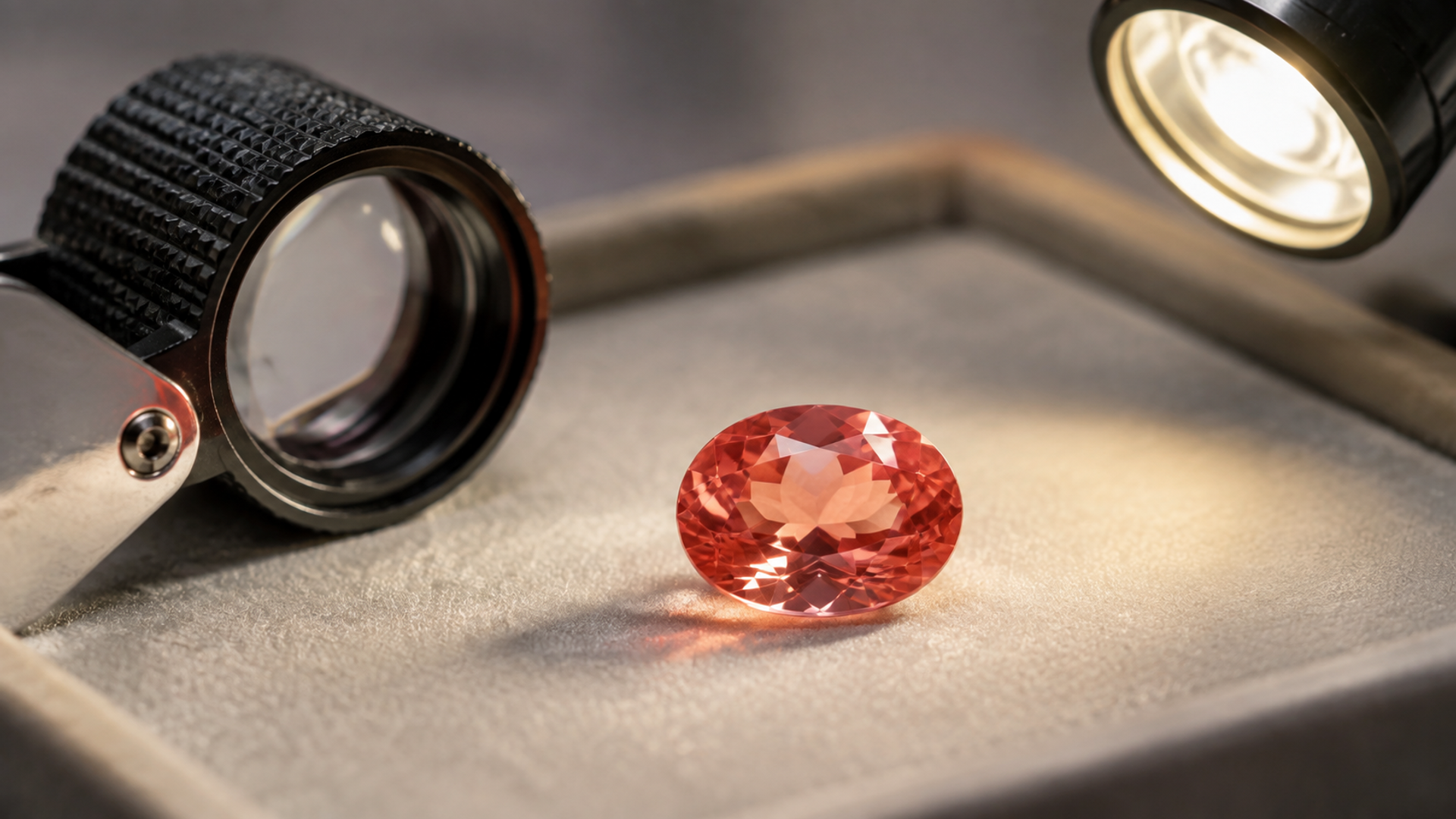
Padparadscha is one of the most disputed names in coloured gemstones because it describes a narrow pink-orange appearance rather than a simple chemical category. Lighting, photography, saturation and colour distribution can move a stone in or out of the buyer’s mental picture, while heat, diffusion and laboratory terminology can change market value. A seller’s label is therefore only the start. A serious purchase joins the actual stone to an independent laboratory report, treatment disclosure, return right and a comparison under controlled light. The goal is not to chase the palest or most expensive specimen. It is to buy a stable, wearable colour whose documentation and price tell the same story.
Direct answer: padparadscha sapphire
Prioritise balanced pink-orange colour in person, then verify natural origin, treatment and any padparadscha opinion through an independent laboratory. Compare face-up dimensions, colour zoning, windowing, clarity and durability. Price an unheated premium only when the report supports it and the visible result matters to you.
| Decision factor | Evidence to collect | Why it changes the answer | Control before purchase |
|---|---|---|---|
| Colour balance | view stone under daylight-equivalent and warm light | photographs can exaggerate orange or pink | compare loose stones side by side |
| Laboratory wording | report identifies species, natural origin, treatment and colour opinion | the trade name may not be accepted for every stone | verify report number directly |
| Treatment | report distinguishes no heat, heat and diffusion where detectable | treatment changes rarity and price | require written disclosure before payment |
| Cut and windowing | face-up inspection shows extinction, window and colour zoning | carat weight can hide weak visual spread | compare dimensions and video through tilt |
| Origin | laboratory may offer an origin opinion when possible | origin can attract a premium without improving beauty | separate origin premium from colour quality |
| Setting risk | design protects pavilion, girdle and exposed corners | a rare stone can be damaged by poor mounting | use a jeweller experienced with corundum |
This matrix is the article-specific value object for padparadscha sapphire. It prevents a famous name, a single specification or one price from silently becoming the recommendation.
Current evidence baseline
Evidence 1. GIA describes padparadscha as a narrow pinkish-orange to orangy-pink sapphire range and explains why laboratory identification and treatment disclosure matter. Source.
Evidence 2. GIA explains that a coloured-stone report can identify whether sapphire is natural or laboratory-grown and disclose detectable treatments. Source.
Evidence 3. The Laboratory Manual Harmonisation Committee publishes shared wording and treatment nomenclature used by major gem laboratories. Source.
Evidence 4. US Federal Trade Commission jewellery guides address representations about gemstones, precious metals and treatments. Source.
For padparadscha sapphire, these sources support only the claims directly attached above. They do not establish permanent availability, universal authenticity, future appreciation or suitability for every owner.
How the decision factors change the result
Colour balance. Collect evidence showing that view stone under daylight-equivalent and warm light. This changes the decision because photographs can exaggerate orange or pink. The practical control is to compare loose stones side by side. Record the exact object, date, source and assumption that would reverse the conclusion. If the evidence remains unavailable, mark this factor unknown rather than converting uncertainty into a favourable score.
Laboratory wording. Collect evidence showing that report identifies species, natural origin, treatment and colour opinion. This changes the decision because the trade name may not be accepted for every stone. The practical control is to verify report number directly. Record the exact object, date, source and assumption that would reverse the conclusion. If the evidence remains unavailable, mark this factor unknown rather than converting uncertainty into a favourable score.
Treatment. Collect evidence showing that report distinguishes no heat, heat and diffusion where detectable. This changes the decision because treatment changes rarity and price. The practical control is to require written disclosure before payment. Record the exact object, date, source and assumption that would reverse the conclusion. If the evidence remains unavailable, mark this factor unknown rather than converting uncertainty into a favourable score.
Cut and windowing. Collect evidence showing that face-up inspection shows extinction, window and colour zoning. This changes the decision because carat weight can hide weak visual spread. The practical control is to compare dimensions and video through tilt. Record the exact object, date, source and assumption that would reverse the conclusion. If the evidence remains unavailable, mark this factor unknown rather than converting uncertainty into a favourable score.
Origin. Collect evidence showing that laboratory may offer an origin opinion when possible. This changes the decision because origin can attract a premium without improving beauty. The practical control is to separate origin premium from colour quality. Record the exact object, date, source and assumption that would reverse the conclusion. If the evidence remains unavailable, mark this factor unknown rather than converting uncertainty into a favourable score.
Setting risk. Collect evidence showing that design protects pavilion, girdle and exposed corners. This changes the decision because a rare stone can be damaged by poor mounting. The practical control is to use a jeweller experienced with corundum. Record the exact object, date, source and assumption that would reverse the conclusion. If the evidence remains unavailable, mark this factor unknown rather than converting uncertainty into a favourable score.
Worked decision scenario
Compare three certified stones between 1.5 and 2.0 carats. Photograph each in the same neutral light beside a grey card, then record dimensions, colour description, treatment, origin opinion, windowing and price. Calculate price per face-up square millimetre as well as price per carat. Remove the origin and no-heat premiums in a second comparison. If the preferred stone changes, decide whether documentation or visible colour is actually driving the purchase.
Colour is a range, not a paint chip
A useful padparadscha comparison avoids saturated orange, straight pink and brownish modifiers, but laboratory boundaries are not identical to personal preference. View the gem in daylight-equivalent illumination, warm interior light and the light in which it will be worn. Ask for unedited video with white balance disclosed. A colour that survives those changes is more valuable to the owner than an online image engineered for one screen.
Read every line of the report
Confirm that the report belongs to the stone by matching dimensions, weight and any plotted characteristics. Look for natural versus laboratory-grown origin, indications of heating, diffusion or other treatment, and whether the laboratory itself uses the word padparadscha. An identification report is not a valuation. It does not guarantee future price, but it prevents a premium from resting solely on seller language.
Cut can improve or destroy the colour
Coloured-stone cutters often preserve weight, which can leave a deep pavilion, window or uneven face-up colour. Examine the centre for transparency through to the background and rotate the stone to locate extinction. Compare millimetre dimensions rather than carat alone. A slightly lighter stone with even colour and better spread may present more strongly in a ring than a heavier specimen carrying invisible weight below the setting.
Origin is secondary to a coherent stone
Sri Lanka has historic association with padparadscha, while material is also reported from other sources. An origin opinion can influence rarity narratives and price, but it is not a substitute for colour, treatment and cut. Laboratory origin determination also has limits. Buy the origin premium only when the report is clear and that provenance matters personally, not because a salesperson implies that every stone from one country is superior.
Design the setting around inspection and repair
Corundum is durable for jewellery, yet chips can occur at exposed edges and poor workmanship can damage a valuable stone. Keep the laboratory report, loose-stone photographs and measurements. Choose a setting that protects vulnerable points without blocking the colour. Ask whether the stone can be removed for future laboratory work and insure it using a current independent appraisal rather than the seller’s marketing estimate.
Evidence checklist
[ ] View in several lights
[ ] Verify independent report
[ ] Confirm treatment disclosure
[ ] Compare dimensions not only carat
[ ] Inspect windowing and zoning
[ ] Separate origin premium
[ ] Secure return period
[ ] Document stone before setting
For the padparadscha sapphire decision, unchecked fields remain unknown and should not be converted into favourable assumptions merely to complete a purchase.
Reader-visible sources and method
The external pages above were checked for this padparadscha sapphire analysis. Price, availability, service, tax, regulation and platform terms must be reconfirmed for the buyer's market and date. Ranking pages informed a separate SERP benchmark; their wording and paragraph order were not copied.
Continue with adjacent VERTU editorial research
For padparadscha sapphire, these links provide adjacent premium-lifestyle and decision context; they do not replace specialist or official evidence for the exact decision.
Final judgement
Prioritise balanced pink-orange colour in person, then verify natural origin, treatment and any padparadscha opinion through an independent laboratory. Compare face-up dimensions, colour zoning, windowing, clarity and durability. Price an unheated premium only when the report supports it and the visible result matters to you.
The useful standard for padparadscha sapphire is not certainty created by confident language. It is a decision whose evidence, downside and next review point are visible to the reader.