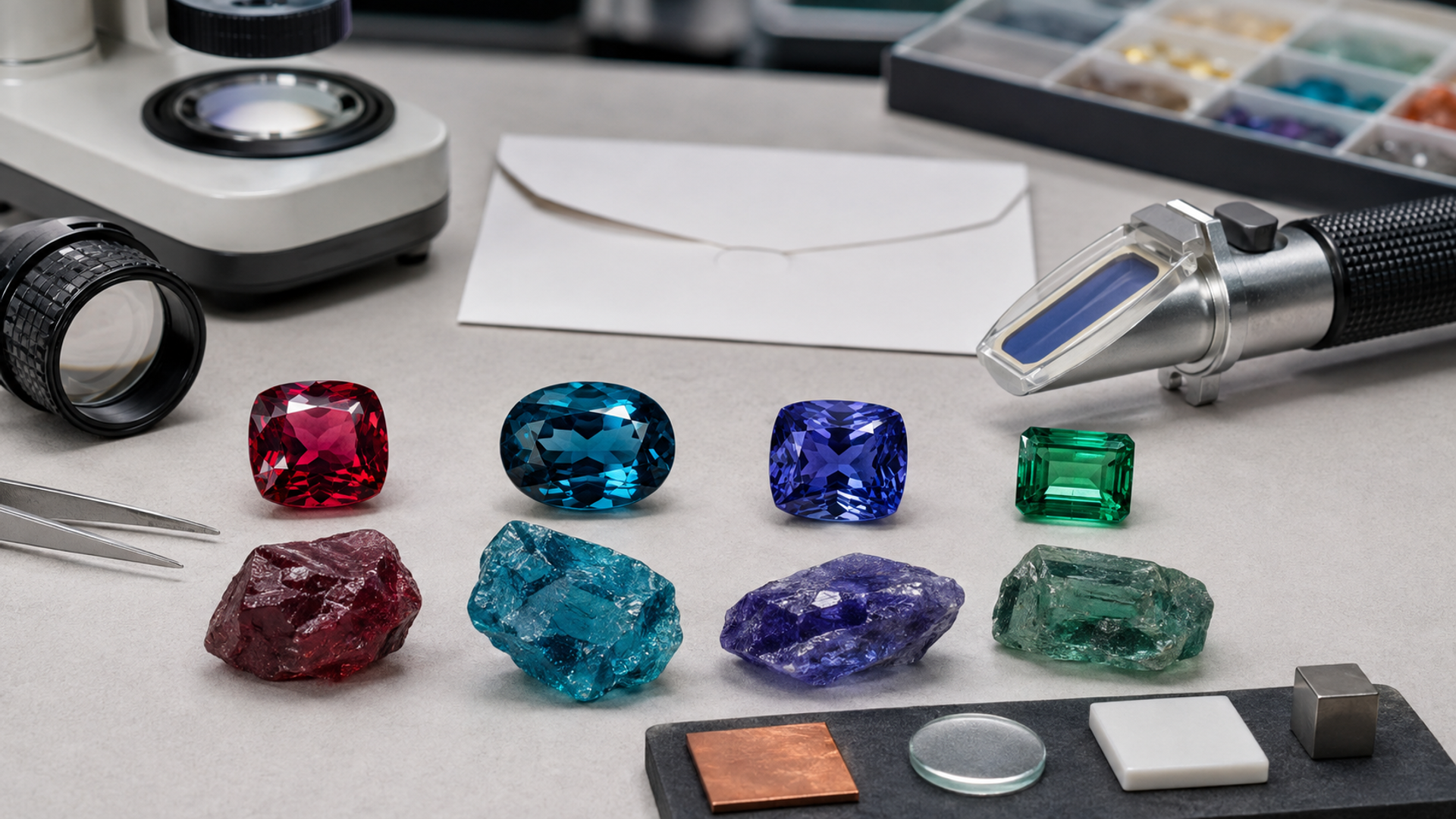
The rarest mineral is not automatically the rarest wearable gemstone, and the rarest gemstone is not automatically the most valuable. Scarcity can refer to how little material exists, how little is transparent enough to facet, whether only one locality produces it, or whether a particular colour and size combination almost never appears. A fragile specimen prized by mineral collectors can be unsuitable for a ring; a famous gem can be valuable because demand is deep even when supply is larger.
A credible list must therefore state what kind of rarity it measures. This guide compares geological occurrence, gem-quality yield, treatment, laboratory identification, durability, source concentration and observable market depth. It avoids permanent ‘rarest in the world’ claims when discoveries and classifications can change.
Direct answer: most rare gemstone
Painite, red beryl, fine alexandrite, Paraíba-type tourmaline, musgravite and gem-quality grandidierite often appear in rarity discussions, but they are rare for different reasons. Buy the exact stone, not the list: require a recognised laboratory report, treatment and origin disclosure where supportable, durability fit for the jewellery design, and comparable transactions in the relevant size and quality.
| Decision factor | Evidence to collect | Why it changes the answer | Control before purchase |
|---|---|---|---|
| Species and variety | laboratory identification separates look-alikes | trade names can obscure what the stone is | require a report for material claims |
| Gem-quality yield | few crystals may be transparent and clean enough to facet | mineral abundance does not equal jewellery supply | distinguish specimens from faceted gems |
| Locality | single-source or concentrated deposits can constrain supply | origin claims can carry premiums and uncertainty | accept origin only within laboratory scope |
| Treatment | heat, filling and other processes can alter appearance | undisclosed treatment changes value and care | obtain explicit treatment disclosure |
| Wearability | hardness, toughness and cleavage govern jewellery risk | rare does not mean suitable for daily rings | match setting and use to durability |
| Market depth | public sales and specialist dealer observations show liquidity | extreme rarity can make pricing opaque | use multiple comparables and wide uncertainty |
This matrix is the article-specific value object for most rare gemstone. It prevents a famous name, a single specification or one price from silently becoming the recommendation.
Current evidence baseline
Evidence 1. GIA's gem encyclopaedia describes gem species, quality factors and care considerations but does not create a universal rarity ranking. Source.
Evidence 2. GIA reports that Paraíba-type tourmaline colour and geographic origin require gemological analysis and can affect market interpretation. Source.
Evidence 3. GIA notes that fine tanzanite supply is associated with one commercially important geographic area and that treatment disclosure matters. Source.
Evidence 4. The US Federal Trade Commission's jewellery guides require truthful representation of gemstone nature and treatment in the US market. Source.
For most rare gemstone, these sources support only the stated claims. They do not prove permanent availability, universal authenticity, future appreciation or suitability for every owner.
How the decision factors change the result
Species and variety. The evidence to collect is that laboratory identification separates look-alikes. That changes the decision because trade names can obscure what the stone is. The practical control is to require a report for material claims. For this species and variety test within most rare gemstone, record the date, exact object, source and assumption that would reverse the conclusion. If evidence remains unavailable, label the factor unknown rather than converting it into a favourable score.
Gem-quality yield. The evidence to collect is that few crystals may be transparent and clean enough to facet. That changes the decision because mineral abundance does not equal jewellery supply. The practical control is to distinguish specimens from faceted gems. For this gem-quality yield test within most rare gemstone, record the date, exact object, source and assumption that would reverse the conclusion. If evidence remains unavailable, label the factor unknown rather than converting it into a favourable score.
Locality. The evidence to collect is that single-source or concentrated deposits can constrain supply. That changes the decision because origin claims can carry premiums and uncertainty. The practical control is to accept origin only within laboratory scope. For this locality test within most rare gemstone, record the date, exact object, source and assumption that would reverse the conclusion. If evidence remains unavailable, label the factor unknown rather than converting it into a favourable score.
Treatment. The evidence to collect is that heat, filling and other processes can alter appearance. That changes the decision because undisclosed treatment changes value and care. The practical control is to obtain explicit treatment disclosure. For this treatment test within most rare gemstone, record the date, exact object, source and assumption that would reverse the conclusion. If evidence remains unavailable, label the factor unknown rather than converting it into a favourable score.
Wearability. The evidence to collect is that hardness, toughness and cleavage govern jewellery risk. That changes the decision because rare does not mean suitable for daily rings. The practical control is to match setting and use to durability. For this wearability test within most rare gemstone, record the date, exact object, source and assumption that would reverse the conclusion. If evidence remains unavailable, label the factor unknown rather than converting it into a favourable score.
Market depth. The evidence to collect is that public sales and specialist dealer observations show liquidity. That changes the decision because extreme rarity can make pricing opaque. The practical control is to use multiple comparables and wide uncertainty. For this market depth test within most rare gemstone, record the date, exact object, source and assumption that would reverse the conclusion. If evidence remains unavailable, label the factor unknown rather than converting it into a favourable score.
Worked decision scenario
For a candidate stone, create a confidence-adjusted value sheet. Record species, weight, measurements, colour, clarity, cut, treatment, origin opinion, report laboratory, durability, seller return terms and three comparables. Give each evidence field a confidence score. Apply no premium for origin, untreated status or rarity when the report does not support it. Add setting and insurance cost, then stress-test resale at a wide discount because thin markets can be difficult to exit.
Define the rarity being claimed
A seller may mean few known crystals, little facetable rough, unusual colour, one locality or a large clean example. Ask which definition applies and what source supports it. New deposits can change availability without changing beauty. A list should be dated and conditional. The more absolute the superlative, the stronger the burden of evidence. ‘Among the rarest gem-quality materials observed’ is often more accurate than a permanent number-one claim.
Painite and the problem of old records
Painite became famous when very few specimens were known. Later discoveries increased the number of available crystals, while fine facetable material remained uncommon. This illustrates why rarity claims need a date and a distinction between specimens and wearable stones. An inexpensive listing labelled painite is not evidence of a bargain; it is a reason to verify species, treatment, quality and seller credibility.
Colour-change and neon stones
Fine alexandrite is valued for strength of colour change, colour quality, clarity, size and origin evidence. Paraíba-type tourmaline is valued for copper-related vivid colour, but origin and nomenclature require laboratory context. Neither category can be judged from saturated online images. Review stones in controlled lighting and ordinary daylight, and ask the laboratory exactly what its report does and does not conclude.
Rarity must survive the setting
Red beryl, grandidierite and other uncommon materials can present cutting, cleavage or toughness constraints. A pendant experiences less impact than a ring. Protective bezels, low settings and occasional wear can reduce risk but change appearance. Discuss cleaning restrictions with a gemologist and jeweller. The best rare stone is not necessarily the rarest name; it is the specimen whose evidence and durability match the intended object.
Thin markets require wider uncertainty
A stone with few public transactions can be difficult to price and sell. Dealer asks may reflect replacement difficulty rather than completed demand. Compare equivalent size, colour, treatment and report, and document why each comparable is relevant. Insure using a professional appraisal, while recognising that replacement value is not guaranteed cash value. Buy primarily for connoisseurship unless the buyer has specialist market access.
Evidence checklist
[ ] Define rarity category
[ ] Verify species
[ ] Record treatment
[ ] Review origin scope
[ ] Assess gem-quality yield
[ ] Match durability to setting
[ ] Collect three comparables
[ ] Stress-test illiquidity
Unchecked fields for most rare gemstone remain unknown. They should never become favourable assumptions merely to complete this decision.
Reader-visible sources and method
The external pages above were checked for this most rare gemstone publication. Price, availability, service, tax, regulation and platform terms must be reconfirmed for the buyer's market and date. Ranking pages informed a separate SERP benchmark; their wording and paragraph order were not copied.
Continue with adjacent VERTU editorial research
For most rare gemstone, these links provide adjacent premium-lifestyle and decision context. They do not replace specialist or official evidence for the decision.
Final judgement
Painite, red beryl, fine alexandrite, Paraíba-type tourmaline, musgravite and gem-quality grandidierite often appear in rarity discussions, but they are rare for different reasons. Buy the exact stone, not the list: require a recognised laboratory report, treatment and origin disclosure where supportable, durability fit for the jewellery design, and comparable transactions in the relevant size and quality.
The useful standard for most rare gemstone is not certainty created by confident language. It is a decision whose evidence, downside and next review point are visible to the reader.