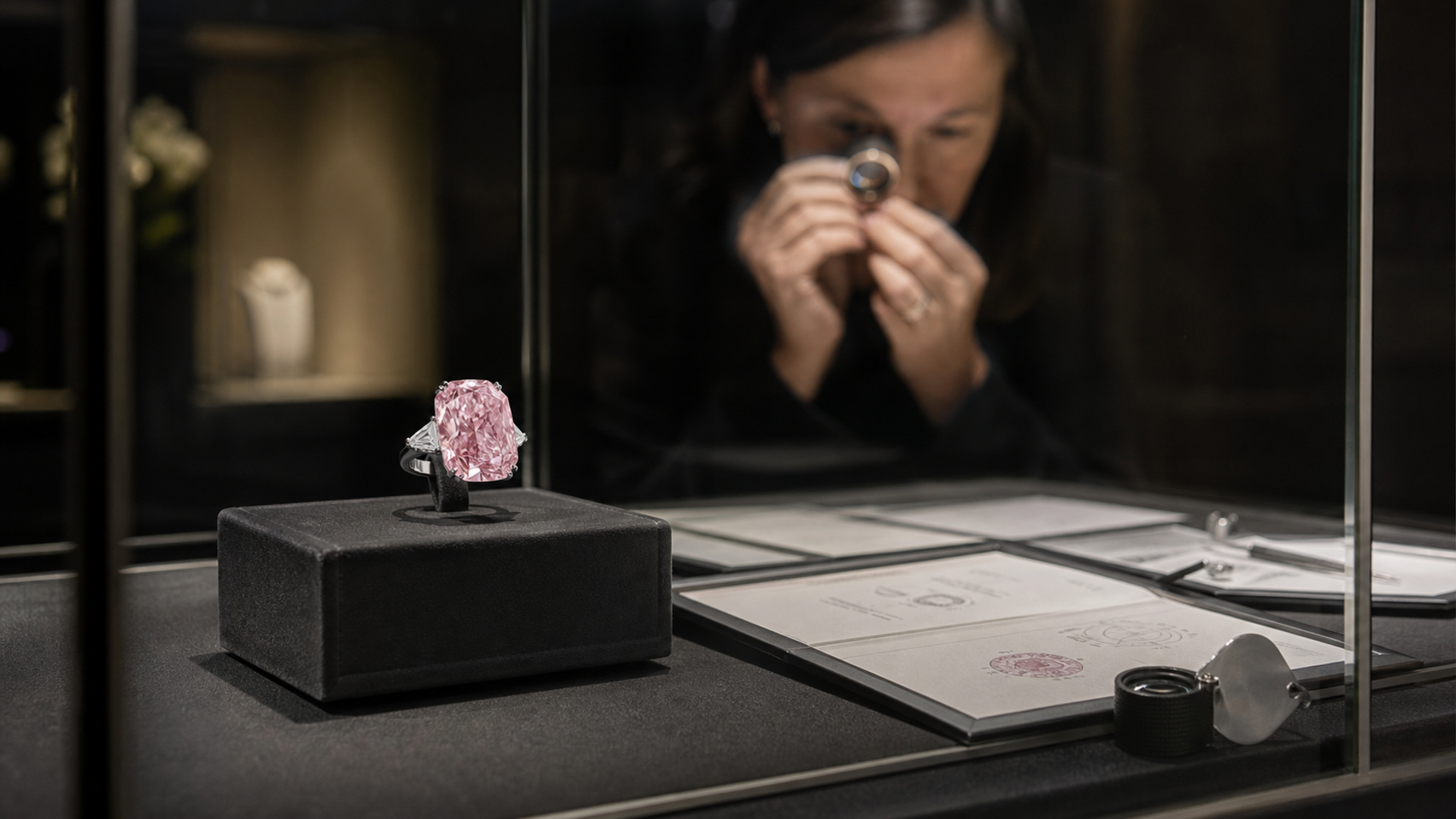
The answer depends on whether 'expensive' means a public sale, an insurance estimate or an object considered culturally irreplaceable. Sotheby's identifies the 59.60-carat CTF Pink Star as the world auction record for any diamond or jewel at US$71.2 million. That is the cleanest public price benchmark because it records a competitive transaction under stated auction conditions.
Museum objects such as the Hope Diamond belong to a different category. Their historical and cultural significance may generate extraordinary estimates, but they are not being offered to establish a current market-clearing price. Mixing a museum estimate with an auction result gives a dramatic ranking and a poor answer.
Direct answer: most expensive jewel in the world
For a verified public transaction, the CTF Pink Star's US$71.2 million Sotheby's result is the leading benchmark. It should not be presented as proof that no privately held or museum jewel is more valuable. Auction price, appraisal and cultural value answer different questions.
| Decision factor | Verified starting point | Why it changes the answer | Control before acting |
|---|---|---|---|
| Evidence type | Sotheby's reports a completed $71.2 million auction result | a sale is stronger price evidence than an estimate | state whether fees are included and date the result |
| Gem identity | the Pink Star is a 59.60-carat fancy vivid pink internally flawless diamond | specific grading drives rarity | verify the laboratory report and inscription |
| Provenance | named ownership and sale history can affect confidence | story and title risk change value | trace custody and export history |
| Design | a jewel's setting may add authorship and wearability | loose-stone and finished-jewel markets differ | value stone and setting separately before combining |
| Museum status | the Hope Diamond is held by the Smithsonian | cultural significance is not a live asking price | keep institutional objects outside sale rankings |
| Liquidity | top stones require a tiny global buyer pool | record price does not guarantee quick resale | stress-test fees, time and a lower bid |
For most expensive jewel in the world, this decision matrix is the article-specific value object. It separates price evidence from ownership exposure, so a dramatic headline cannot silently become a recommendation.
Verified evidence baseline
Evidence 1. Sotheby's states that the CTF Pink Star achieved US$71.2 million, a world auction record for any diamond or jewel. Source.
Evidence 2. GIA explains the special grading framework used for fancy-colour diamonds. Source.
Evidence 3. The Smithsonian describes the Hope Diamond as part of the National Gem and Mineral Collection rather than a market listing. Source.
Evidence 4. A public auction result and a museum valuation are not interchangeable evidence classes. Source.
The primary-source boundary for most expensive jewel in the world is deliberately narrow. Dated records, manufacturer specifications and official guidance support only the claims they actually make; they do not prove private transaction prices, future appreciation or universal suitability.
How each decision factor changes the result
Evidence type. The starting evidence for most expensive jewel in the world is that sotheby's reports a completed $71.2 million auction result. This changes the decision because a sale is stronger price evidence than an estimate. Before committing, state whether fees are included and date the result. The dated result belongs in the buyer's evidence file, together with the exact model, market and assumption that could reverse it.
Gem identity. The starting evidence for most expensive jewel in the world is that the Pink Star is a 59.60-carat fancy vivid pink internally flawless diamond. This changes the decision because specific grading drives rarity. Before committing, verify the laboratory report and inscription. The dated result belongs in the buyer's evidence file, together with the exact model, market and assumption that could reverse it.
Provenance. The starting evidence for most expensive jewel in the world is that named ownership and sale history can affect confidence. This changes the decision because story and title risk change value. Before committing, trace custody and export history. The dated result belongs in the buyer's evidence file, together with the exact model, market and assumption that could reverse it.
Design. The starting evidence for most expensive jewel in the world is that a jewel's setting may add authorship and wearability. This changes the decision because loose-stone and finished-jewel markets differ. Before committing, value stone and setting separately before combining. The dated result belongs in the buyer's evidence file, together with the exact model, market and assumption that could reverse it.
Museum status. The starting evidence for most expensive jewel in the world is that the Hope Diamond is held by the Smithsonian. This changes the decision because cultural significance is not a live asking price. Before committing, keep institutional objects outside sale rankings. The dated result belongs in the buyer's evidence file, together with the exact model, market and assumption that could reverse it.
Liquidity. The starting evidence for most expensive jewel in the world is that top stones require a tiny global buyer pool. This changes the decision because record price does not guarantee quick resale. Before committing, stress-test fees, time and a lower bid. The dated result belongs in the buyer's evidence file, together with the exact model, market and assumption that could reverse it.
Worked scenario calculation
For a sale-comparable jewel, begin with the laboratory identity and normalise the auction result for buyer's premium, currency and date. Compare stones of similar colour grade, size, clarity and cut rather than using a generic price per carat. Add or deduct for provenance, setting, condition, restrictions and market depth. Then calculate likely net proceeds after seller fees, insurance, transport and tax. For a museum object, stop: the absence of a willing sale means the same market calculation is not available.
Why the Pink Star is the cleanest record answer
The Sotheby's result connects a named object, exact carat weight, grade, place, date and price. That chain allows readers to understand what was sold. It is stronger than a list that assigns values to crown jewels or museum pieces without a transaction. The record is still conditional: it applies to publicly auctioned diamonds and jewels, not every private transfer or institutional treasure.
Colour rarity changes the price curve
Fancy-colour diamonds are assessed for hue, tone and saturation, and the rarest combinations can command values that bear little relation to ordinary colourless stones. Size compounds rarity because large stones with exceptional colour are scarcer. A record cannot be divided by carats and applied mechanically to another pink diamond whose colour distribution, clarity or cut differs.
The setting can both add and constrain value
A signed historic setting may carry design and provenance value, while a setting tailored to one stone can complicate alteration. Condition, repairs and replaced components matter. Some buyers want a wearable jewel; others focus on the gemstone and may consider resetting. A proper appraisal states whether the object is valued intact and how much evidence supports the maker attribution.
Security, title and cross-border movement
At record values, storage, transport and exhibition are operational decisions. Title, sanctions, customs, cultural-property rules and insurance conditions require specialist review. A laboratory report confirms gem characteristics, not clean title. The owner should maintain separate files for scientific identity, ownership provenance, condition and movement permissions.
Cultural value resists a price ranking
The Hope Diamond's scientific, historical and public role gives it meaning that is not captured by a hypothetical private sale. Declaring it worth a precise sum may create false certainty. A stronger article lets auction markets answer a price question and museums answer a cultural question, without forcing every object into the same list. This separation also protects readers from treating an insurer's replacement figure, an auction estimate and a curator's statement as competing bids. Each is produced for a different purpose, under different assumptions and with a different answer to whether the object could actually change hands.
Risk-control checklist for most expensive jewel in the world
[ ] Define sale or valuation
[ ] Read the lab report
[ ] Confirm premium treatment
[ ] Trace provenance and title
[ ] Inspect the setting
[ ] Quote insurance and transit
[ ] Model seller costs
[ ] Exclude museum objects from sale ranks
The most expensive jewel in the world checklist is meant to be completed with evidence. An unchecked item remains an unknown rather than being treated as a favourable assumption.
Reader-visible sources and methodology
The record and product pages for most expensive jewel in the world were observed for this publication run. Market-variable price, availability, tax, insurance, service and regulatory conditions must be reconfirmed in the buyer's jurisdiction. Competitor pages informed the SERP gap analysis but were not copied and do not control the claims above.
Continue with adjacent VERTU editorial research
For most expensive jewel in the world, these internal links provide adjacent premium-lifestyle and decision context. They do not replace the authoritative evidence or professional advice required for a specific transaction.
Final judgement
For a verified public transaction, the CTF Pink Star's US$71.2 million Sotheby's result is the leading benchmark. It should not be presented as proof that no privately held or museum jewel is more valuable. Auction price, appraisal and cultural value answer different questions.
For most expensive jewel in the world, quality means preserving the boundary between a verified fact, a reported estimate and an ownership assumption. The decision should be reopened when a source, market, condition or intended use materially changes.