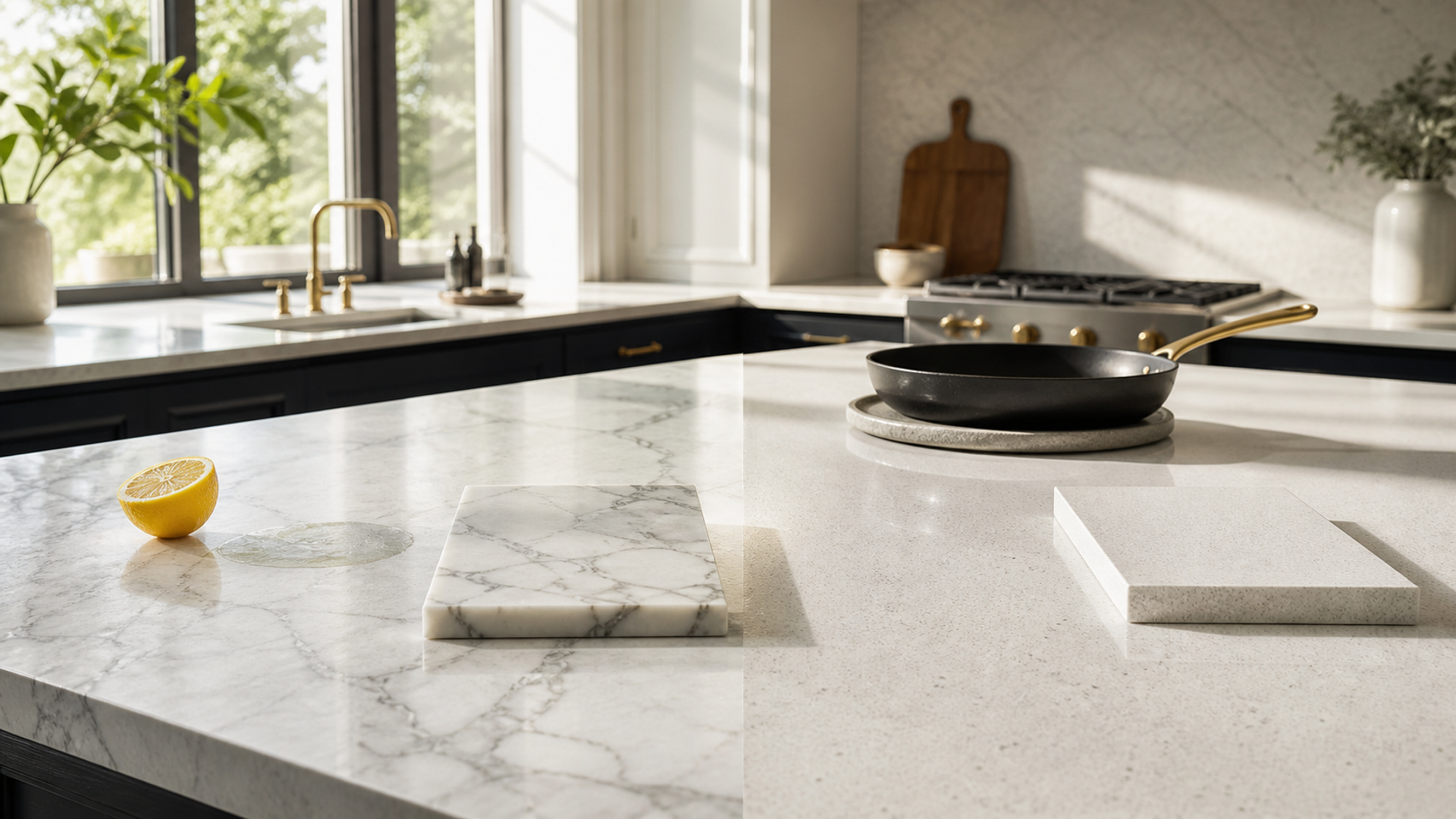
Marble and engineered quartz can both create a refined kitchen, but they age by different mechanisms. Marble is natural calcitic stone that can etch when acids contact it. Engineered quartz uses mineral aggregate and binders that provide controlled pattern and low routine porosity but impose product-specific heat and chemical limits. The choice is between two care profiles, not perfection and failure.
Start with the marks you can accept
Choose marble when natural variation and a developing patina are desired and the household accepts rapid acid etching. Choose engineered quartz when predictable appearance and simpler routine stain care matter more, while trivets and maker-approved cleaners are realistic. Restore the current surface when stains, chips or finish issues can be professionally repaired.
| Decision factor | Natural marble | Engineered quartz | Keep and restore the current worktop |
|---|---|---|---|
| Acid contact | Etching is accepted as patina or can be restored | Binder and surface follow maker chemical limits | Repair habits and test the present top |
| Heat | Stone still uses trivets to protect installation and finish | Hot cookware never sits directly on the surface | Add permanent landing zones |
| Pattern | Unique veining and slab variation are desired | Controlled repeat and colour suit the scheme | Retain the existing coherent surface |
| Seams | Slab layout and vein match are approved | Fabricator plans joints and pattern transitions | Redesign spans before ordering |
| Repair | Local honing and stone repair are available | Approved repair route exists for the exact colour | Commission restoration before replacement |
| Daily care | Blotting and pH-neutral care fit the household | Maker-approved cleaning and trivets fit the household | Change the routine before material |
This marble vs quartz countertop matrix is the article's working value object. Read the marble vs quartz countertop rows together: the decisive failure mode depends on this topic's evidence, operating context and reader objective.
What stone and resin change
Evidence 1. The Natural Stone Institute's consumer care guidance distinguishes stains from acid etching and recommends material-appropriate cleaning and professional restoration where needed.
Evidence 2. Natural marble varies by slab, fissure, finish and mineral composition, so a small sample cannot represent every visual or performance detail.
Evidence 3. Caesarstone's care guidance requires protection from excessive heat and the use of appropriate cleaners on engineered quartz surfaces.
Evidence 4. Engineered quartz is not the same as quarried quartzite; product composition, finish, warranty and fabricator instructions must be checked by exact code.
Reader-visible sources checked for this article:
naturalstoneinstitute.org — reader-visible current or official evidence
caesarstoneus.com — reader-visible current or official evidence
For marble vs quartz countertop, these sources establish only the claims inside their documented scope. Recheck every changeable specification, availability condition, price, policy or service term in the relevant market before acting.
Run a kitchen-specific sample trial
The decision changes at acid contact. Choose the first path only if etching is accepted as patina or can be restored; move to the second when binder and surface follow maker chemical limits; use the third when repair habits and test the present top. Save the downside that would make this row fail.
For heat, the first route works when stone still uses trivets to protect installation and finish; the second requires hot cookware never sits directly on the surface. The control for the third is add permanent landing zones. Verify this row against the exact product, property, account or environment before it can reverse the decision.
The pattern row exposes a practical boundary. Route one assumes unique veining and slab variation are desired, while route two is defensible only when controlled repeat and colour suit the scheme. Route three depends on retain the existing coherent surface. If that evidence is absent, keep the more reversible option.
Read seams as a stop/go test: slab layout and vein match are approved supports the first option; fabricator plans joints and pattern transitions supports the second; and redesign spans before ordering supports the third. Record which source proves the condition and when it was checked.
A buyer can resolve repair without starting from a brand preference. Ask whether local honing and stone repair are available; compare that with whether approved repair route exists for the exact colour; then use commission restoration before replacement as the third route's safeguard. An unknown condition stays unknown.
On daily care, popularity is not enough. The evidence for option one is that blotting and pH-neutral care fit the household. Option two means maker-approved cleaning and trivets fit the household. Option three is rational where change the routine before material. Recheck any changeable term immediately before commitment.
Facts that would reverse the current choice
Reversal control 1 — Acid contact. Before choosing Natural marble, write down how the decision changes if “Etching is accepted as patina or can be restored” proves false. Do the same for Engineered quartz and “Binder and surface follow maker chemical limits”. Keep the Keep and restore the current worktop route available until “Repair habits and test the present top” is verified. This control belongs to marble vs quartz countertop; update it from the cited source or exact supplier rather than copying a generic checklist.
Reversal control 2 — Heat. Before choosing Natural marble, write down how the decision changes if “Stone still uses trivets to protect installation and finish” proves false. Do the same for Engineered quartz and “Hot cookware never sits directly on the surface”. Keep the Keep and restore the current worktop route available until “Add permanent landing zones” is verified. This control belongs to marble vs quartz countertop; update it from the cited source or exact supplier rather than copying a generic checklist.
Reversal control 3 — Pattern. Before choosing Natural marble, write down how the decision changes if “Unique veining and slab variation are desired” proves false. Do the same for Engineered quartz and “Controlled repeat and colour suit the scheme”. Keep the Keep and restore the current worktop route available until “Retain the existing coherent surface” is verified. This control belongs to marble vs quartz countertop; update it from the cited source or exact supplier rather than copying a generic checklist.
Reversal control 4 — Seams. Before choosing Natural marble, write down how the decision changes if “Slab layout and vein match are approved” proves false. Do the same for Engineered quartz and “Fabricator plans joints and pattern transitions”. Keep the Keep and restore the current worktop route available until “Redesign spans before ordering” is verified. This control belongs to marble vs quartz countertop; update it from the cited source or exact supplier rather than copying a generic checklist.
Reversal control 5 — Repair. Before choosing Natural marble, write down how the decision changes if “Local honing and stone repair are available” proves false. Do the same for Engineered quartz and “Approved repair route exists for the exact colour”. Keep the Keep and restore the current worktop route available until “Commission restoration before replacement” is verified. This control belongs to marble vs quartz countertop; update it from the cited source or exact supplier rather than copying a generic checklist.
Reversal control 6 — Daily care. Before choosing Natural marble, write down how the decision changes if “Blotting and pH-neutral care fit the household” proves false. Do the same for Engineered quartz and “Maker-approved cleaning and trivets fit the household”. Keep the Keep and restore the current worktop route available until “Change the routine before material” is verified. This control belongs to marble vs quartz countertop; update it from the cited source or exact supplier rather than copying a generic checklist.
Accept or reject patina explicitly
Place lemon, coffee, oil and coloured food on a sealed offcut for controlled intervals, then clean as instructed. View the marks in daylight and evening light. Decide whether etching reads as unacceptable damage or welcome ageing before the material covers an entire island.
Template the real kitchen
Approve full slabs where relevant and map sinks, hobs, taps, overhangs, support, seams and vein direction. A dramatic sample can produce awkward joints when the room geometry is ignored. Record edge profiles and reinforcement so design decisions survive the handoff to fabrication.
Audit thermal and cleaning habits
Observe where hot trays, pressure cookers, acidic prep and strong cleaners actually land. Provide trivets and cutting stations at those points. Test the household's existing products against the exact care sheet rather than assuming every stone or quartz surface tolerates the same routine.
Price restoration and replacement
Obtain local estimates for honing marble, repairing chips, changing silicone, removing stains and replacing a quartz section. Check whether the chosen colour remains available and whether a seam can be reopened. Long-term value depends on a credible repair path, not only day-one appearance.
Three kitchens, three answers
Showpiece kitchen whose owner likes natural ageing
Marble can be rewarding when variation and patina are part of the brief rather than surprises. Define the fact that would reverse this recommendation before committing.
Busy household seeking visual consistency
Engineered quartz can reduce routine uncertainty when heat and chemical limits are respected. Define the fact that would reverse this recommendation before committing.
Sound but tired existing stone
Professional cleaning, chip repair and refinishing may deliver the desired change with less disruption. Define the fact that would reverse this recommendation before committing.
Action checklist
Identify exact material.
Approve full slabs.
Test acid and oil.
Read heat guidance.
Map seams.
Verify cabinet support.
Choose edge profile.
Price restoration.
Save product code.
Keep matching offcuts.
Continue the decision
The linked VERTU articles expand adjacent parts of the marble vs quartz countertop decision. They do not substitute for the external evidence above.
The marble-quartz verdict
Choose marble when natural variation and a developing patina are desired and the household accepts rapid acid etching. Choose engineered quartz when predictable appearance and simpler routine stain care matter more, while trivets and maker-approved cleaners are realistic. Restore the current surface when stains, chips or finish issues can be professionally repaired.
Keep the marble vs quartz countertop decision reversible until its material cost, safety, access, privacy and compatibility facts are verified. Unknown evidence stays unknown; it is never silently scored as favourable.