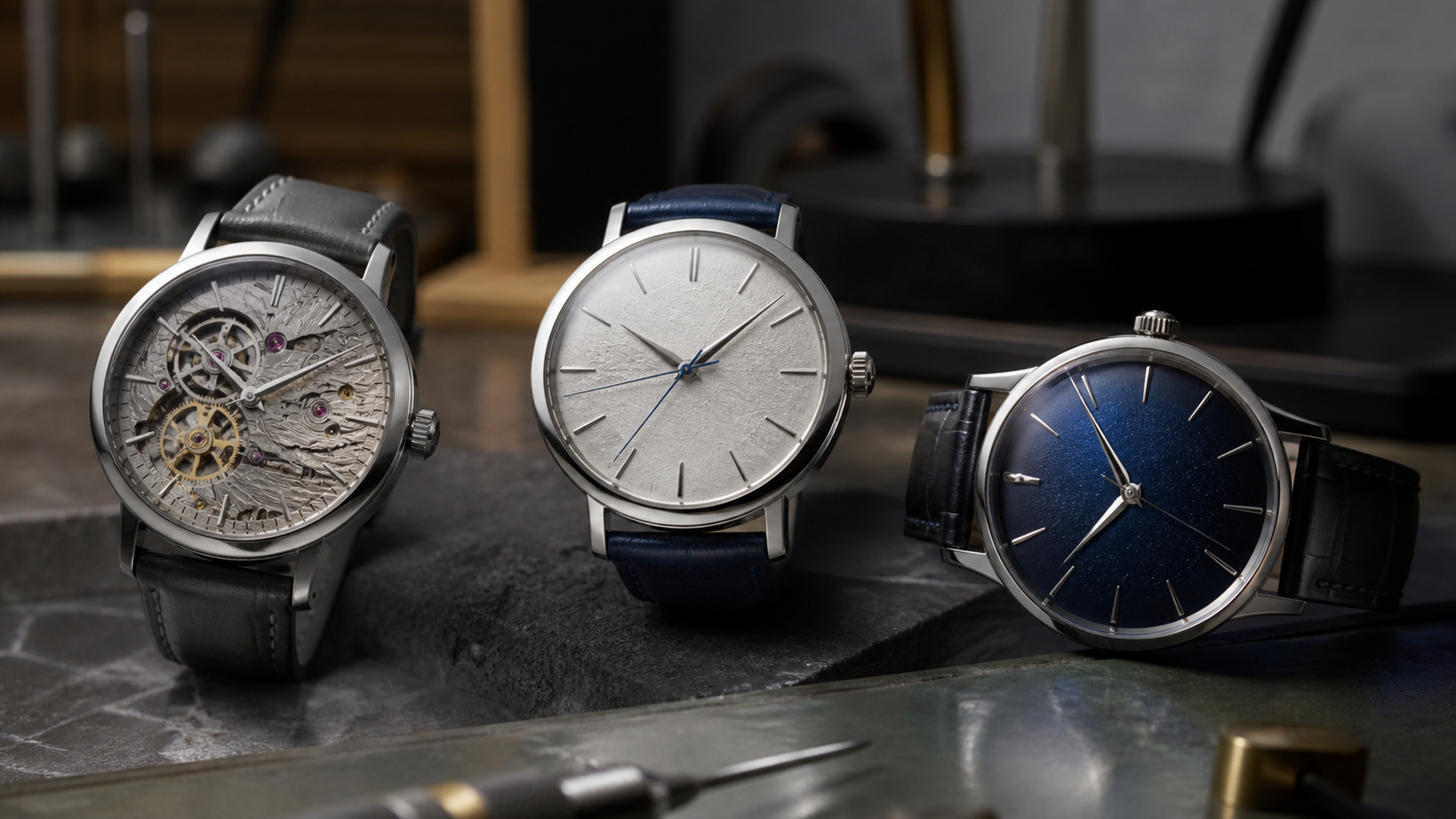
Japanese high-end watchmaking is often reduced to a list of brands, but the more useful distinction is between manufacturing philosophies. One watch may express industrial precision and robust daily function; another may centre on hand finishing, traditional decorative craft or a movement architecture unavailable elsewhere. The country label does not create one style or one level of exclusivity.
Grand Seiko, Credor, high-end Seiko and Citizen references can share national roots while targeting different collectors. Independent makers add another layer with very small production and personal authorship. A buyer should therefore trace the exact calibre, case and dial workshop, then ask whether the service path and wearing experience support the story. Heritage is meaningful only when it is visible in the object and maintainable after sale.
Direct answer: Japanese high end watches
Choose a Japanese high-end watch by the exact movement, finishing standard, dial technique, case fit and service route—not by a generic hierarchy of brands. Compare an attainable daily reference, an artisanal piece and an independent watch side by side so the premium paid for craft or scarcity is explicit.
| Decision factor | Evidence to collect | Why it changes the answer | Control before purchase |
|---|---|---|---|
| Movement system | Japanese makers offer mechanical, Spring Drive, quartz and solar architectures | each creates a different relationship with accuracy and maintenance | choose the technology that supports the intended use |
| Finishing | polished case planes and movement decoration vary by line and workshop | a brand name cannot guarantee the same handwork across references | inspect the exact watch under neutral magnification |
| Dial craft | lacquer, enamel, metalwork and textured dials use different processes | fragility, variation and repair options differ | ask who made the dial and what future restoration is possible |
| Fit | case geometry and bracelets range from compact dress to sports forms | photogenic proportions can fail on the wrist | test lug span, thickness and clasp adjustment |
| Service | special movements may return to designated Japanese facilities | downtime and logistics become part of ownership | obtain the official route and current estimate before purchase |
| Collector depth | scarcity may come from production, craft or limited distribution | small supply does not automatically create liquidity | track completed sales and the number of active buyers |
For Japanese high end watches, this matrix is the article-specific value object. It prevents a single price, feature or viral claim from silently becoming a recommendation.
Current evidence baseline
Evidence 1. Grand Seiko presents Spring Drive as a movement that uses a mainspring for energy while regulating time through its proprietary system. Source.
Evidence 2. Grand Seiko's current World of Grand Seiko overview places case finishing, movement engineering and dial craft within one manufacturing philosophy. Source.
Evidence 3. Seiko's heritage material documents a history spanning mechanical and quartz watchmaking rather than a single technology. Source.
Evidence 4. Citizen's Eco-Drive information explains light-powered operation and the need to understand model-specific charging guidance. Source.
For Japanese high end watches, these sources support only the claims stated above. They do not establish private transaction prices, permanent availability, universal authenticity or future appreciation.
How the decision factors change the result
Movement system. The relevant evidence is that japanese makers offer mechanical, Spring Drive, quartz and solar architectures. That matters because each creates a different relationship with accuracy and maintenance. For this decision, choose the technology that supports the intended use. Record the dated result, exact model or route, and the assumption that would cause the conclusion to change.
Finishing. The relevant evidence is that polished case planes and movement decoration vary by line and workshop. That matters because a brand name cannot guarantee the same handwork across references. For this decision, inspect the exact watch under neutral magnification. Record the dated result, exact model or route, and the assumption that would cause the conclusion to change.
Dial craft. The relevant evidence is that lacquer, enamel, metalwork and textured dials use different processes. That matters because fragility, variation and repair options differ. For this decision, ask who made the dial and what future restoration is possible. Record the dated result, exact model or route, and the assumption that would cause the conclusion to change.
Fit. The relevant evidence is that case geometry and bracelets range from compact dress to sports forms. That matters because photogenic proportions can fail on the wrist. For this decision, test lug span, thickness and clasp adjustment. Record the dated result, exact model or route, and the assumption that would cause the conclusion to change.
Service. The relevant evidence is that special movements may return to designated Japanese facilities. That matters because downtime and logistics become part of ownership. For this decision, obtain the official route and current estimate before purchase. Record the dated result, exact model or route, and the assumption that would cause the conclusion to change.
Collector depth. The relevant evidence is that scarcity may come from production, craft or limited distribution. That matters because small supply does not automatically create liquidity. For this decision, track completed sales and the number of active buyers. Record the dated result, exact model or route, and the assumption that would cause the conclusion to change.
Worked ownership scenario
Compare three exact references with a weighted craft ledger. Score movement interest, external finishing, dial authorship, fit, service clarity and personal distinctiveness. Add five-year purchase, insurance and a prudent service/logistics allowance. Then record the current completed-sale range and apply a slow-exit discount rather than using optimistic listings. The purpose is not to turn craft into a spreadsheet winner; it is to expose whether the premium is being paid for something the owner can identify, use and maintain.
Spring Drive changes the usual categories
Spring Drive uses mechanical energy while regulating the glide wheel through an electronic control system. That makes it neither a conventional Swiss-lever mechanical watch nor ordinary battery quartz. The smooth seconds hand is the visible result, but the collector should also consider power reserve, calibre decoration, case design and service access. Buying it solely for accuracy misses the philosophy; buying it solely for novelty misses the practical responsibility of owning a specialised movement.
Case finishing should be seen in motion
Highly polished planes reveal their quality as light moves across them. Examine whether reflections remain controlled, transitions stay crisp and brushed surfaces meet polished ones cleanly. Macro photographs can exaggerate dust and hide the whole form, so inspect the watch at normal distance as well. Refinishing later requires judgement because aggressive polishing can alter edges. Ask how the maker restores the case and whether the current watch already shows softened geometry.
Dials can be workshops of their own
Japanese luxury dials may use lacquer, enamel, engraving, hammering or repeated stamping. Variation can be part of the craft, but the seller should distinguish deliberate texture from damage. Understand how the dial reacts to moisture, ultraviolet exposure and service intervention. When artisan attribution is important, retain the maker's documentation. A poetic nickname created by collectors is not a substitute for the official production technique or the exact reference history.
Do not ignore high-end quartz
Thermocompensated or carefully finished quartz can express a Japanese pursuit of precision and utility as strongly as a complicated mechanical watch. It may offer a thin case and low daily friction, yet battery service, seals and electronics still deserve a plan. Evaluate the movement on its own objectives rather than using price as proof that it should imitate mechanical watchmaking. A collection becomes more interesting when technologies are chosen intentionally.
Independent Japanese watchmaking
Small independent makers can offer personal design language and extraordinary handwork, but availability, price discovery and service continuity require additional diligence. Meet the maker or authorised representative where possible, understand the order and deposit terms, and ask what happens if a component becomes unavailable. Scarcity creates emotional appeal but can also make resale evidence thin. The purchase should make sense as patronage and ownership even if no liquid secondary market develops.
Evidence checklist for Japanese high end watches
[ ] Identify the exact calibre
[ ] Inspect finishing in changing light
[ ] Document the dial process
[ ] Test case and clasp fit
[ ] Confirm the service destination
[ ] Budget international logistics
[ ] Use completed-sale evidence
[ ] State why the technology belongs
In a Japanese high end watches decision, an unchecked item remains unknown. It should not be converted into a favourable assumption merely to complete the purchase.
Reader-visible sources and method
The external pages above were checked for this Japanese high end watches publication. Price, availability, service, tax, regulation and platform terms must be reconfirmed for the buyer's market and date. Ranking pages informed the separate SERP benchmark, but their prose was not copied and they do not control the claims in this article.
Continue with adjacent VERTU editorial research
These internal links provide adjacent premium-lifestyle and decision context for Japanese high end watches; they do not replace the specialist or official evidence needed for a specific transaction.
Final judgement
Choose a Japanese high-end watch by the exact movement, finishing standard, dial technique, case fit and service route—not by a generic hierarchy of brands. Compare an attainable daily reference, an artisanal piece and an independent watch side by side so the premium paid for craft or scarcity is explicit.
The useful standard for Japanese high end watches is not certainty created by confident language. It is a decision whose evidence, downside and next review point are visible to the reader.