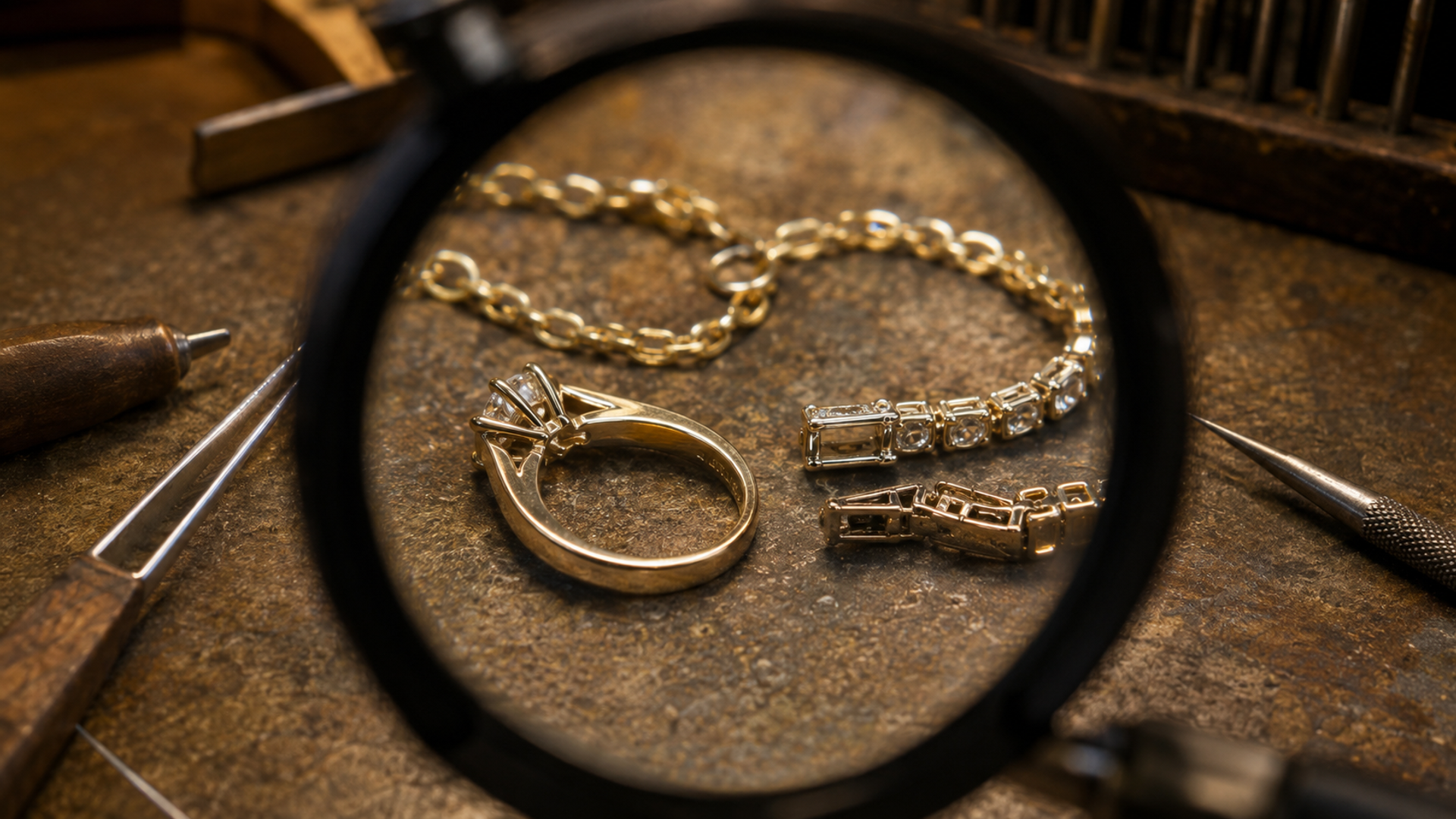
High-quality jewellery is not defined by weight, sparkle or price alone. A heavy piece can have weak joints; a bright stone can be treated or poorly set; a polished surface can hide rough edges underneath. Quality becomes visible when materials are accurately represented, construction supports the intended wear, stones are secure, surfaces are consistently finished and future repair is possible. The standard should also match the object: an everyday chain, an engagement ring and a transformable high-jewellery piece face different mechanical demands.
Direct answer
Verify metal fineness and stone disclosure, then inspect construction under magnification, closures under movement and surfaces against the skin. Ask how the piece will be sized, repaired and cleaned. Quality is the agreement between materials, workmanship, design and intended use.
The evidence-first decision matrix
| Decision factor | Evidence to collect | Why it changes the answer | Control |
|---|---|---|---|
| Metal specification | confirm fineness, alloy and hallmark context | colour and durability depend on composition | match the invoice to marks |
| Stone disclosure | record natural or laboratory-grown origin and treatments | appearance alone does not establish identity | use appropriate laboratory evidence |
| Setting | inspect prongs, beads, channels and seat consistency | security depends on precise contact | check under magnification |
| Joints and closures | operate hinges, solder points and clasps | movement concentrates wear | test repeatedly without forcing |
| Finish | inspect polish, edges, underside and symmetry | quality should continue beyond the front | view in neutral light |
| Serviceability | ask about sizing, replacement and refinishing | some designs are difficult to repair | obtain a care plan |
This matrix is the article-specific value object for high quality jewelry. It makes the reader’s trade-offs visible and prevents one price, one specification or one prestige cue from becoming the entire recommendation.
Current evidence baseline
Evidence 1. The FTC Jewellery Guides cover representations about precious-metal content, gemstones and treatments. Source.
Evidence 2. GIA provides education on gemstone identity, treatments and jewellery evaluation. Source.
Evidence 3. GIA provides education on gemstone identification, reports, treatments and jewellery care. Source.
Evidence 4. The Responsible Jewellery Council maintains standards for responsible practices in jewellery supply chains. Source.
For high quality jewelry, these sources support only the claims attached to them. They do not prove permanent availability or universal authenticity for this specific decision. Its product specifications, prices, policies and service terms must be reconfirmed for the exact market and date.
How each factor changes the result
Metal specification
Collect evidence that confirm fineness, alloy and hallmark context. For high quality jewelry, this factor changes the answer because colour and durability depend on composition. The minimum metal specification control for this shortlist is to match the invoice to marks. Record the exact high quality jewelry object, market, date and assumption. If metal specification evidence is missing, keep that field unknown instead of awarding a favourable conclusion. Compare metal specification across every shortlisted high quality jewelry option; otherwise a persuasive photograph or famous name can silently change the standard halfway through the decision.
Stone disclosure
Collect evidence that record natural or laboratory-grown origin and treatments. For high quality jewelry, this factor changes the answer because appearance alone does not establish identity. The minimum stone disclosure control for this shortlist is to use appropriate laboratory evidence. Record the exact high quality jewelry object, market, date and assumption. If stone disclosure evidence is missing, keep that field unknown instead of awarding a favourable conclusion. Compare stone disclosure across every shortlisted high quality jewelry option; otherwise a persuasive photograph or famous name can silently change the standard halfway through the decision.
Setting
Collect evidence that inspect prongs, beads, channels and seat consistency. For high quality jewelry, this factor changes the answer because security depends on precise contact. The minimum setting control for this shortlist is to check under magnification. Record the exact high quality jewelry object, market, date and assumption. If setting evidence is missing, keep that field unknown instead of awarding a favourable conclusion. Compare setting across every shortlisted high quality jewelry option; otherwise a persuasive photograph or famous name can silently change the standard halfway through the decision.
Joints and closures
Collect evidence that operate hinges, solder points and clasps. For high quality jewelry, this factor changes the answer because movement concentrates wear. The minimum joints and closures control for this shortlist is to test repeatedly without forcing. Record the exact high quality jewelry object, market, date and assumption. If joints and closures evidence is missing, keep that field unknown instead of awarding a favourable conclusion. Compare joints and closures across every shortlisted high quality jewelry option; otherwise a persuasive photograph or famous name can silently change the standard halfway through the decision.
Finish
Collect evidence that inspect polish, edges, underside and symmetry. For high quality jewelry, this factor changes the answer because quality should continue beyond the front. The minimum finish control for this shortlist is to view in neutral light. Record the exact high quality jewelry object, market, date and assumption. If finish evidence is missing, keep that field unknown instead of awarding a favourable conclusion. Compare finish across every shortlisted high quality jewelry option; otherwise a persuasive photograph or famous name can silently change the standard halfway through the decision.
Serviceability
Collect evidence that ask about sizing, replacement and refinishing. For high quality jewelry, this factor changes the answer because some designs are difficult to repair. The minimum serviceability control for this shortlist is to obtain a care plan. Record the exact high quality jewelry object, market, date and assumption. If serviceability evidence is missing, keep that field unknown instead of awarding a favourable conclusion. Compare serviceability across every shortlisted high quality jewelry option; otherwise a persuasive photograph or famous name can silently change the standard halfway through the decision.
Worked comparison
Compare two diamond necklaces and one plain gold chain at different prices. Record metal mass and fineness, stone reporting, joint count, clasp design, surface finish, comfort and service terms. Apply a wear-intensity factor: daily, weekly or occasion-only. A simpler chain can score higher quality for its purpose than a more expensive piece with vulnerable construction.
For high quality jewelry, run a second comparison with the most optimistic assumption removed, then a third with the largest downside cost added. A high quality jewelry recommendation that survives all three scenarios is more useful than one built from a single ideal case. If its ranking changes, state the decisive assumption plainly.
Materials must be described precisely
Terms such as gold, platinum, diamond and sapphire need qualifying details. Confirm fineness, plating, filling, natural or laboratory-grown origin and detectable treatment. Hallmarks help but vary by jurisdiction and are not substitutes for a complete invoice. The description should allow another professional to understand what was sold without relying on promotional language.
For high quality jewelry, apply this point to the exact reference, seller and market rather than to the category in general. Keep materials must be described precisely photographs, written representations and the date of observation so that a later service, return or resale decision can reconstruct what was known.
Setting quality appears at contact points
Prongs should be proportionate, seated and finished without snagging. Pavé beads should be consistent and stones should not rattle. Channels and bezels should hold stones evenly without obvious gaps. Magnification can reveal work, but the final test includes touch and movement. Sharp edges and catching surfaces reduce practical quality.
For high quality jewelry, apply this point to the exact reference, seller and market rather than to the category in general. Keep setting quality appears at contact points photographs, written representations and the date of observation so that a later service, return or resale decision can reconstruct what was known.
The reverse matters
Look underneath a ring, necklace or bracelet. Openings should permit sensible cleaning, edges should be comfortable and structural elements should appear intentional. Hollow construction is not automatically poor, but it should suit the expected loads and be disclosed. Symmetry, solder quality and consistent articulation show care where marketing photographs rarely focus.
For high quality jewelry, apply this point to the exact reference, seller and market rather than to the category in general. Keep the reverse matters photographs, written representations and the date of observation so that a later service, return or resale decision can reconstruct what was known.
Comfort is an engineering outcome
Weight distribution, chain flexibility, clasp placement and ring profile determine whether the piece rotates, pinches or catches. Wear it long enough to reveal pressure points. Consider work, travel, gloves, children and other jewellery. A secure clasp that is impossible for the owner to operate may not be the best design.
For high quality jewelry, apply this point to the exact reference, seller and market rather than to the category in general. Keep comfort is an engineering outcome photographs, written representations and the date of observation so that a later service, return or resale decision can reconstruct what was known.
Service completes the quality claim
Ask how often settings should be checked, whether sizing is possible, how finishes are restored and whether matching stones can be sourced. Keep detailed photographs and invoices before service. A piece built with honest materials and accessible construction can often be maintained more responsibly than a delicate design that depends on unavailable proprietary parts.
For high quality jewelry, apply this point to the exact reference, seller and market rather than to the category in general. Keep service completes the quality claim photographs, written representations and the date of observation so that a later service, return or resale decision can reconstruct what was known.
Buyer’s evidence checklist
[ ] Confirm metal fineness
[ ] Document every stone claim
[ ] Inspect settings under magnification
[ ] Operate clasps and hinges
[ ] Check the reverse and edges
[ ] Wear-test for comfort
[ ] Request care and service terms
[ ] Keep invoice and photographs
Unchecked high quality jewelry fields remain unknown. Do not convert them into favourable assumptions simply to finish this purchase or produce a confident ranking.
Sources and method
ftc.gov — The FTC Jewellery Guides cover representations about precious-metal content, gemstones and treatments.
gia.edu — GIA provides education on gemstone identity, treatments and jewellery evaluation.
gia.edu — GIA provides education on gemstone identification, reports, treatments and jewellery care.
responsiblejewellery.com — The Responsible Jewellery Council maintains standards for responsible practices in jewellery supply chains.
The external pages above were checked specifically for high quality jewelry. Its ranking pages informed a separate SERP benchmark, but their wording, paragraph order and distinctive framing were not copied. This article adds a query-specific matrix, worked comparison and downside controls.
Continue with adjacent research
These internal links add adjacent ownership context to high quality jewelry. They do not replace the specialist inspection, laboratory evidence, official specification or seller terms required by this particular decision.
Final judgement
Verify metal fineness and stone disclosure, then inspect construction under magnification, closures under movement and surfaces against the skin. Ask how the piece will be sized, repaired and cleaned. Quality is the agreement between materials, workmanship, design and intended use.
For high quality jewelry, the useful standard is not certainty created by confident language. It is a decision whose evidence, downside and next verification step remain visible to the reader.