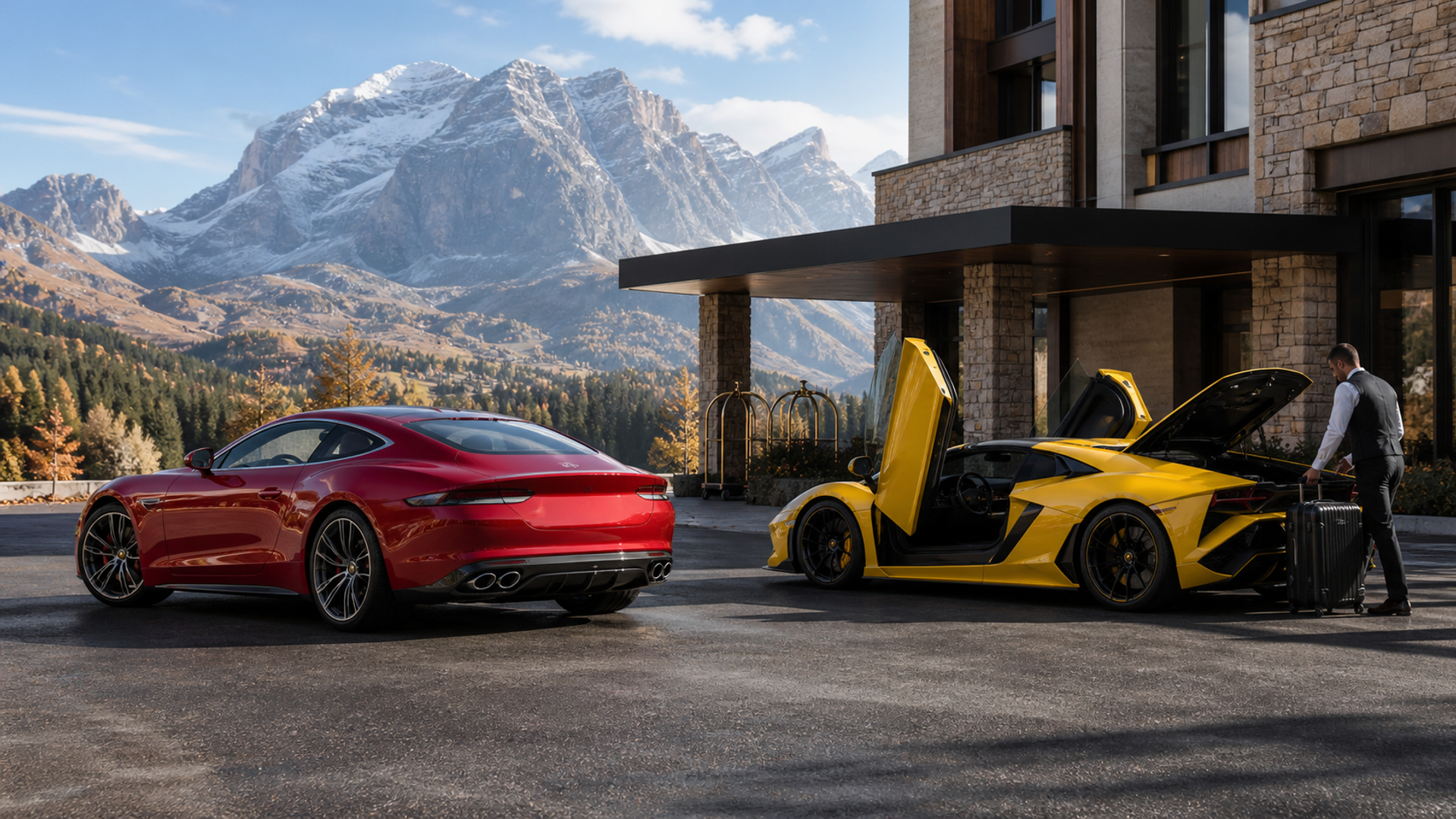
Ferrari versus Lamborghini is usually reduced to styling, acceleration and brand mythology. Those dimensions matter emotionally, but they do not decide whether a particular car works for an owner. The current market spans grand tourers, mid-engined supercars, V12 hybrids and high-performance SUVs; comparing two badges without naming models produces almost no decision value.
A useful comparison begins with mission. How often will the car travel, in what climate, with which passenger and luggage needs, and how far is the authorised service network? Ferrari's published after-sales material highlights its seven-year maintenance programme on eligible new cars. Lamborghini's current Revuelto specification combines a V12 with three electric motors and publishes concrete performance and energy data. These are ownership inputs, not a universal winner.
Direct answer: Ferrari vs Lamborghini
Choose the exact Ferrari or Lamborghini model whose packaging, drivetrain, service access and character fit the intended use. Ferrari offers a clearly documented scheduled-maintenance proposition on eligible new cars; Lamborghini's current line emphasises dramatic hybrid performance and distinct model roles. Test and cost the actual configurations.
| Decision factor | Verified starting point | Why it changes the answer | Control before acting |
|---|---|---|---|
| Mission | both brands offer cars with very different layouts and use cases | a badge comparison cannot answer practicality | define trips, roads, passengers and luggage first |
| Powertrain | current models include combustion and high-voltage hybrid systems | complexity changes charging, service and ageing exposure | understand the exact battery and warranty terms |
| Maintenance | Ferrari documents scheduled maintenance and extended cover programmes | included service can change early ownership cost | confirm eligibility by model, market and date |
| Ergonomics | visibility, ingress, controls and ride vary by model | occasional drama can become daily friction | complete a representative road test and parking test |
| Specification | options materially affect price and future audience | personal taste may not be recoverable at resale | separate essential function from decorative spend |
| Network | authorised service distance affects downtime | transport and scheduling can dominate inconvenience | map service and recovery before purchase |
For Ferrari vs Lamborghini, this decision matrix is the article-specific value object. It separates price evidence from ownership exposure, so a dramatic headline cannot silently become a recommendation.
Verified evidence baseline
Evidence 1. Ferrari's 2024 annual report describes its seven-year maintenance programme for new cars and extended warranty pathways. Source.
Evidence 2. Ferrari after-sales material describes annual or 20,000-kilometre servicing in specified programmes without a mileage limitation. Source.
Evidence 3. Lamborghini publishes the Revuelto's combined 1,015 CV hybrid powertrain and model-specific performance data. Source.
Evidence 4. Manufacturer performance figures use stated test conditions and do not substitute for a buyer's road, climate and use-case evaluation. Source.
The primary-source boundary for Ferrari vs Lamborghini is deliberately narrow. Dated records, manufacturer specifications and official guidance support only the claims they actually make; they do not prove private transaction prices, future appreciation or universal suitability.
How each decision factor changes the result
Mission. The starting evidence for Ferrari vs Lamborghini is that both brands offer cars with very different layouts and use cases. This changes the decision because a badge comparison cannot answer practicality. Before committing, define trips, roads, passengers and luggage first. The dated result belongs in the buyer's evidence file, together with the exact model, market and assumption that could reverse it.
Powertrain. The starting evidence for Ferrari vs Lamborghini is that current models include combustion and high-voltage hybrid systems. This changes the decision because complexity changes charging, service and ageing exposure. Before committing, understand the exact battery and warranty terms. The dated result belongs in the buyer's evidence file, together with the exact model, market and assumption that could reverse it.
Maintenance. The starting evidence for Ferrari vs Lamborghini is that ferrari documents scheduled maintenance and extended cover programmes. This changes the decision because included service can change early ownership cost. Before committing, confirm eligibility by model, market and date. The dated result belongs in the buyer's evidence file, together with the exact model, market and assumption that could reverse it.
Ergonomics. The starting evidence for Ferrari vs Lamborghini is that visibility, ingress, controls and ride vary by model. This changes the decision because occasional drama can become daily friction. Before committing, complete a representative road test and parking test. The dated result belongs in the buyer's evidence file, together with the exact model, market and assumption that could reverse it.
Specification. The starting evidence for Ferrari vs Lamborghini is that options materially affect price and future audience. This changes the decision because personal taste may not be recoverable at resale. Before committing, separate essential function from decorative spend. The dated result belongs in the buyer's evidence file, together with the exact model, market and assumption that could reverse it.
Network. The starting evidence for Ferrari vs Lamborghini is that authorised service distance affects downtime. This changes the decision because transport and scheduling can dominate inconvenience. Before committing, map service and recovery before purchase. The dated result belongs in the buyer's evidence file, together with the exact model, market and assumption that could reverse it.
Worked scenario calculation
Compare two actual configurations over four years. Add delivered price, options, finance if used, insurance, tax, tyres, fuel or electricity, service outside included programmes, storage and transport. Estimate realistic annual mileage and days unavailable. At exit, use conservative trade or consignment proceeds rather than an optimistic advertised price. Run a second case with one wheel-and-tyre incident and a longer workshop stay. The result will show whether an apparently similar acquisition price creates a very different ownership burden.
Start with model pairs that solve the same job
A front-engined Ferrari grand tourer should not be judged against a low-slung Lamborghini purely because both are expensive. Pair V12 hybrid flagships, mid-engined sports cars or performance SUVs according to the mission. Compare dimensions, luggage, lift systems, seat comfort and road range before power. This removes the false drama of declaring one brand faster based on unrelated models.
Hybrid performance adds a new ownership layer
Electric motors can sharpen response and enable new control strategies, but high-voltage systems also introduce charging behaviour, cooling and long-term warranty questions. Ask how the car behaves with a depleted battery, what service equipment is required and which components are covered over time. Do not assume a hybrid supercar operates like a conventional plug-in commuter.
The service proposition has economic value
Ferrari's scheduled-maintenance programme can reduce uncertainty for eligible new cars, although consumables, damage and market-specific exclusions still require confirmation. Lamborghini ownership should likewise be quoted through the authorised network for the chosen model. Compare not only invoice estimates but collection, transport, parts lead time and the availability of trained high-voltage technicians.
Design theatre versus repeated usability
Scissor doors, dramatic seating positions and highly responsive controls can create the experience the owner wants. They can also complicate tight garages, formal clothing or long journeys. Ferrari's cabin and driving character may create a different compromise depending on model. Perform entry, exit, luggage, phone connection, low-speed manoeuvring and rough-road tests rather than judging from a short fast drive.
The correct winner is personal but not vague
Preference does not mean evidence is irrelevant. Once the buyer scores mission fit, service access, ergonomics, powertrain comfort, cost and emotional pull, the trade-off becomes visible. A Lamborghini can win because spectacle is the purpose; a Ferrari can win because touring integration matters more—or the reverse for another model pair. The method prevents brand folklore from hiding a poor individual fit. Keep the two completed scorecards and repeat the assessment after a representative day rather than immediately after a dramatic test drive. Fatigue, parking stress, cabin heat, phone reliability and passenger response often become visible only when the car is used as transport, not presented as an event.
Risk-control checklist for Ferrari vs Lamborghini
[ ] Name the exact model pair
[ ] Define intended journeys
[ ] Test garage and luggage fit
[ ] Understand hybrid cover
[ ] Confirm service programme
[ ] Price tyres and insurance
[ ] Control option spend
[ ] Model net exit value
The Ferrari vs Lamborghini checklist is meant to be completed with evidence. An unchecked item remains an unknown rather than being treated as a favourable assumption.
Reader-visible sources and methodology
The record and product pages for Ferrari vs Lamborghini were observed for this publication run. Market-variable price, availability, tax, insurance, service and regulatory conditions must be reconfirmed in the buyer's jurisdiction. Competitor pages informed the SERP gap analysis but were not copied and do not control the claims above.
Continue with adjacent VERTU editorial research
For Ferrari vs Lamborghini, these internal links provide adjacent premium-lifestyle and decision context. They do not replace the authoritative evidence or professional advice required for a specific transaction.
Final judgement
Choose the exact Ferrari or Lamborghini model whose packaging, drivetrain, service access and character fit the intended use. Ferrari offers a clearly documented scheduled-maintenance proposition on eligible new cars; Lamborghini's current line emphasises dramatic hybrid performance and distinct model roles. Test and cost the actual configurations.
For Ferrari vs Lamborghini, quality means preserving the boundary between a verified fact, a reported estimate and an ownership assumption. The decision should be reopened when a source, market, condition or intended use materially changes.