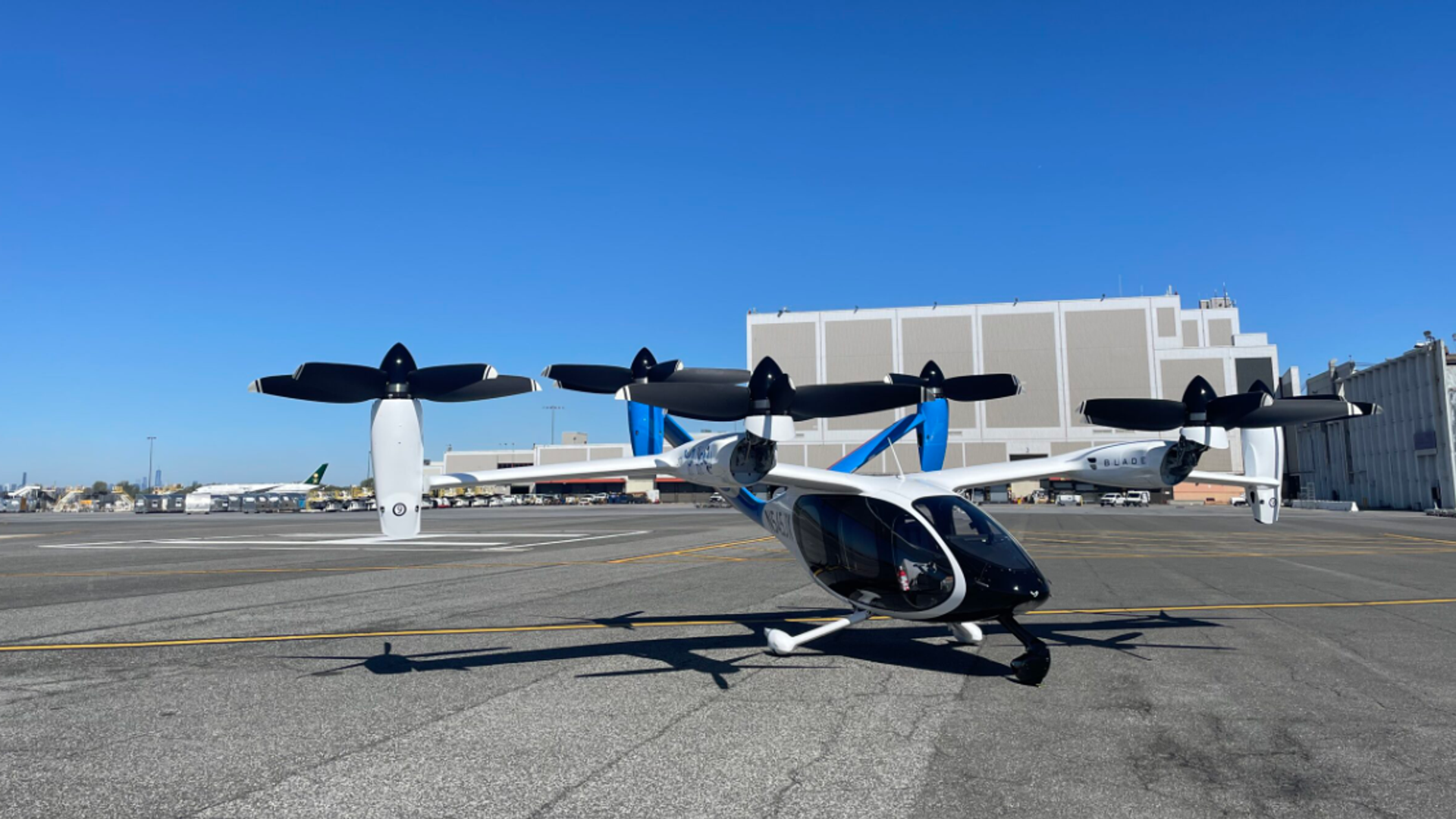
In the past 24 hours, electric air taxis have moved from future speculation to headline reality.
A demonstration flight in New York City by Joby Aviation captured global attention after successfully transporting passengers between John F. Kennedy International Airport (JFK) and Manhattan in under 10 minutes. What is typically a congested, hour-long journey on the ground was completed in a quiet, electric vertical flight above the city’s skyline.
More importantly, this was not a closed test environment or a controlled showcase. It was a real urban route, using existing heliports, within one of the most complex airspaces in the world.
The implication is clear: electric air taxis are no longer just prototypes or long-term visions. They are beginning to operate within real city infrastructure, in real time.
What Exactly Is an Electric Air Taxi — Now Proven in New York
Until recently, electric air taxis were often explained through prototypes and promises. That changed this week.
In a landmark demonstration, Joby Aviation completed the first-ever point-to-point electric air taxi flights in New York City, connecting John F. Kennedy International Airport (JFK) with Manhattan heliports—one of the most congested urban corridors in the world.
This wasn’t a test in isolation. It was a real route, in real airspace, with real infrastructure.
The aircraft—an all-electric eVTOL—carried passengers across the city in under 10 minutes, a journey that typically takes over an hour by car.
That single data point reframes the entire category.
Electric air taxis are no longer theoretical alternatives to helicopters. They are emerging as integrated extensions of existing transport networks, designed to plug directly into airports, heliports, and city mobility systems.
How It Works: Not Just Flight, But Integration
What the New York demonstration revealed is that the real innovation is not just the aircraft—it is the system around it.
Joby’s flights didn’t rely on new, futuristic infrastructure. Instead, they used existing heliports across Manhattan, including Downtown and Midtown landing sites, effectively turning today’s aviation footprint into tomorrow’s mobility network.
This matters.
Because it means scaling electric air taxis may not require rebuilding cities from scratch—it requires upgrading and electrifying what already exists.
The operational flow is designed to feel seamless:
- Ground transport (e.g., ride-hailing) to a vertiport
- Short security and boarding process
- 5–10 minute flight
- Immediate connection into the city grid
In fact, Joby is already working toward integrating bookings with platforms like Uber, aiming for a door-to-door, app-based experience rather than a standalone aviation service.
This is where air taxis diverge sharply from helicopters: they are not just vehicles—they are nodes in a connected mobility ecosystem.
From 60 Minutes to 10: A Real Use Case Emerges
The most compelling insight from the New York flights is not technological—it’s behavioral.
Airport transfers are one of the most inefficient parts of modern travel. In cities like New York, the journey from Manhattan to JFK can take anywhere from 60 to 90 minutes depending on traffic.
Electric air taxis compress that into single-digit minutes.
- Traditional commute: 60–90 minutes
- Air taxi commute: under 10 minutes
This is not incremental improvement. It is a category shift.
And importantly, the route itself is not arbitrary. Airport-city connections are:
- High-frequency
- Time-sensitive
- High willingness to pay
Which makes them the perfect first commercial use case.
How Much Will It Cost — Based on Real Models
Unlike earlier speculation, pricing is now beginning to take shape.
Joby and its partners have indicated that initial fares will be comparable to premium ride-hailing services, such as Uber Black—roughly in the range of $150–$200 per trip in early stages.
This is a critical detail.
It positions electric air taxis not as ultra-exclusive aviation (like helicopters), but as:
A premium mobility upgrade—rather than a luxury outlier
Over time, costs are expected to decrease significantly due to:
- Battery efficiency improvements
- Higher flight frequency
- Autonomous operations
Some projections even suggest that, at scale, per-seat pricing could fall dramatically, making the service accessible beyond the ultra-wealthy.
Why This Changes the Entire Narrative
Before this week, electric air taxis were discussed in terms of “future potential.”
Now, they can be described in terms of:
- Route: JFK ↔ Manhattan
- Time: under 10 minutes
- Infrastructure: existing heliports
- Model: app-based, on-demand
- Price: comparable to premium ground transport
That level of specificity matters. It turns imagination into expectation.
More importantly, it signals that the first phase of air taxi adoption will not be broad or abstract—it will be highly targeted, high-value routes, where time savings are undeniable.
A Subtle Shift: From Luxury Experience to Time Infrastructure
At first glance, a 10-minute aerial commute may seem like a luxury experience.
But what the New York example suggests is something deeper:
Electric air taxis are becoming time infrastructure.
They don’t just move people faster—they redefine:
- What counts as “far”
- What counts as “late”
- What counts as “accessible”
For a certain class of user—executives, global travelers, high-frequency flyers—this is not about novelty. It is about control over time.
And as with every major shift in mobility—from private jets to ride-sharing—the pattern is familiar:
- Starts as premium
- Becomes normalized
- Eventually reshapes everyday expectations
Who Will Use It First?
As with most emerging mobility innovations, early adoption will skew toward those with the highest sensitivity to time.
High-net-worth individuals, business executives, and global travelers are the natural first users. For them, the value proposition is immediate: a 60-minute journey reduced to 10 or 15 minutes is not just a convenience—it is leverage.
Airport transfers are expected to be one of the earliest use cases. The ability to bypass traffic and arrive directly at a terminal or nearby hub transforms one of the most unpredictable parts of travel into something controlled.
There are also secondary applications. Emergency services, medical transport, and critical logistics may benefit from the same infrastructure, accelerating adoption through dual-use scenarios.
A Broader Shift in How We Live
Electric air taxis are not just about transportation. They are about redefining how time and space interact.
Shorter travel times can reshape work patterns, enabling greater flexibility in where people live and how they commute. Businesses may become more distributed. Cities may become less centralized.
At the same time, questions of access will emerge. As with any premium technology, early availability may reinforce existing inequalities before broader adoption balances the scales.
From an environmental perspective, electric propulsion offers clear advantages over helicopters, though it is not without impact. The true sustainability equation will depend on energy sources and system efficiency at scale.
Looking Forward: A Seamless Mobility Future
The long-term vision extends beyond individual flights. Electric air taxis will likely integrate into intelligent mobility ecosystems—platforms that coordinate ground and air transport in real time.
In such a system, journeys become orchestrated rather than planned. A device in your hand could manage transitions across multiple modes of transport, optimizing for time, privacy, and efficiency.
For those operating at a global level, where movement is constant and schedules are fluid, this convergence of mobility and digital intelligence becomes particularly valuable. Secure, always-on connectivity—of the kind increasingly embedded in high-end personal technology—will quietly underpin the experience.
Conclusion: From Roads to Skies
Electric air taxis represent more than a new vehicle category. They signal the opening of a new dimension in everyday movement.
The shift will not happen overnight. Infrastructure, regulation, and public trust will shape the pace. But the direction is increasingly clear.
As cities grow denser and time becomes more constrained, the ability to move above the friction of the ground is no longer a distant vision. It is an emerging reality.
The real question is not whether we will adopt this new layer of mobility—but how it will redefine the value of time, and who will shape its earliest chapters.