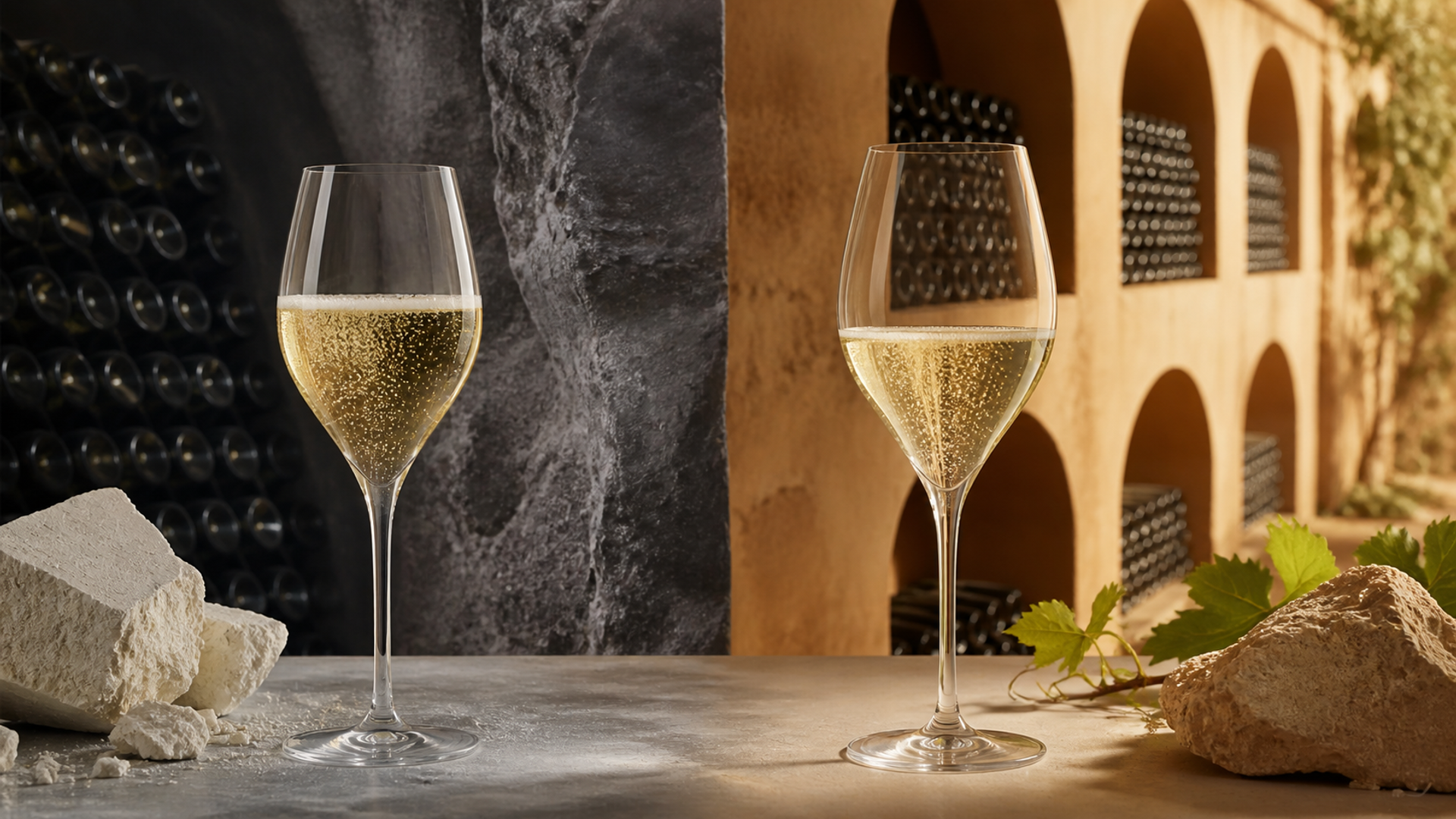
Champagne and Cava are protected sparkling-wine identities, not interchangeable words for bubbles. Champagne comes from the delimited French region under its appellation rules. Cava is a Spanish geographical indication with its own permitted zones, grapes, production and ageing categories. Both can use a second fermentation in bottle, but climate, grapes, reserve wine, lees time, dosage and producer decisions change the result. Prestige and price do not remove the need to read the exact label and taste the intended bottle.
Protected origin comes first
Choose Champagne when its protected origin, producer style and flavour justify the premium for the occasion. Choose Cava when its Spanish identity, grape profile and quality category deliver the better glass or value. Choose by producer and occasion when food, dosage, age, availability and recipient preference matter more than regional fame.
| Decision factor | Champagne | Cava | Choose by producer and occasion |
|---|---|---|---|
| Origin | Protected Champagne appellation | Protected Cava geographical indication | Verify the exact designation |
| Grapes | Permitted Champagne varieties and blends | Permitted Cava varieties and blends | Read the producer technical sheet |
| Method | Second fermentation and ageing rules apply | Traditional-method framework applies | Do not infer equal flavour |
| Age | Non-vintage and vintage rules vary | Cava categories communicate ageing | Decode the exact release |
| Dosage | Brut and other terms indicate dosage bands | Dosage terms also apply | Taste sweetness with food |
| Value | Recognition can raise price | Quality spans everyday to long-aged | Compare producer, condition and serve |
This champagne vs cava matrix is the article's working value object. Read the champagne vs cava rows together: the decisive failure mode depends on this topic's evidence, operating context and reader objective.
Shared method does not mean identical style
Evidence 1. The Champagne appellation is tied to a delimited French production area and a controlled production framework.
Evidence 2. The Cava protected designation defines origin, permitted practices and ageing categories within its own rulebook.
Evidence 3. Traditional-method bottle fermentation is an important shared process, but grape, base wine, lees ageing and dosage still produce different styles.
Evidence 4. Geographical identity establishes authenticity of category, not automatic superiority or suitability for every meal and buyer.
Reader-visible sources checked for this article:
champagne.fr — reader-visible current or official evidence
cava.wine — reader-visible current or official evidence
agriculture.ec.europa.eu — reader-visible current or official evidence
For champagne vs cava, these sources establish only the claims inside their documented scope. Recheck every changeable specification, availability condition, price, policy or service term in the relevant market before acting.
Taste blind at serving temperature
The decision changes at origin. Choose the first path only if protected Champagne appellation; move to the second when protected Cava geographical indication; use the third when verify the exact designation. Save the downside that would make this row fail.
For grapes, the first route works when permitted Champagne varieties and blends; the second requires permitted Cava varieties and blends. The control for the third is read the producer technical sheet. Verify this row against the exact product, property, account or environment before it can reverse the decision.
The method row exposes a practical boundary. Route one assumes second fermentation and ageing rules apply, while route two is defensible only when traditional-method framework applies. Route three depends on do not infer equal flavour. If that evidence is absent, keep the more reversible option.
Read age as a stop/go test: non-vintage and vintage rules vary supports the first option; cava categories communicate ageing supports the second; and decode the exact release supports the third. Record which source proves the condition and when it was checked.
A buyer can resolve dosage without starting from a brand preference. Ask whether brut and other terms indicate dosage bands; compare that with whether dosage terms also apply; then use taste sweetness with food as the third route's safeguard. An unknown condition stays unknown.
On value, popularity is not enough. The evidence for option one is that recognition can raise price. Option two means quality spans everyday to long-aged. Option three is rational where compare producer, condition and serve. Recheck any changeable term immediately before commitment.
Facts that would reverse the current choice
Reversal control 1 — Origin. Before choosing Champagne, write down how the decision changes if “Protected Champagne appellation” proves false. Do the same for Cava and “Protected Cava geographical indication”. Keep the Choose by producer and occasion route available until “Verify the exact designation” is verified. This control belongs to champagne vs cava; update it from the cited source or exact supplier rather than copying a generic checklist.
Reversal control 2 — Grapes. Before choosing Champagne, write down how the decision changes if “Permitted Champagne varieties and blends” proves false. Do the same for Cava and “Permitted Cava varieties and blends”. Keep the Choose by producer and occasion route available until “Read the producer technical sheet” is verified. This control belongs to champagne vs cava; update it from the cited source or exact supplier rather than copying a generic checklist.
Reversal control 3 — Method. Before choosing Champagne, write down how the decision changes if “Second fermentation and ageing rules apply” proves false. Do the same for Cava and “Traditional-method framework applies”. Keep the Choose by producer and occasion route available until “Do not infer equal flavour” is verified. This control belongs to champagne vs cava; update it from the cited source or exact supplier rather than copying a generic checklist.
Reversal control 4 — Age. Before choosing Champagne, write down how the decision changes if “Non-vintage and vintage rules vary” proves false. Do the same for Cava and “Cava categories communicate ageing”. Keep the Choose by producer and occasion route available until “Decode the exact release” is verified. This control belongs to champagne vs cava; update it from the cited source or exact supplier rather than copying a generic checklist.
Reversal control 5 — Dosage. Before choosing Champagne, write down how the decision changes if “Brut and other terms indicate dosage bands” proves false. Do the same for Cava and “Dosage terms also apply”. Keep the Choose by producer and occasion route available until “Taste sweetness with food” is verified. This control belongs to champagne vs cava; update it from the cited source or exact supplier rather than copying a generic checklist.
Reversal control 6 — Value. Before choosing Champagne, write down how the decision changes if “Recognition can raise price” proves false. Do the same for Cava and “Quality spans everyday to long-aged”. Keep the Choose by producer and occasion route available until “Compare producer, condition and serve” is verified. This control belongs to champagne vs cava; update it from the cited source or exact supplier rather than copying a generic checklist.
Read the full designation
Record region, producer, cuvee, vintage status, grape disclosure, dosage term, alcohol and disgorgement information where available. Verify unfamiliar wording with the governing body. For this Champagne versus Cava decision, record the exact item, place, date, measurement and source in the evidence log. Keep observations separate from category shorthand, repeat the check in the environment that matters, and price the downside of a wrong choice. If the protected identity cannot be reconciled, stop paying an origin premium. When that condition appears, reopen the choice instead of defending the original preference.
Control service
Chill both bottles to a consistent temperature and use identical clean glasses and measured pours. Taste before food and with the intended dish. For this Champagne versus Cava decision, record the exact item, place, date, measurement and source in the evidence log. Keep observations separate from category shorthand, repeat the check in the environment that matters, and price the downside of a wrong choice. If the pairing reverses the blind preference, buy for the meal. When that condition appears, reopen the choice instead of defending the original preference.
Separate bubbles from structure
Score aroma, fruit, acidity, autolytic notes, texture, mousse, sweetness and finish independently. Retaste after ten minutes as temperature and carbonation change. For this Champagne versus Cava decision, record the exact item, place, date, measurement and source in the evidence log. Keep observations separate from category shorthand, repeat the check in the environment that matters, and price the downside of a wrong choice. If one wine becomes unbalanced with air, revise the occasion fit. When that condition appears, reopen the choice instead of defending the original preference.
Check storage and condition
Inspect fill, closure, label, provenance and exposure to heat or light, especially for older bottles. Buy consequential bottles from a traceable source. For this Champagne versus Cava decision, record the exact item, place, date, measurement and source in the evidence log. Keep observations separate from category shorthand, repeat the check in the environment that matters, and price the downside of a wrong choice. If condition is uncertain, age and prestige do not guarantee quality. When that condition appears, reopen the choice instead of defending the original preference.
Model replacement value
Include tax, delivery, restaurant markup and the ability to buy the same cuvee again. Compare bottles at the role they will actually serve. For this Champagne versus Cava decision, record the exact item, place, date, measurement and source in the evidence log. Keep observations separate from category shorthand, repeat the check in the environment that matters, and price the downside of a wrong choice. If scarcity prevents repeat use, choose a stable benchmark for regular occasions. When that condition appears, reopen the choice instead of defending the original preference.
Four occasions, four answers
Celebratory gift
Champagne may offer immediate recognition when the recipient values the appellation. Define the fact that would reverse this recommendation before committing.
Food-led dinner
A well-chosen Cava can outperform a famous label when acidity, dosage and texture fit the menu. Define the fact that would reverse this recommendation before committing.
Learning tasting
Matched dosage and ageing categories reveal more than comparing the cheapest Cava with prestige Champagne. Define the fact that would reverse this recommendation before committing.
Cellar purchase
Producer, release, disgorgement, storage and future availability become central. Define the fact that would reverse this recommendation before committing.
Action checklist
Verify designation.
Record producer.
Read grape disclosure.
Decode age category.
Read dosage.
Check disgorgement.
Inspect condition.
Serve at matched temperature.
Taste blind.
Test with food.
Check replacement price.
Save provenance.
Continue the decision
The linked VERTU articles expand adjacent parts of the champagne vs cava decision. They do not substitute for the external evidence above.
The Champagne-versus-Cava verdict
Choose Champagne when its protected origin, producer style and flavour justify the premium for the occasion. Choose Cava when its Spanish identity, grape profile and quality category deliver the better glass or value. Choose by producer and occasion when food, dosage, age, availability and recipient preference matter more than regional fame.
Keep the champagne vs cava decision reversible until its material cost, safety, access, privacy and compatibility facts are verified. Unknown evidence stays unknown; it is never silently scored as favourable.