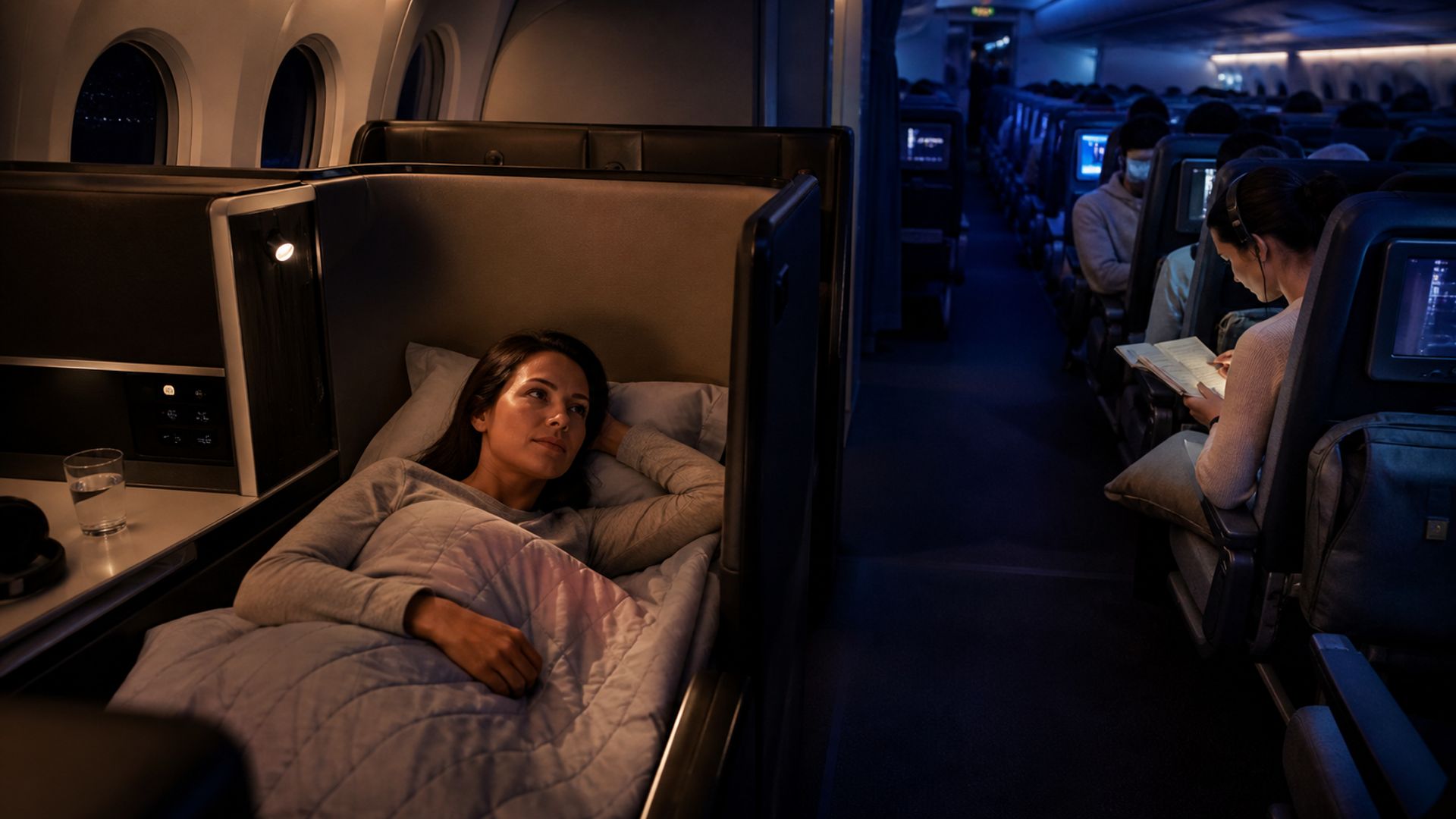
Business class versus economy is not a contest between luxury and thrift. It is a route-specific decision about space, sleep, schedule reliability, fare flexibility and the value of the traveller's first day after landing. A lie-flat seat on an overnight sector can change the trip; a recliner on a short daytime flight may not. The cabin label alone does not reveal which product is being sold.
The comparison should therefore use the exact airline, aircraft, seat map, operating carrier and fare conditions. Ground benefits, baggage, lounge access and rebooking rules can matter as much as the seat. Points introduce another currency but not free travel: taxes, opportunity cost and availability remain. The rational upgrade is the one whose benefits solve a named consequence at an acceptable incremental cost.
Direct answer: business class versus economy
Pay or redeem for business class when the exact product materially improves sleep, work, health or schedule recovery on a high-consequence journey. Keep economy when the flight is short, daytime, low-stakes or the premium crowds out more valuable parts of the trip. Compare incremental cost per useful benefit, not cabin stereotypes.
| Decision factor | Evidence to collect | Why it changes the answer | Control before purchase |
|---|---|---|---|
| Seat and sleep | business products range from recliners to private lie-flat suites | cabin name does not guarantee restorative sleep | verify aircraft, seat map and recent operating pattern |
| Schedule | connections and departure time affect total journey quality | a superior seat can lose to a poor itinerary | price delay exposure and arrival commitments |
| Fare rules | refund, change and no-show terms vary within both cabins | flexibility can be more valuable than catering | compare the exact filed fare conditions |
| Ground benefits | lounge, priority, baggage and fast-track inclusion varies | assumed perks may not appear on the ticket | confirm each benefit for every segment and guest |
| Points | award availability and surcharges create a separate market | low mileage does not necessarily mean low cost | value points at a consistent personal rate and add cash fees |
| Arrival value | sleep and early deplaning matter only when the first day has consequences | an upgrade can protect work or merely feel pleasant | name the meetings, driving or care duties after landing |
For business class versus economy, this matrix is the article-specific value object. It prevents a single price, feature or viral claim from silently becoming a recommendation.
Current evidence baseline
Evidence 1. NerdWallet's current premium-cabin guide notes that products and benefits vary by airline and route, so travellers should research the exact ticket. Source.
Evidence 2. British Airways' Club World description provides a current airline example of business-class space, lounge access, dining and a flat bed. Source.
Evidence 3. EU passenger-rights guidance explains that protections depend on itinerary and circumstances rather than cabin prestige. Source.
Evidence 4. IATA's baggage programme illustrates the operational complexity behind baggage handling, a benefit area that should be verified in the exact fare. Source.
For business class versus economy, these sources support only the claims stated above. They do not establish private transaction prices, permanent availability, universal authenticity or future appreciation.
How the decision factors change the result
Seat and sleep. The relevant evidence is that business products range from recliners to private lie-flat suites. That matters because cabin name does not guarantee restorative sleep. For this decision, verify aircraft, seat map and recent operating pattern. Record the dated result, exact model or route, and the assumption that would cause the conclusion to change.
Schedule. The relevant evidence is that connections and departure time affect total journey quality. That matters because a superior seat can lose to a poor itinerary. For this decision, price delay exposure and arrival commitments. Record the dated result, exact model or route, and the assumption that would cause the conclusion to change.
Fare rules. The relevant evidence is that refund, change and no-show terms vary within both cabins. That matters because flexibility can be more valuable than catering. For this decision, compare the exact filed fare conditions. Record the dated result, exact model or route, and the assumption that would cause the conclusion to change.
Ground benefits. The relevant evidence is that lounge, priority, baggage and fast-track inclusion varies. That matters because assumed perks may not appear on the ticket. For this decision, confirm each benefit for every segment and guest. Record the dated result, exact model or route, and the assumption that would cause the conclusion to change.
Points. The relevant evidence is that award availability and surcharges create a separate market. That matters because low mileage does not necessarily mean low cost. For this decision, value points at a consistent personal rate and add cash fees. Record the dated result, exact model or route, and the assumption that would cause the conclusion to change.
Arrival value. The relevant evidence is that sleep and early deplaning matter only when the first day has consequences. That matters because an upgrade can protect work or merely feel pleasant. For this decision, name the meetings, driving or care duties after landing. Record the dated result, exact model or route, and the assumption that would cause the conclusion to change.
Worked ownership scenario
Calculate the incremental upgrade cost after subtracting benefits that would otherwise be purchased: baggage, lounge, seat selection, hotel night avoided and flexible-fare value. Add the personal value of points used and all surcharges. Then divide the remaining premium by protected hours of sleep or productive arrival time, using a conservative estimate. Run a second case where an aircraft swap removes the expected seat. If the decision collapses in that case, understand the airline's remedies before paying.
The aircraft matters more than the marketing image
Airlines may operate several seat generations under the same cabin name, and partner flights can differ again. Verify the operating carrier, aircraft type and seat map shortly before booking and again before travel. Look for bed length, aisle access, privacy, storage and whether travelling companions can communicate. Treat a specific seat as expected rather than guaranteed because operational swaps occur. If the product difference drives the purchase, record what compensation or rebooking options exist.
Sleep has a route and body context
An overnight eastbound flight before a critical morning creates more potential value than a daytime return followed by rest. Departure time, meal service, cabin temperature, turbulence and personal sleep ability all influence the result. A lie-flat seat does not guarantee sleep. Some travellers benefit more from a direct economy flight than a connecting business itinerary. Compare door-to-door time and the first 24 hours after arrival, not merely hours in the premium cabin.
Fare flexibility can dominate the seat
Business tickets can still be restrictive, while a flexible economy fare can offer valuable changes. Read cancellation deadline, refund form, change fee, fare difference, no-show rule and missed-connection treatment. Corporate travellers should consider whether company policy, travel insurance or status already supplies some protection. A premium paid for flexibility is only valuable if the rules actually cover the likely disruption and the traveller can execute the change.
Use points as money with constraints
A points redemption avoids part of the cash fare but spends an asset that could serve another journey. Apply one consistent personal valuation, add taxes and carrier surcharges, and consider whether transferring points is irreversible. Do not book an inferior route solely because it looks cheap in miles. Compare the award with the best acceptable cash itinerary and preserve enough flexibility for schedule changes. Availability scarcity should not force a trip that no longer makes sense.
A repeatable upgrade rule
Create three categories. Protect: overnight or high-consequence travel where sleep and recovery have real value. Consider: long daytime flights where space or work matters but alternatives exist. Decline: short, low-consequence sectors where the premium buys little usable time. Review the rule after each trip using actual sleep, delays, work completed and arrival condition. This turns cabin choice into a learning system instead of a status reflex.
Evidence checklist for business class versus economy
[ ] Verify operating carrier and aircraft
[ ] Inspect the exact seat map
[ ] Compare door-to-door schedules
[ ] Read fare rules
[ ] Confirm ground benefits
[ ] Value points consistently
[ ] Describe the first arrival day
[ ] Record the actual outcome
In a business class versus economy decision, an unchecked item remains unknown. It should not be converted into a favourable assumption merely to complete the purchase.
Reader-visible sources and method
The external pages above were checked for this business class versus economy publication. Price, availability, service, tax, regulation and platform terms must be reconfirmed for the buyer's market and date. Ranking pages informed the separate SERP benchmark, but their prose was not copied and they do not control the claims in this article.
Continue with adjacent VERTU editorial research
These internal links provide adjacent premium-lifestyle and decision context for business class versus economy; they do not replace the specialist or official evidence needed for a specific transaction.
Final judgement
Pay or redeem for business class when the exact product materially improves sleep, work, health or schedule recovery on a high-consequence journey. Keep economy when the flight is short, daytime, low-stakes or the premium crowds out more valuable parts of the trip. Compare incremental cost per useful benefit, not cabin stereotypes.
The useful standard for business class versus economy is not certainty created by confident language. It is a decision whose evidence, downside and next review point are visible to the reader.