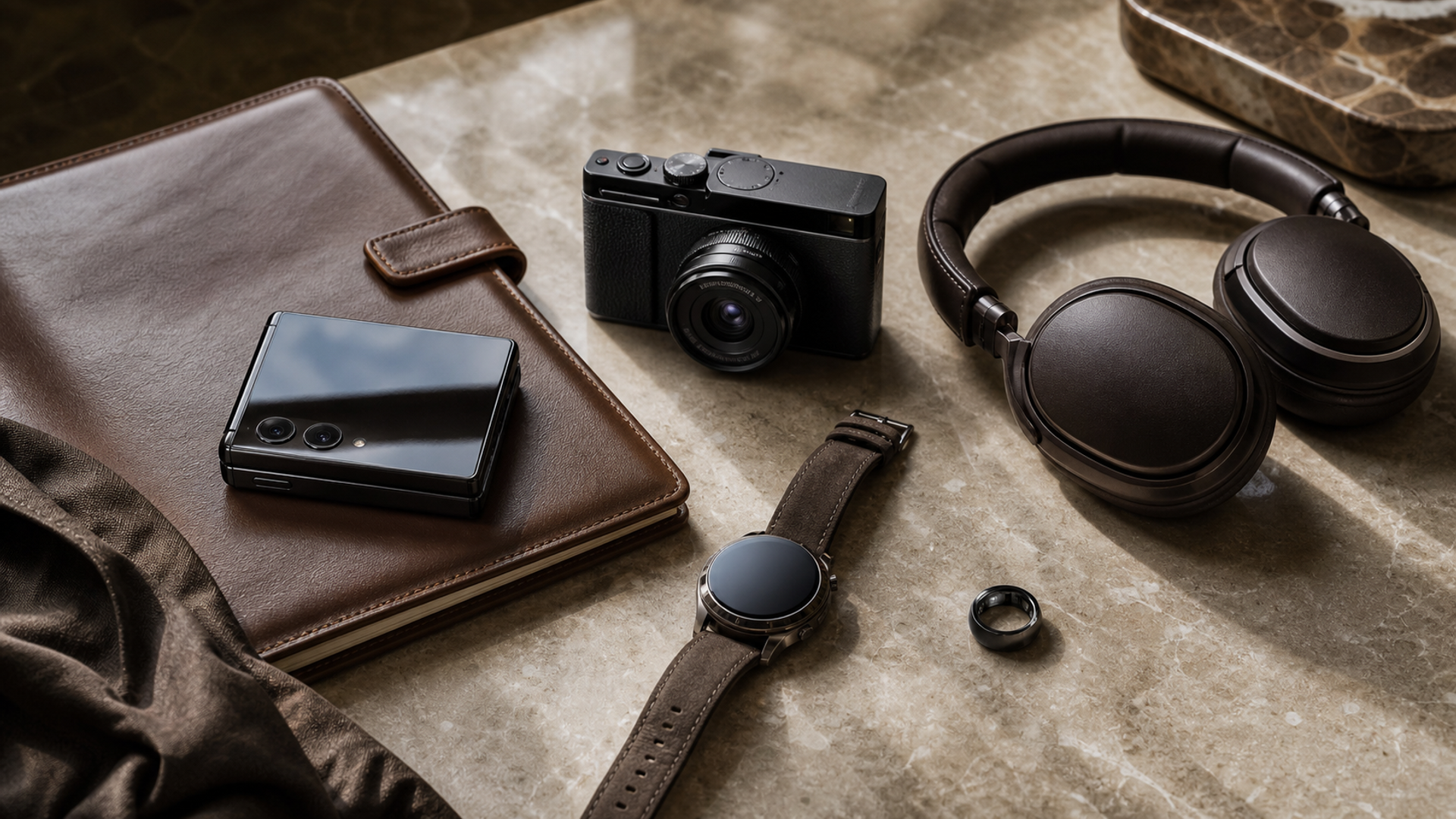
The best luxury technology does not become desirable merely because it is expensive. It earns its place by solving a specific problem with better materials, a calmer interface, specialist service or a form that ordinary electronics cannot match. In 2026, the strongest shortlist includes a foldable executive phone, spatial computer, fixed-lens camera, Swiss connected watch, repairable headphones and smart jewellery that can be worn without looking like gym equipment.
This list is deliberately selective. If a product has no convincing answer to "Why this instead of the mainstream version?", it does not belong here.
The shortlist
| Product | What makes it worth considering | Who should skip it |
|---|---|---|
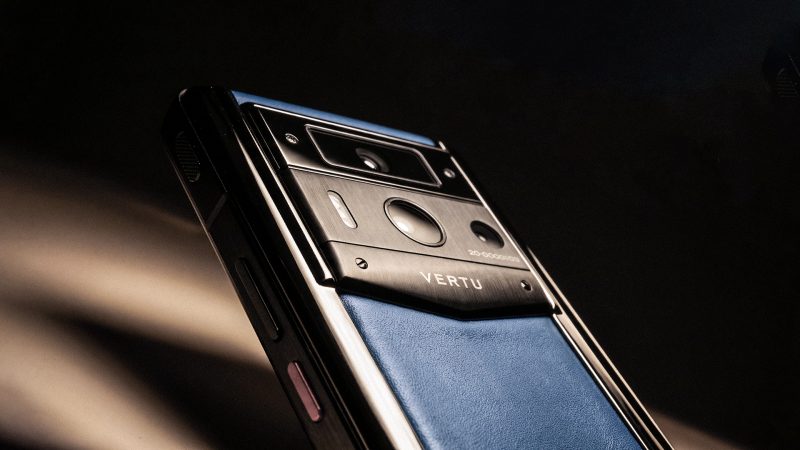
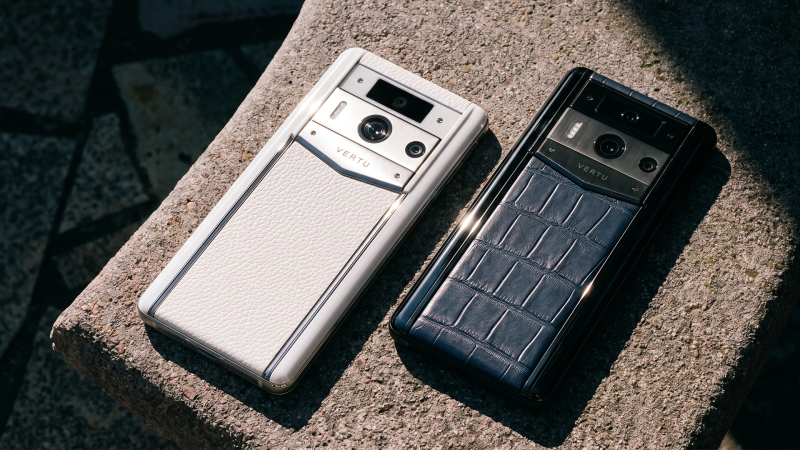
| VERTU AlphaFold | Foldable workspace, private agent boundaries, craft and concierge | Buyers who only need a conventional phone |
| Apple Vision Pro with M5 | High-end spatial work and media | Anyone without a clear weekly use case |
| Leica Q3 43 | One camera, one natural focal length, 60MP full-frame sensor | Buyers who need interchangeable lenses |
| TAG Heuer Connected Calibre E5 | Swiss case design with focused sports software | App-store maximalists |
| Bang & Olufsen Beoplay H100 | Premium sound, materials and serviceable design | Value-first commuters |
| VERTU Aura Ring Ultra | Ultra-thin, modular smart jewellery | Athletes needing live workout data |
| Oura Ring 4 Ceramic | Polished wellness experience in ceramic finishes | Subscription-averse buyers |
| Samsung Galaxy S26 Ultra | Built-in privacy display and broad flagship utility | Buyers wanting a small phone |
| VERTU Phantom OWS AI Earbuds | Open-wear comfort, translation and distinctive materials | Those needing maximum isolation |
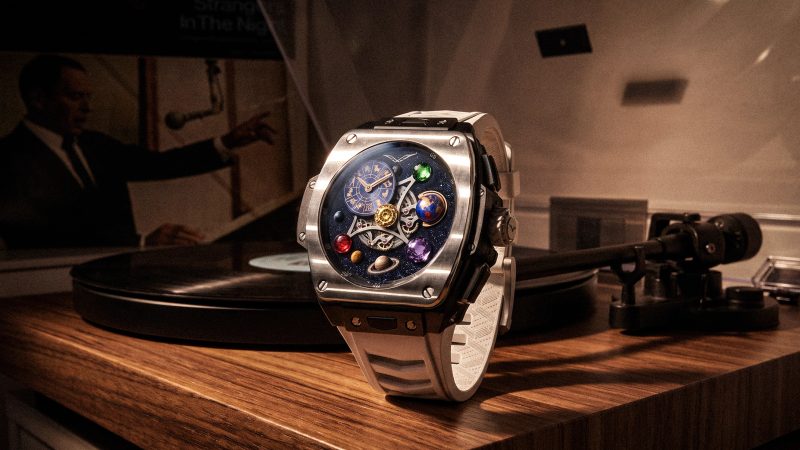
| VERTU Grand Watch | Tonneau design, ceramic/carbon cases and sapphire mirror | Buyers seeking a generic app platform |
Prices and availability move by market and configuration. Use each official product page as the live source before purchasing.
1. VERTU AlphaFold: the executive device that justifies its size
Many foldables are ordinary Android phones with a larger canvas. AlphaFold is more coherent when the buyer actually works from that canvas. The 8.05-inch inner display gives contracts, dashboards, presentations and side-by-side apps room to breathe; the 6.53-inch outer screen handles quick tasks.
VERTU pairs the hardware with Hermes Agent, privacy controls, selected enterprise connectivity and concierge support. The useful caveat is equally important: supported apps, ERP connections and business workflows depend on user authorisation, private deployment and configuration. Buy it for a real mobile-work pattern, not for a specification contest.
2. Apple Vision Pro with M5: spatial computing for a defined routine
The M5 version of Vision Pro improves performance, display rendering and battery life, and ships with the Dual Knit Band. Its best use is not wandering through a catalogue of demonstrations. It is creating a repeatable private workspace, reviewing spatial design, watching immersive media or collaborating in a field where three-dimensional context matters.
The purchase test is brutal: name the three sessions you will use every week. If you cannot, book a demonstration and wait. Luxury technology becomes clutter quickly when the use case is only curiosity.
3. Leica Q3 43: less choice, better attention
The Q3 43 combines a 60.3-megapixel full-frame sensor with a fixed APO-Summicron 43mm f/2 lens. The focal length is close to a natural perspective and works well for travel, people and everyday observation. The metal body weighs about 772 grams with battery and carries an IP52 rating.
Its luxury is constraint. There is no lens bag to organise and no zoom ring to hide behind. The camera asks the owner to move, frame and pay attention. Skip it if wildlife, field sports or ultra-wide architecture are central to your work.
4. TAG Heuer Connected Calibre E5: a connected watch with a point of view
The 45mm Calibre E5 uses a steel case, ceramic bezel and sapphire crystal. TAG Heuer's own operating system includes wellness, golf and sports features, while the 45mm model is rated for up to three days in low-power mode and 17 hours in running mode.
The decision hinges on software philosophy. E5 does not offer an open app store. TAG Heuer manages the applications itself. That restraint can feel calm and coherent, or limiting, depending on whether the owner wants a watch or a miniature phone.
5. Bang & Olufsen Beoplay H100: headphones designed beyond the first owner
Beoplay H100 competes on sound and industrial design, but its more interesting claim is longevity. Bang & Olufsen has discussed replaceable or serviceable elements and long-term ownership around the model. A premium headphone should not become waste because a battery or cushion ages.
Listen before buying. Comfort, clamp and tuning are personal, and prestige cannot correct a poor fit. Ask the retailer exactly which components can be replaced, for how long and at what cost in your region.
6. VERTU Aura Ring Ultra: smart jewellery that can change its outward character
Aura Ring Ultra separates the sensing core from interchangeable outer bands. VERTU announced a 2mm profile and 2.3-gram form, with subscription-free wellness insights and pre-orders in 2026. The modular idea is more important than another dashboard: the same electronic core can move between discreet and more expressive finishes.
It suits someone who wants sleep and daily wellness trends without wearing a black sports watch to dinner. It is not a replacement for GPS, live pace or advanced training tools.
7. Oura Ring 4 Ceramic: the polished smart-ring choice
Oura Ring 4 Ceramic uses a zirconia-ceramic exterior and titanium inner shell. The software remains Oura's main advantage, turning sleep, activity and recovery signals into a readable daily view. The trade-off is an ongoing membership for the complete experience.
Buy it if you value the app enough to accept the fee and prefer ceramic colour and lustre over a conventional titanium finish.
8. Samsung Galaxy S26 Ultra: privacy hardware enters the mainstream
The S26 Ultra's built-in Privacy Display narrows what a person at the side can see when the feature is enabled. It can be applied to the full screen or selected content such as notifications. Samsung also warns that visibility still depends on angle, brightness and environment.
This is useful engineering for travellers, not absolute protection. Its inclusion matters because it treats visual privacy as a hardware and interface decision rather than an adhesive accessory.
9. VERTU Phantom OWS AI Earbuds: open listening with a different material language
Phantom open-wear earbuds are designed for awareness and long comfort rather than sealing the ear canal. VERTU specifies AI translation and transcription, 8.8-gram earpieces, up to 25 hours total battery life and selected wood materials.
Open-wear audio is useful in an office, hotel or walk where awareness matters. It is less suitable on a loud aircraft. Confirm language support and service availability for the market in which the earbuds will be used.
10. VERTU Grand Watch: connected technology in a tonneau form
Grand Watch uses a barrel-shaped case, microcrystalline black ceramic or filament-coloured carbon, and a sapphire mirror. It exists for the buyer who finds mainstream round and square wearables visually anonymous.
Its wellness features should be treated as consumer information, not clinical assessment. The purchasing case rests on form, materials and the VERTU design language, not a promise that every metric will replace specialist equipment.
A better way to judge luxury technology
Before buying, score the product on five questions:
Will I use its distinctive feature every week?
Can it be repaired, updated or serviced after the launch cycle?
Does the material improve touch and durability, or only the product photograph?
What happens when the battery ages?
Is there a human service path when software fails?
The answer does not have to be perfect. It does have to be specific.
Five red flags in a luxury-tech purchase
First, beware of a precious finish applied to obsolete electronics. Gold and leather cannot extend a chipset's support life. Second, ask whether the battery is replaceable through an official service route. A sealed product with no battery plan is a short-lived collectible.
Third, distinguish limited production from manufactured scarcity. A numbered edition is meaningful only when the number, configuration and delivery are documented. Fourth, verify that concierge, translation, cloud storage or AI services work in the country where the device will be used. A service icon on a global page is not a regional contract.
Finally, reject vague material language. "Aerospace", "ceramic" and "carbon" describe families of materials, not a measurable level of quality. The seller should identify which material appears on the exact product and how it affects weight, wear, repair and care.
Plan the exit before the purchase
Good ownership includes the end of ownership. Ask whether personal data can be exported and erased, whether the device can be transferred to another person and whether the manufacturer recycles batteries. Keep invoices, serial numbers, certificates and service records together. Those documents matter for insurance and resale, but they also make responsible disposal possible when software support ends.
A luxury object should leave a clear record, not an abandoned account and an unknown battery in a drawer.
Verdict
AlphaFold, Leica Q3 43 and TAG Heuer Calibre E5 are the strongest purchases for people with clear work, photography or sport routines. Vision Pro is extraordinary when spatial computing already has a job. Aura Ring Ultra, Oura Ceramic and Grand Watch serve buyers who want technology to coexist with personal style. The S26 Ultra's Privacy Display is the year's most practical reminder that luxury can also mean discretion.
Buy fewer devices. Demand a clearer reason from each one.