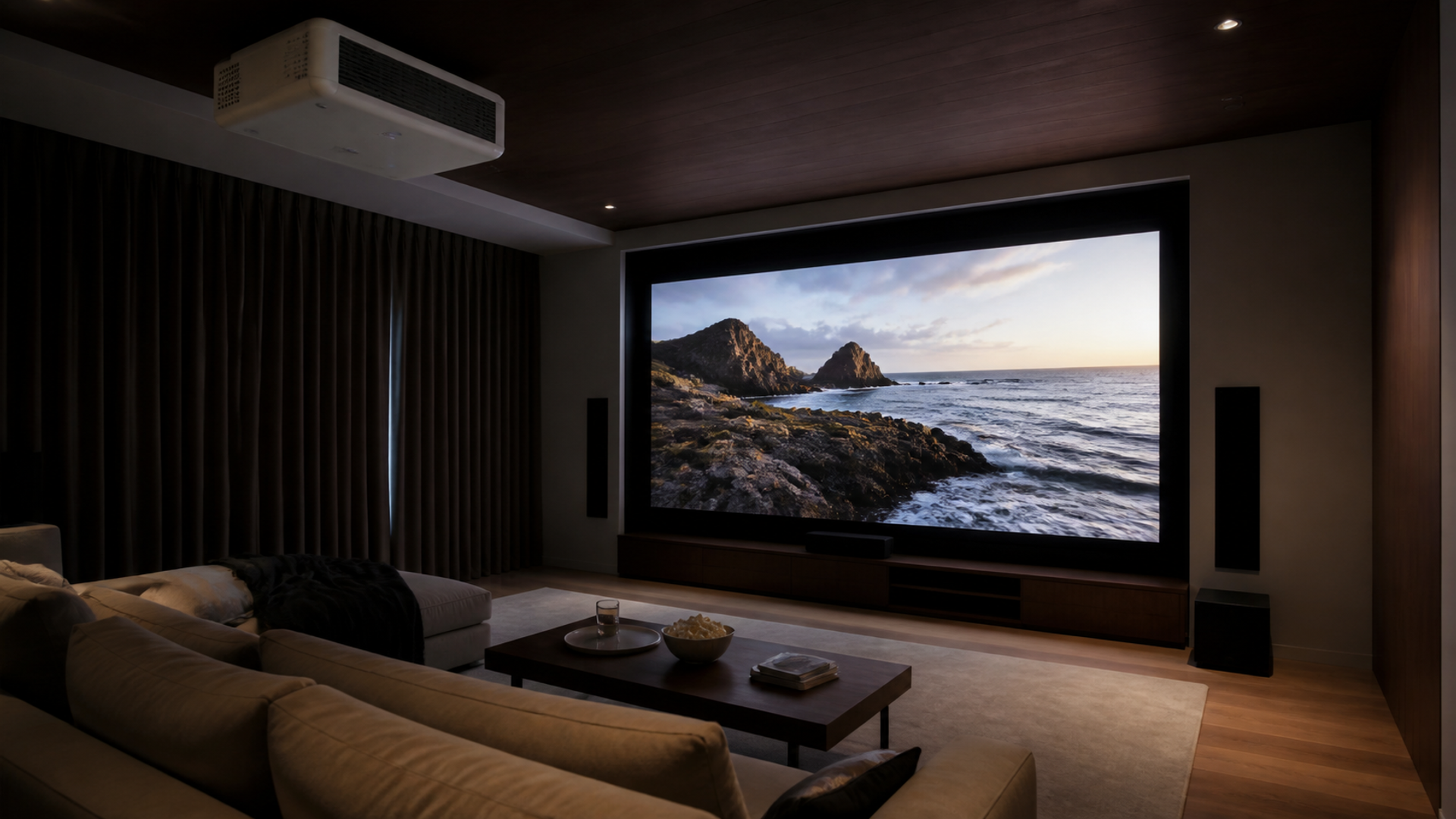
A home projector is a room system, not a screen that can be judged in isolation. Throw distance, screen material, daylight, mounting, fan noise and the location of the source equipment determine whether a large image feels cinematic or merely inconvenient. The strongest 2026 buying decision begins with the room and viewing ritual, then selects the projector class that can serve them without heroic compromises.
Match the projector to the room
Choose short throw when the room is shallow and the wall can be prepared carefully; standard throw when a dedicated cinema layout gives the lens and screen space; or a flexible projector when portability matters more than the largest, most calibrated image. Confirm brightness, lens shift, throw ratio, noise and service terms from the current model documentation before committing.
| Decision factor | Short-throw projector | Standard-throw projector | Flexible portable projector |
|---|---|---|---|
| Room depth | The screen is close to the projector position | A dedicated throw distance is available | The device moves between rooms |
| Screen plan | A fixed screen and alignment are possible | The screen and lens are calibrated together | A wall or temporary screen is acceptable |
| Ambient light | Blackout is strong and controlled | The room can be darkened for films | Daytime use cannot be controlled |
| Installation | Careful mounting and geometry are acceptable | A permanent AV plan is preferred | Fast setup matters more than calibration |
| Sound | A separate sound system is planned | AV receiver and speakers are already present | Simple sound or headphones are preferred |
| Service | Local installation and support are available | A dedicated service path is budgeted | Portable replacement is more practical |
This best home projector 2026 matrix is the article's working value object. Read the best home projector 2026 rows together: the decisive failure mode depends on this topic's evidence, operating context and reader objective.
What installation evidence can prove
Evidence 1. Projector Central’s buying and review resources treat throw ratio, brightness, contrast, resolution and room conditions as connected parts of the decision.
Evidence 2. Sony’s projector information shows that current models differ in installation design, image size and features; model-level documentation is required for final specifications.
Evidence 3. A projector’s perceived brightness changes with screen size, screen gain and ambient light, so the same lumen claim can produce different results in different rooms.
Evidence 4. Fan noise, mounting access, lens alignment and the route for HDMI or network cabling are ownership considerations that are invisible in a simple resolution comparison.
Reader-visible sources checked for this article:
projectorcentral.com — reader-visible current or official evidence
sony.com — reader-visible current or official evidence
epson.com — reader-visible current or official evidence
thx.com — reader-visible current or official evidence
For best home projector 2026, these sources establish only the claims inside their documented scope. Recheck every changeable specification, availability condition, price, policy or service term in the relevant market before acting.
Build a reliable home cinema system
On room depth, popularity is not enough. The evidence for option one is that the screen is close to the projector position. Option two means a dedicated throw distance is available. Option three is rational where the device moves between rooms. Recheck any changeable term immediately before commitment.
The decision changes at screen plan. Choose the first path only if a fixed screen and alignment are possible; move to the second when the screen and lens are calibrated together; use the third when a wall or temporary screen is acceptable. Save the downside that would make this row fail.
For ambient light, the first route works when blackout is strong and controlled; the second requires the room can be darkened for films. The control for the third is daytime use cannot be controlled. Verify this row against the exact product, property, account or environment before it can reverse the decision.
The installation row exposes a practical boundary. Route one assumes careful mounting and geometry are acceptable, while route two is defensible only when a permanent AV plan is preferred. Route three depends on fast setup matters more than calibration. If that evidence is absent, keep the more reversible option.
Read sound as a stop/go test: a separate sound system is planned supports the first option; aV receiver and speakers are already present supports the second; and simple sound or headphones are preferred supports the third. Record which source proves the condition and when it was checked.
A buyer can resolve service without starting from a brand preference. Ask whether local installation and support are available; compare that with whether a dedicated service path is budgeted; then use portable replacement is more practical as the third route's safeguard. An unknown condition stays unknown.
Facts that would reverse the current choice
Reversal control 1 — Room depth. Before choosing Short-throw projector, write down how the decision changes if “The screen is close to the projector position” proves false. Do the same for Standard-throw projector and “A dedicated throw distance is available”. Keep the Flexible portable projector route available until “The device moves between rooms” is verified. This control belongs to best home projector 2026; update it from the cited source or exact supplier rather than copying a generic checklist.
Reversal control 2 — Screen plan. Before choosing Short-throw projector, write down how the decision changes if “A fixed screen and alignment are possible” proves false. Do the same for Standard-throw projector and “The screen and lens are calibrated together”. Keep the Flexible portable projector route available until “A wall or temporary screen is acceptable” is verified. This control belongs to best home projector 2026; update it from the cited source or exact supplier rather than copying a generic checklist.
Reversal control 3 — Ambient light. Before choosing Short-throw projector, write down how the decision changes if “Blackout is strong and controlled” proves false. Do the same for Standard-throw projector and “The room can be darkened for films”. Keep the Flexible portable projector route available until “Daytime use cannot be controlled” is verified. This control belongs to best home projector 2026; update it from the cited source or exact supplier rather than copying a generic checklist.
Reversal control 4 — Installation. Before choosing Short-throw projector, write down how the decision changes if “Careful mounting and geometry are acceptable” proves false. Do the same for Standard-throw projector and “A permanent AV plan is preferred”. Keep the Flexible portable projector route available until “Fast setup matters more than calibration” is verified. This control belongs to best home projector 2026; update it from the cited source or exact supplier rather than copying a generic checklist.
Reversal control 5 — Sound. Before choosing Short-throw projector, write down how the decision changes if “A separate sound system is planned” proves false. Do the same for Standard-throw projector and “AV receiver and speakers are already present”. Keep the Flexible portable projector route available until “Simple sound or headphones are preferred” is verified. This control belongs to best home projector 2026; update it from the cited source or exact supplier rather than copying a generic checklist.
Reversal control 6 — Service. Before choosing Short-throw projector, write down how the decision changes if “Local installation and support are available” proves false. Do the same for Standard-throw projector and “A dedicated service path is budgeted”. Keep the Flexible portable projector route available until “Portable replacement is more practical” is verified. This control belongs to best home projector 2026; update it from the cited source or exact supplier rather than copying a generic checklist.
Measure the throw before comparing models
Mark the intended screen width and lens position. Calculate whether a standard or short-throw design fits without blocking a walkway or creating a shadow. Check lens shift and keystone limits; digital correction can make placement easier but should not become the default substitute for correct geometry. Keep the source rack, ventilation and service access visible in the plan.
Match brightness to the actual room
A bright room, a large screen and a low-gain surface each reduce perceived impact. A small dark room has different needs. View the planned screen size in daylight and at night, and note whether curtains, lamps and wall colour change the result. Avoid selecting a projector only because a headline lumen figure is higher; calibrated, comfortable images matter more than a single number.
Decide whether the screen is part of the system
A fixed screen can improve repeatability and hide a complex wall; a motorised screen supports a room used for other purposes; a painted wall offers flexibility but can expose texture and colour issues. Include screen placement, speaker location, masking, power and cable routes. A projector without a suitable screen plan is an unfinished purchase.
Protect the everyday experience
Choose a remote and source-switching workflow that the household will use. Confirm start-up time, app support, firmware, cleaning instructions and warranty. If the room is used for gaming or sport, test motion and latency in the current mode. For films, test black scenes, subtitles and quiet dialogue rather than relying on a bright demonstration clip.
Three projector-room decisions
Dedicated dark cinema
Standard throw with a fixed screen and planned sound system gives the strongest route to scale and repeatability. Define the fact that would reverse this recommendation before committing.
Shallow media room
A carefully installed short-throw design can work, but screen flatness and alignment deserve unusual attention. Define the fact that would reverse this recommendation before committing.
Occasional multi-room viewing
A flexible projector is reasonable when the owner accepts a smaller image, more setup and less consistent calibration. Define the fact that would reverse this recommendation before committing.
Action checklist
Measure throw distance and screen width.
Record daylight and blackout conditions.
Choose screen type and gain.
Check lens shift and keystone limits.
Plan mount, power and cables.
Test fan noise from the seats.
Confirm source switching and apps.
Test motion and gaming latency.
Read cleaning and warranty terms.
Verify local installation support.
Continue the decision
The linked VERTU articles expand adjacent parts of the best home projector 2026 decision. They do not substitute for the external evidence above.
The home-projector verdict
Choose short throw when the room is shallow and the wall can be prepared carefully; standard throw when a dedicated cinema layout gives the lens and screen space; or a flexible projector when portability matters more than the largest, most calibrated image. Confirm brightness, lens shift, throw ratio, noise and service terms from the current model documentation before committing.
Keep the best home projector 2026 decision reversible until its material cost, safety, access, privacy and compatibility facts are verified. Unknown evidence stays unknown; it is never silently scored as favourable.