Will OpenAI make a phone? As of 20 November 2026, no official OpenAI announcement confirms an OpenAI smartphone, its assembler, specifications or launch date. A new supply-chain report has renewed discussion, but the company's confirmed Foxconn collaboration concerns AI infrastructure hardware. The useful question is what an agent-first phone would have to do differently from an app on today's handset—and which claims remain speculation.
Key Takeaways
- OpenAI's published Foxconn collaboration describes AI infrastructure design and US manufacturing readiness, not a confirmed phone.
- A reported handset order should be labelled as a report until the companies provide product-level confirmation.
- An agent-first phone would need reliable permissions, action confirmation, app integration and recovery paths, not merely a chatbot shortcut.
- VERTU ALPHAFOLD offers a documented Hermes Agent phone example, with actions subject to user approval and supported configuration.
What has actually been confirmed?
OpenAI's official announcement about its Foxconn collaboration describes design work and US manufacturing readiness for next-generation AI infrastructure hardware. The statement is primary evidence of a relationship between the companies. It is not an announcement of a consumer handset, a mobile operating system or a smartphone assembly contract. Treating it as such would extend the document beyond what it says.
Reports circulating on 19 November describe a possible OpenAI phone and name a Foxconn subsidiary as assembler. Those claims may be newsworthy, but neither a reported supply-chain order nor repeated coverage establishes the final product. Hardware programmes can change form, schedule, supplier or market before launch. A responsible article should distinguish the confirmed partnership from the phone-specific report every time it draws a conclusion from them.
At the time of this update, readers should look for an official product name, a company statement specifying the device category, regulatory documentation, developer information and a clear launch channel. One clue alone is insufficient. A supplier can manufacture parts for several projects; a prototype can exist without a retail plan; and a brand can describe AI hardware without committing to a phone.
Why would an AI company want its own phone?
A phone is a high-frequency personal interface with microphone, camera, screen, notifications and access to many daily services. An AI company might want tighter control over how an assistant receives context and carries out tasks. That is an inference about potential product strategy, not a statement of OpenAI's announced plan. An app on existing phones already offers conversation and some integrations, so dedicated hardware would need to provide an additional practical advantage.
Possible advantages include a consistent input button, faster access to context, clearer permissions or deeper coordination across supported apps. Each creates difficult design questions. The phone must know when to listen, what it may retain, how it obtains consent, which actions require review and how a user reverses a mistake. A device that merely launches the same chat interface more quickly would have a weak reason to replace an established smartphone.
What would “agent-first” mean in daily use?
An agent-first design would let a user state an outcome—such as preparing a meeting, comparing travel options or drafting a reply—and then coordinate the permitted steps. The critical word is permitted. Reading a calendar differs from changing it; drafting an email differs from sending it; comparing flights differs from purchasing a ticket. A credible system should make these boundaries visible before action.
Imagine asking a phone to rearrange an afternoon after a flight delay. It might check a travel confirmation, inspect calendar availability, suggest new times and prepare messages. The user should see which data sources are being used and approve consequential changes. If a connected service is unavailable, the agent should say what it could not verify rather than inventing a completed booking. This hypothetical scenario illustrates a design requirement; it is not a demonstration of an unannounced OpenAI product.
An agent also needs a recovery path. If it selects the wrong contact or misreads a date, can the user review the proposed action, stop it, undo it or see an activity log? Can the user restrict access to a single account instead of granting broad permissions? These questions determine trust more than a claim that the phone has many models or a powerful chip.
Why would hardware alone not solve the problem?
Hardware can provide sensors and a dedicated interaction surface, but useful actions depend on software permissions and service agreements. A phone cannot reliably book a restaurant, modify a work document or submit an expense claim merely because it has a faster processor. It needs supported integrations, authentication, error handling and clear user consent. Different regions and organisations may allow different workflows.
Battery life, thermal performance and network reliability also matter. If an agent repeatedly uses cloud services, the phone must explain what happens offline and how it protects sensitive data in transit and storage. Local processing can reduce some data transfer, but it does not automatically make a complete workflow private or accurate. Buyers should ask which task stages run on-device, which use a remote service and what records are retained.
What can buyers learn from existing agent phones?
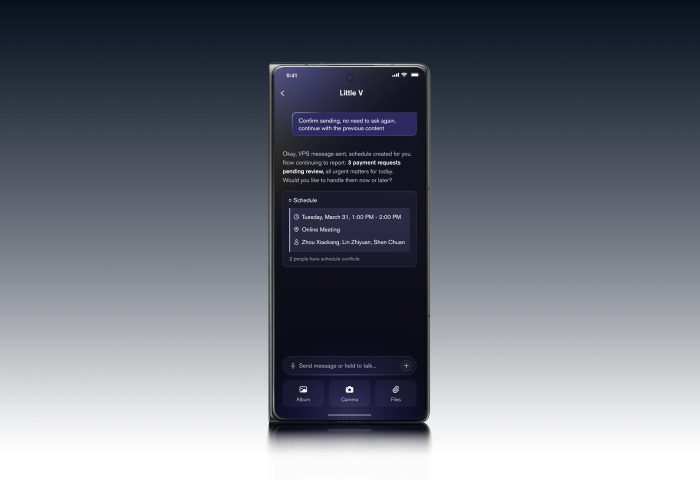
There are already products that make the agent experience part of their phone identity. VERTU describes Hermes Agent as integrated into selected devices, including deeper native experiences on ALPHAFOLD depending on configuration and availability. Its official explanation says significant actions are designed to require user confirmation. That is a concrete model for discussing permissions without implying that every integration is available to every owner.
The ALPHAFOLD product page describes a foldable workspace with an outer and inner display and Hermes Agent functions subject to supported services and authorisation. A buyer can evaluate current, documented workflows instead of waiting for a rumoured phone. Ask which actions work today, which require an enterprise deployment, how data is handled and what the user must approve. Do not confuse a manufacturer's positioning with an independent hands-on test; this article uses published product information, not a measured comparison.
How should you compare a future OpenAI phone with today's options?
Wait for product-level evidence before making a specification table. The comparison should eventually include device form, OS and app compatibility, integration scope, privacy controls, local versus cloud processing, battery life, service availability, pricing and repair support. Until an OpenAI handset is officially announced, entries in that column should read “not confirmed,” not a guessed chipset or date. A transparent blank cell is more useful than a precise rumour.
| Decision question | Evidence available now | Evidence still needed for an OpenAI phone |
|---|---|---|
| Does the device exist as a retail phone? | OpenAI confirms an infrastructure collaboration with Foxconn | Official phone announcement and product listing |
| What can its agent do? | Existing agent phones publish selected workflow examples | Demonstrated supported actions and permission model |
| How is data handled? | Current providers publish their own terms | Device-specific privacy architecture and retention policy |
| When can it be bought? | No confirmed OpenAI-phone date | Official launch, regions and sales channel |
What should readers watch next?
Prioritise primary evidence. A company announcement that explicitly names a smartphone is stronger than a supply-chain leak; a product page is stronger than a concept image; a live developer framework is stronger than an anonymous description of cross-app action. Regulatory filings can support identification, but they may not reveal consumer experience. A launch demonstration should be followed by independent testing of what the device can actually do.
Be alert to language that shifts from “reported” to “will” without a new source. A claim about a supplier does not prove a retail date. A claim about an AI model does not prove operating-system control. A partnership in data-centre infrastructure does not by itself explain consumer-device manufacturing. The details may eventually connect, but the link must be shown rather than assumed.
Does this change what you should buy now?
For most buyers, an unconfirmed device should not determine a current phone purchase. Compare phones that exist in your market against your actual needs: communication, camera, display, software support, privacy controls, app access and service. If agent workflows matter, test current supported functions and ask where human approval is required. A product available today can be evaluated; a rumour cannot be returned, serviced or tested.
A buyer who can wait may sensibly observe the category, but waiting has a cost too. Workflows and phone contracts continue in the meantime. Decide whether any currently available agent phone solves a problem you face now. If not, keep your existing device until a future option has published details and credible independent evidence. That is a decision framework, not a prediction of OpenAI's product schedule.
Frequently asked questions
Has OpenAI confirmed it is making a smartphone?
No official OpenAI source cited here confirms a smartphone as of 20 November 2026. Its Foxconn announcement concerns AI infrastructure hardware.
Is Foxconn confirmed as an OpenAI phone assembler?
No. The companies have confirmed a collaboration, but the official statement does not identify a phone assembly contract. Handset-specific claims remain reported, not confirmed.
What is an agent-first smartphone?
It is a phone designed around helping users complete permitted multi-step tasks. The useful test is how it handles integrations, approvals, errors and privacy in practice.
Does VERTU ALPHAFOLD already support an agent?
VERTU describes Hermes Agent on selected devices, with deeper ALPHAFOLD experiences depending on configuration and availability. Confirm the exact current workflow before purchase.
Conclusion
The OpenAI phone story is a question, not a confirmed product launch. OpenAI and Foxconn have announced an AI-infrastructure collaboration; reports of a handset require separate confirmation. If a model maker does build a phone, its value will depend on trustworthy actions, permissions and service rather than the novelty of its name. Until details are official, compare existing documented agent-phone experiences and leave unknown specifications unknown.