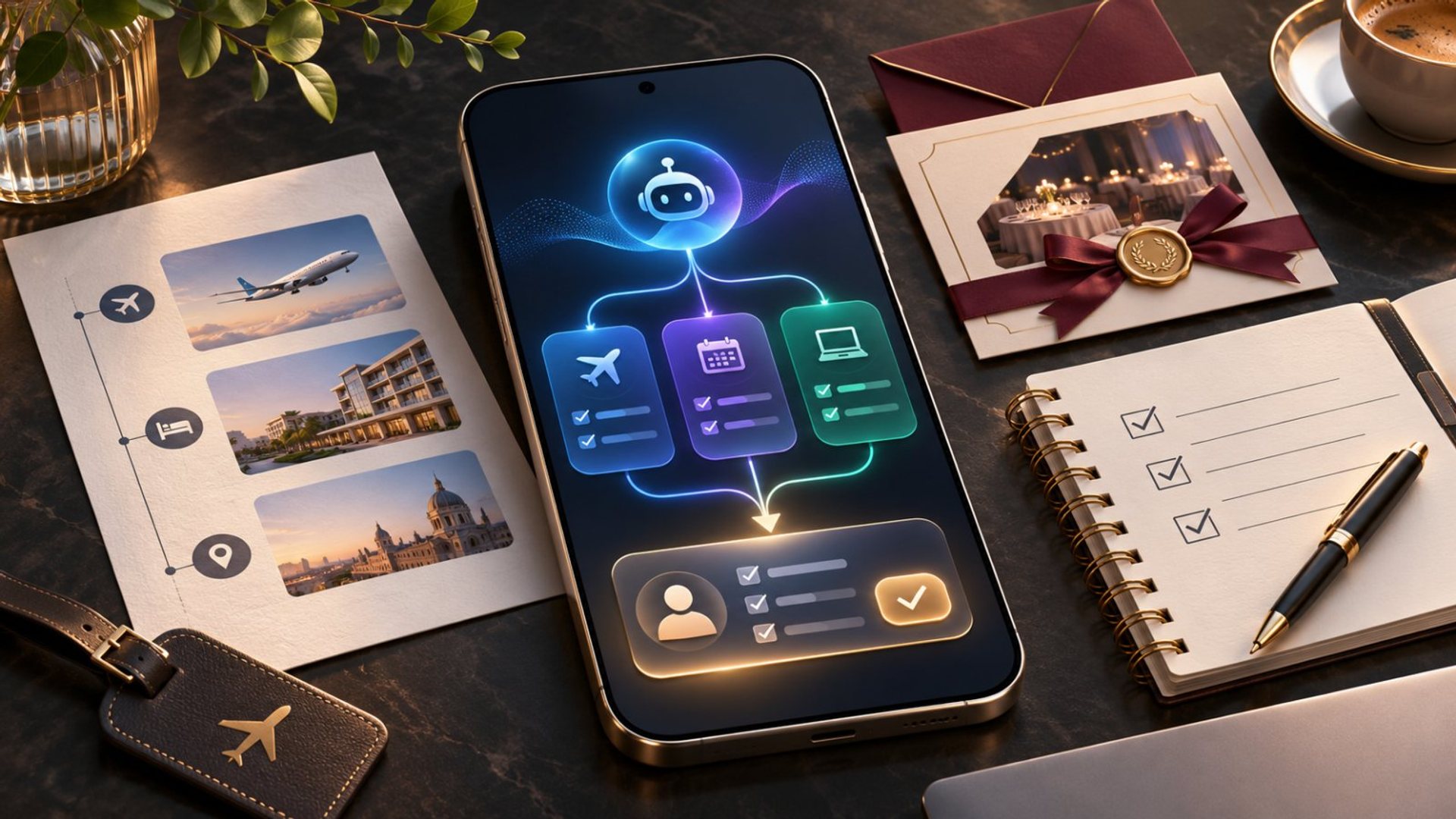
AI agent phone use cases become useful when a phone can move beyond answering a question to planning and carrying out a supported sequence of actions. For travel, that may mean preparing an itinerary and coordinating calendar details; for an event, turning notes into follow-ups; for work, drafting a brief and organising next steps. The exact actions depend on connected services, permissions, region and the user's confirmation. Judge the completed result, not the sophistication of the prompt.
What distinguishes an agent task from an ordinary assistant answer?
An ordinary assistant can summarise a message or suggest a plan. An agent-style workflow takes a stated outcome, identifies steps, uses authorised tools or services and returns a result that can be checked. IBM's AI-agent definition likewise centres on workflows and tools. VERTU's Agent Phone category definition frames the distinction around intent, multi-step planning, execution across supported services, user-controlled permissions and recovery from failure. That is a framework for evaluating a phone, not a promise that every conceivable app or service is available on every device.
For any task, write down five things: the information the phone needs, the services it can actually access, the actions it proposes, the point at which you approve a consequential step, and the evidence of completion. A polished answer can sound like a completed booking when it is only a suggested itinerary. A drafted email is not a sent email. The distinction matters most when payment, travel, confidential data or another person's schedule is involved.
Agent Q's official product introduction describes Ruby Talk as a gateway to AI agents and distinguishes it from the legacy Ruby Key's human-service connection. The page presents ambitious scenarios. Treat each as a capability to verify for your software version, region, linked accounts and available partners. The human Concierge remains a separate support route for requests requiring judgement or service coordination; an AI answer should not be represented as a human booking confirmation.
Travel: can the phone coordinate a changing itinerary?
A useful travel workflow starts with constraints: destination, dates, meeting times, preferred transport and documents you already hold. Ask the agent to propose a sequence, identify assumptions and show sources for time-sensitive facts. It may help organise flights, hotel choices, ground transport and calendar entries through supported integrations. Confirm which services are connected before expecting a reservation or payment. Travel availability, prices and entry requirements can change and should be checked with the actual provider or official authority.
Test a simple task first: “Draft a two-day itinerary around these three meeting times, and flag conflicts.” Check whether the output places meetings in the correct time zone, leaves realistic transfer time and distinguishes confirmed reservations from proposals. Then test a change: move one meeting and ask what else must be adjusted. If the phone only rewrites a list, it has helped plan; if it updates authorised calendar entries and presents a change log, it has executed part of the workflow. Both can be useful, but they are different outcomes.
For a missed connection, the phone can help collect options and prepare messages, but the user should retain control over cancellations, new charges and messages to others. Ask what happens if an airline site fails, the network disappears or an integrated account has expired. A trustworthy workflow should surface the failure and preserve the last confirmed state. Do not assume an offline reasoning claim means a live reservation can be made without a network or partner connection.
Events: can it turn attendance into follow-up?
At a conference or private event, the most common friction is not finding another note-taking app; it is remembering who said what and sending an accurate follow-up. An agent phone can help organise notes, identify action items and draft messages if the relevant recording, transcription or note functions are supported and authorised. Before collecting anyone else's voice or details, obtain any consent required by the venue and applicable rules. The device should not quietly infer consent from the fact that a meeting is on your calendar.
Use a narrow prompt such as “From these notes, list commitments I made, open questions and draft a thank-you message for review.” Check names, companies, dates and promises manually. If a note says someone will introduce you, the agent should not invent that the introduction has already been made. Keep drafts separate from sent messages. If it can create tasks or calendar reminders, verify the assigned owner and deadline before syncing them.
For a multilingual event, translation can support a conversation but may miss names, tone or specialist terminology. Ask for uncertain passages to be marked and confirm a consequential statement with the speaker. An AI summary can save time, yet it should remain traceable to the source notes. If the system cannot show how it reached a claim, treat the claim as unverified rather than as a meeting record.
Work: which actions deserve an approval step?
Workflows often cross confidential documents, email, calendar and external services. Start with low-risk tasks: outline a report, compare two versions of a brief or prepare a meeting agenda. Then consider actions that change external state, such as sending a message, updating a shared record or placing an order. Ask exactly when the phone requests confirmation and whether the user can inspect the proposed action before it happens. A single “approve all” screen may be convenient but give too little control for a complex workflow.
A useful test is to give the agent an ambiguous instruction: “Prepare the board pack and tell attendees it is ready.” Does it ask which version is final and who should receive it, or does it send an unfinished document? Good task execution includes recognising missing inputs. Ask the phone to show what it has done, what remains pending and what it could not complete. This is more informative than a demonstration in which every account is already configured and every service responds perfectly.
Control also includes the ability to recover. If an attachment is wrong, can you stop the send? If a calendar entry conflicts, can you inspect and correct it? If a payment attempt fails, does the system say so plainly rather than implying success? NIST's AI Agent Standards Initiative notes that real-world utility depends on interactions with external systems and data. The official VERTU category framework describes user permissions and failure recovery as core considerations. Evaluate them with your real workflow before relying on an agent for a high-stakes task.
How to evaluate VERTU Agent Q without overpromising
VERTU's knowledge base identifies Agent Q and Ruby Talk as the AI-agent entry point. The official page describes travel coordination, meetings and business scenarios, and also presents a human-in-the-loop service model. These claims give a shortlist of demonstrations to request, not proof that every third-party booking, payment or enterprise system is already available to every buyer. Ask for a live demonstration in your market with the exact accounts and permissions you intend to use.
For each scenario, request a record of the proposed plan, the actions actually taken, the approvals asked of you and the final result. Check data access and retention terms for your configuration separately; a broad privacy slogan is not a substitute for a product-specific policy. If you need an executive buying framework rather than a scenario test, our Agent Q productivity guide covers approvals, resilience and privacy at that level. This article focuses on what a task should look like when it is performed.
Frequently asked questions
Can an AI agent phone book travel by itself?
Only if the exact service integration and permissions support booking. Confirm the provider, price, payment approval and booking reference before treating a suggested itinerary as a reservation.
Does an agent phone replace a human concierge?
No. AI planning and execution are distinct from human service. Agent Q's Ruby Talk gateway and VERTU Concierge should be evaluated as different routes with different availability and roles.
Can the phone work without internet access?
Some on-device functions may work offline, depending on the model and software. Live bookings, account updates and external messages generally require a connection to the relevant service.
What should I approve manually?
Review payments, messages to others, changes to shared records and any task using sensitive information. Check the actual approval controls and account permissions on the device.
Conclusion
An AI agent phone earns its name when it helps complete supported tasks with visible controls and verifiable outcomes. Travel, events and work are useful tests because they reveal missing integrations, ambiguous instructions and the need for human approval. Ask the phone to show the plan, the action and the result; that is a stronger test than an impressive answer alone.